Key takeaways
- Most GEO programs don't produce measurable visibility gains until weeks 6-10. Expecting results in the first two weeks is the fastest way to lose internal buy-in.
- The first 30 days are almost entirely diagnostic: auditing your current AI visibility, identifying prompt gaps, and fixing technical issues that prevent AI crawlers from reading your content.
- Days 31-60 are about publishing the right content -- not volume. One well-targeted article that answers a high-intent prompt beats ten generic blog posts.
- Days 61-90 are when you start seeing early citation signals and can begin attributing AI-driven traffic to specific pages.
- The programs that fail in 90 days almost always skipped the diagnostic phase and jumped straight to publishing.
Starting a GEO program feels a bit like starting a new job. You show up on day one with energy, a list of things you want to fix, and a rough sense of what success looks like. Then reality sets in. The systems are more complicated than expected. The quick wins aren't as quick. And the metrics you thought would move in week two are still flat in week six.
That's not failure. That's a normal 90-day ramp.
The problem is that most teams don't know what "normal" looks like for a GEO program, so they either panic too early or stay patient too long. This guide is an attempt to fix that -- to lay out what actually happens, week by week, when you start taking AI search visibility seriously.
What you're actually trying to accomplish in 90 days
Before getting into the timeline, it's worth being clear about the goal. In 90 days, you are not going to dominate AI search. You're not going to appear in every ChatGPT response in your category. What you can realistically accomplish is:
- A clear baseline of where you stand today (which most companies don't have)
- A working understanding of which prompts matter for your business
- A handful of content pieces that are genuinely optimized for AI citation
- Early evidence that AI models are starting to find and use your content
- A repeatable process you can scale in months 4-6
That's it. And honestly, that's a lot. Most companies are starting from zero -- no prompt tracking, no citation data, no idea which pages AI models are actually reading. Getting from zero to "we have a system and early signals" in 90 days is a real achievement.
Days 1-30: The diagnostic phase
The first month is almost entirely about understanding what you're working with. This is the phase most teams rush through, and it's where most programs go wrong.
Establish your baseline AI visibility
You can't improve what you haven't measured. Before you publish a single piece of content, you need to know where you currently appear (and don't appear) in AI search responses.
This means running your core prompts through the major AI models -- ChatGPT, Perplexity, Claude, Gemini, Google AI Overviews -- and documenting what comes back. Are you mentioned? Are competitors mentioned instead? What sources are being cited? This is tedious to do manually, which is why most teams use a platform to automate it.
Promptwatch is built for exactly this starting point -- it runs your prompts across 10+ AI models, logs citations, and gives you a visibility score you can actually track over time.

Other tools worth looking at for baseline tracking:
Audit your technical AI crawlability
This is the step that surprises most teams. Before AI models can cite your content, their crawlers need to be able to read it. A lot of sites have issues here that they don't know about -- JavaScript rendering problems, robots.txt rules that block AI crawlers, pages that return errors when Perplexity or ChatGPT's crawler visits them.
Pull your server logs (or use a platform that does this for you) and look for:
- Which AI crawlers are visiting your site (GPTBot, ClaudeBot, PerplexityBot, etc.)
- Which pages they're reading vs. ignoring
- Any 4xx or 5xx errors they're encountering
- How frequently they're returning
If you find that AI crawlers are hitting your site but not reading your most important pages, that's a technical fix that can have a meaningful impact before you publish anything new.
Map your prompt universe
Not all prompts are equal. Some are high-volume questions your customers are genuinely asking AI models. Others are niche or low-intent. You need to know which is which before you start creating content.
Spend time in week two building out a prompt map -- the specific questions, comparisons, and queries your target customers are likely typing into ChatGPT or Perplexity. Group them by intent: informational, comparison, purchase-intent, brand-specific.
Then look at which of those prompts your competitors are already winning. The gap between "prompts your competitors appear in" and "prompts you appear in" is your opportunity set. That gap is what you're going to spend months 2 and 3 closing.
What you should have at the end of day 30
- A visibility score baseline across your priority prompts
- A list of technical issues affecting AI crawlability (with fixes prioritized)
- A prompt map organized by intent and competitive gap
- A clear picture of which competitors are outperforming you and on which topics
Days 31-60: The content creation phase
Month two is where most teams want to start. They want to publish things. They want to see movement. The good news is that if you did month one properly, you now know exactly what to publish -- which makes month two much more efficient than it would have been otherwise.
Focus on answer gaps, not volume
The biggest mistake in this phase is treating GEO like a content volume game. It's not. Publishing 20 generic blog posts won't move your AI visibility. Publishing three well-structured articles that directly answer prompts AI models are struggling to find good sources for -- that can move the needle.
Look at your prompt map from month one. Find the prompts where:
- There's meaningful search/query volume
- Your competitors are appearing but you're not
- Your site has relevant expertise but hasn't addressed the topic directly
Those are your priority targets. Write for those first.
What makes content AI-citation-worthy
This is where GEO diverges from traditional SEO. AI models aren't just looking for keyword density or backlinks. They're looking for content that:
- Directly and clearly answers the question being asked
- Is structured so the answer is easy to extract (clear headings, concise paragraphs, no fluff)
- Comes from a source that AI models have already learned to trust (domain authority still matters)
- Includes specific facts, data points, or original perspectives that aren't available elsewhere
The last point is worth dwelling on. AI models are increasingly good at identifying generic content that just restates what's already out there. If your article says the same thing as the top five results, there's no reason for an AI to cite you specifically. Give it a reason.
Content formats that tend to get cited
Based on citation patterns across GEO platforms, a few formats consistently outperform:
| Format | Why it gets cited | Best for |
|---|---|---|
| Direct Q&A articles | Easy for AI to extract a clean answer | Informational prompts |
| Comparison pages | Addresses high-intent "X vs Y" queries | Purchase-intent prompts |
| Listicles with specifics | Structured, scannable, quotable | "Best X for Y" prompts |
| Original research/data | Unique, citable, not replicated elsewhere | Brand authority prompts |
| How-to guides | Step-by-step structure AI models love | Process/tutorial prompts |
Tools that help with AI-optimized content creation
If you're producing content at any scale, you'll want tooling that helps you optimize for AI citation, not just traditional SEO signals.

For content generation that's grounded in GEO data (prompt volumes, citation patterns, competitor analysis), Promptwatch's built-in writing agent is worth using here -- it generates content specifically engineered to get cited, not just to rank in Google.
What you should have at the end of day 60
- 3-8 new content pieces targeting your highest-priority prompt gaps
- Technical crawlability issues from month one resolved
- A content calendar for the next 30 days based on your remaining prompt gaps
- Early data on whether AI crawlers are visiting your new pages
Days 61-90: The measurement and iteration phase
Month three is when things start to get interesting -- and also when patience gets tested. You've done the diagnostic work. You've published content. Now you're waiting to see if it works.
Here's the honest reality: citation patterns in AI search move slowly. AI models don't update their knowledge in real-time (with some exceptions like Perplexity's live search). A piece of content you publish today might not show up in AI responses for several weeks. That's not a bug in your strategy -- it's just how the technology works.
What to track in month three
Run your priority prompts again across the same AI models you tracked in month one. Compare:
- Has your overall visibility score improved?
- Are you appearing in prompts where you weren't before?
- Which specific pages are being cited, and by which models?
- Are competitors gaining or losing ground on specific prompts?
Don't just look at the aggregate number. Page-level tracking matters here. If one article is getting cited regularly by Perplexity but nothing else is moving, that tells you something about what's working -- and you can reverse-engineer why.
Connecting AI visibility to actual traffic
This is the step most GEO programs skip, and it's a mistake. Visibility scores are useful, but they don't pay the bills. You need to connect AI citations to actual website traffic and, eventually, to revenue.
There are a few ways to do this:
- A JavaScript snippet on your site that captures referral data from AI sources
- Google Search Console integration to see traffic from AI-adjacent queries
- Server log analysis to identify sessions that came from AI model domains
When you can say "this article is being cited by ChatGPT, and we're seeing 400 additional monthly sessions from AI referrals since we published it," that's a story you can tell internally. That's how GEO programs get budget for month four and beyond.
Benchmarks: what "good" actually looks like at 90 days
This is the question everyone asks, and the honest answer is that it varies a lot by industry, domain authority, and how competitive your prompt landscape is. But here are rough benchmarks based on what teams typically see:
| Metric | Realistic at 90 days | Strong result at 90 days |
|---|---|---|
| Visibility score improvement | +5-15% | +20-30% |
| New prompts where you appear | 3-10 | 15-25 |
| Pages being cited by AI models | 2-5 | 8-15 |
| AI-attributed traffic (monthly) | 50-200 sessions | 500+ sessions |
| Competitor prompts captured | 2-5 | 10+ |
If you're hitting the "realistic" column at 90 days, you're on track. If you're hitting the "strong" column, either you had a significant technical issue that you fixed (which can produce fast gains) or you're in a low-competition prompt space.
If you're below the "realistic" column, go back to the diagnostic phase. Something is likely blocking AI crawlers, or your content isn't structured in a way that AI models can easily extract answers from.
What you should have at the end of day 90
- A clear before/after visibility comparison across your priority prompts
- Specific pages that are being cited, with citation frequency by model
- Early traffic attribution data connecting AI visibility to sessions
- A prioritized list of next actions: more content gaps to close, technical fixes still needed, new prompts to target
- An internal report you can use to justify continued investment
The mistakes that kill GEO programs before day 90
A few patterns consistently derail programs in the first 90 days:
Skipping the diagnostic phase. Teams that jump straight to publishing content without first understanding their current visibility, their prompt landscape, or their technical crawlability issues end up publishing into the void. They don't know what's working because they don't have a baseline to compare against.
Treating GEO like traditional SEO. The tactics overlap, but they're not the same. Keyword stuffing, thin content, and link-building schemes don't move AI visibility. What moves it is being the clearest, most direct answer to a specific question.
Expecting linear progress. AI visibility doesn't improve in a straight line. You'll often see nothing for weeks, then a jump when a model updates or recrawls your content. Don't interpret flat weeks as failure.
Measuring only aggregate scores. A single visibility score hides what's actually happening. You need page-level and prompt-level data to understand what's working and why.
Not fixing technical issues first. If AI crawlers can't read your pages, no amount of content will help. The technical audit in month one isn't optional.
Tools that support a 90-day GEO program
Here's a practical overview of the tooling landscape for each phase:
| Phase | Task | Tools to consider |
|---|---|---|
| Days 1-30 | AI visibility baseline | Promptwatch, Otterly.AI, Profound |
| Days 1-30 | Technical crawl audit | Promptwatch (crawler logs), Botify, Prerender.io |
| Days 1-30 | Prompt research | Promptwatch, Peec AI, SE Ranking |
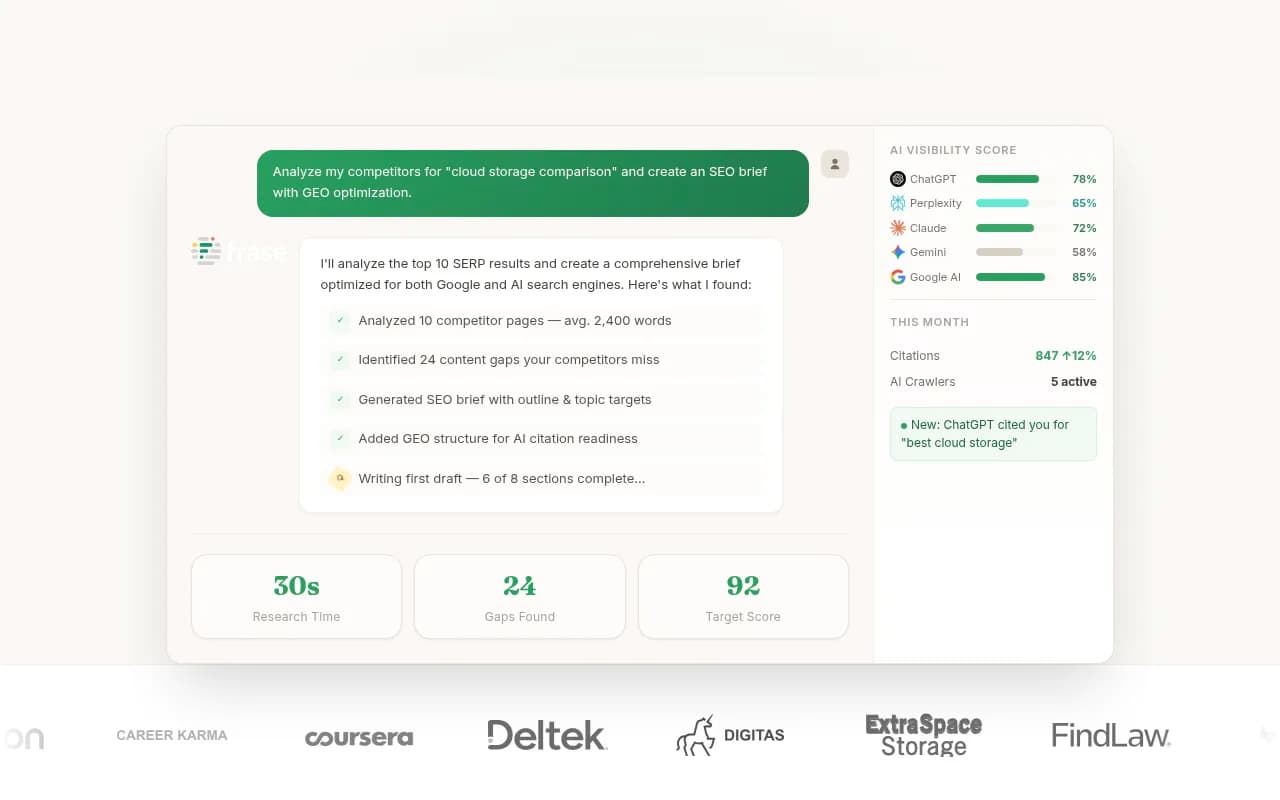
| Days 31-60 | Content gap analysis | Promptwatch, MarketMuse, Frase |
| Days 31-60 | Content creation | Promptwatch writing agent, Jasper, Surfer SEO |
| Days 61-90 | Citation tracking | Promptwatch, LLMrefs, Scrunch AI |
| Days 61-90 | Traffic attribution | Promptwatch, Google Search Console, HockeyStack |

What months 4-6 look like (a brief preview)
At 90 days, you have a foundation. The real compounding starts in months 4-6, when you're publishing content consistently against a known prompt map, iterating based on citation data, and starting to see AI-attributed traffic grow month over month.
The teams that get there are the ones that treated the first 90 days as a diagnostic and learning phase, not a sprint to instant results. The content you publish in month two gets cited in month three. The technical fixes you make in month one mean AI crawlers are reading everything you publish from that point forward. The prompt map you built in week two guides your content calendar for the next six months.
It's slow at first. Then it compounds. That's how GEO works in 2026 -- and understanding that rhythm is half the battle.