Key takeaways
- The AEO tool market matured significantly in 2025, but the gap between monitoring-only tools and true optimization platforms widened rather than closed.
- The biggest improvements were in prompt intelligence, crawler log visibility, and content gap analysis -- features that barely existed in early 2024.
- Several tools that launched as simple dashboards added content generation in 2025, with mixed results.
- The category's persistent weak spot: most tools still can't tell you why AI models cite some pages and not others, only that they do.
- Reddit and YouTube tracking, ChatGPT Shopping visibility, and multi-model comparison remain differentiators that most platforms haven't caught up on.
2025 was a strange year for AEO tools. The category went from "a handful of scrappy startups" to a crowded market with dozens of platforms, all claiming to help you "dominate AI search." Some of them actually delivered. Others shipped dashboards full of numbers that looked impressive but left you with no idea what to do next.
This guide is a frank look at what actually changed. Not a feature list for every tool -- there are plenty of those. Instead: what problems got solved, what improvements were real versus cosmetic, and what the category still hasn't figured out.
The state of AEO tools at the start of 2025
To understand what improved, it helps to remember where things stood at the beginning of 2025.
Most tools were essentially prompt-runners: you'd enter a list of queries, the tool would ask ChatGPT or Perplexity those questions, and then show you whether your brand appeared in the answer. That's it. No context on why you appeared or didn't. No guidance on what to do. No way to track changes over time with any statistical confidence.
The better tools had added basic share-of-voice metrics -- showing you what percentage of responses mentioned your brand versus competitors. That was genuinely useful. But the workflow still stopped there.
The fundamental problem: monitoring is the easy part. Knowing you're invisible in AI search is not actionable by itself. What do you do with that information?
That question drove most of the meaningful development in 2025.
What genuinely improved
Prompt intelligence got real
Early AEO tools treated all prompts equally. You'd pick a list of queries and track them. The problem is that some prompts are asked by millions of people, and some are asked by almost nobody. Tracking them the same way produces misleading data.
In 2025, several platforms started shipping prompt volume estimates and difficulty scores. This matters a lot. If you're a mid-size brand with limited content resources, you want to know which prompts are actually worth winning -- high volume, lower competition, where your existing content is close but not quite there.
Promptwatch went further by adding query fan-outs: showing how a single prompt branches into related sub-queries that AI models use when generating answers. This is closer to how AI search actually works than a flat list of tracked queries.

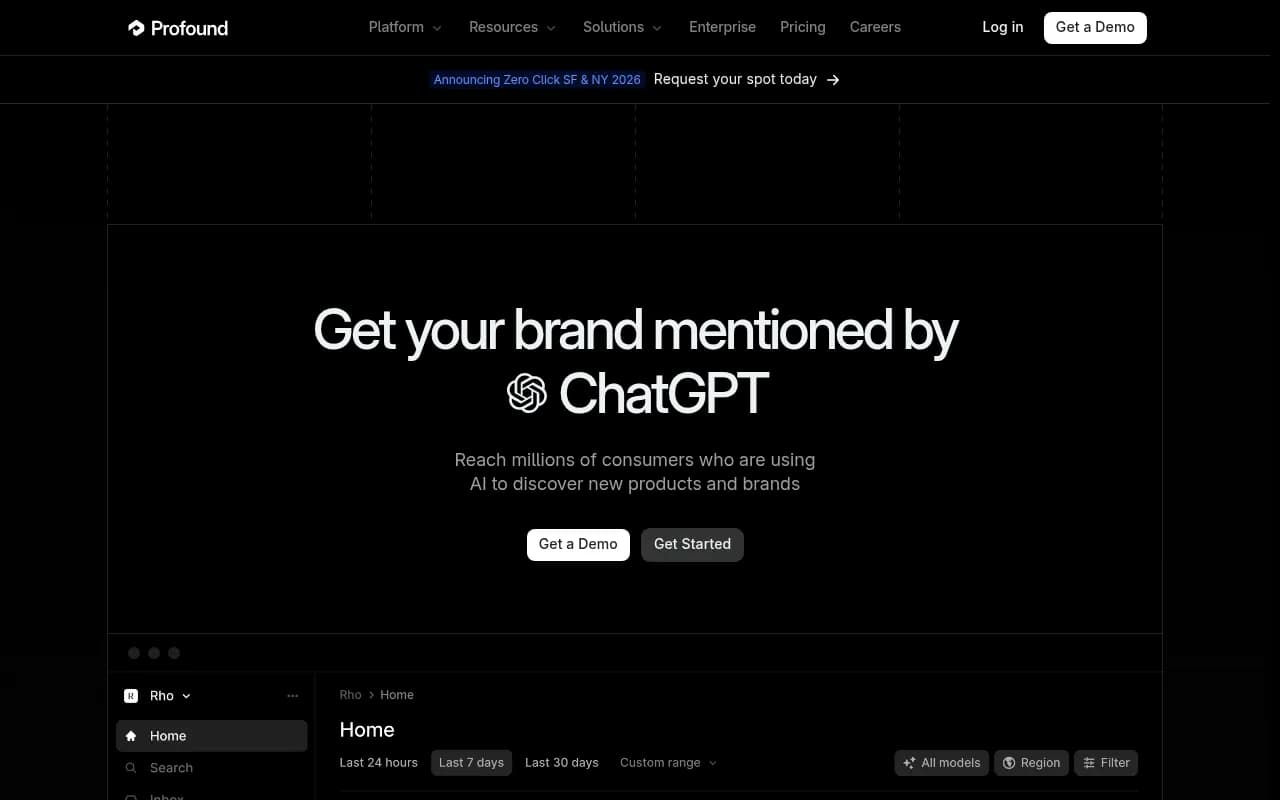
Tools like Profound AI also added prompt volume data, though the methodology for estimating AI search volumes varies across platforms and none of them are as precise as Google Search Console data for traditional search.
Crawler log visibility appeared as a real feature
This was probably the most underrated improvement of 2025. A handful of platforms started showing you actual AI crawler activity on your website -- which pages ChatGPT's crawler visited, how often, what errors it encountered, and whether those crawls eventually led to citations.
Before this existed, you were essentially guessing whether AI models could even read your content. You might have great answers on your site, but if the crawler was hitting a 403 error on your key pages, you'd never know.
Promptwatch built this out with what they call Agent Analytics -- real-time logs of AI crawlers hitting your site, with a timeline from crawl to citation. It connects to your site through Cloudflare, Fastly, Vercel, server logs, or a tracking snippet. Seeing that timeline -- page published, crawler visits, citation appears -- is the kind of concrete feedback loop that was completely missing from the category a year ago.
Most monitoring-only tools still don't have this. It requires actual website integration rather than just querying AI APIs, which is a higher bar to clear.
Content gap analysis moved from vague to specific
"You're missing content on topic X" was the generic advice most tools gave in early 2024. By late 2025, the better platforms were showing you the specific questions AI models were answering for competitors that your site had no content for -- with the actual prompt text, the competitor pages being cited, and context on what those pages contained.
That's a fundamentally different level of specificity. Instead of "write more about project management," you get "ChatGPT is citing Competitor A's page on async standup templates when users ask about remote team coordination -- you have nothing on this topic."
Multi-model tracking became standard
In early 2024, most tools tracked one or two AI models, usually ChatGPT and maybe Perplexity. By the end of 2025, tracking across ChatGPT, Perplexity, Gemini, Claude, Grok, and Google AI Overviews was table stakes for any serious platform. The differences between models matter -- a brand that's well-cited in Perplexity might be nearly invisible in Gemini, and the reasons often differ.
Platforms that still only track one or two models are increasingly hard to justify, especially as Google AI Mode has become a significant traffic source.
What got fixed (that was genuinely broken)
Response freshness
Early tools had a serious problem: they'd query an AI model, cache the response, and show you that cached response for days or weeks. AI model outputs change constantly -- new training data, updated retrieval systems, model updates. Stale cached responses were actively misleading.
Most mature platforms addressed this in 2025 by moving to more frequent re-querying and being more transparent about when responses were captured. Not perfect, but meaningfully better.
The "API vs. real UI" gap
This one took longer to fix and many tools still haven't. When you query ChatGPT through the API, you get different responses than what a real user sees in the ChatGPT interface. The user-facing product has shopping recommendations, source carousels, maps, and other features that the API doesn't expose.
Platforms that only use API queries were giving brands a false picture of their AI visibility. If you sell a physical product, your ChatGPT Shopping appearance is arguably more important than your citation in a plain text answer -- and API-only tools couldn't see it at all.
Promptwatch specifically tracks real user interface behavior rather than just API outputs, which is why their ChatGPT Shopping tracking feature exists. Most competitors still can't do this.
Hallucination detection
AI models sometimes cite brands with incorrect information -- wrong pricing, discontinued products, inaccurate feature descriptions. In 2025, a few platforms started flagging these hallucinations automatically rather than requiring manual review of every response.
This is still imperfect, but it's a real improvement over having no systematic way to catch AI models saying wrong things about your brand.
The comparison table: where platforms stand in 2026
| Platform | Prompt volumes | Crawler logs | Content generation | Multi-model (6+) | Reddit/YouTube tracking | ChatGPT Shopping |
|---|---|---|---|---|---|---|
| Promptwatch | Yes | Yes | Yes | Yes (10 models) | Yes | Yes |
| Profound AI | Yes | Yes | Yes | Yes | No | Limited |
| Otterly.AI | No | No | No | Partial | No | No |
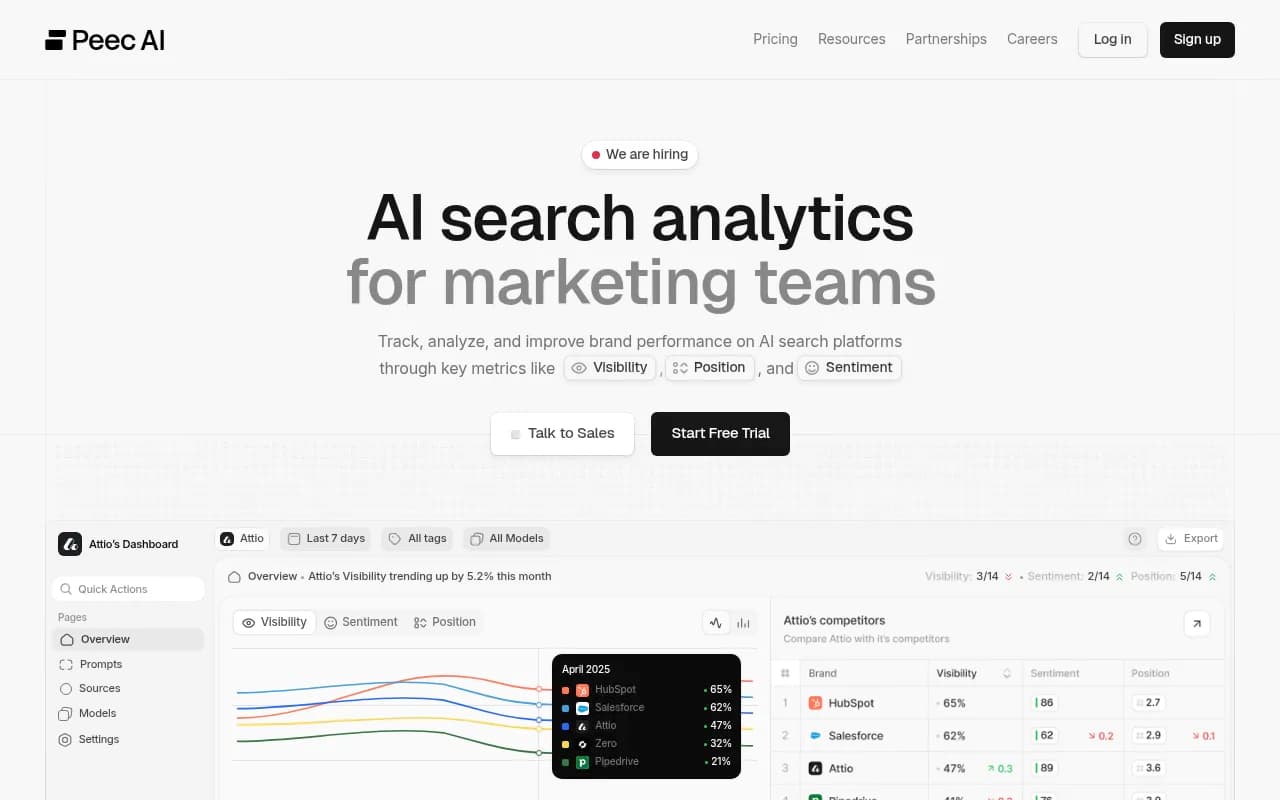
| Peec AI | No | No | No | Partial | No | No |
| AthenaHQ | Partial | No | No | Yes | No | No |
| Scrunch AI | No | No | No | Yes | No | No |
| Search Party | Partial | No | No | Partial | No | No |
| Semrush | No | No | No | Limited | No | No |
| Ahrefs Brand Radar | No | No | No | Limited | No | No |

Search Party
The content generation question
The biggest debate in the AEO tool space through 2025 was whether content generation belonged inside these platforms at all.
The argument against: content generation is a solved problem. You have ChatGPT, Claude, Jasper, and a dozen other tools. Why would you pay a premium for an AEO platform's content features?
The argument for: generic AI content generation has no idea which prompts are driving AI citations, which competitor pages are being cited, what the actual gap is between your content and what AI models want to see. Content generated without that context is just more SEO filler.
The platforms that got this right in 2025 were the ones that grounded content generation in real prompt data. Not "write me an article about X" but "here are the 47 prompts where competitors are visible and you're not, here are the pages being cited, here's what they contain -- now generate content that fills this specific gap."
That's a different product. Whether it works depends heavily on the quality of the underlying prompt and citation data.
What still doesn't work
Being honest here matters more than being promotional. The AEO tool category has real unsolved problems heading into 2026.
Nobody can reliably explain why you get cited
Every platform can tell you that you appear in X% of responses for a given prompt. Very few can tell you why -- what specific signals caused the AI model to cite your page over a competitor's. Is it domain authority? Structured data? Content freshness? Specific phrasing? The honest answer is that nobody knows with confidence, and any tool claiming otherwise is oversimplifying.
This makes optimization feel partly like guesswork. You can follow best practices -- structured data, clear Q&A formatting, comprehensive topic coverage -- but the causal link between those changes and citation improvements is hard to establish.
Attribution from AI to revenue remains murky
"We improved our AI visibility score by 40%" is a nice metric. "That drove $X in revenue" is what your CFO wants to hear. The gap between those two statements is still large for most platforms.
Traffic attribution from AI search is getting better -- some tools can now show you sessions that arrived via AI referrals -- but connecting that to actual conversions and revenue requires integrations with your analytics stack that most platforms don't have fully built out yet.
Small brands get limited value
Most AEO tools are built around competitive analysis: you track your brand against competitors, see who's winning for which prompts, and try to close the gap. If you're a small brand with limited brand recognition, AI models may not mention you at all -- and the competitive framing doesn't help you figure out how to get on the map in the first place.
The prompt intelligence features help here (find prompts where nobody is dominant yet), but the overall product experience of most platforms assumes you're already visible enough to have something to compare.
Prompt coverage is still too narrow
Even the best platforms track hundreds or low thousands of prompts. The actual space of queries where AI models might mention your brand or category is orders of magnitude larger. You're always working with a sample, and the quality of that sample -- whether it represents how real users actually prompt -- varies a lot.
How to think about the category in 2026
The AEO tool market has split into two distinct tiers, and the gap widened in 2025.
Tier one: monitoring dashboards. These tools tell you where you appear, how often, and compared to whom. They're useful for reporting and for catching regressions. Several of them are reasonably priced and do this job adequately. If you just need to answer "are we visible in AI search?" for a quarterly business review, they'll do.
Tier two: optimization platforms. These tools go beyond monitoring to help you actually improve. They identify specific content gaps, generate content grounded in real citation data, track AI crawler behavior on your site, and close the loop between publishing and citation. There are fewer of these, and they cost more.
The mistake most teams make is buying a tier-one tool and expecting tier-two results. Knowing you're invisible doesn't make you visible.
If you're evaluating tools right now, the questions worth asking are:
- Can this platform show me the specific prompts where competitors are cited and I'm not -- with the actual prompt text?
- Can I see AI crawler activity on my own site?
- Does content generation use real prompt and citation data, or is it generic AI writing with an AEO label on it?
- Can I track across at least 6 AI models, including Google AI Overviews and Google AI Mode?
- Is there any attribution connecting AI visibility to actual traffic or revenue?
If a platform can't answer yes to most of those, you're buying a monitoring dashboard and should price it accordingly.
A few tools worth watching
Beyond the major platforms already mentioned, a few tools made notable progress in 2025 that's worth noting.
The category is still moving fast. Tools that were limited monitoring dashboards in early 2025 shipped meaningful optimization features by Q4. The platforms that were already doing optimization are now working on the harder problems: better attribution, more reliable citation explanations, and coverage of the long tail of prompts.
The honest summary: 2025 was the year AEO tools stopped being toys and started being real business tools. 2026 will be the year we find out which ones actually move the needle.