Key takeaways
- Frase is the better choice for most small-to-mid-size teams: fast onboarding, solid content briefs, built-in AI writing, and a price that doesn't require budget approval from three people.
- MarketMuse is genuinely more powerful for large-scale content strategy -- topic modeling, personalized difficulty scores, and site-wide inventory analysis are legitimately better.
- The price gap is real and significant: Frase starts around $38/month, MarketMuse around $149/month, and the enterprise tiers go much higher.
- Neither tool is built for AI search visibility (ChatGPT, Perplexity, Google AI Overviews) -- that's a separate problem requiring a different category of tool.
- If you're running a content team of one or two people, Frase almost certainly wins. If you're managing hundreds of pages across a large site, MarketMuse's depth may justify the cost.
There's a version of this comparison that just lists features in a table and calls it done. This isn't that.
Frase and MarketMuse have been competing for the same audience for years, and the honest answer to "which one should I use?" depends entirely on what you're actually trying to accomplish. They overlap in some areas, diverge sharply in others, and neither is the obvious winner for every team.
Let's get into it.
What each tool is actually trying to do
Before comparing features, it's worth being clear about the core purpose of each platform, because they're not quite the same thing despite looking similar from the outside.
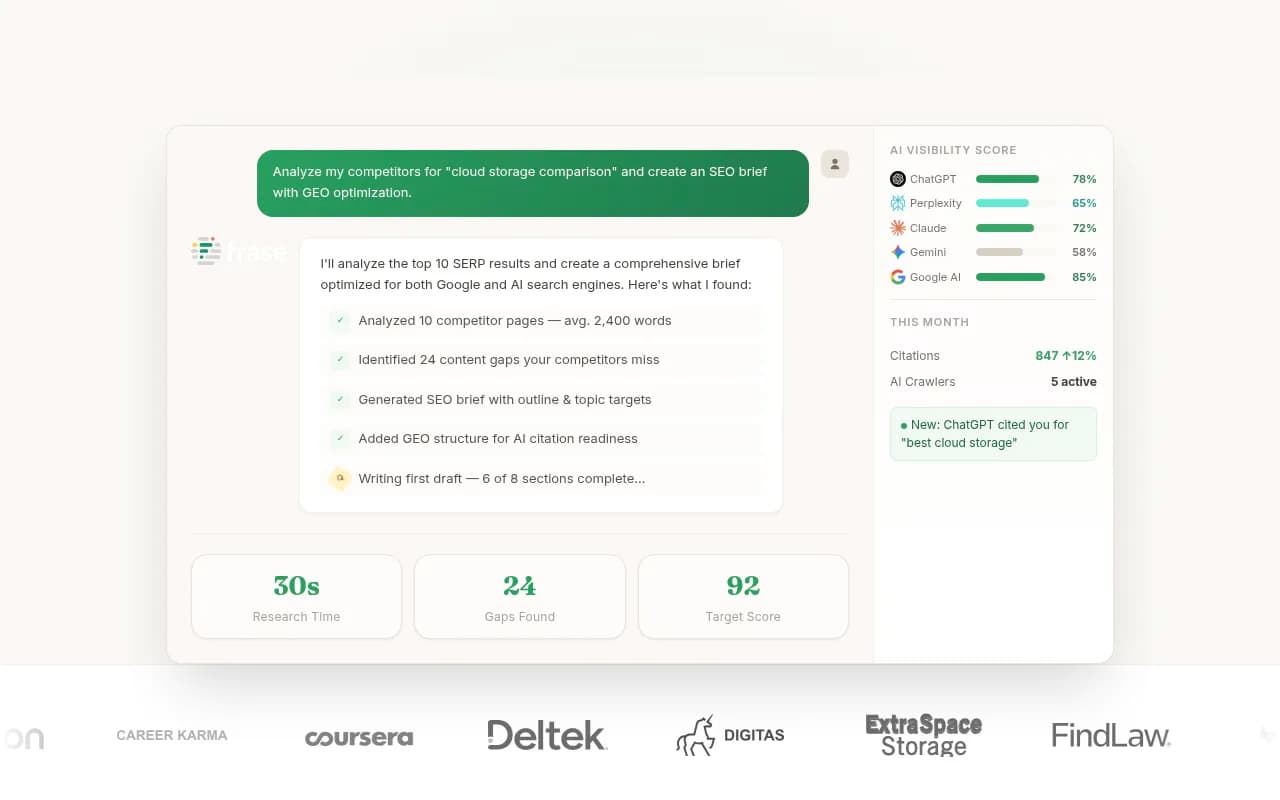
Frase is primarily a content workflow tool. You bring it a topic or keyword, it pulls together SERP data, helps you build a brief, and then lets you write (or generate) content inside the same interface. The whole experience is designed to be fast. You can go from "I need to write about X" to a publishable draft in a single session.
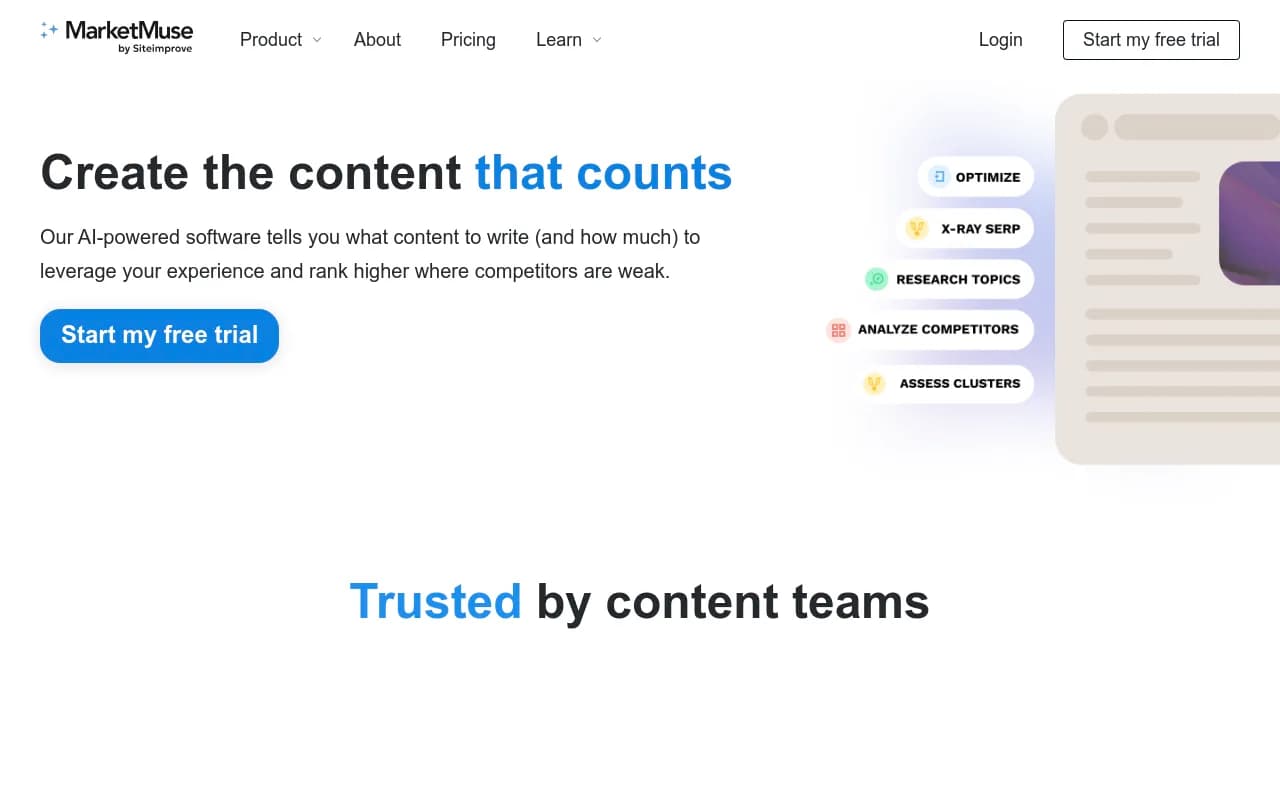
MarketMuse is more of a content strategy platform. It's less focused on the individual article workflow and more focused on helping you understand your entire content landscape -- which topics you have authority on, which ones you're missing, how your existing pages relate to each other, and where to invest next. It's a planning tool first, a writing tool second.
That distinction matters a lot when you're deciding which one to pay for.
Features side by side
Here's a direct comparison of the core capabilities:
| Feature | Frase | MarketMuse |
|---|---|---|
| Content briefs | Yes, SERP-driven | Yes, topic model-driven |
| AI writing assistant | Yes, built-in | Yes, but secondary |
| Topic modeling | Basic | Advanced (personalized difficulty) |
| Site-wide content inventory | Limited | Full site analysis |
| Content scoring | Yes | Yes (more sophisticated) |
| Keyword research | Basic | Moderate |
| CMS publishing | Yes | No |
| Content monitoring | Yes | Yes |
| Starting price | ~$38/month | ~$149/month |
| Free trial | Yes | Yes (limited) |
| Best for | Individual writers, small teams | Content strategists, large sites |
Frase: what it does well
Frase's biggest strength is speed. You can set up a project, pull SERP data, generate a brief, and start writing in under 15 minutes. For teams that need to produce content regularly without a lot of strategic overhead, that matters.
The content editor is genuinely useful. It shows you the topics and questions your competitors are covering, gives you a score as you write, and the AI writing features are good enough to accelerate drafts without feeling like you're just hitting "generate" and hoping for the best.
The pricing is also a real advantage. At around $38/month for the basic plan, it's accessible to freelancers, small agencies, and early-stage companies that can't justify a four-figure monthly tool budget. There's no lengthy sales process, no custom pricing negotiation -- you just sign up and start.
Where Frase falls short is depth. The topic modeling isn't as sophisticated as MarketMuse's, the competitive analysis is surface-level compared to what MarketMuse offers, and if you're trying to build a content strategy for a 500-page site, Frase isn't really designed for that job.
MarketMuse: what it does well
MarketMuse's personalized difficulty scores are one of its genuinely differentiated features. Instead of giving you a generic keyword difficulty number based on domain authority, it calculates how hard it would be for your specific site to rank for a topic, based on your existing content authority. That's a meaningfully different and more useful signal.
The site-wide content inventory is also legitimately powerful. You can see across your entire domain -- which topics you own, which ones you're weak on, where there are gaps, and how pages relate to each other thematically. For a content strategist managing a large site, this is the kind of view that's hard to replicate manually.
The content briefs MarketMuse generates are also more strategically grounded. They're built on topic modeling rather than just SERP scraping, which means they tend to surface angles and subtopics that pure SERP-based tools miss.
The downside is the price and the learning curve. MarketMuse starts around $149/month, and the enterprise tiers go significantly higher. It also takes longer to get value from -- you need to have it analyze your site, understand the topic model outputs, and integrate it into a workflow. It's not a tool you can pick up in an afternoon.
Pricing: the honest breakdown
This is where the decision gets real for most teams.
Frase's pricing is transparent and accessible:
- Basic: around $38/month (1 user, limited documents)
- Team: around $97/month (3 users, more documents)
- Enterprise: custom
MarketMuse's pricing is more opaque and significantly higher:
- Optimize: around $149/month (limited queries)
- Research: higher tiers for more usage
- Enterprise: custom, typically several hundred to thousands per month
The gap isn't just a number. It reflects a fundamental difference in who each tool is built for. Frase is priced for individuals and small teams. MarketMuse is priced for content operations with real budgets.
If you're a solo content marketer or a two-person team, MarketMuse's price is hard to justify unless you're already running a large, established site where the strategic depth pays off. If you're a content director managing a team of five writers across a 1,000-page site, the calculus flips.
Who should use Frase
- Freelance writers and content marketers working on their own
- Small agencies producing content for multiple clients
- Early-stage companies building out their content library
- Teams that need to move fast and don't have time for complex onboarding
- Anyone who wants AI writing assistance built into the same tool as their research
Who should use MarketMuse
- Content strategists at mid-to-large companies
- SEO teams managing sites with hundreds or thousands of pages
- Organizations that need to make strategic decisions about where to invest content resources
- Teams that have already mastered the basics and need more sophisticated competitive intelligence
- Companies where content is a core revenue driver and the ROI on better strategy is measurable
What neither tool does: AI search visibility
Here's something worth flagging that most comparisons skip entirely.
Both Frase and MarketMuse are built around traditional search -- Google rankings, SERP analysis, keyword difficulty. They're good at that. But in 2026, a growing share of content discovery happens through AI search engines: ChatGPT, Perplexity, Google AI Overviews, Claude, and others.
Neither Frase nor MarketMuse tracks whether your content is being cited by AI models, which prompts are driving AI-generated answers in your category, or why a competitor is showing up in ChatGPT responses while you're not. That's a different problem requiring a different category of tool.
If AI search visibility is a priority for your team -- and increasingly it should be -- platforms like Promptwatch are built specifically for that job. They track citations across AI models, identify content gaps based on what AI engines are actually answering, and help you create content that gets picked up by those systems.

It's not a replacement for Frase or MarketMuse. It's a different layer of the stack for a different distribution channel.
A few tools worth knowing about
If you're evaluating Frase and MarketMuse, you're probably also looking at the broader content optimization space. A few others worth knowing:
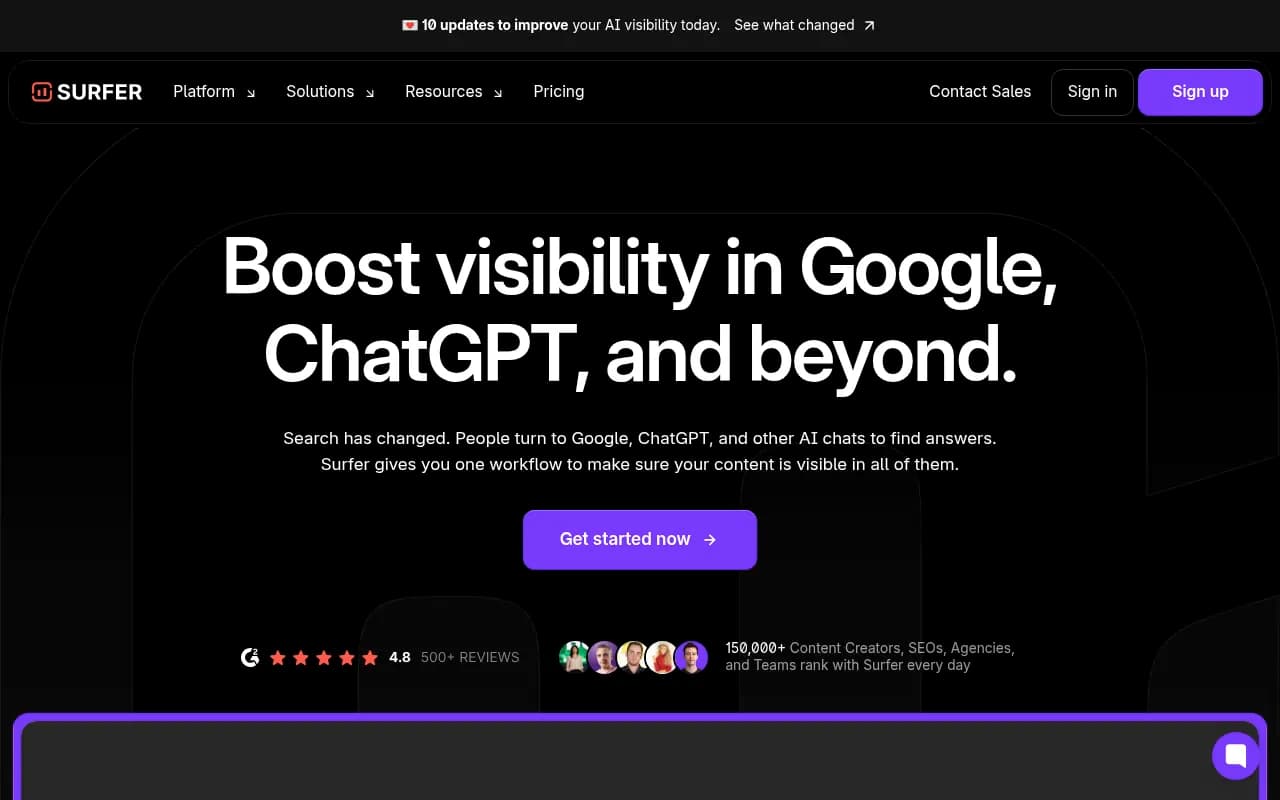
Surfer SEO sits in a similar space to Frase -- real-time content scoring, AI writing, and a strong content editor. It's a bit more focused on on-page optimization signals.
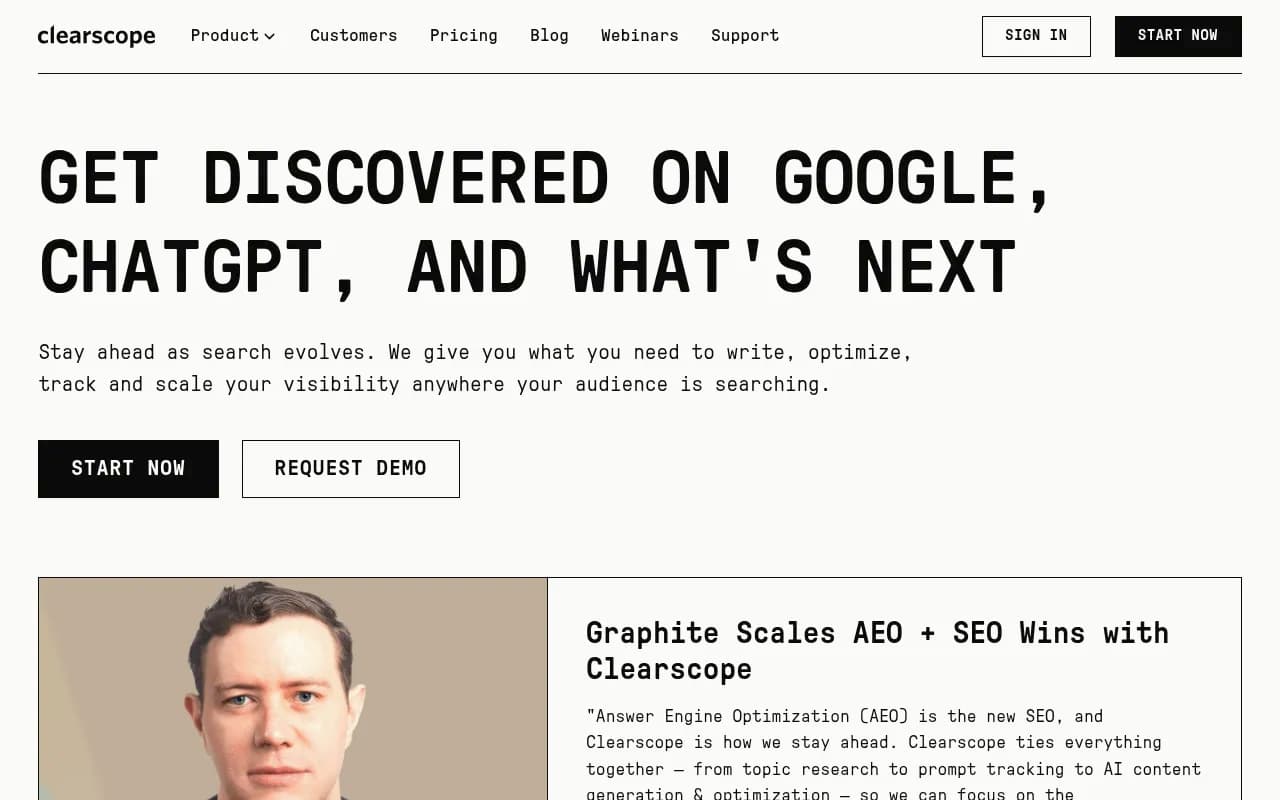
Clearscope is another strong option for content grading and optimization, with a cleaner interface and a solid content inventory dashboard. It tends to attract teams that want less AI writing assistance and more rigorous scoring.
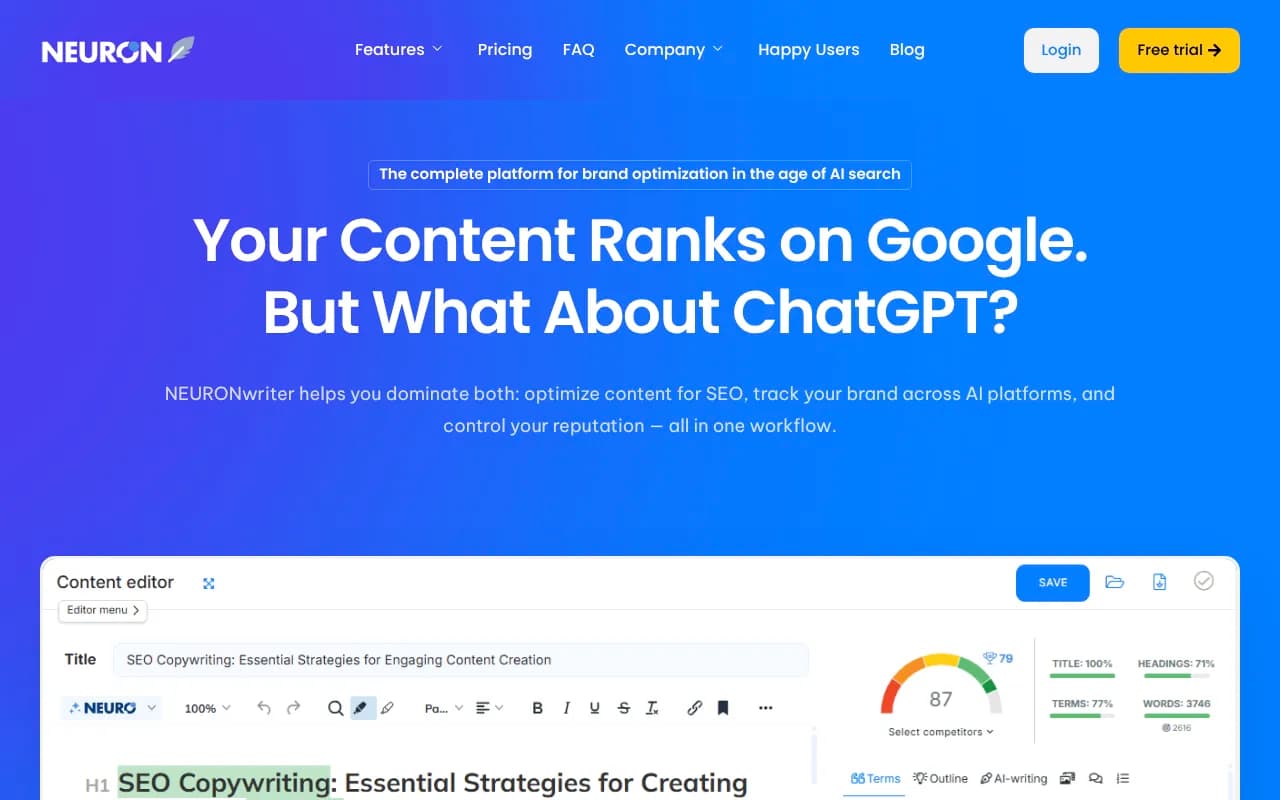
NeuronWriter is worth a look if budget is a real constraint -- it has a free plan and paid tiers starting around $23/month, with NLP entity support across 19 languages.
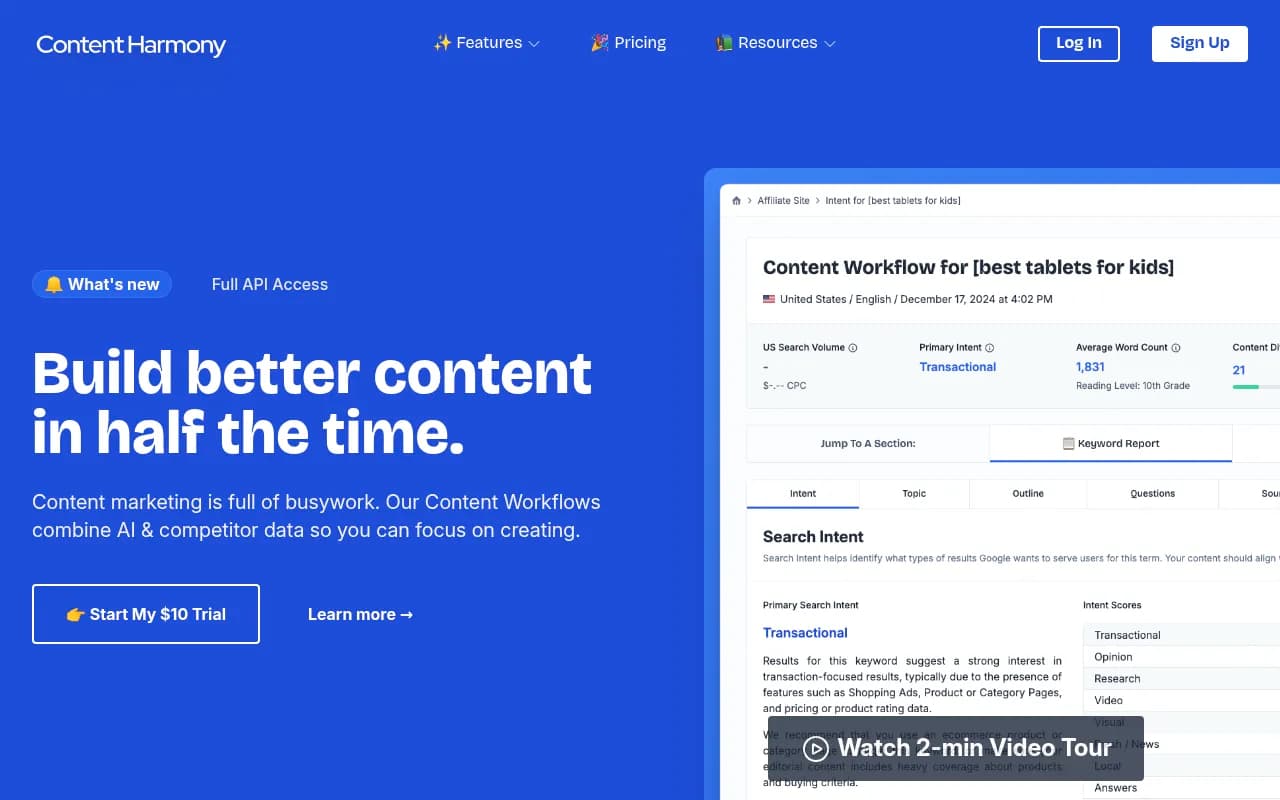
Content Harmony focuses specifically on content briefs and is worth considering if brief generation is your primary use case.
The actual verdict
Frase wins for most people reading this. The price is accessible, the workflow is fast, and the AI writing features are good enough for most content production needs. If you're not running a large site with a dedicated content strategy function, Frase gives you 80% of what you need at a fraction of the cost.
MarketMuse wins if you're managing a large, established site and need to make strategic decisions about content investment at scale. The personalized difficulty scores and site-wide topic modeling are genuinely better than what Frase offers, and for the right team, that depth is worth the price premium.
The mistake most people make is buying MarketMuse when they actually need Frase, because MarketMuse sounds more impressive. More sophisticated doesn't mean more useful for your specific situation. Start with Frase, see if you hit its ceiling, and upgrade your thinking (and your tools) from there.
And if you're starting to think about how your content performs in AI search -- not just Google -- that's a separate conversation that neither tool is equipped to have with you yet.