Key takeaways
- Rankscale is a capable AI visibility tracker, but it's primarily a monitoring tool -- it shows you data without helping you act on it.
- The market has split into two camps: monitoring-only dashboards and full optimization platforms that include content gap analysis, AI writing, and traffic attribution.
- Promptwatch is the only platform in 2026 rated as a "Leader" across all GEO categories -- the key difference is its action loop: find gaps, generate content, track results.
- For teams that just need lightweight brand monitoring, Otterly.AI and Peec AI are solid budget options.
- For agencies and enterprises that need to actually move the needle on AI visibility, the gap between monitoring tools and optimization platforms is significant.
What Rankscale does (and where it falls short)
Rankscale is an AI visibility scaling platform that lets you track how your brand appears across AI search engines like ChatGPT, Perplexity, and Google AI Overviews. It's a reasonable starting point -- you can set up prompt monitoring, see share-of-voice data, and get a sense of where competitors are showing up.
The problem is that "reasonable starting point" is also kind of the ceiling. Rankscale tells you what's happening but doesn't do much to help you change it. There's no content gap analysis, no built-in writing tools, no crawler logs, and no traffic attribution. You can watch your visibility score sit flat and not have a clear path to improving it.
That's not unique to Rankscale -- most tools in this space have the same limitation. But as GEO (Generative Engine Optimization) matures, the gap between monitoring dashboards and actual optimization platforms is becoming harder to ignore.
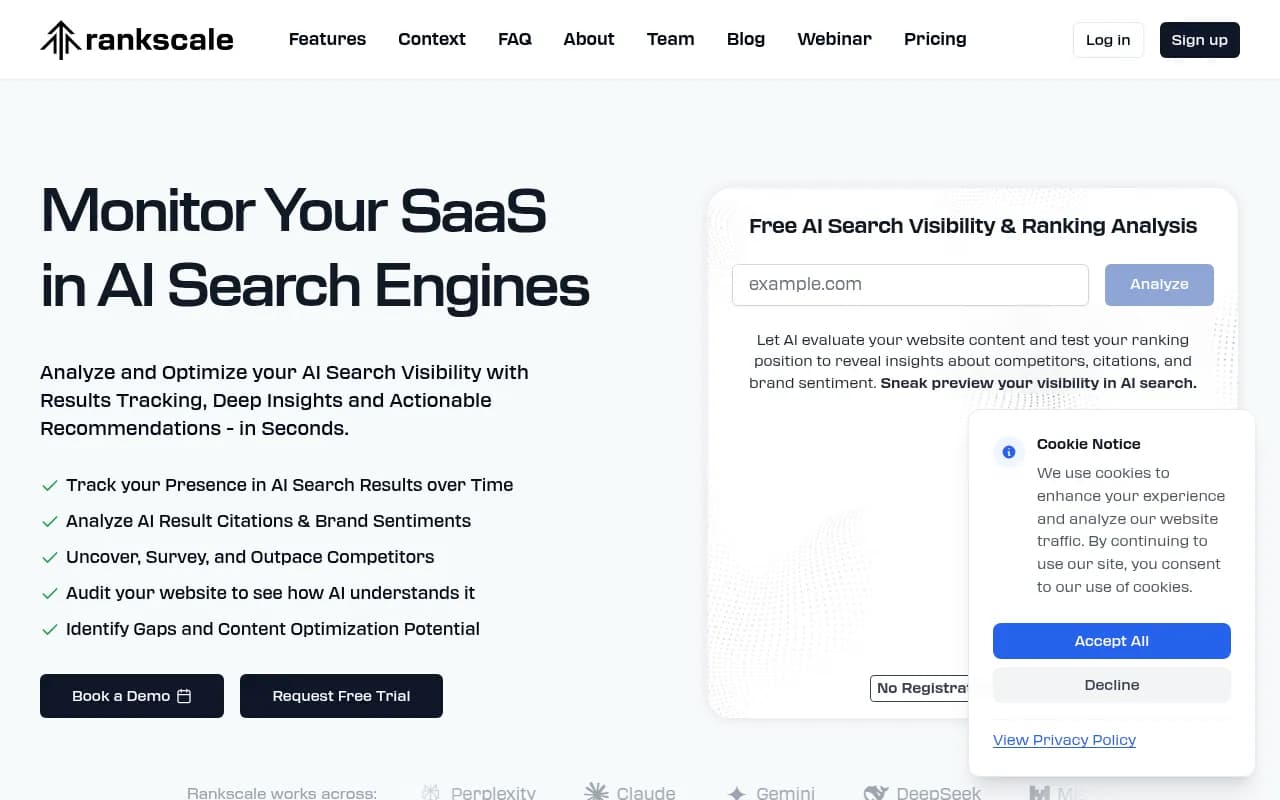
So if you're looking for something more capable, here's what the market actually looks like in 2026.
The Rankscale alternatives worth considering
Promptwatch -- best for teams that want to actually improve AI visibility
Promptwatch is the platform I'd point most teams to first, and not just because it monitors well. The core difference is what happens after you see the data.
The Answer Gap Analysis shows you exactly which prompts your competitors are visible for that you're not -- not in a vague "you're missing content" way, but with specific topics, angles, and questions that AI models want answers to but can't find on your site. Then the built-in AI writing agent generates articles, listicles, and comparisons grounded in 880M+ citations analyzed. The content isn't generic SEO filler; it's built to get cited by ChatGPT, Claude, Perplexity, and other models.
On top of that: AI crawler logs (real-time logs of ChatGPT, Claude, Perplexity crawlers hitting your site), prompt volume and difficulty scores, Reddit and YouTube citation tracking, ChatGPT Shopping monitoring, and traffic attribution via GSC integration or server log analysis. It covers 10 AI models and supports multi-language, multi-region monitoring.
Pricing starts at $99/month for the Essential plan (1 site, 50 prompts, 5 articles), $249/month for Professional (2 sites, 150 prompts, crawler logs), and $579/month for Business (5 sites, 350 prompts). Free trial available.

Otterly.AI -- best for lightweight monitoring on a budget
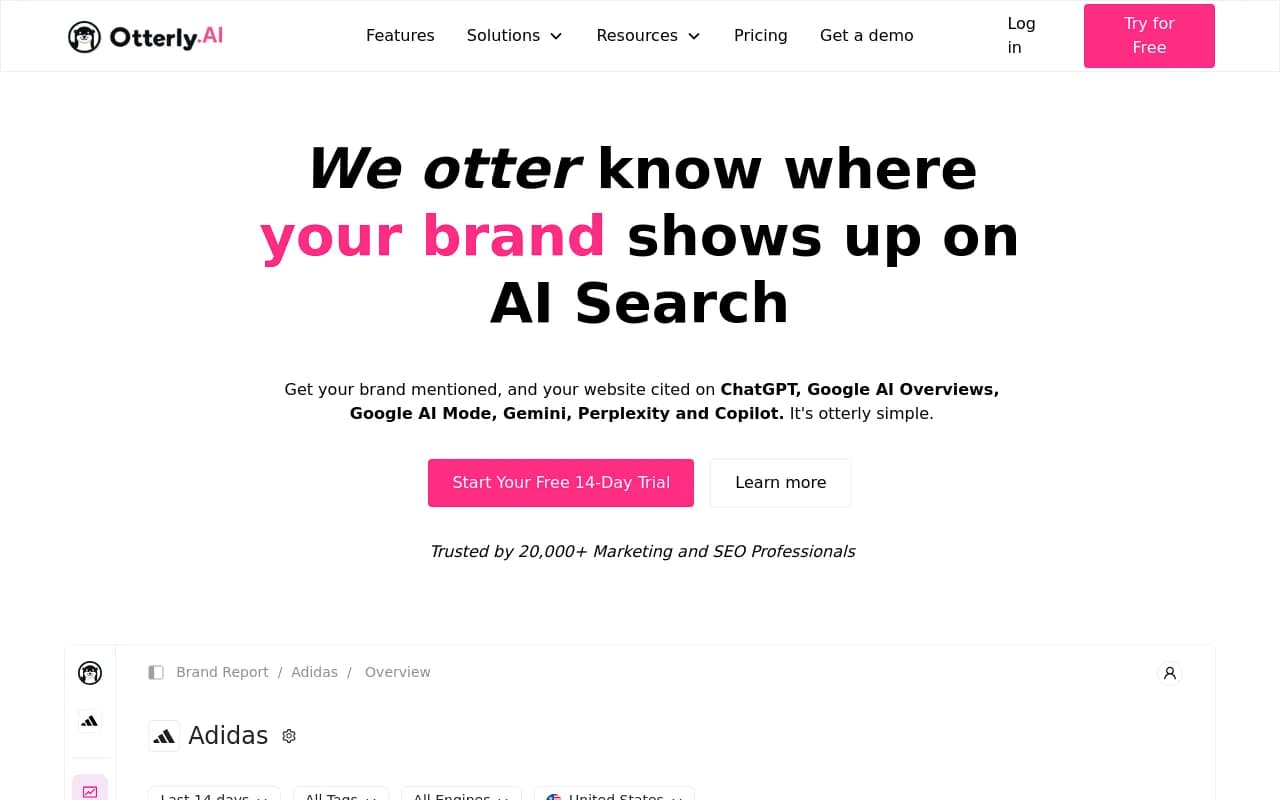
Otterly.AI is one of the more popular entry-level options. It's easy to set up, covers the main AI models, and gives you brand mention tracking and basic share-of-voice data. If you're a small team that just wants alerts when your brand appears (or disappears) in AI responses, it does that job fine.
What it doesn't do: content gap analysis, content generation, crawler logs, or traffic attribution. It's a monitoring dashboard, full stop. That's fine if monitoring is all you need, but worth being clear-eyed about.
Peec AI -- best for marketing teams focused on share-of-voice dashboards
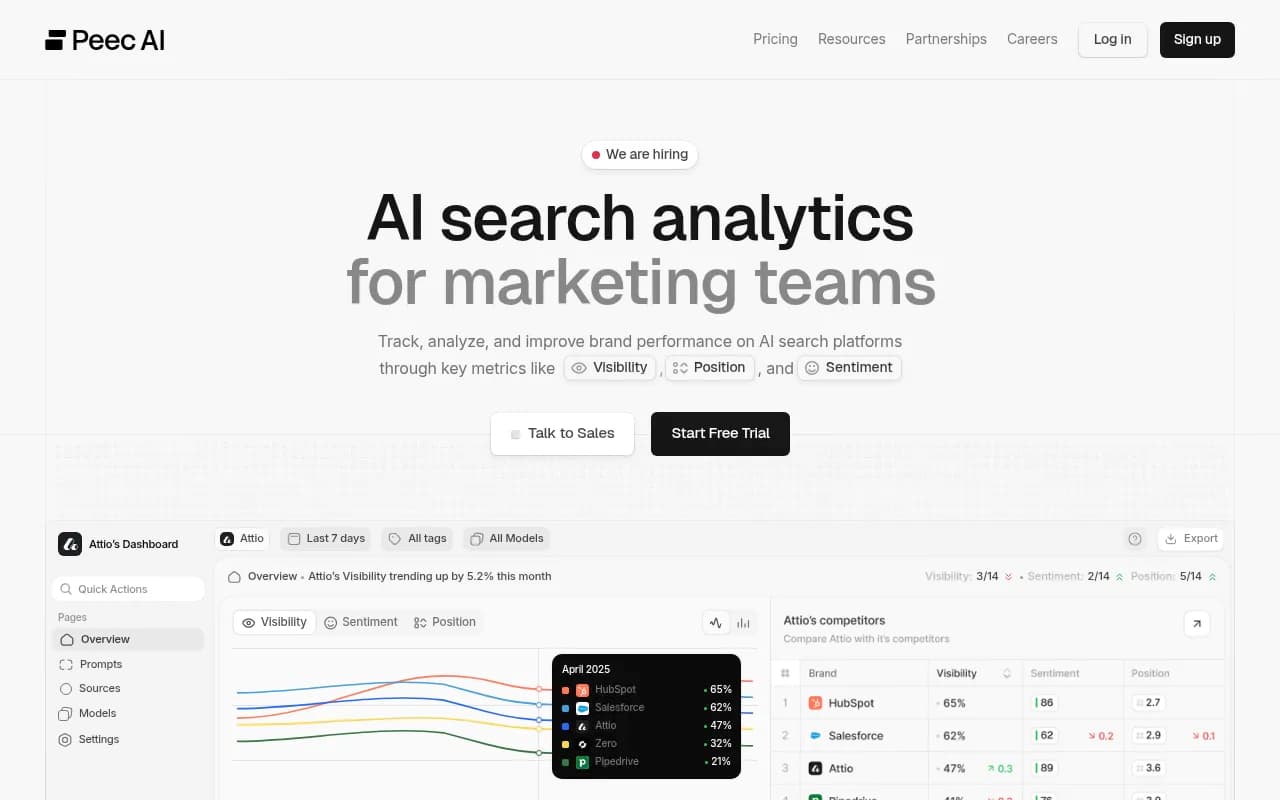
Peec AI is strong on the reporting side. The dashboards are clean, the share-of-voice comparisons are easy to read, and it supports multiple languages -- which matters if you're running campaigns across markets. It's a good fit for marketing teams that need to show AI visibility data to stakeholders without a lot of setup friction.
Like Otterly.AI, it's primarily a monitoring tool. No content generation, no crawler logs, no gap analysis.
Profound -- best for enterprise citation and source-level analysis
Profound goes deeper on citation analysis than most tools. You can see exactly which sources AI models are pulling from, track citation trends over time, and get fairly detailed competitive intelligence. It's used by larger teams that want to understand the "why" behind their AI visibility, not just the "what."
The tradeoff is price -- Profound sits at a higher price point than most alternatives here, and it's still primarily an analysis tool rather than an optimization one. No built-in content generation.
Scrunch AI -- best for enterprise AI journey mapping
Scrunch AI takes a different angle: it focuses on the full AI customer journey, not just whether your brand gets mentioned. It covers ChatGPT, Perplexity, Claude, Meta AI, Gemini, and Google AI Overviews, and it's built for larger organizations that want to understand how AI models are shaping their customers' decision-making process.
Starts at $100/month for the Starter plan. Strong feature set, but the focus on journey mapping means it's more of a strategic research tool than a day-to-day optimization platform.
Athena HQ -- best for GEO modeling and demand estimation
AthenaHQ has a distinctive approach: it tries to estimate AI search demand (how many people are asking AI models questions relevant to your category) and model your GEO opportunity. The QVEM (Query Volume Estimation Model) is genuinely useful for prioritizing which topics to go after.
It's monitoring-focused though -- no content generation, no crawler logs. Good for strategy work, less useful for execution.
SE Ranking AI Visibility Tracker -- best for teams already using SE Ranking for SEO
If you're already in the SE Ranking ecosystem, their AI Visibility Tracker is a natural add-on. It integrates with your existing keyword and ranking data, which makes it easier to see how your traditional SEO performance correlates with AI visibility. The reporting is solid and the pricing is reasonable.
The limitation is that it's an add-on to an SEO tool, not a purpose-built GEO platform. The depth of AI-specific features doesn't match dedicated tools.
Semrush AI Toolkit -- best for teams that want AI monitoring inside their existing SEO workflow
Similar story to SE Ranking: if you're already paying for Semrush, the AI Toolkit gives you some AI visibility data without adding another tool to your stack. The prompts are fixed (you can't customize them), and there's no AI traffic attribution, but for basic brand monitoring it works.
Ahrefs Brand Radar -- best for Ahrefs users who want a quick AI visibility check
Ahrefs Brand Radar is the most limited of the traditional SEO tool add-ons. Fixed prompts, no traffic attribution, no content gap analysis. It's useful for a quick sanity check on whether your brand is appearing in AI responses, but not much more than that.
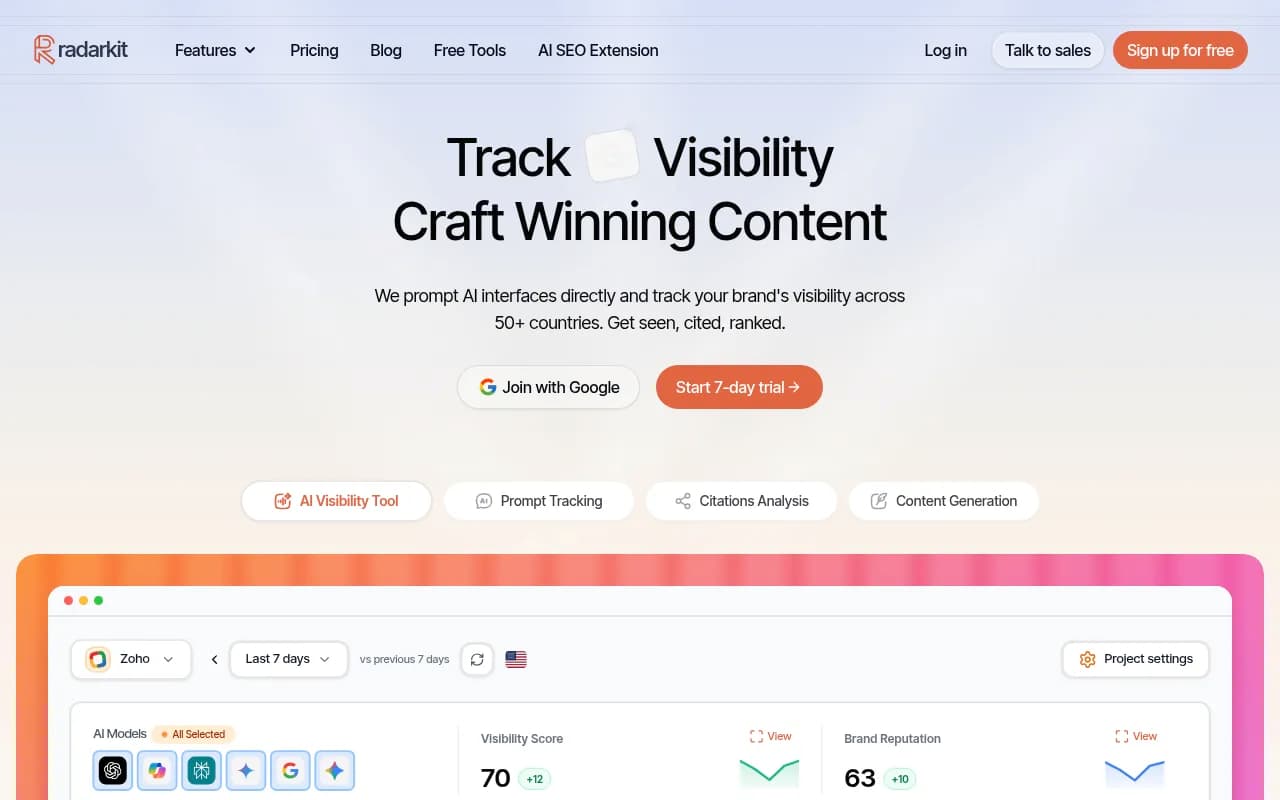
Radarkit -- best for in-depth LLM answer analysis with sentiment tracking
Radarkit focuses on analyzing the actual content of AI responses -- not just whether you're mentioned, but how you're described, what sentiment the AI uses, and how that compares to competitors. It covers ChatGPT, Perplexity, and Gemini, and offers multi-location checks. Starts at $29/month for the Lite plan, which makes it one of the more affordable options for teams that want more than basic mention tracking.
How these tools compare
Here's a side-by-side view of the key capabilities across the main alternatives:
| Tool | Monitoring | Content gap analysis | AI content generation | Crawler logs | Traffic attribution | Starting price |
|---|---|---|---|---|---|---|
| Promptwatch | Yes (10 models) | Yes | Yes | Yes | Yes | $99/mo |
| Otterly.AI | Yes | No | No | No | No | ~$49/mo |
| Peec AI | Yes | No | No | No | No | ~$49/mo |
| Profound | Yes (deep) | No | No | No | No | ~$200/mo |
| Scrunch AI | Yes | No | No | No | No | $100/mo |
| AthenaHQ | Yes | No | No | No | No | Custom |
| SE Ranking AI | Yes | No | No | No | No | Add-on |
| Semrush AI Toolkit | Yes (fixed prompts) | No | No | No | No | Add-on |
| Ahrefs Brand Radar | Yes (fixed prompts) | No | No | No | No | Add-on |
| Radarkit | Yes (sentiment) | No | No | No | No | $29/mo |
| Rankscale | Yes | No | No | No | No | Varies |
The pattern is pretty clear. Almost every tool in this space is a monitoring dashboard. The only platform that closes the full loop -- find gaps, create content, track results -- is Promptwatch.
What actually matters when choosing a tool
Monitoring coverage
At minimum, you want a tool that covers ChatGPT, Perplexity, Google AI Overviews, and Claude. Those four account for the vast majority of AI search traffic right now. Tools that only cover one or two models give you an incomplete picture.
Promptwatch covers 10 models. Most dedicated GEO tools cover 4-6. The traditional SEO tool add-ons (Semrush, Ahrefs) tend to be narrower.
Prompt customization
Fixed prompts are a real limitation. If you can't define the specific questions your target customers are asking, you're monitoring the wrong thing. Look for tools that let you build a custom prompt set based on your actual buyer journey.
What happens after you see the data
This is the question most buyers don't ask until they've been using a monitoring tool for three months and their visibility score hasn't moved. Seeing that a competitor is visible for a prompt you're not visible for is useful information. But what do you do with it?
Tools with content gap analysis (Promptwatch is the main one here) tell you specifically what content you're missing. Tools with built-in content generation let you act on that immediately. Tools with crawler logs tell you whether AI models are even reading your existing content. That full stack is what separates optimization platforms from dashboards.
Traffic attribution
Most teams eventually want to know: is AI visibility actually driving traffic and revenue? Very few tools can answer that question. Promptwatch connects AI visibility to actual traffic via Google Search Console integration, a code snippet, or server log analysis. Most competitors don't offer this at all.
Which tool is right for you
If you're just starting out and want to understand whether your brand is showing up in AI responses, Otterly.AI or Radarkit are low-cost ways to get oriented. They're not going to help you improve your visibility, but they'll tell you where you stand.
If you're at a point where you need to actually move the needle -- improve your AI visibility scores, create content that gets cited, understand which pages AI crawlers are reading -- you need a platform that goes beyond monitoring. Promptwatch is the only tool in 2026 that covers the full cycle: gap analysis, content generation, crawler logs, and traffic attribution in one place.
For enterprise teams with specific needs around AI journey mapping, Scrunch AI is worth a look. For teams that want deep citation analysis, Profound is strong. But for most marketing and SEO teams that want to see results, the monitoring-only approach has a pretty clear ceiling.
The GEO space is moving fast. A year ago, most teams were happy just knowing whether they appeared in AI responses. Now the question is how to consistently appear, for the right prompts, with the right framing -- and how to measure the business impact. The tools that answer all of those questions are still a short list.