Key takeaways
- Peec AI and Profound are solid monitoring tools, but both leave you to figure out what to do with the data yourself.
- Scrunch takes a different angle -- it serves AI-optimized content at the CDN edge, which is genuinely novel but narrows who it's useful for.
- Promptwatch is the only one of the four that closes the loop from monitoring to content creation to traffic attribution, which is why it's the recommendation for most marketing teams.
- Pricing is surprisingly similar across all four at the mid-tier level, so the decision comes down to what you actually need to do with the data.
- If you're just starting out and want simple brand mention tracking, Peec AI is cheap and easy. If you want to actually improve your AI visibility, you'll need more.
The AI search visibility space has gotten crowded fast. Twelve months ago, most marketing teams hadn't heard of GEO (Generative Engine Optimization). Now there are dozens of tools claiming to help you rank in ChatGPT, Perplexity, and Google AI Overviews -- and the differences between them matter a lot more than the marketing copy suggests.
Four platforms keep coming up in real conversations: Peec AI, Promptwatch, Profound, and Scrunch. They all sit in the same general category, but they're solving slightly different problems. This guide breaks down what each one actually does, where users run into friction, and which one makes sense for different situations.
What these tools are actually trying to do
Before comparing features, it helps to understand the core job each platform is designed for.
AI search visibility tools exist because traditional SEO metrics don't capture what's happening when someone asks ChatGPT "what's the best project management software" and your brand doesn't appear. You can have a perfectly optimized website and still be invisible in AI-generated answers. These tools try to measure that gap and, in some cases, help you close it.
The key distinction in this space is between monitoring and optimization. Monitoring tools tell you where you appear (or don't) in AI responses. Optimization tools go further -- they help you figure out why you're missing and give you something to do about it.
All four platforms in this comparison do monitoring. Only some of them do optimization.
Peec AI: clean monitoring, limited depth
Peec AI is the most straightforward of the four. You set up prompts, it tracks how often your brand appears in AI responses across a handful of models, and you get a dashboard showing your visibility score over time.
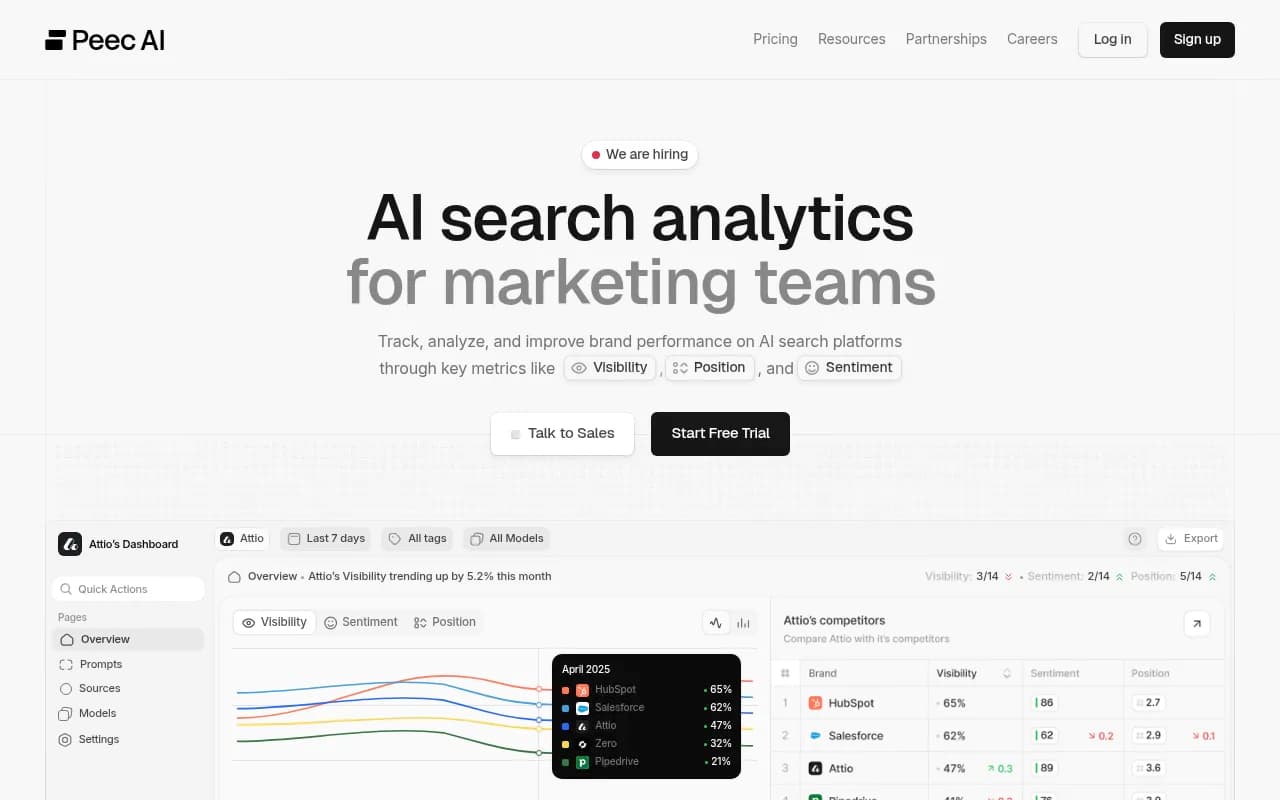
The setup is genuinely easy. You can be tracking prompts within minutes, and the interface doesn't require any technical knowledge. For teams that just want to know whether they're appearing in AI answers, it does that job cleanly.
Where it starts to show limits is when you want to do something with the data. Peec AI doesn't tell you why you're not appearing, which specific pages AI models are or aren't citing, or what content you'd need to create to improve. One reviewer on Reddit put it plainly: "Peec AI does not provide a playbook or AI-search visibility recommendations." You get the score, but not the path to improving it.
Peec AI pricing
| Plan | Monthly price | Prompts | Projects | Notable limits |
|---|---|---|---|---|
| Starter | $95/mo | 50 | 1 | 3 AI models, chat support only |
| Pro | $245/mo | 150 | 2 | Email support added |
| Advanced | $495/mo | 350 | 5 | Multi-country, GSC/GA/Looker integrations |
| Enterprise | Custom | Unlimited | Unlimited | API access, SSO |
The pricing is competitive at the Starter tier. The jump to Advanced ($495/mo) is steep if you need multi-country tracking, which is a feature most serious teams will eventually want.
Who Peec AI works for
Teams that want a quick, low-friction way to monitor AI brand mentions without committing to a complex platform. It's also a reasonable starting point if you're just trying to convince leadership that AI visibility is worth caring about -- the dashboard is easy to screenshot and share.
Profound: enterprise depth, limited action
Profound has built a reputation as the enterprise-grade option in this space. The platform covers a wide range of AI models, offers solid reporting, and has recently shipped autonomous Agents and MCP support. If you're at a large brand that needs stakeholder-ready dashboards and detailed visibility analysis, Profound is worth a serious look.
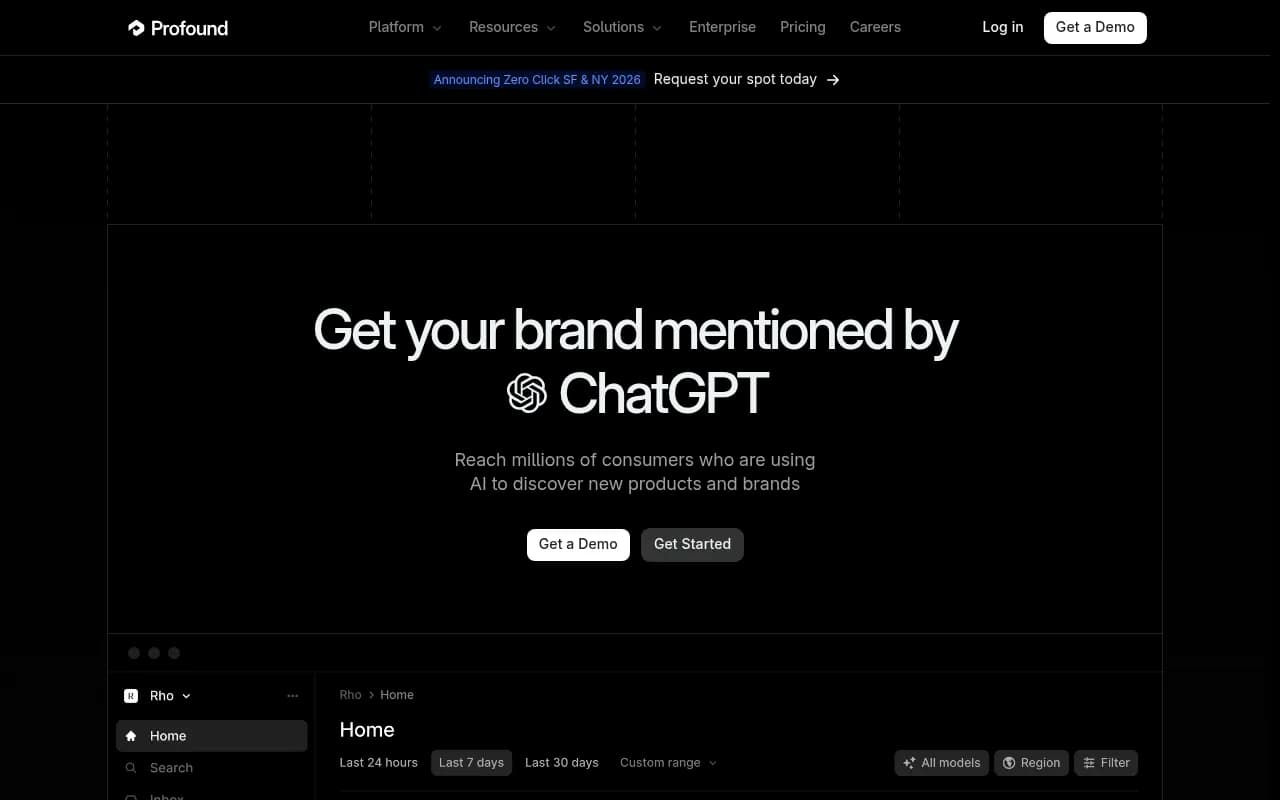
The platform does give some recommendations -- more than Peec AI -- but users report that these are limited in volume. One Reddit commenter noted that Profound provides "only a few recommendations per week," which isn't enough to run a serious content program. You end up with good data about where you're invisible, but not enough guidance to systematically fix it.
Profound also sits at a higher price point than the other three platforms here. That's defensible if you're a large enterprise with complex reporting needs, but it's harder to justify for mid-market teams who want to actually move the needle on visibility.
Where Profound stands out
- Breadth of AI model coverage
- Reporting quality and dashboard design
- Enterprise integrations and SSO
- The autonomous Agents feature (newer, still maturing)
Where it falls short
- Content optimization is limited
- Recommendations are sparse relative to the price
- Overkill for smaller teams who don't need the enterprise reporting layer
Scrunch: a genuinely different approach
Scrunch is doing something architecturally different from the other three. Rather than just monitoring AI responses, it serves AI-optimized content at the CDN edge -- meaning it can intercept requests and deliver content specifically structured for AI crawlers. That's a real technical differentiator.
For teams with the technical setup to take advantage of CDN-level optimization, Scrunch is interesting. It launched in 2024 and has been moving fast. The monitoring side of the product covers the basics, and the edge-delivery angle is something none of the other platforms in this comparison offer.
The limitation is that CDN-edge optimization is a fairly specialized capability. Most marketing teams don't have the infrastructure context to evaluate it, and it requires more technical involvement than the other tools here. It's also less clear how this approach performs across all AI models -- some models crawl content differently, and edge-delivered optimization may not work uniformly.
Scrunch is worth watching, especially if you're on a team with strong engineering involvement in your SEO workflow. For pure marketing teams, it's probably not the right fit yet.
Promptwatch: monitoring plus the full optimization loop
Promptwatch takes the most complete approach of the four. It tracks AI visibility across 10 models (ChatGPT, Perplexity, Claude, Gemini, Google AI Overviews, Grok, DeepSeek, Meta AI, Copilot, Mistral), but the monitoring is really just the starting point.

The part that separates it from the others is what happens after you see the data. The Answer Gap Analysis shows you exactly which prompts your competitors appear for but you don't -- not just a visibility score, but the specific content your site is missing. From there, Content Agents generate articles, listicles, and comparison pages grounded in real prompt data, citation patterns, and competitor analysis. Then page-level tracking shows whether that new content actually starts getting cited.
That loop -- find gaps, create content, track results -- is what most teams actually need. Monitoring alone tells you there's a problem. Promptwatch is built to help you fix it.
Features that stand out
A few Promptwatch capabilities don't have equivalents in the other three platforms:
AI Crawler Logs: Real-time logs showing when AI crawlers (ChatGPT, Claude, Perplexity, etc.) visit your pages, which pages they read, errors they hit, and when a crawled page moves to an actual citation. This is how you debug why content isn't getting picked up.
Reddit and YouTube insights: Surfaces the discussions and videos that AI models are actually citing in their responses. Most platforms ignore this entirely, but it's a meaningful channel for AI visibility.
ChatGPT Shopping tracking: Monitors when your brand appears in ChatGPT's product recommendations and shopping carousels -- relevant for e-commerce brands.
Offsite citation analysis: Tracks which external pages, Reddit threads, and third-party sites are driving AI citations for your brand, not just your own domain.
Traffic attribution: Connects AI visibility to actual website traffic and revenue, so you can show ROI on GEO work.
Promptwatch pricing
| Plan | Monthly price | Sites | Prompts | Articles | Notable features |
|---|---|---|---|---|---|
| Essential | $99/mo | 1 | 50 | 5 | Core monitoring + content agents |
| Professional | $249/mo | 2 | 150 | 15 | Crawler logs, state/city tracking |
| Business | $579/mo | 5 | 350 | 30 | Multi-site, full feature set |
| Agency/Enterprise | Custom | Custom | Custom | Custom | White-label, API, custom workflows |
The Essential plan at $99/mo is actually cheaper than Peec AI's Starter at $95/mo, and it includes content generation that Peec AI doesn't offer at any tier.
Head-to-head comparison
| Feature | Peec AI | Profound | Scrunch | Promptwatch |
|---|---|---|---|---|
| AI model coverage | 3+ | Broad | Moderate | 10 models |
| Prompt tracking | Yes | Yes | Yes | Yes |
| Citation analytics | Basic | Yes | Yes | Yes |
| Content gap analysis | No | Limited | No | Yes |
| Content generation | No | No | No | Yes |
| AI crawler logs | No | No | No | Yes |
| Traffic attribution | No | No | No | Yes |
| Reddit/YouTube insights | No | No | No | Yes |
| ChatGPT Shopping tracking | No | No | No | Yes |
| Multi-country | Advanced+ plan | Yes | Yes | Professional+ |
| CDN-edge optimization | No | No | Yes | No |
| Starting price | $95/mo | Higher | Custom | $99/mo |
| Best for | Simple monitoring | Enterprise reporting | Technical teams | Full optimization loop |
What real users say
The pattern in user feedback is pretty consistent across review sites and forums.
Peec AI users appreciate the simplicity but hit a wall when they want to take action. The data is clean, but there's no next step built in.
Profound users tend to be satisfied with the reporting quality but frustrated by the limited recommendations. Several users mention that the platform is great for showing executives the problem but doesn't help the team solve it.
Scrunch gets positive feedback from technically-oriented teams who understand the CDN angle. Less experienced teams find the setup more involved than expected.
Promptwatch users most often mention the Answer Gap Analysis and Content Agents as the features that actually changed their workflow -- not just showing them where they're invisible, but giving them something to publish. The crawler logs also come up frequently as a feature that helps teams debug why content isn't getting picked up.
Which platform should you choose?
The honest answer depends on what you're trying to do.
If you want the simplest possible way to monitor AI brand mentions and don't have budget for anything more, Peec AI's Starter plan at $95/mo does that job. Don't expect it to tell you how to improve.
If you're at a large enterprise with complex reporting needs and a dedicated SEO team that can interpret data and build their own content strategy around it, Profound is worth evaluating. The price is higher, but the reporting depth is real.
If you have engineering resources and want to experiment with CDN-edge AI optimization, Scrunch is genuinely interesting. It's doing something architecturally novel and worth watching.
If you want to actually improve your AI visibility -- not just measure it -- Promptwatch is the strongest option of the four. The combination of monitoring, gap analysis, content generation, and attribution in one platform means you're not stitching together multiple tools or trying to figure out what to do with a dashboard full of data. The Essential plan at $99/mo is also the most accessible entry point for teams that want the full stack without committing to enterprise pricing.
The GEO space is still maturing fast. All four platforms are shipping new features regularly. But the core question -- do you want monitoring or optimization -- is likely to remain the right frame for choosing between them for the foreseeable future.