Key takeaways
- Peec AI and LLM Pulse are monitoring-only tools -- they show you data but won't help you fix anything.
- Promptwatch is the only one of these four platforms that closes the loop: track gaps, generate content, measure results.
- LLM Pulse has the lowest entry price and unlimited team seats, making it popular with lean marketing teams.
- "Rankshift" doesn't appear in any major 2026 platform benchmark -- it may be a rebranded or niche tool with limited public track record.
- The most common complaint across all budget tools is the same: you see the problem but have no way to act on it inside the platform.
Budget AI visibility tools are multiplying fast. Every few months a new tracker appears, promises to show you where your brand appears in ChatGPT and Perplexity, and charges somewhere between $50 and $200 a month for the privilege. Some are genuinely useful. Some are dashboards dressed up as strategy tools.
This guide focuses on four names that come up regularly in budget conversations: Peec AI, Promptwatch, LLM Pulse, and Rankshift. We'll look at what each actually does, what users complain about, and where the real gaps are.
What "budget" means in AI visibility in 2026
The AI visibility market has two rough tiers. Enterprise platforms like Profound and Bluefish AI charge $1,000+ per month and target Fortune 500 teams. Then there's everything else -- tools priced between $50 and $600 a month that serve marketing teams, agencies, and growth-stage SaaS companies.
All four tools in this comparison sit in that second tier. But "budget" doesn't mean they're equivalent. The gap between a $99 monitoring dashboard and a $249 optimization platform is enormous if one helps you actually improve your AI citations and the other just shows you that you're losing.
Peec AI: solid monitoring, nothing more
Peec AI was one of the first purpose-built tools for tracking brand visibility across AI search engines. It uses UI scraping (not just API calls) to simulate real user queries, which matters because ChatGPT's user-facing answers can differ from what the API returns.
The platform tracks share of voice, citation rate, and source URLs across ChatGPT, Perplexity, and Google AI Overviews. Pricing starts at $100/month, which is competitive.

What users like
- Clean, readable dashboards. The data is well-organized and easy to share with stakeholders.
- Transparent pricing. No enterprise sales call required to find out what it costs.
- Good for answering "are we visible in AI search?" quickly.
The main complaints
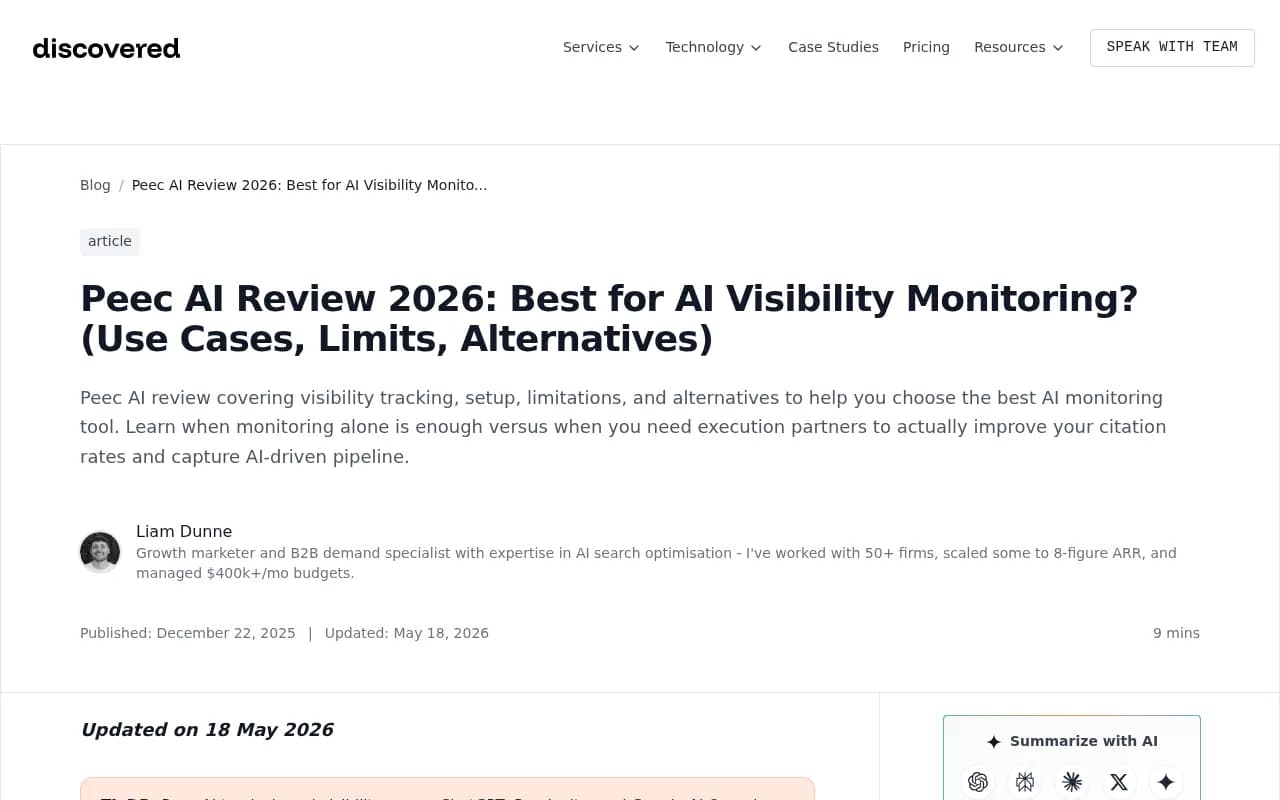
The consistent criticism of Peec AI is that it stops at diagnosis. According to a detailed review from Discovered Labs, Peec AI "tracks mentions but doesn't write content, build authority signals, or implement technical optimizations needed to improve your numbers." You get a clear picture of the problem. Then you're on your own.
A few other friction points come up regularly:
- No crawler logs, so you can't see which pages AI engines are actually reading.
- No content generation or brief creation.
- No Reddit or YouTube tracking, which matters because AI models frequently cite community discussions.
- Limited model coverage compared to platforms that track 10+ LLMs.
For teams that just need a monitoring signal and have a separate content operation to act on the data, Peec AI works fine. For teams that want to close the loop inside one tool, it falls short.
LLM Pulse: best value for lean teams
LLM Pulse is bootstrapped (no VC funding), and that shows in its pricing philosophy. It offers unlimited team seats, which is genuinely unusual in this market -- most competitors charge per seat or per user.
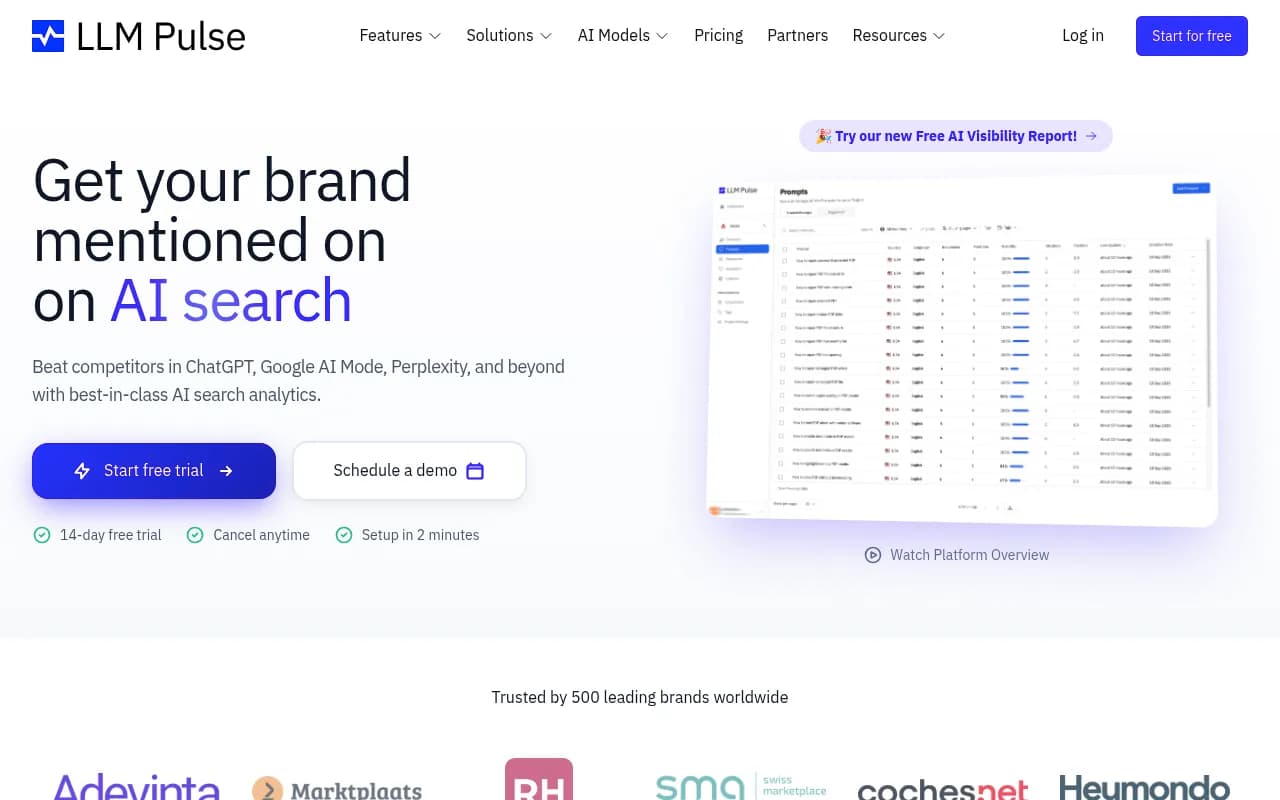
The platform focuses on the most widely used AI platforms rather than trying to cover every model. It includes features like Brand Sentiment tracking, query fan-out analysis, app store tracking, white-label reporting, and a Chrome Extension for capturing real AI prompts in the wild.
What users like
- Unlimited seats means the whole marketing team can access data without a per-user cost conversation.
- White-label reporting is useful for agencies.
- The Chrome Extension is a clever way to capture real prompts that users are actually typing.
- Lower price point than most comparable tools.
The main complaints
LLM Pulse's own comparison page (written with ChatGPT's help, which they disclose) acknowledges the trade-offs honestly: Promptwatch has broader model coverage, AI crawler logs, and built-in content generation that LLM Pulse doesn't offer.
The core limitation is the same as Peec AI: it's a monitoring and reporting tool. There's no content gap analysis, no content generation, and no page-level tracking that shows which specific URLs are being cited. If you need to understand why you're being cited (or not), and then do something about it, you'll hit a ceiling.
That said, for a small team that needs clean reporting and collaboration features without paying per seat, LLM Pulse has fewer complaints than most tools at its price point.
Rankshift: limited public track record
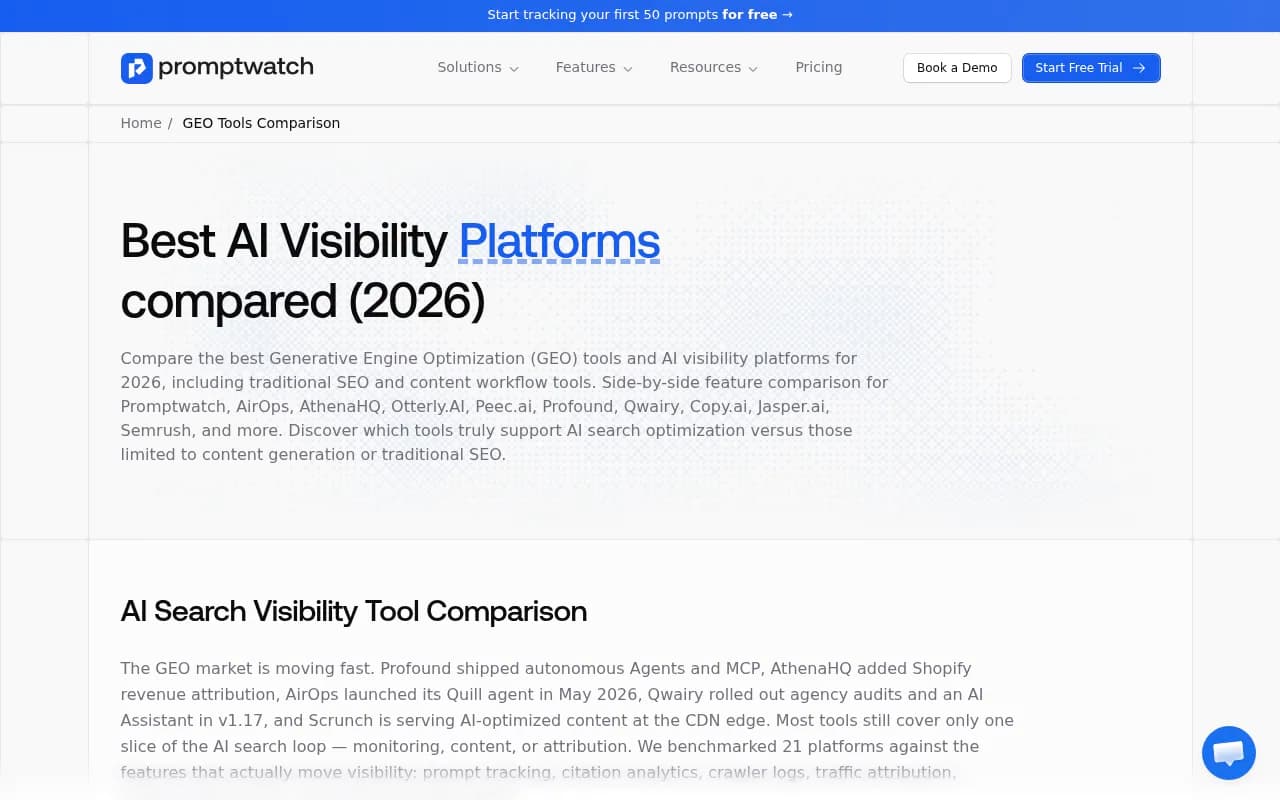
Rankshift doesn't appear in any of the major 2026 AI visibility benchmarks -- not in Promptwatch's comparison of 21 platforms, not in Zapier's roundup, not in the Frictionai landscape review. That's worth noting.
This could mean a few things: it's a very new entrant, it's a rebranded tool, or it operates in a niche segment without significant market presence. Without reliable third-party reviews or benchmark data, it's hard to make strong claims about its capabilities or complaint patterns.
If you're considering Rankshift specifically, the practical advice is to ask for a trial, check whether it covers the AI models you care about, and verify whether it does anything beyond monitoring. The monitoring-only problem affects most tools in this space regardless of name.
Promptwatch: the one that goes beyond tracking
Promptwatch is the most feature-complete option in this comparison. It's not the cheapest -- plans start at $99/month for the Essential tier -- but it's the only platform here that covers the full optimization loop rather than just the monitoring piece.

The core difference: most tools show you that competitors are appearing in AI answers where you're not. Promptwatch shows you the same thing, then helps you fix it. The Answer Gap Analysis identifies specific prompts where competitors have visibility and you don't. Content Agents then generate articles, comparisons, and briefs built around those exact gaps. Page-level tracking shows whether the new content gets crawled and cited.
It also has AI Crawler Logs -- real-time data on which AI crawlers are hitting your site, which pages they read, and what errors they encounter. This is the kind of data that explains why you're invisible, not just that you're invisible. Most competitors in this price range don't offer it at all.
What users like
- Full coverage: 10 AI models including ChatGPT, Perplexity, Claude, Gemini, Google AI Overviews, Grok, DeepSeek, Mistral, Meta AI, and Copilot.
- Content generation that's grounded in real prompt data, not generic SEO filler.
- Reddit and YouTube tracking, which surfaces discussions that influence AI recommendations.
- ChatGPT Shopping tracking for e-commerce brands.
- Prompt volume and difficulty scoring, so you can prioritize winnable gaps.
The main complaints
The most common friction is the learning curve. Promptwatch has a lot of features, and teams that just want a simple "are we visible?" dashboard sometimes find it more than they need. The Essential plan ($99/month) is limited to 50 prompts and 5 articles per month, which can feel tight for competitive categories.
Some users also note that the content generation features require investment -- you get better output when you feed in brand guidelines, competitor data, and specific instructions. It's not a one-click solution.
Side-by-side comparison
| Feature | Peec AI | LLM Pulse | Promptwatch | Rankshift |
|---|---|---|---|---|
| Starting price | ~$100/mo | Lower than Promptwatch | $99/mo | Unknown |
| AI models covered | ChatGPT, Perplexity, Google AIO | Major platforms | 10 models | Unknown |
| Content generation | No | No | Yes (Content Agents) | Unknown |
| Answer gap analysis | No | No | Yes | Unknown |
| AI crawler logs | No | No | Yes | Unknown |
| Reddit/YouTube tracking | No | No | Yes | Unknown |
| ChatGPT Shopping tracking | No | No | Yes | Unknown |
| Prompt volume/difficulty | No | Partial (query fan-out) | Yes | Unknown |
| White-label reporting | No | Yes | Agency/Enterprise | Unknown |
| Unlimited team seats | No | Yes | No (seat-based) | Unknown |
| Chrome Extension | No | Yes | No | Unknown |
| Third-party benchmarks | Yes | Limited | Yes (21-platform study) | None found |
The complaint that runs through all of them
Here's the honest pattern: the most common complaint about budget AI visibility tools in 2026 isn't about bugs or pricing. It's about the monitoring-only ceiling.
Teams buy a tracker, get excited about the data, share dashboards with leadership, and then realize they have no clear path from "we're not visible for these prompts" to "now we are." The data is interesting. The action is missing.
Peec AI and LLM Pulse are both well-executed monitoring tools. They do what they say. But if your goal is to actually improve your AI citations -- not just measure them -- you'll eventually need either a platform that includes optimization features or an external agency to execute on the data.
Promptwatch is the only tool in this comparison that tries to solve the full problem. Whether that's worth the trade-off in price and complexity depends on your team's capacity and goals.
Which tool should you pick?
The honest answer depends on what you're trying to do.
If you need a clean monitoring dashboard to answer "are we visible in AI search?" and you have a separate content team to act on the data, Peec AI or LLM Pulse will serve you well. LLM Pulse has the edge for teams that need unlimited seats and white-label reporting. Peec AI has slightly more established third-party coverage.
If you want to actually move the needle -- identify gaps, create content that fills them, and track whether it works -- Promptwatch is the only option in this group that supports the full loop. The Essential plan at $99/month is a reasonable starting point, and the Professional plan at $249/month unlocks crawler logs and city-level tracking.
Rankshift is a question mark. Without reliable benchmark data or user reviews, it's hard to recommend it over tools with established track records.
One more thing worth saying: the AI visibility market is moving fast. Tools that were monitoring-only six months ago are adding optimization features. Tools that launched in 2025 are already being acquired or pivoting. Whatever you choose, make sure the core monitoring data is reliable before worrying about the extras.