Key takeaways
- These tools solve different problems. Promptwatch tracks and improves your visibility in AI search engines (ChatGPT, Claude, Perplexity, etc.). Content Harmony speeds up content brief creation for traditional Google SEO. There's almost no direct overlap in core function.
- If your team is asking "why aren't we showing up in ChatGPT answers?", Promptwatch is the answer. If you're asking "how do we write better content for Google faster?", Content Harmony is the answer.
- Both start at $99/mo, but the value delivered is completely different. Promptwatch's entry plan gives you 50 prompts tracked and 5 AI-generated articles per month. Content Harmony's entry plan gives you roughly 10 content workflow credits.
- Content Harmony is a mature, agency-tested brief tool with a credit-based model and unlimited users on every plan -- great for content teams with high output volume.
- Promptwatch goes beyond monitoring: it identifies which prompts competitors rank for that you don't, then generates content designed to get cited by AI models. That's a workflow most SEO tools don't touch.
- For teams running both a traditional SEO program and an AI search program, these tools complement each other rather than compete.
Overview
Promptwatch

Promptwatch is an AI search visibility platform used by 6,700+ brands and agencies. It monitors how your brand appears across 10 AI models -- ChatGPT, Claude, Perplexity, Gemini, Grok, DeepSeek, Copilot, Meta AI, Mistral, and Google AI Overviews -- and then helps you do something about what you find. The core loop: identify which prompts competitors are visible for that you're not, generate content engineered to get cited by AI models, and track whether your visibility improves. It also logs AI crawler activity on your site, tracks citation sources (including Reddit and YouTube), and connects visibility data to actual traffic.
Content Harmony
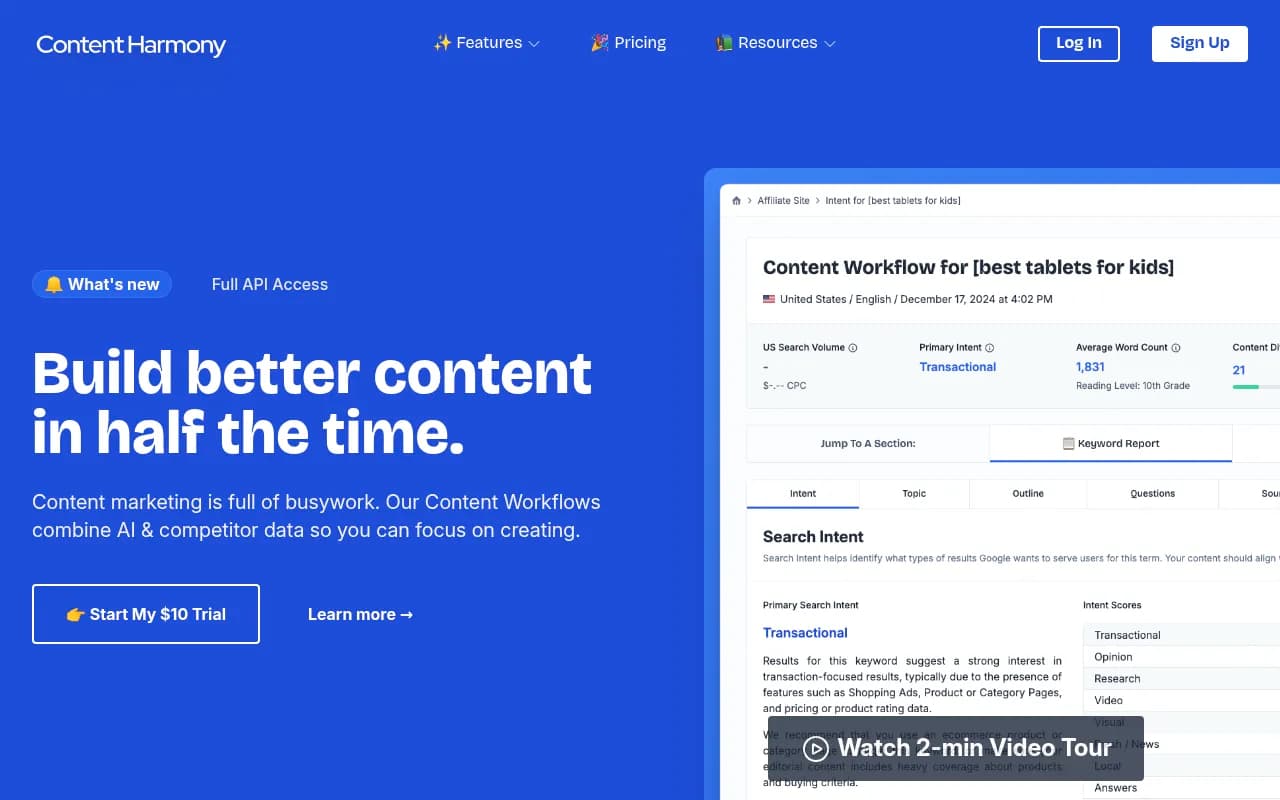
Content Harmony is a content intelligence platform built by former agency operators. Its job is to make content brief creation faster and more thorough -- combining keyword research, search intent classification, competitor structure mapping, and AI topic modeling into one workflow. Teams that used to spend hours building briefs manually can cut that down significantly. It's squarely aimed at SEO teams and content agencies producing high volumes of Google-targeted content. Every plan includes unlimited users and rollover credits, which makes it practical for larger teams.
Side-by-side comparison
| Feature | Promptwatch | Content Harmony |
|---|---|---|
| Primary use case | AI search visibility & optimization | SEO content brief creation |
| Target search engines | ChatGPT, Claude, Perplexity, Gemini, Grok, etc. | Google (traditional search) |
| AI model monitoring | 10 models tracked | None |
| Content brief generation | Yes (AI-optimized for LLM citations) | Yes (optimized for Google rankings) |
| Keyword research | Prompt volume & difficulty scoring | Full keyword research suite |
| Competitor analysis | AI visibility heatmaps, citation gaps | SERP competitor structure mapping |
| Content generation | Built-in AI writing agent | AI-assisted brief drafting |
| Traffic attribution | Yes (GSC, code snippet, server logs) | No |
| Crawler logs | Yes (AI crawlers: GPT, Claude, etc.) | No |
| Reddit/YouTube tracking | Yes | No |
| ChatGPT Shopping tracking | Yes | No |
| Unlimited users | No (seat-based) | Yes (all plans) |
| Free trial | 7-day free trial | $10 trial (10 workflows) |
| Starting price | $99/mo | $99/mo |
| API access | Yes | Limited |
| Multi-language/region | Yes | Limited |
Head-to-head feature deep-dive
Core purpose and workflow
This is where the two tools diverge completely. Content Harmony is built around a single, well-defined workflow: you enter a keyword, it pulls SERP data, classifies search intent, maps competitor content structures, and produces a brief your writer can follow. The output is a document. The goal is a well-ranking Google article.
Promptwatch is built around a different question: "Are AI models recommending my brand, and if not, why?" You track prompts relevant to your business, see which competitors appear in AI responses when you don't, identify the content gaps causing that, and generate articles specifically designed to get cited. The output is improved AI search visibility over time.
Verdict: Neither is better -- they're solving different problems. The only overlap is that both help you figure out what content to create and assist in writing it.
Content creation capabilities
Both tools help you create content, but the underlying logic is different.
Content Harmony builds briefs grounded in what's already ranking on Google. It analyzes competitor pages, extracts common headings and topics, and gives writers a structured outline to follow. The AI layer helps with topic modeling and brief drafting, but the brief is ultimately a guide for a human writer.
Promptwatch's AI writing agent generates full articles (listicles, comparisons, guides) grounded in citation data from 880M+ analyzed citations. The content is engineered to match what AI models actually cite -- specific angles, topic depth, and structure that LLMs respond to. It's less about matching what's on Google page one and more about matching what AI models want to reference.
| Aspect | Promptwatch | Content Harmony |
|---|---|---|
| Brief creation | Prompt-gap-driven | SERP-driven |
| Full article generation | Yes | No (briefs only) |
| Optimization target | LLM citations | Google rankings |
| Competitor input | AI visibility data | SERP competitor pages |
| Writer-facing output | Full draft | Structured brief |
Verdict: Content Harmony wins for teams that need to brief writers at scale for Google. Promptwatch wins if you need content that gets cited in AI answers.
Pricing and plan structure
Both tools start at $99/mo, which is a coincidence worth noting -- but the plans work differently.
Content Harmony uses a credit model. Credits roll over, there are no per-seat fees, and every plan includes unlimited users. That's genuinely useful for agencies where multiple people need access. The $10 trial for 10 workflows is low-risk.
Promptwatch is structured around sites, prompts, and article credits per month. The 7-day free trial gives you a real look at the platform before committing.
Pricing table
| Plan | Promptwatch | Content Harmony |
|---|---|---|
| Trial | 7-day free trial | $10 for 10 workflows |
| Entry ($99/mo) | 1 site, 50 prompts, 5 articles/mo | ~10 workflow credits/mo |
| Mid-tier ($249/mo) | 2 sites, 150 prompts, 15 articles/mo | ~30 workflow credits/mo |
| Upper tier ($579/mo) | 5 sites, 350 prompts, 30 articles/mo | ~100 workflow credits/mo |
| Unlimited users | No | Yes (all plans) |
| Rollover credits | No | Yes |
| Agency/Enterprise | Custom pricing | Custom pricing |
Verdict: Content Harmony's unlimited users and rollover credits make it more flexible for agencies with large teams. Promptwatch's pricing scales with the scope of your AI monitoring program.
Competitor and market intelligence
Content Harmony's competitor intelligence is SERP-focused: it looks at who's ranking for your target keyword, what headings they use, how long their content is, what topics they cover. This is useful for writing content that matches or exceeds what's already ranking.
Promptwatch's competitor intelligence is AI-visibility-focused: it shows you which brands appear in AI responses for specific prompts, how often, and across which models. The Answer Gap Analysis specifically surfaces prompts where competitors are visible but you're not. There's also a heatmap view comparing your AI visibility vs competitors across different LLMs.
These are genuinely different types of intelligence. One tells you how to beat competitors on Google. The other tells you how to beat them in ChatGPT.
Verdict: Depends entirely on where you're competing. Most teams need both.
Tracking and analytics
Content Harmony doesn't have a tracking layer. It's a brief creation tool -- once the brief is done and the content is published, you'd use Google Search Console or another analytics tool to track performance.
Promptwatch has a full tracking layer built in. Page-level tracking shows which pages are being cited by AI models, how often, and by which model. Traffic attribution connects AI visibility to actual site visits via a code snippet, GSC integration, or server log analysis. The AI crawler logs show which pages AI bots are reading and how often they return.
Verdict: Promptwatch wins this category outright. Content Harmony doesn't compete here.
Ease of use and onboarding
Content Harmony is designed to be picked up quickly. The workflow is linear -- enter keyword, get brief -- and the interface is built around that single action. Former agency operators built it, so it's optimized for speed and repeatability. Free team training is included on all plans.
Promptwatch has more surface area. Setting up prompt tracking, configuring personas, interpreting citation data, and using the content generation tools takes more time to learn. That said, the platform is built around a clear loop (find gaps, create content, track results), which gives it structure. The 7-day trial is enough time to get a feel for it.
Verdict: Content Harmony is simpler to start with. Promptwatch has a steeper learning curve but covers more ground.
Pros and cons
Promptwatch
Pros:
- Monitors 10 AI models in one platform, including Google AI Overviews, Grok, and DeepSeek
- Answer Gap Analysis identifies exactly which content is missing
- Built-in AI writing agent generates content engineered for LLM citations
- AI crawler logs show how AI bots interact with your site
- Traffic attribution connects AI visibility to revenue
- Reddit and YouTube citation tracking -- a channel most tools ignore
- Multi-language and multi-region monitoring
Cons:
- No traditional Google SERP analysis or keyword research for organic rankings
- Per-site and per-prompt limits can feel restrictive on lower plans
- Learning curve is real -- there's a lot to configure upfront
- No unlimited-user pricing; seat costs add up for large teams
Content Harmony
Pros:
- Genuinely fast brief creation -- the core workflow is well-designed
- Unlimited users on every plan, which is rare and valuable for agencies
- Rollover credits reduce waste
- $10 trial is low-risk
- Free team training included
- Built by people who ran content agencies, so the workflow reflects real-world needs
Cons:
- No AI search monitoring or LLM visibility tracking
- No traffic attribution or post-publish analytics
- Content is optimized for Google, not AI models
- Limited API access
- Once a brief is done, the tool's job is over -- no feedback loop
Who should pick which tool
Pick Promptwatch if:
- Your team is focused on AI search visibility -- you want to know why ChatGPT or Perplexity isn't recommending your brand
- You're running a GEO (Generative Engine Optimization) program and need data to back it up
- You want to generate content specifically designed to get cited by AI models, not just rank on Google
- You need to track AI crawler activity on your site and understand how LLMs discover your content
- You're an agency offering AI search visibility as a service
Pick Content Harmony if:
- Your content program is primarily Google-focused and you need to scale brief production
- You have a large content team or agency where unlimited users is a meaningful cost saving
- You want to cut the time your writers spend on research and structure
- You're producing high volumes of content and need a repeatable, fast workflow
- Traditional SEO is your primary channel and you're not yet investing in AI search
Consider using both if:
- You're running parallel programs for Google SEO and AI search visibility
- Your agency serves clients across both traditional and AI search channels
- You want Content Harmony for brief creation and Promptwatch for tracking whether that content gets cited in AI responses
Final verdict
Promptwatch and Content Harmony aren't really competing for the same buyer. Content Harmony is a well-built tool for teams that need to produce Google-optimized content faster. Promptwatch is for teams that want to understand and improve how they appear in AI search results -- and actually do something about it.
If you're still treating Google as your only search channel, Content Harmony is the more immediately useful tool. But if AI models are already sending traffic to your competitors and you're not sure why, Promptwatch is the one that tells you what's happening and gives you a path to fix it.
The $99/mo starting price is the same. The problems they solve are not.