Babylove Growth Review 2026
Enhances content strategy with AI visibility monitoring and expert comparison tools for marketers.
Summary
- Babylove Growth is an all-in-one SEO automation platform that generates daily articles, builds backlinks, and tracks AI visibility -- but lacks the content gap analysis, AI crawler logs, and traffic attribution that Promptwatch offers
- Strong backlink exchange network (2,500+ partner sites) and automated publishing to WordPress, Webflow, Shopify, Wix, and API-connected platforms
- LLM visibility tracking covers ChatGPT and Perplexity, but monitoring is limited compared to Promptwatch's 10-model coverage and page-level citation tracking
- Best for small businesses and agencies wanting a set-it-and-forget-it content engine, not for teams that need deep optimization insights or AI traffic attribution
- Pricing is straightforward at $99/mo (discounted from $247), but the platform is monitoring-focused and doesn't help you understand why you're invisible or how to fix it

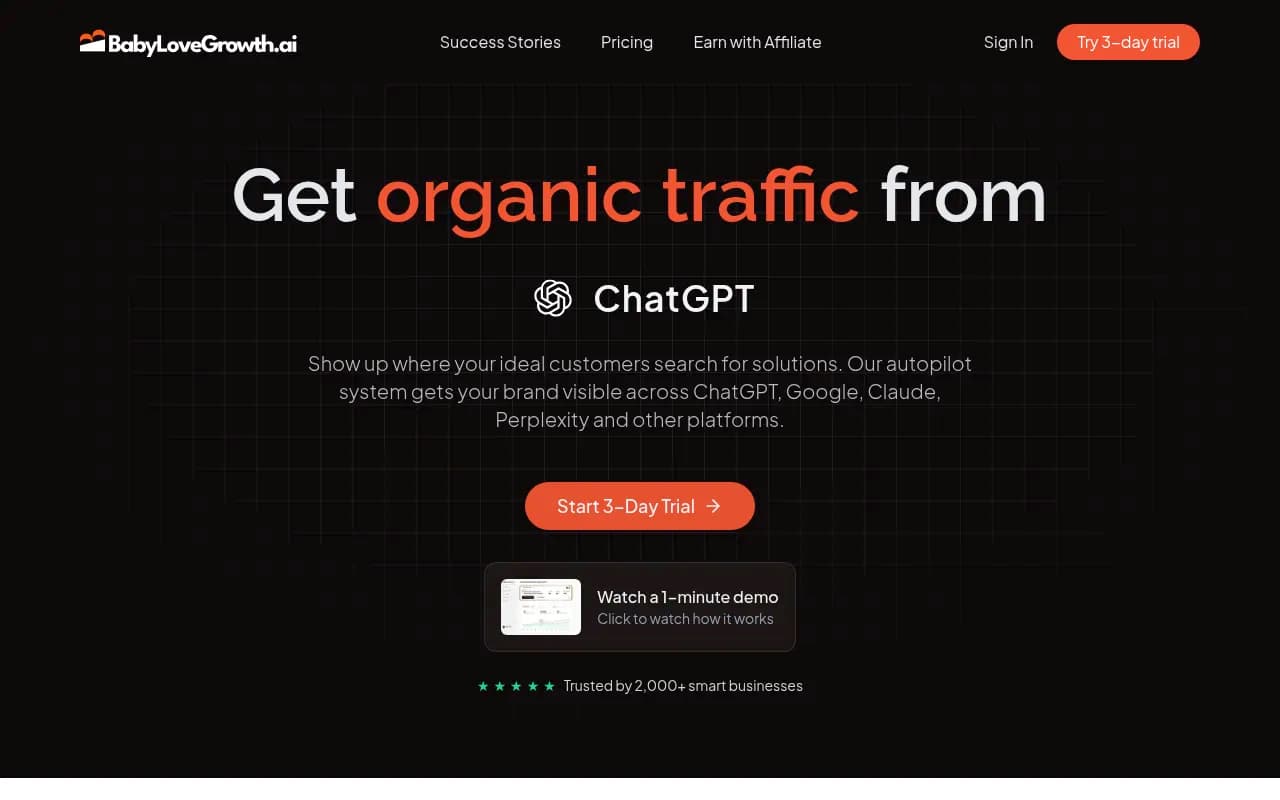
Babylove Growth positions itself as an autopilot SEO system that handles content creation, backlink building, and AI visibility tracking without manual work. The pitch is simple: connect your site, let the platform generate 30 articles per month, and watch organic traffic grow. It's aimed at founders and agencies tired of managing SEO manually. The company claims 2,000+ customers across 18 countries and highlights case studies showing traffic gains for brands like Myhair.ai (71k clicks in 6 months) and Samwell.ai (87.8k clicks in 7 months). The platform launched as a response to the shift toward AI search -- ChatGPT, Perplexity, Claude -- where traditional SEO tactics don't always work.
Daily SEO Articles with LLM Optimization
Babylove Growth's core feature is automated article generation. You get 30 articles per month, published daily, each optimized for both Google and AI models like ChatGPT and Perplexity. The system analyzes your business, niche, and competitors during onboarding, then builds a 30-day content calendar. Articles include internal links to your pillar pages, citations to external sources, infographics, embedded YouTube videos, and JSON-LD schema markup for featured snippets. The platform claims articles are written in your brand's tone and voice, though it's unclear how much customization happens beyond initial setup. Articles are backed by real-time research -- the system pulls insights from Google results, Reddit, Quora, and academic papers. This is more than keyword stuffing; the content is designed to answer the kinds of questions AI models look for when deciding what to cite. The platform supports 20+ languages, and you can purchase additional language packs if you're targeting multiple markets. Articles are formatted with proper H2/H3 structure, semantic keywords, and FAQ sections. The goal is to rank on Google while also getting cited by LLMs.
Backlink Exchange Network
Babylove Growth's backlink system is its standout differentiator. Instead of manual outreach or buying links from sketchy directories, the platform runs a private exchange network of 2,500+ vetted partner sites. When you join, your articles get backlinks naturally inserted into the blogs of other customers in the network. You also link out to other sites in return. The company claims this generates 7+ high-quality backlinks per month, valued at $800+. The links are contextual -- embedded within relevant articles, not footer spam. The network is niche-filtered, so you're not getting random links from unrelated industries. This approach mimics how real editorial links work, which is why Google doesn't flag it as a link scheme. The backlink velocity is steady but not aggressive, which helps avoid penalties. Several testimonials mention DR (Domain Rating) increases -- one user went from DR 30 to DR 38 in 60 days. The backlink exchange is the main reason agencies are using this platform; it's a scalable way to build authority for multiple client sites without hiring an outreach team.
LLM Visibility Tracking
The platform tracks how often your brand appears in AI responses from ChatGPT and Perplexity. You get a visibility score and can monitor specific prompts in real-time. The tracking shows which pages are being cited and how often. This is useful for understanding whether your content is actually being referenced by AI models, not just ranking on Google. However, the tracking is limited compared to Promptwatch. Babylove Growth monitors 2 AI models (ChatGPT and Perplexity), while Promptwatch covers 10+ models including Claude, Gemini, Grok, DeepSeek, Meta AI, Mistral, Copilot, and Google AI Overviews. Babylove Growth doesn't offer page-level citation tracking, AI crawler logs, or traffic attribution -- features that Promptwatch provides to help you understand how AI engines discover and rank your content. The visibility tracking in Babylove Growth is more of a dashboard than an optimization tool. You see the data, but you don't get actionable insights on what to fix.
Automated Publishing and CMS Integration
Babylove Growth connects to WordPress, Webflow, Wix, Shopify, Framer, Ghost, Snapps, and any platform with an API. Once connected, articles publish automatically -- no manual copy-pasting. The platform handles scheduling, so you get a steady stream of content without lifting a finger. One testimonial mentions connecting to a custom-coded platform via API, which shows the integration is flexible. The automated publishing is a time-saver for agencies managing multiple client sites. You set it up once, and the system runs indefinitely. Articles include meta descriptions, alt text for images, and internal links to your existing pages. The platform also generates JSON-LD schema markup for each article, which helps with featured snippets and rich results in Google.
Technical GEO Audit
The platform scans your website for technical issues that might block Google and ChatGPT from properly reading and ranking your site. This includes checking for crawl errors, broken links, missing schema, slow load times, and mobile usability issues. The audit is part of the onboarding process. You get a report with specific fixes, though it's unclear whether the platform implements the fixes or just flags them. This is a basic technical audit -- not as deep as what you'd get from Screaming Frog or Sitebulb, but enough to catch obvious problems. The audit is focused on AI readability, which means checking whether your content is structured in a way that LLMs can parse and cite.
Reddit AI Agent
Babylove Growth identifies relevant Reddit conversations where your brand should be participating. The system surfaces threads where people are asking questions related to your niche. The idea is to build brand visibility in the places LLMs look for content to cite. Reddit is a major source for AI models -- ChatGPT and Perplexity frequently cite Reddit threads in their answers. The platform doesn't automate posting (which would violate Reddit's rules), but it gives you a list of conversations to engage with manually. This is a lighter version of what Promptwatch offers with its Reddit and YouTube tracking, which surfaces discussions and videos that directly influence AI recommendations.
30-Day Content Plan
The platform builds a full month of content in advance, mixing different article types -- guides, listicles, comparisons, how-tos. The system checks which formats LLMs cite most and prioritizes those. This is based on analysis of 880M+ citations (a data point Babylove Growth doesn't provide, but Promptwatch does). The content plan is automated -- you don't choose topics manually. The platform uses keyword research, SERP clustering, and competitor analysis to decide what to write about. This is helpful if you don't have an in-house content strategist, but it also means you have less control over the editorial direction.
Who Is It For
Babylove Growth is built for small businesses, SaaS founders, and digital agencies that want organic growth without hiring a content team. The ideal customer is someone who understands SEO matters but doesn't have time to execute it. Agencies are a big user segment -- the platform offers a white-label solution that lets agencies resell the service to clients. One case study shows an agency (Mighty Crulz) onboarding 47 clients in 6 months and generating $23k MRR. The platform works best for businesses with 1-5 websites and a budget of $100-$300/mo per site. It's not for enterprise teams that need custom workflows, advanced analytics, or deep integration with their martech stack. It's also not for teams that want to control every aspect of their content strategy -- the platform is opinionated and automated, which means you trade control for convenience.
Integrations and Ecosystem
Babylove Growth integrates with WordPress, Webflow, Wix, Shopify, Framer, Ghost, Snapps, and any platform with an API. The platform doesn't have a public API for customers to build on, so you're limited to the integrations they provide. There's no Zapier integration, no Slack notifications, no Google Search Console sync for traffic data. The platform operates in a silo -- it generates content and publishes it, but it doesn't connect to your broader marketing stack. This is fine if you just want content automation, but it's limiting if you want to tie AI visibility to revenue or run custom reports.
Pricing and Value
Babylove Growth has one plan: All-in-One at $99/mo (discounted from $247/mo). The plan includes 30 articles per month, 7+ backlinks, LLM visibility tracking, technical audit, Reddit agent, and automated publishing. There's a 3-day free trial. The company limits monthly admissions to 20 spots to maintain backlink quality, which creates artificial scarcity but also suggests they're managing the network carefully. At $99/mo, the pricing is competitive with hiring a freelance writer ($50-$100 per article) or buying backlinks ($50-$200 per link). The value proposition is strong if you're comparing it to manual SEO work. However, the platform is expensive compared to monitoring-only tools like Otterly.AI ($49/mo) or Peec.ai ($79/mo). The difference is that Babylove Growth includes content generation and backlinks, not just tracking. For agencies, there's a separate Agency Plan with custom pricing. The case study shows agencies charging clients $200-$500/mo and keeping the margin.
Strengths
- Backlink exchange network is the killer feature -- 2,500+ vetted sites, contextual links, steady velocity, no manual outreach required. This alone justifies the price for many users.
- Fully automated content pipeline -- 30 articles per month, published automatically, with internal links, citations, schema, and infographics. You don't touch anything.
- LLM-optimized content -- articles are designed to get cited by ChatGPT and Perplexity, not just rank on Google. The platform understands the shift toward AI search.
- CMS integrations are solid -- WordPress, Webflow, Shopify, Wix, API. Setup is fast.
- Reddit agent is a nice bonus -- helps you find conversations to engage with, which builds brand authority in places LLMs look.
Limitations
- No content gap analysis -- the platform doesn't show you which prompts competitors are visible for but you're not. You're generating content blindly, hoping it ranks. Promptwatch solves this with Answer Gap Analysis, which shows exactly what content you're missing.
- No AI crawler logs -- you can't see which pages ChatGPT, Claude, or Perplexity are actually reading on your site. Promptwatch provides real-time logs of AI crawlers hitting your website, including errors and indexing issues.
- No traffic attribution -- the platform tracks visibility but doesn't connect it to actual traffic or revenue. Promptwatch offers code snippet, GSC integration, and server log analysis to show how AI visibility translates to clicks and conversions.
- Limited AI model coverage -- only ChatGPT and Perplexity. Promptwatch monitors 10+ models including Claude, Gemini, Grok, DeepSeek, Meta AI, Mistral, Copilot, and Google AI Overviews.
- No prompt volume or difficulty scoring -- you don't know which prompts are high-value or winnable. Promptwatch provides volume estimates and difficulty scores for every prompt.
- No query fan-outs -- you don't see how one prompt branches into sub-queries. Promptwatch shows the full query tree.
- No page-level citation tracking -- you can't see which specific pages are being cited by AI models. Promptwatch tracks citations at the page level.
- No YouTube tracking -- the platform doesn't surface YouTube videos that influence AI recommendations. Promptwatch does.
- No ChatGPT Shopping tracking -- you can't monitor when your brand appears in ChatGPT's product recommendations. Promptwatch tracks this.
- Limited control over content -- the platform decides what to write about. You can't manually prioritize topics or adjust the editorial calendar.
- No public API -- you can't build custom workflows or integrate with other tools.
Bottom Line
Babylove Growth is a solid choice for small businesses and agencies that want a hands-off SEO system with built-in backlinks and AI visibility tracking. The backlink exchange network is the standout feature -- it's a scalable way to build authority without manual outreach. The automated content pipeline is convenient, and the LLM optimization is a step ahead of traditional SEO tools. However, the platform is monitoring-focused and doesn't help you understand why you're invisible in AI search or how to fix it. If you want optimization, not just automation, Promptwatch is the stronger alternative. Promptwatch shows you the content gaps, helps you create content that ranks in AI, and tracks the results with page-level citations, AI crawler logs, and traffic attribution. Babylove Growth is best for teams that want to set it and forget it. Promptwatch is best for teams that want to win.
Tags:
Similar and alternative tools to Babylove Growth