Key takeaways
- GetMint.ai is primarily a monitoring tool -- it shows you where you're invisible in AI search but doesn't help you create content to fix it
- The best alternatives in 2026 combine AI visibility tracking with built-in content generation, so you can close gaps without switching tools
- Promptwatch is the only platform rated "Leader" across all GEO categories in a 2026 comparison of 12 platforms, and it's the strongest pick if you want monitoring, gap analysis, and content generation in one place
- Other strong options include Relixir, Writesonic, SearchAtlas, and Babylove Growth -- each with different strengths depending on your team size and budget
- If you only need monitoring, GetMint.ai is fine. If you need to actually improve your AI search visibility, you need a platform that helps you act on the data
GetMint.ai does a decent job of showing you where your brand appears (or doesn't appear) across AI models like ChatGPT, Claude, and Perplexity. The interface is clean, the prompt tracking is useful, and for teams that just want a visibility dashboard, it works.
But here's the problem most teams run into: knowing you're invisible doesn't make you visible. You still need to figure out what content to create, write it, publish it, and then track whether it actually moved the needle. GetMint.ai leaves all of that to you.
In 2026, the more interesting category of tools is platforms that close the loop -- they show you the gap and then help you fill it. That's what this guide is about.

What "built-in content generation" actually means
Before getting into the list, it's worth being precise about what this means, because a lot of tools claim to "generate content" when they really just spit out generic AI text with no connection to your actual visibility data.
The useful version of built-in content generation looks like this:
- The platform identifies which prompts your competitors are being cited for but you're not
- It uses that data (plus citation analysis, prompt volume, and competitor content) to inform what you should write
- It generates a draft article, listicle, or comparison that's specifically engineered to get cited by AI models
- You can track whether that new content improves your visibility scores over time
That's a fundamentally different thing from just having a "write with AI" button. The tools below all do some version of this, though they vary in how deep the integration goes.
1. Promptwatch -- best overall for the full action loop
Promptwatch is the most complete platform in this category. It's used by 6,700+ brands and agencies and has processed over 1.1 billion citations, clicks, and prompts -- which is what makes its content generation actually useful rather than generic.

The core workflow is what sets it apart. First, the Answer Gap Analysis shows you exactly which prompts competitors rank for in AI search that you don't. You see the specific topics and questions AI models want to answer but can't find on your site. Then the built-in AI writing agent generates articles, listicles, and comparisons grounded in that citation data -- not just keyword stuffing, but content structured the way AI models actually want to cite it. Then you track whether your visibility scores improve.
Most GEO tools stop at step one. Promptwatch runs all three.
A few other things worth knowing: it monitors 10 AI models (ChatGPT, Claude, Perplexity, Gemini, Grok, DeepSeek, Copilot, Meta AI, Mistral, and Google AI Overviews), logs which AI crawlers are hitting your pages and what errors they encounter, and tracks Reddit and YouTube discussions that directly influence AI recommendations -- a channel most competitors ignore entirely.
Pricing starts at $99/month for the Essential plan (1 site, 50 prompts, 5 articles), $249/month for Professional (2 sites, 150 prompts, 15 articles, crawler logs), and $579/month for Business (5 sites, 350 prompts, 30 articles). There's a free trial.
Who it's for: marketing and SEO teams that want to actually improve their AI search visibility, not just measure it. Agencies managing multiple clients will find the Business and custom Agency plans particularly useful.
2. Relixir -- strong GEO platform with content generation
Relixir positions itself as an all-in-one GEO platform with AI content generation built in alongside its analytics. It's a newer entrant but has been gaining traction with teams that want something more action-oriented than a pure monitoring dashboard.
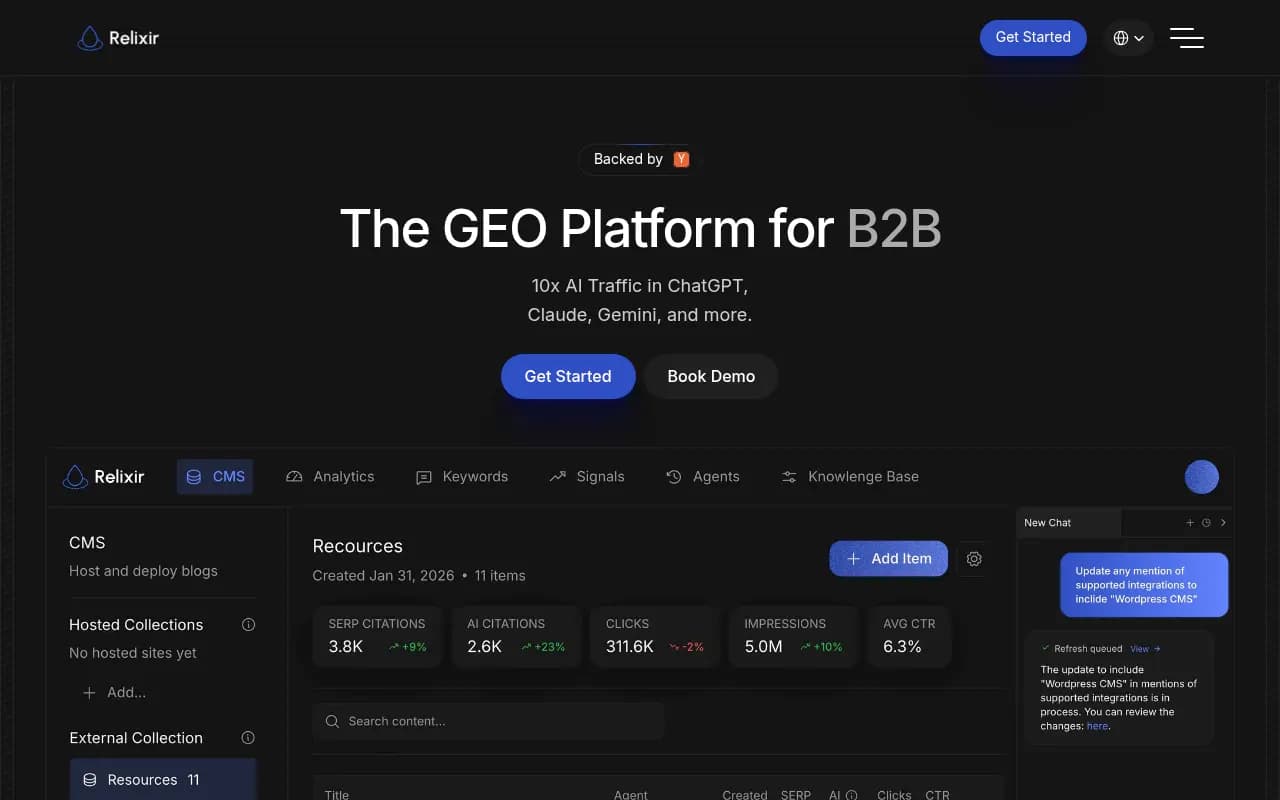
The content generation side is tied to its competitive analysis -- you can see where competitors are winning in AI search and generate content to target those same prompts. The interface is reasonably clean and the workflow from gap identification to content creation is more connected than you'd find in tools like Otterly.AI or Peec.ai.
Where it falls short compared to Promptwatch is depth of data. The citation database is smaller, there's no Reddit/YouTube tracking, and the crawler log functionality is limited. But for teams with a tighter budget or simpler needs, it's a solid option.
Who it's for: mid-market teams that want GEO monitoring and content generation without enterprise pricing.
3. Writesonic -- AI search visibility with content tools
Writesonic started as an AI writing tool and has since expanded into AI search visibility tracking. That history shows in the product -- the content generation side is genuinely good, and the writing quality is above average compared to most GEO-native tools that bolted on a writing feature.
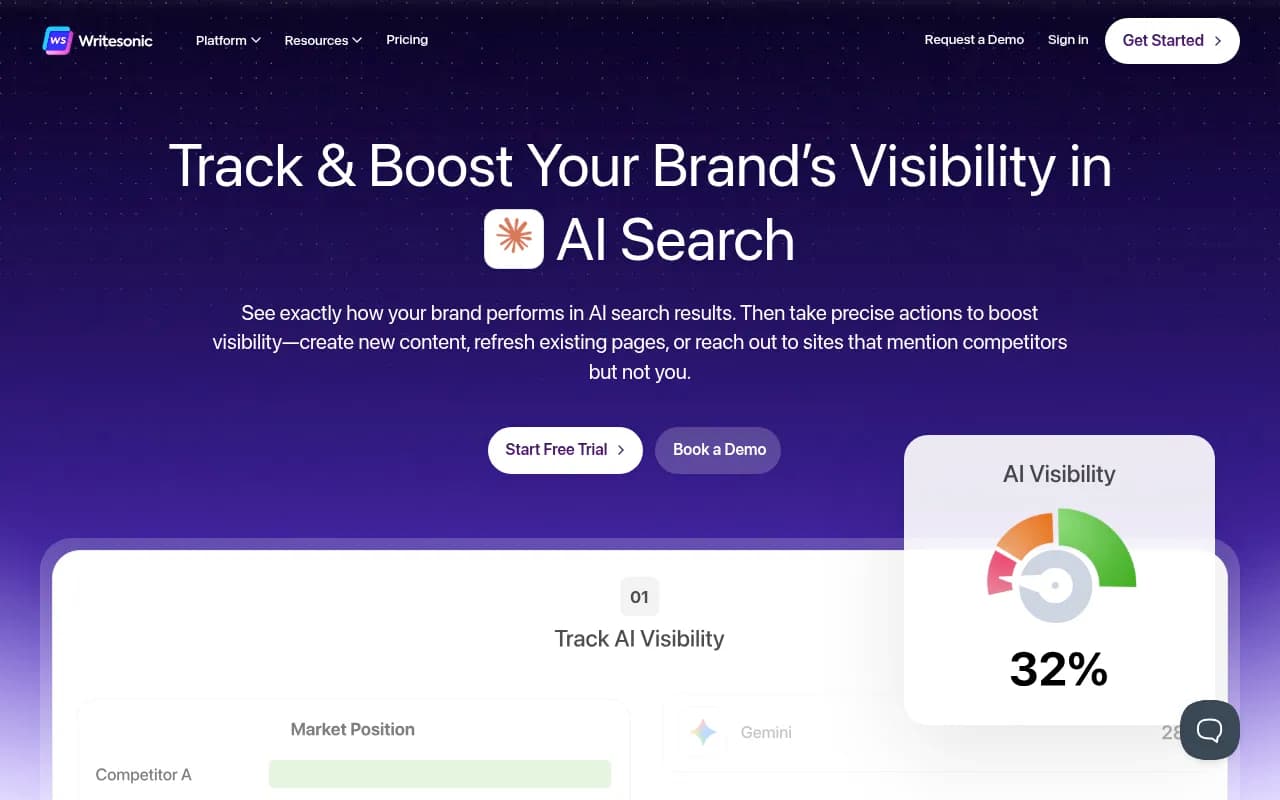
The AI search tracking covers major models and gives you visibility scores and competitor comparisons. The content generation is fast and handles multiple formats well (blog posts, FAQs, comparison pages). The integration between the two sides of the product has improved significantly in 2026 -- you can now generate content directly from visibility gap data rather than having to do it manually.
The limitation is that Writesonic's roots are in content creation, so the GEO analytics side is less sophisticated than a purpose-built platform. Prompt volume estimates, query fan-outs, and page-level citation tracking are areas where it's thinner.
Who it's for: content teams that already use Writesonic for writing and want to add AI search visibility without switching platforms.
4. SearchAtlas LLM visibility -- SEO automation with AI content
SearchAtlas has built a reputation in traditional SEO and has expanded its platform to include LLM visibility tracking and AI-driven content generation. The key differentiator here is the automation angle -- it doesn't just generate content, it deploys fixes and content directly.

For teams managing large sites, this matters. Instead of generating an article and then manually publishing it, SearchAtlas can push content into your CMS as part of an automated workflow. The LLM visibility tracking covers the major AI models and connects to the content side reasonably well.
The trade-off is complexity. SearchAtlas is a bigger, more complicated platform, and getting value from it requires more setup time than the other tools on this list. It's also priced accordingly.
Who it's for: enterprise SEO teams or large agencies that want automation at scale, not just a writing assistant.
5. Babylove Growth -- content automation with AI visibility tracking
Babylove Growth takes a different angle: it's primarily a content automation platform that has added AI visibility tracking, rather than a GEO platform that added content. It generates brand-aligned articles optimized for both Google and ChatGPT, automates publishing, plans 30-day content calendars based on ranking and citation trends, and builds contextual backlinks through a partner network.
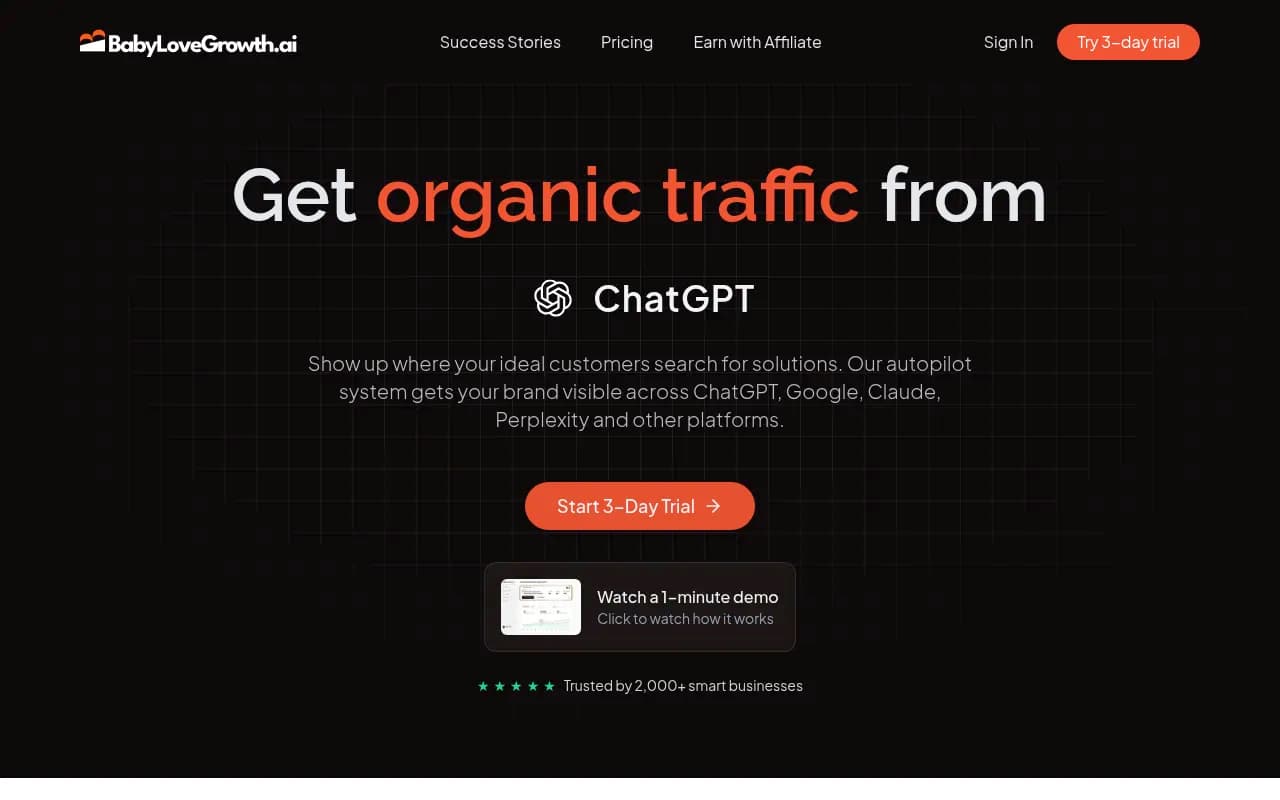
The AI visibility tracking covers ChatGPT and Perplexity brand mentions, and the platform runs technical GEO audits. It's not as deep on the analytics side as Promptwatch or Relixir, but the content automation is genuinely impressive -- if you want to publish a high volume of AI-optimized content without a large team, this is worth a look.
Multilingual support is also a standout feature, which matters for brands operating in multiple markets.
Who it's for: small to mid-size teams that want content production on autopilot with some AI visibility tracking baked in.
Comparison table
| Tool | Content generation | AI models tracked | Crawler logs | Reddit/YouTube tracking | Prompt volume data | Best for |
|---|---|---|---|---|---|---|
| Promptwatch | Yes -- gap-driven, citation-grounded | 10 | Yes | Yes | Yes | Full action loop: monitor, generate, track |
| Relixir | Yes -- tied to competitive analysis | Several | Limited | No | Partial | Mid-market teams wanting GEO + content |
| Writesonic | Yes -- strong writing quality | Major models | No | No | No | Content teams adding AI visibility |
| SearchAtlas | Yes -- automated deployment | Major models | Partial | No | Partial | Enterprise SEO with automation needs |
| Babylove Growth | Yes -- high-volume automation | ChatGPT, Perplexity | No | No | No | Content-first teams, multilingual markets |
| GetMint.ai | No | Several | No | No | Partial | Monitoring only |
How to choose
The honest answer is that it depends on where you are in the process.
If you're just starting to think about AI search visibility and want to understand where you stand before doing anything else, GetMint.ai or a simpler monitoring tool might be enough for now. There's no point paying for content generation features you're not ready to use.
If you already know you have visibility gaps and you want to fix them, you need a platform that connects the analysis to the action. That's where Promptwatch is the strongest option -- the gap analysis, content generation, and tracking are all built around the same data, so you're not stitching together three separate tools.
If content volume is your primary constraint (you need to publish a lot, fast), Babylove Growth's automation approach is worth evaluating. If you're already deep in the Writesonic ecosystem, the expanded GEO features might be enough to avoid switching.
The one thing I'd push back on is the idea that monitoring alone is a strategy. Knowing your competitors are visible in ChatGPT for prompts you're missing is useful information -- but only if you do something with it. The tools that help you act on that information are where the real value is in 2026.