Key takeaways
- Bluefish AI and Babylove Growth are solving adjacent problems but for completely different audiences. Bluefish is enterprise-only; Babylove Growth is built for SMBs and agencies.
- Pricing is the most dramatic difference: Babylove Growth starts at $99/month with a 3-day free trial. Bluefish AI starts at an estimated $4,000+/month and requires a sales demo just to see the product.
- Babylove Growth is primarily a content automation tool that layers in LLM visibility tracking. Bluefish AI is primarily a monitoring and influence platform that layers in optimization workflows.
- If you need automated article publishing, backlink building, and CMS integration, Babylove Growth does all of that out of the box. Bluefish AI does not.
- If you need enterprise infosec compliance, custom audience segmentation, agentic commerce tracking, or Fortune 500-grade data controls, Bluefish AI is the only option here.
- Neither tool is a perfect fit for mid-market teams who want deep AI visibility analytics plus content generation -- that gap is worth noting when you're evaluating options.
Overview
Bluefish AI
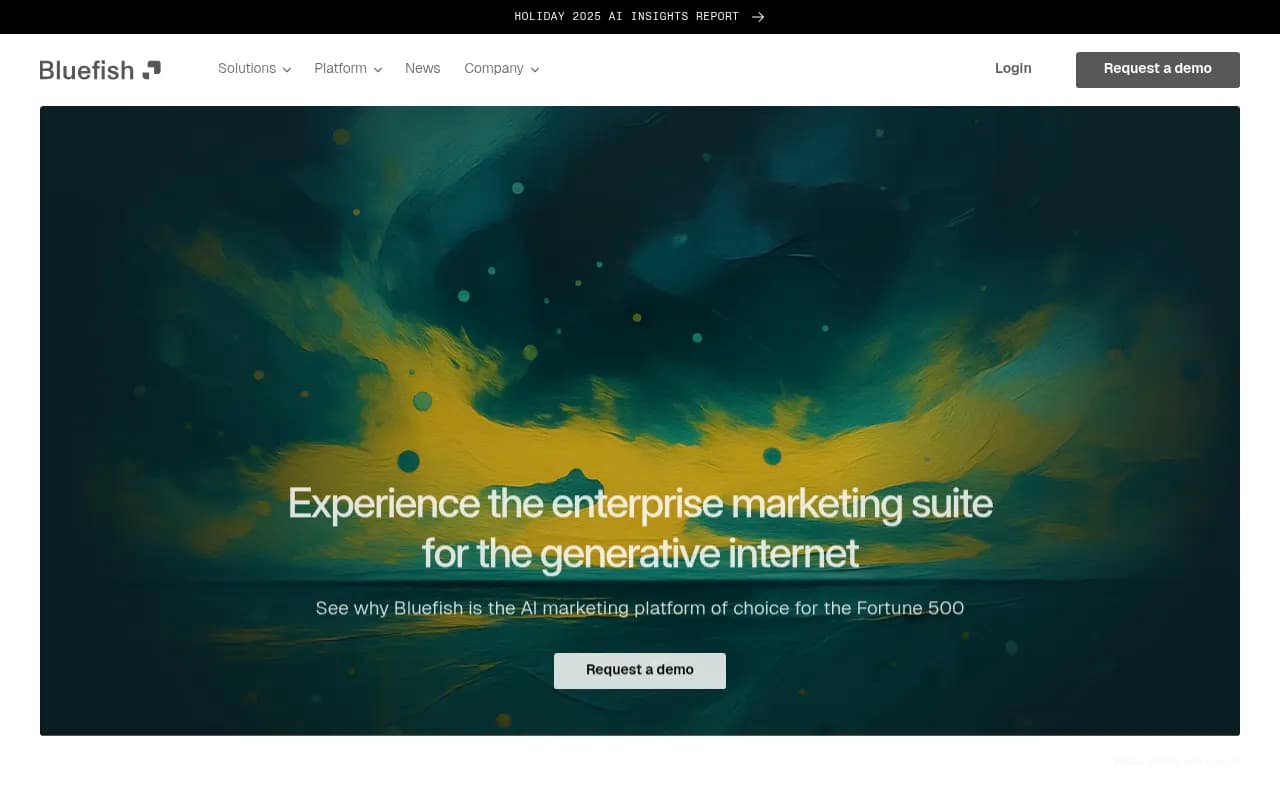
Bluefish AI positions itself as the AI marketing platform for the Fortune 500. The pitch is authority, influence, and control -- not just tracking where your brand shows up in AI responses, but understanding how AI models "think" about your brand and shaping that perception at scale. The platform covers AI monitoring, GEO optimization, measurement, and agentic commerce (think: product recommendations inside AI shopping flows). It's built to pass enterprise infosec reviews and offers deep customization for data teams. The catch is that none of this comes cheap or self-serve. You need to book a demo, go through a sales process, and budget for enterprise-level spend.
Babylove Growth
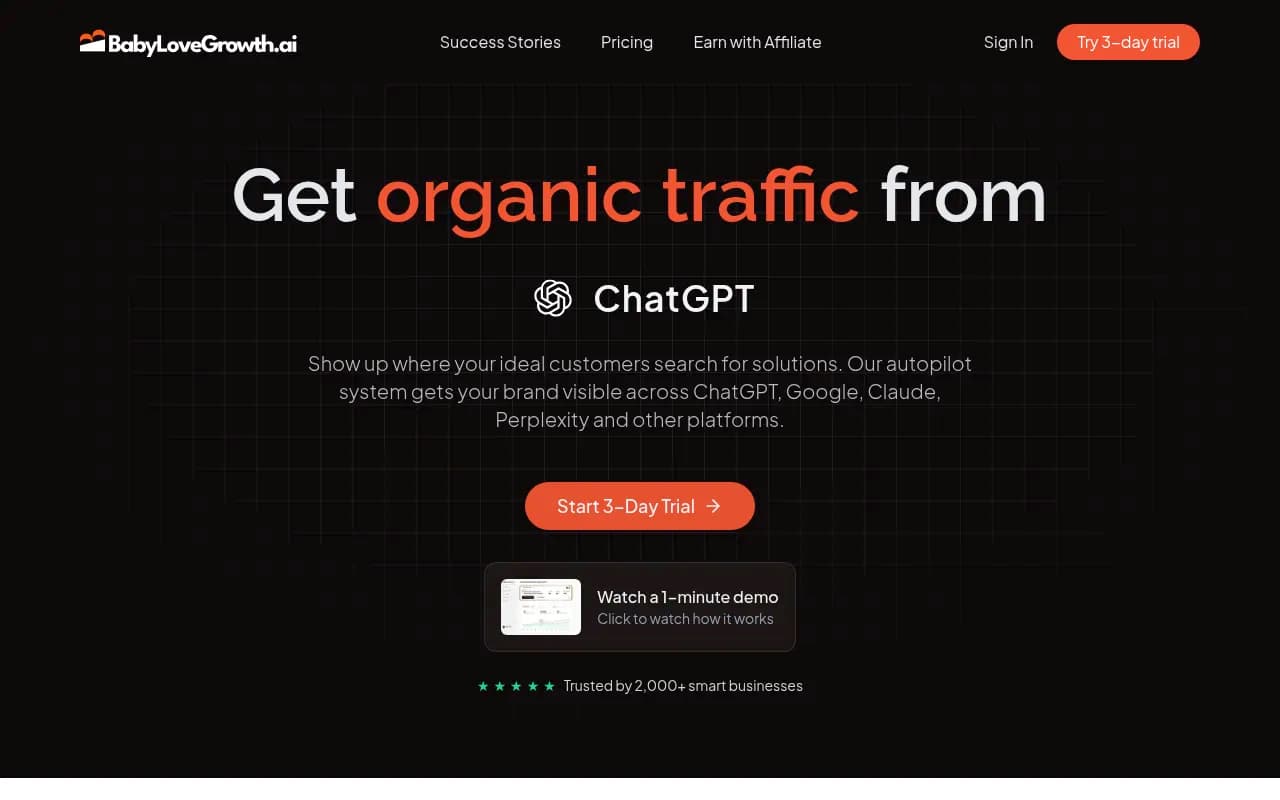
Babylove Growth takes a different angle entirely. It's an autopilot growth system: you connect your CMS, and it generates daily SEO articles optimized for both Google and LLMs like ChatGPT, Claude, and Perplexity. It builds backlinks through a client network, tracks your LLM visibility, runs a Reddit agent, and publishes content automatically. The whole thing is designed to run with minimal hands-on time. At $99/month (discounted from $247), it's accessible to solo founders, small marketing teams, and agencies running white-label operations. Over 2,000 businesses across 18 countries use it, and there are documented case studies showing brands ranking in ChatGPT within three months.
Side-by-side comparison
| Feature | Bluefish AI | Babylove Growth |
|---|---|---|
| Target audience | Fortune 500 / enterprise | SMBs, startups, agencies |
| Starting price | ~$4,000+/month (quote) | $99/month |
| Free trial | No (demo only) | 3-day free trial |
| AI models tracked | ChatGPT, Perplexity, Claude, Gemini, others | ChatGPT, Claude, Perplexity, Google + others |
| Content generation | No (optimization workflows, not writing) | Yes -- daily AI articles, 30/month |
| Automated publishing | No | Yes (WordPress, Webflow, Shopify, Wix, Ghost, Framer, API) |
| Backlink building | No | Yes -- cross-client network |
| LLM visibility tracking | Yes -- deep monitoring | Yes -- included in base plan |
| Agentic commerce tracking | Yes | No |
| Reddit tracking | No | Yes -- Reddit agent included |
| Custom audience segmentation | Yes | Limited |
| White-label / agency plan | No | Yes |
| Enterprise infosec compliance | Yes | Not specified |
| Pricing model | Custom / quote | Subscription (monthly) |
| Self-serve onboarding | No | Yes |
| CMS integration | Not specified | WordPress, Webflow, Shopify, Wix, Framer, Ghost, Snapps, API |
Head-to-head feature deep-dive
Pricing and accessibility
This is where the two tools diverge most sharply. Babylove Growth is self-serve: you start a 3-day trial, pick a plan, connect your CMS, and you're running. The base plan at $99/month includes 30 articles, 7+ backlinks, LLM tracking, a technical audit, and a Reddit agent. That's a lot of functionality for under $100.
Bluefish AI has no public pricing. You fill out a contact form, wait for a sales call, and go through a procurement process. Estimated spend is $4,000+/month for enterprise clients. That's not a criticism -- enterprise software often works this way -- but it means Bluefish AI is simply not an option for most businesses reading this.
Verdict: Babylove Growth wins on accessibility and price by a wide margin. Bluefish AI is only viable if you have an enterprise budget and a procurement team.
Content creation and publishing
Babylove Growth is, at its core, a content machine. It analyzes your business, builds a 30-day content plan, writes daily branded articles in your tone, and publishes them automatically to your CMS. It checks which article formats LLMs cite most and optimizes accordingly. The backlink network is a nice addition -- links are placed naturally within other clients' blogs, which is a low-risk approach compared to traditional link schemes.
Bluefish AI does not do content generation. It's focused on monitoring your existing presence and optimizing workflows around that data. If you need to create content that ranks in AI search, you'd need a separate tool.
Verdict: Babylove Growth wins here outright. Content creation isn't part of Bluefish AI's offering.
AI monitoring depth
Bluefish AI's monitoring is built for enterprise complexity. It tracks brand reputation and performance across AI-native experiences in real time, with custom audiences, tailored prompts, and deep segmentation. The "Collections" feature (launched February 2026) measures the ROI of digital marketing campaigns in the AI channel specifically -- useful for large brands running paid media and wanting to see how it influences AI recommendations. The Super Bowl ad research they published is a good example of the depth they're going for.
Babylove Growth's LLM tracking is more straightforward. You see where your brand appears across the major AI models, and the system uses that data to inform content strategy. It's functional for most SMB needs but lacks the granular control and custom segmentation that enterprise teams require.
Verdict: Bluefish AI wins on monitoring depth. For enterprise brands that need custom audiences and campaign-level attribution in AI channels, there's no comparison.
Agentic commerce and AI shopping
Bluefish AI explicitly covers "AI Commerce" -- tracking and optimizing for agentic shopping flows where AI models recommend products directly. This is a real and growing channel, especially as ChatGPT and Perplexity roll out shopping features. For e-commerce brands or consumer product companies, this is a meaningful differentiator.
Babylove Growth doesn't mention agentic commerce tracking. Its focus is on organic content visibility, not product recommendation flows.
Verdict: Bluefish AI wins here. If AI shopping is a priority for your business, Babylove Growth doesn't address it.
Agency and white-label use
Babylove Growth has a dedicated white-label agency plan. One agency testimonial on their site mentions onboarding 15 new clients in two months using the automated system. The whole workflow -- analysis, content, publishing, backlinks -- can run under your agency's brand.
Bluefish AI is designed for in-house enterprise marketing teams. There's no white-label offering, and the sales-led model doesn't lend itself to agency reselling.
Verdict: Babylove Growth wins for agencies. It's purpose-built for that use case.
Reddit and community tracking
Babylove Growth includes a Reddit agent in its base plan. Reddit is increasingly influential in AI responses -- ChatGPT and Perplexity frequently cite Reddit threads, so tracking and engaging with relevant discussions matters.
Bluefish AI doesn't mention Reddit tracking in its feature set. Given its enterprise focus, this may be less relevant for Fortune 500 brands, but it's a gap worth noting.
Verdict: Babylove Growth wins here. Reddit's influence on LLM citations is real, and having an agent built in is useful.
Enterprise controls and compliance
Bluefish AI explicitly calls out that it "consistently passes infosec reviews with ease" and gives data teams more ways to customize, segment, and optimize. For large organizations with security requirements, vendor review processes, and data governance needs, this matters a lot.
Babylove Growth doesn't address enterprise security or compliance. It's a SaaS product with standard integrations -- fine for most small businesses, but not something you'd put through a Fortune 500 procurement review.
Verdict: Bluefish AI wins for enterprise compliance requirements.
Pricing comparison
| Plan | Bluefish AI | Babylove Growth |
|---|---|---|
| Free trial | No | 3-day trial |
| Entry plan | ~$4,000+/month (estimated) | $99/month (30 articles, 7+ backlinks, LLM tracking, Reddit agent, technical audit) |
| Mid-tier | Custom | Not publicly listed (agency plan available) |
| Enterprise / agency | Custom quote | Agency white-label plan (contact for pricing) |
| Pricing model | Quote-based, sales-led | Self-serve subscription |
| Annual discount | Not specified | Not specified |
The price gap here is roughly 40x at the entry level. That's not a rounding error -- these are genuinely different products for different markets.
Pros and cons
Bluefish AI
Pros:
- Deep enterprise monitoring with custom audiences and segmentation
- Agentic commerce tracking -- a feature most competitors lack
- Built to pass enterprise infosec and procurement reviews
- Campaign-level ROI measurement in the AI channel (Collections feature)
- Backed by research and Fortune 500 client base
Cons:
- No public pricing -- requires a sales process just to evaluate
- Estimated $4,000+/month puts it out of reach for most businesses
- No content generation or automated publishing
- No self-serve trial
- No white-label or agency offering
- No Reddit tracking
Babylove Growth
Pros:
- $99/month with a 3-day free trial -- genuinely accessible
- Automated content generation and CMS publishing
- Backlink building included in base plan
- Reddit agent included
- White-label agency plan available
- Works across 18 countries, 2,000+ businesses
- Documented case studies (Myhair.ai ranking in ChatGPT within 3 months)
Cons:
- Monitoring is functional but not enterprise-grade
- No agentic commerce tracking
- No custom audience segmentation
- Content quality depends on AI generation -- may need human review
- Not suitable for enterprise infosec requirements
- Less depth for brands that need granular LLM analytics
Who should pick which tool
Pick Bluefish AI if:
- You're at a large enterprise or Fortune 500 brand with a marketing budget to match
- You need to pass infosec and vendor security reviews
- Agentic commerce and AI shopping tracking is a priority
- You need custom audience segmentation and campaign-level attribution in AI channels
- You have a dedicated data team that needs deep customization options
Pick Babylove Growth if:
- You're an SMB, startup, or agency with a limited budget
- You need content creation and automated publishing, not just monitoring
- You want to start quickly with a self-serve trial
- You're running an agency and want white-label AI content and visibility tools
- Reddit visibility and backlink building matter to your strategy
Neither is a great fit if:
- You're a mid-market brand that needs both deep AI visibility analytics and content generation in one platform. Bluefish AI is too expensive and doesn't write content; Babylove Growth's monitoring isn't deep enough for complex needs. In that case, it's worth looking at platforms like Promptwatch that combine prompt intelligence, answer gap analysis, AI content generation, and crawler log monitoring in a single workflow.

Final verdict
Bluefish AI and Babylove Growth are not really competing for the same customers. Bluefish AI is an enterprise intelligence platform for brands with the budget and complexity to justify it. Babylove Growth is an automated growth tool for businesses that want to show up in AI search without hiring a full content team. If you're a Fortune 500 brand, Babylove Growth won't meet your needs. If you're a $99/month SMB, Bluefish AI isn't even an option. Pick based on your actual budget and what you need the tool to do -- monitoring and influence versus content creation and automation -- and the choice becomes straightforward.