Key takeaways
- Surfer SEO is the closest direct competitor to ContentMonk for SEO-focused content creation -- stronger SERP analysis, weaker on brand voice and content ops.
- Clearscope wins on content optimization depth and topical authority tracking, but it's expensive and doesn't generate content natively.
- Frase is the best budget pick for teams that need research + writing in one place, starting at $39/mo.
- Jasper is the right call for large marketing teams running multi-channel campaigns at scale, though the price jumps fast.
- AirOps is built for teams that want to win AI search specifically -- content engineering for GEO, not just SEO.
- Promptwatch is the right choice if your goal is to understand and improve how AI models like ChatGPT, Claude, and Perplexity actually cite your brand -- it goes beyond content creation into full AI visibility optimization.
ContentMonk does a few things well: it keeps brand voice consistent, handles content ops (briefs, team workflows, repurposing), and promises to multiply your output without the generic AI feel. For smaller marketing teams and agencies that need a structured content pipeline, it's a solid tool.
But people look for alternatives for a few common reasons. The pricing isn't transparent -- "custom pricing" with a Pro plan "starting around $59-69/mo per seat" is vague enough to cause friction. The SEO optimization features, while present, aren't as deep as dedicated tools like Surfer or Clearscope. And if your priority has shifted toward AI search visibility (getting cited by ChatGPT, Perplexity, or Gemini), ContentMonk's traditional SEO focus may leave a gap. There's also the question of scale: teams that need to publish hundreds of articles per month may find ContentMonk's workflow limiting compared to platforms built for volume.
Here's a clear-eyed look at the best alternatives.
The alternatives
Promptwatch

ContentMonk helps you create content. Promptwatch helps you make sure that content actually gets seen -- specifically by AI models.
This is a different category, but it's worth putting first because the search landscape has genuinely changed. If you're writing blog posts and optimizing for Google but not tracking whether ChatGPT, Claude, or Perplexity are citing your pages, you're missing a growing slice of discovery traffic.
Promptwatch tracks your brand's visibility across 10+ AI models, shows you which prompts competitors are appearing in that you're not, and then -- this is the key difference from most monitoring tools -- helps you fix it. The Answer Gap Analysis identifies exactly which topics and questions your site isn't answering, and the built-in AI writing agent generates content specifically engineered to get cited by AI engines, drawing on 880M+ citations analyzed.
Where ContentMonk focuses on content operations and brand voice, Promptwatch focuses on the full AI visibility loop: find gaps, create content, track results. It also has crawler logs showing which AI bots are hitting your site, Reddit and YouTube citation tracking, and ChatGPT Shopping monitoring -- none of which ContentMonk touches.
Pricing starts at $99/mo (Essential: 1 site, 50 prompts, 5 articles), $249/mo (Professional), $579/mo (Business). There's a 7-day free trial.
Best for: Marketing and SEO teams who want to understand and improve their visibility in AI search engines, not just traditional Google rankings.
Surfer SEO
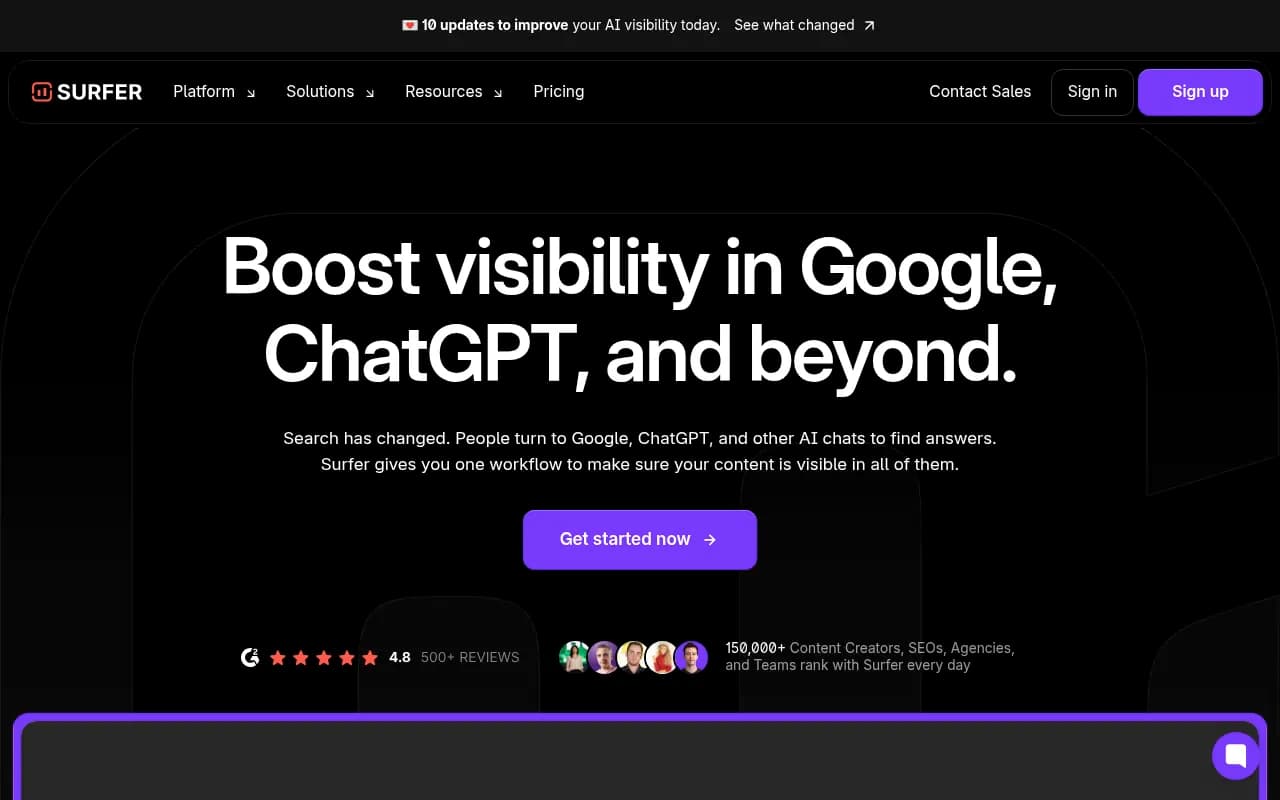
Surfer is probably the most direct competitor to ContentMonk for teams whose primary goal is ranking in Google. It analyzes the top-ranking pages for any keyword and gives you real-time optimization suggestions as you write -- word count targets, NLP terms to include, heading structure, internal linking. The content editor is genuinely good.
Compared to ContentMonk, Surfer is stronger on the SEO data side. The SERP analysis is more detailed, the keyword research is more actionable, and the optimization scoring gives writers clear targets. ContentMonk's brand voice preservation is more developed, though -- Surfer's AI writing tends to feel more generic.
Surfer has also been expanding into AI search optimization, with features aimed at ChatGPT and other AI platforms. It's not as deep as dedicated GEO tools, but it's moving in that direction.
The pricing is clear: $99/mo for 30 articles (Essential), up to $399/mo for 300 articles (Max). That's more expensive than ContentMonk's entry point but more transparent.
One honest trade-off: Surfer's interface has a learning curve. There's a lot of data, and newer writers sometimes get paralyzed by the optimization scores rather than just writing.
Best for: SEO-focused content teams that want strong SERP analysis and optimization scoring, and don't need heavy content ops or repurposing features.
Clearscope

Clearscope is the premium option in this space. It's used by content teams at companies like HubSpot and Shopify, and the reason is simple: the content optimization reports are thorough. You get keyword grading, competitor analysis, readability scoring, and topical coverage suggestions that go deeper than most tools.
The newer version of Clearscope has expanded into AI search tracking -- monitoring visibility in ChatGPT and Gemini -- and topical authority mapping. The "Topic Explorations" feature helps you build content clusters rather than chasing individual keywords.
Where it falls short compared to ContentMonk: Clearscope doesn't generate content natively in a meaningful way. It's an optimization and research tool, not a writing platform. You bring your draft, it tells you how to improve it. ContentMonk's end-to-end workflow (brief to draft to publish) is more complete.
The price is also a real consideration. $189/mo for the Essentials plan is steep if you're a small team or freelancer. ContentMonk is cheaper for what you get in terms of writing output.
Best for: Established content teams that already have writers and want the best-in-class optimization layer, and can afford the premium.
Frase
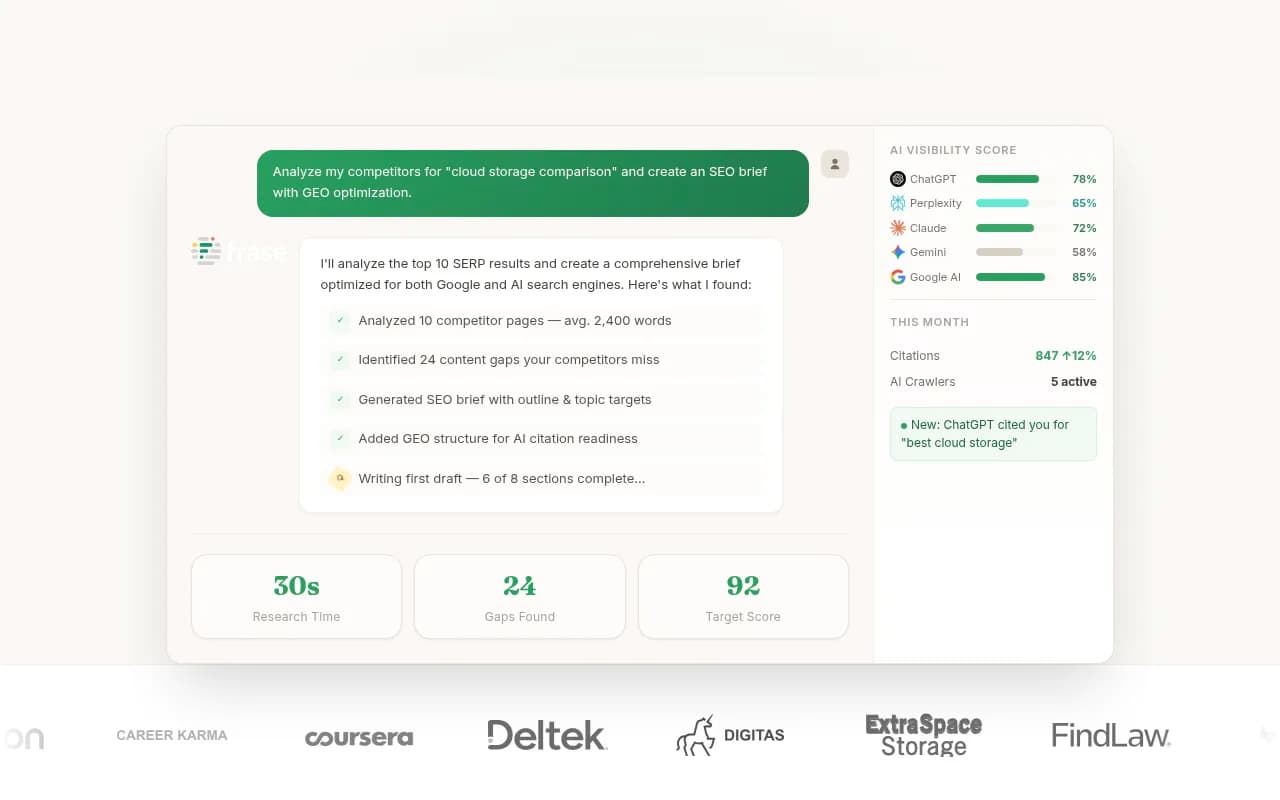
Frase has quietly become one of the better all-in-one options for content teams that want research, brief creation, writing, and optimization without paying Clearscope prices. The SERP research is solid -- it pulls the top results for your target keyword and summarizes what they cover, which makes brief creation fast.
The AI writing is decent but not exceptional. It's better than a blank page, but you'll want to edit heavily. The optimization scoring (similar to Surfer's) is useful without being overwhelming.
Frase has also been adding GEO features -- tracking visibility in ChatGPT and Perplexity -- which puts it in interesting territory. It's not as deep as dedicated GEO platforms, but for teams that want one tool covering traditional SEO and some AI search visibility, it's worth a look.
Compared to ContentMonk, Frase is weaker on brand voice and content ops (no team knowledge base, no repurposing workflows). But it's significantly cheaper: $39/mo for the Solo plan, $114/mo for 3 users. That's a meaningful difference for smaller teams.
Best for: Solo content creators and small teams that want research + writing + basic optimization in one affordable tool.
Copy.ai
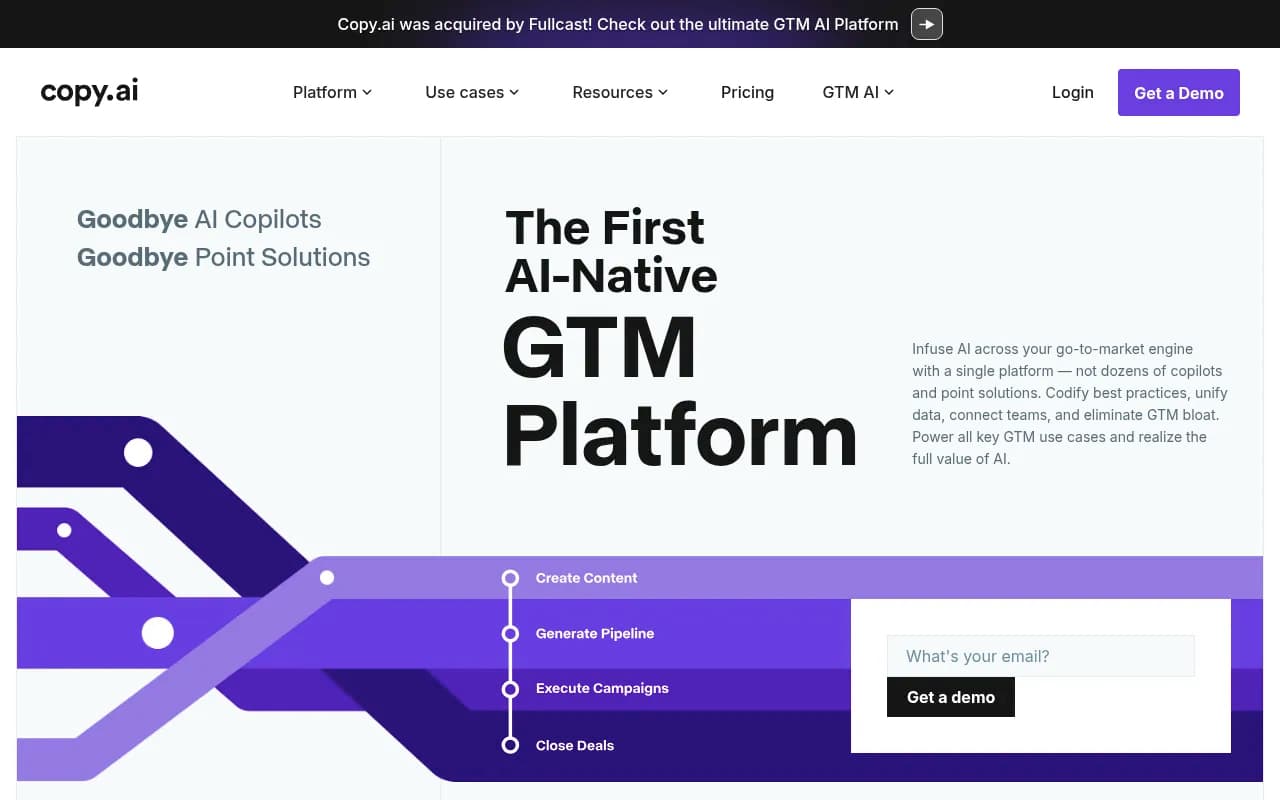
Copy.ai has pivoted hard away from being a writing tool and toward being a "GTM AI Platform" -- go-to-market automation, sales workflows, marketing pipelines. If you're looking for a ContentMonk alternative specifically for blog content and SEO, Copy.ai is probably not the right fit anymore.
That said, if your team needs AI automation across multiple marketing functions (email sequences, ad copy, sales outreach, content), Copy.ai's workflow builder is genuinely powerful. The "Workflows" feature lets you chain AI tasks together in ways that ContentMonk doesn't support.
The pricing reflects the enterprise pivot: the Pro plan is $249/mo (10k credits), and serious enterprise use starts around $1,000-2,000/mo. That's a different budget conversation than ContentMonk.
Best for: Revenue and marketing ops teams that need AI automation across the full GTM stack, not just content creation.
Jasper
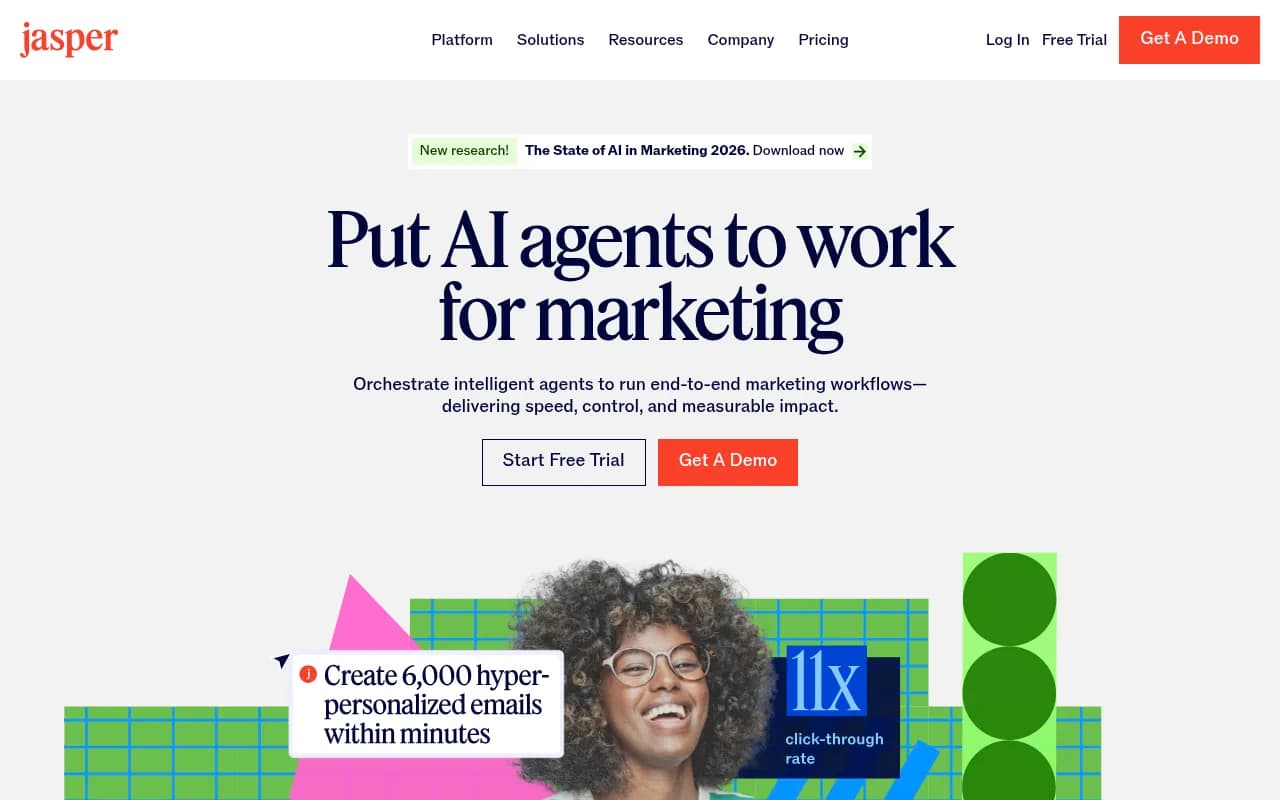
Jasper is the most mature AI writing platform in this list. It's been around longer than most competitors, and the brand voice features -- "Brand IQ," style guides, visual guidelines -- are genuinely sophisticated. If ContentMonk's brand voice preservation is a key reason you're using it, Jasper does this at a higher level.
The "Agents" and "Content Pipelines" features are designed for large marketing teams running campaigns across multiple channels. You can set up repeatable workflows for blog posts, social content, email, and ads -- all governed by your brand rules.
The downside is complexity and cost. Jasper's interface has a lot going on, and the Business plan (where the real power lives) starts around $500-1,000/mo. The Creator plan at $49/mo is limited enough that it's not a fair comparison to ContentMonk's full feature set.
Compared to ContentMonk, Jasper is better for enterprise teams with complex brand governance needs. It's overkill for a 3-person marketing team.
Best for: Enterprise marketing teams that need sophisticated brand governance, multi-channel content pipelines, and can justify the price.
Writesonic
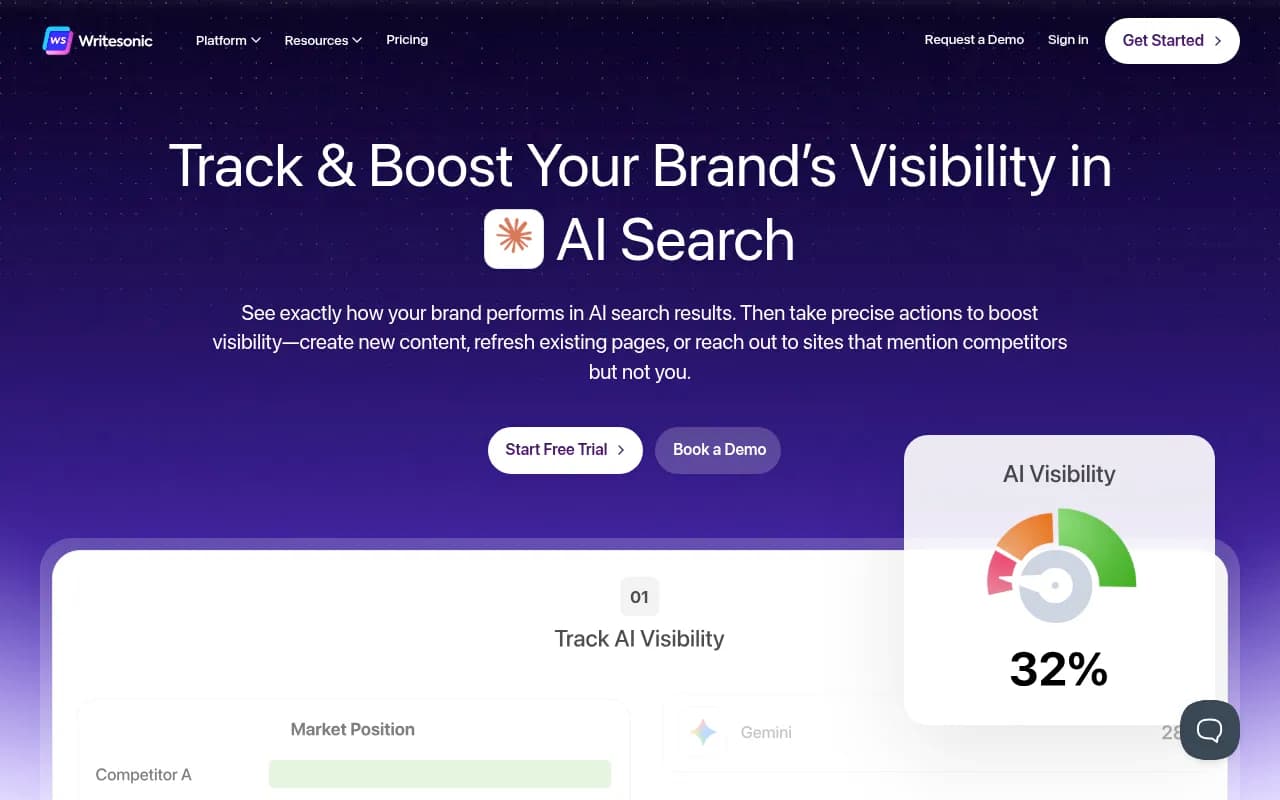
Writesonic has made an interesting pivot -- it's now positioning itself as an AI search visibility platform, not just a writing tool. The current product tracks brand mentions across ChatGPT, Perplexity, Gemini, and 10+ AI engines, identifies citation gaps, and helps you create content to fix them.
This puts Writesonic in a different category than ContentMonk. If you're looking for a writing tool with SEO features, Writesonic's older product did that well. The new direction is more GEO-focused -- closer to what Promptwatch does than what ContentMonk does.
The writing features are still there, and the $49/mo Lite plan makes it accessible. But the product identity is in transition, which means the experience can feel inconsistent depending on which features you're using.
Best for: Teams that want a budget-friendly entry point into AI search visibility tracking combined with content creation, and don't need deep content ops features.
AirOps
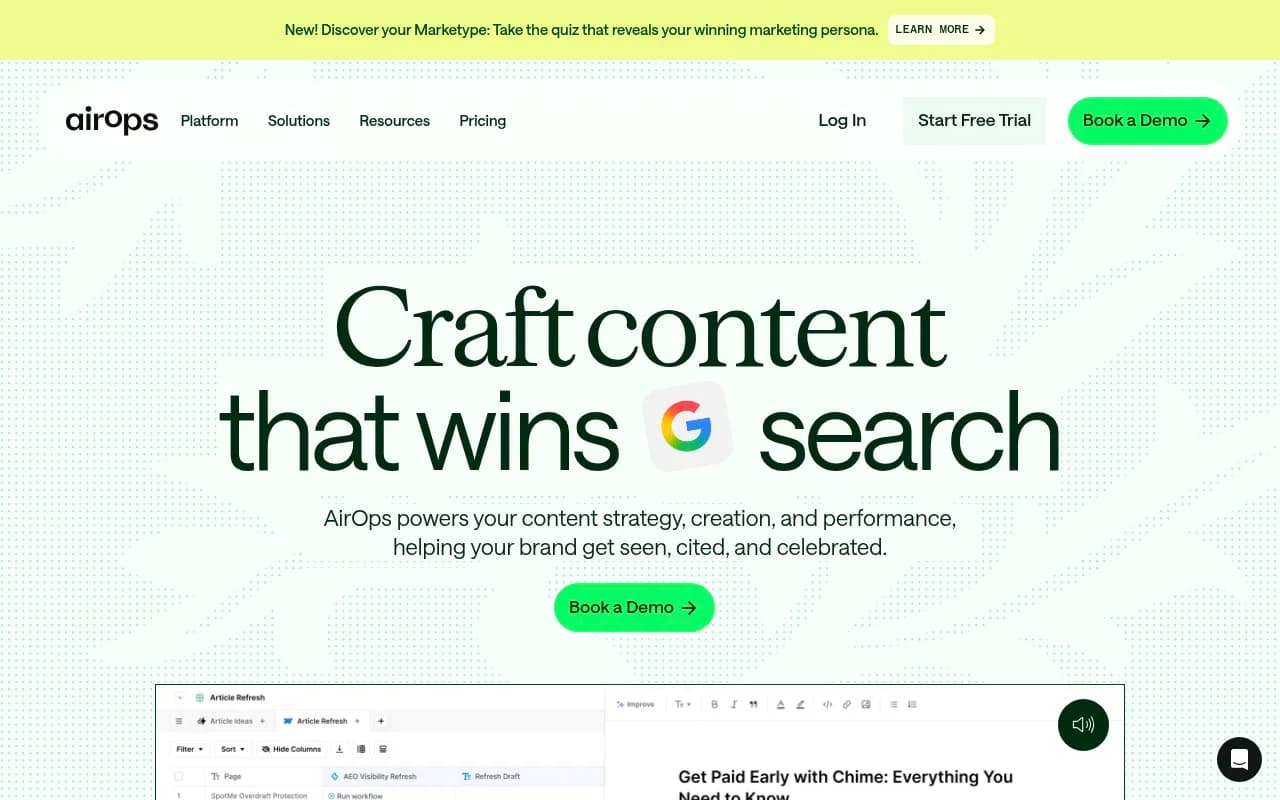
AirOps is the most GEO-native platform in this comparison. It's built specifically around "content engineering for AI search" -- the idea that winning citations in ChatGPT and Perplexity requires a different approach than traditional SEO content.
The platform helps you build content strategies based on what AI models are actually citing, create content optimized for those citation patterns, and track the results. Case studies from Webflow (5x content refresh velocity, 6% increase in AI-attributed signups) and Chime (3x increase in AI search citations) show real outcomes.
Compared to ContentMonk, AirOps is less focused on brand voice and content ops, and more focused on the technical side of AI search optimization. The workflow automation is more powerful, but the learning curve is steeper.
Pricing starts at $200/mo (Solo) and goes to $2,000/mo (Pro), with enterprise pricing above that. It's not cheap, and the per-task costs add up. ContentMonk is more affordable for teams that just need to produce good content consistently.
Best for: Growth and SEO teams at mid-to-large companies that are specifically trying to win AI search citations and can invest in a more technical platform.
Content at Scale (BrandWell)

Content at Scale has rebranded as BrandWell and made a significant pivot -- it's now primarily a B2B intent data and ABM platform that also does content. The "RankWell" content features are still there, but the main pitch is now about identifying who's researching your competitors and surrounding them with ads.
If you came to ContentMonk for content creation and SEO, BrandWell's new direction is probably not what you're looking for. The content features work, but they're no longer the focus.
That said, if you're at a B2B company and want to combine content production with intent data (who's visiting your site, who's researching competitors), BrandWell is doing something genuinely different. The 7-day free trial lets you test both sides.
Best for: B2B marketing teams that want to combine content production with intent data and ABM -- not for teams whose primary need is content ops or SEO writing.
Outrank
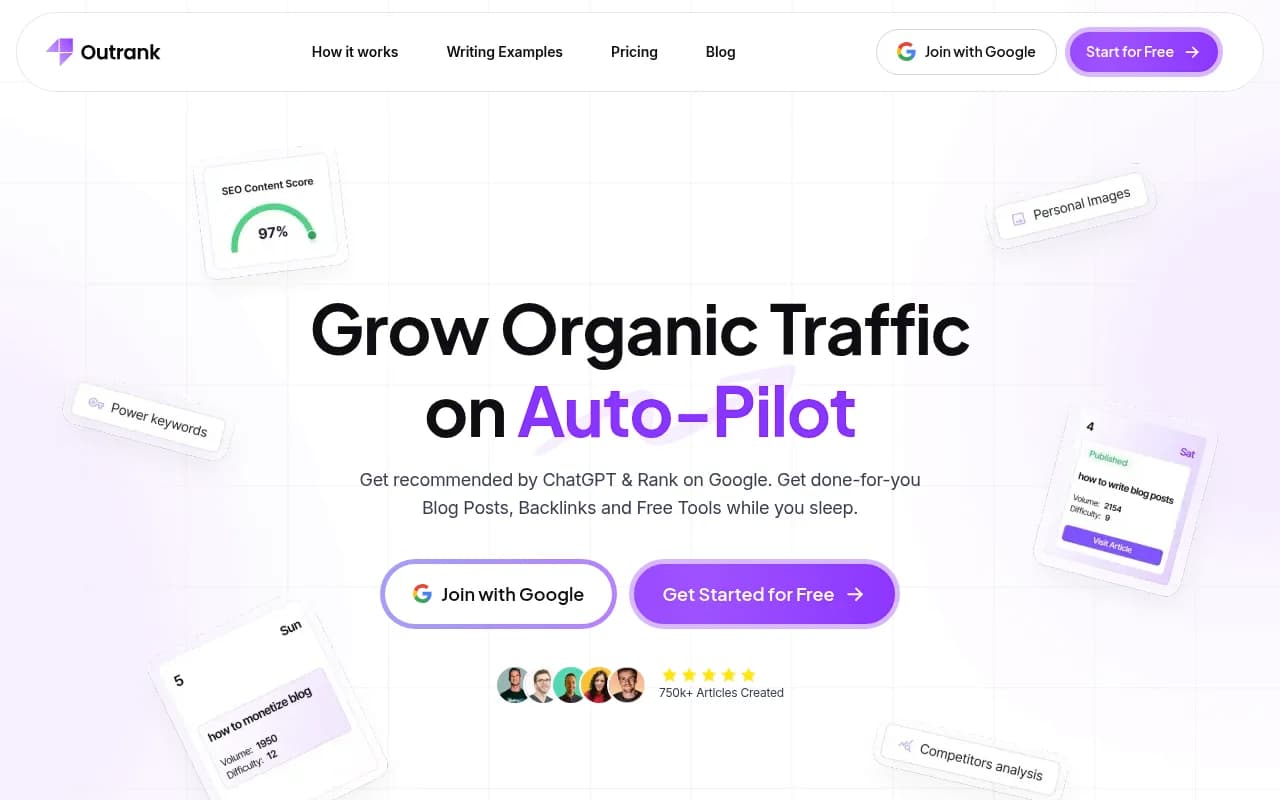
Outrank is the most hands-off option in this list. The pitch is simple: connect your site, and it generates and publishes daily blog posts automatically, builds backlinks through a user exchange network, and handles keyword research. You don't have to do much.
That's also the limitation. The content is automated, which means it's unlikely to preserve your brand voice or produce the kind of differentiated, insight-driven articles that ContentMonk is designed for. The backlink exchange network is a gray-area tactic that some SEOs are uncomfortable with.
Where Outrank makes sense is for founders and small businesses that want some organic traffic without dedicating time to content. The $99/mo All-in-One plan (after a $1 trial) is affordable. But if content quality and brand voice matter to you, Outrank's automation-first approach is a poor substitute for ContentMonk.
Best for: Founders and small businesses that want hands-free SEO content and don't need high editorial quality or brand voice consistency.
How to choose
The right ContentMonk alternative depends on what's actually missing for you.
If ContentMonk's SEO optimization isn't deep enough, go with Surfer SEO or Clearscope. Surfer if you want to write and optimize in one place; Clearscope if you want the most thorough optimization reports and already have writers.
If the price is the issue and you need a simpler tool, Frase at $39/mo covers research, briefs, and writing without the complexity.
If you need enterprise-grade brand governance and multi-channel campaign workflows, Jasper is the more mature platform -- just expect to pay for it.
If your real goal is winning citations in AI search engines (not just Google rankings), AirOps or Promptwatch are the tools built for that. AirOps is more focused on content engineering; Promptwatch covers the full loop from tracking to gap analysis to content generation to traffic attribution.
If you're a B2B company and want to layer intent data on top of content, BrandWell is doing something no one else in this list is doing.
And if you just want something that runs on autopilot without much input, Outrank is the lowest-friction option -- with the quality trade-offs that implies.
ContentMonk's sweet spot is teams that care about brand voice, need structured content ops, and want to repurpose content across formats. If that's not your priority, most of the alternatives above will serve you better in their respective areas.