Key takeaways
- SE Ranking is a full SEO suite that added AI visibility tracking as a module -- great if you want one platform for rankings, backlinks, and AI monitoring together
- Searchable is a niche brand monitoring tool focused on tracking how you appear in AI-generated answers, but stops short of helping you improve
- Promptwatch is the only one of the three built around an optimization loop: find gaps, generate content, track results -- it's an action platform, not just a dashboard
- If your primary goal is improving AI search visibility rather than just watching it, the tool you pick matters a lot
- All three have meaningfully different pricing, depth, and target audiences -- the right choice depends on where you are in your AI visibility journey
The AI search question has moved from "should we care?" to "how do we actually win?" ChatGPT crossed 900 million weekly active users in early 2026. Google AI Overviews now appear across a significant share of high-intent queries. Perplexity has carved out the research segment. When a buyer asks one of these systems "what's the best [your category] tool?", your Google ranking is irrelevant -- what matters is whether the AI mentions you at all.
That shift has created a new category of tools: AI visibility platforms. But they're not all built the same way. Some are extensions of existing SEO suites. Some are standalone monitoring dashboards. And a small number are actually built to help you do something about what you find.
This guide breaks down three tools that represent three different philosophies: SE Ranking (broad SEO coverage with AI features bolted on), Searchable (focused AI brand monitoring), and Promptwatch (end-to-end AI visibility optimization). Understanding the difference will save you from paying for the wrong thing.
What problem are we actually solving?
Before comparing tools, it's worth being precise about the problem. Traditional SEO tools track your position in Google's ten blue links. That's still important. But it tells you nothing about what ChatGPT says when someone asks for a recommendation in your category.
AI visibility tools fill that gap by systematically querying AI models with prompts your potential customers use, then analyzing the responses. The questions you want answered:
- Is your brand being mentioned at all?
- Which pages are being cited?
- How do you compare to competitors across different AI models?
- What topics are competitors getting cited for that you're not?
- What content do you need to create to close those gaps?
The first four questions are monitoring. The fifth is optimization. Most tools do monitoring. Few do optimization. That distinction is the core of this comparison.
SE Ranking: the SEO suite that grew into AI visibility
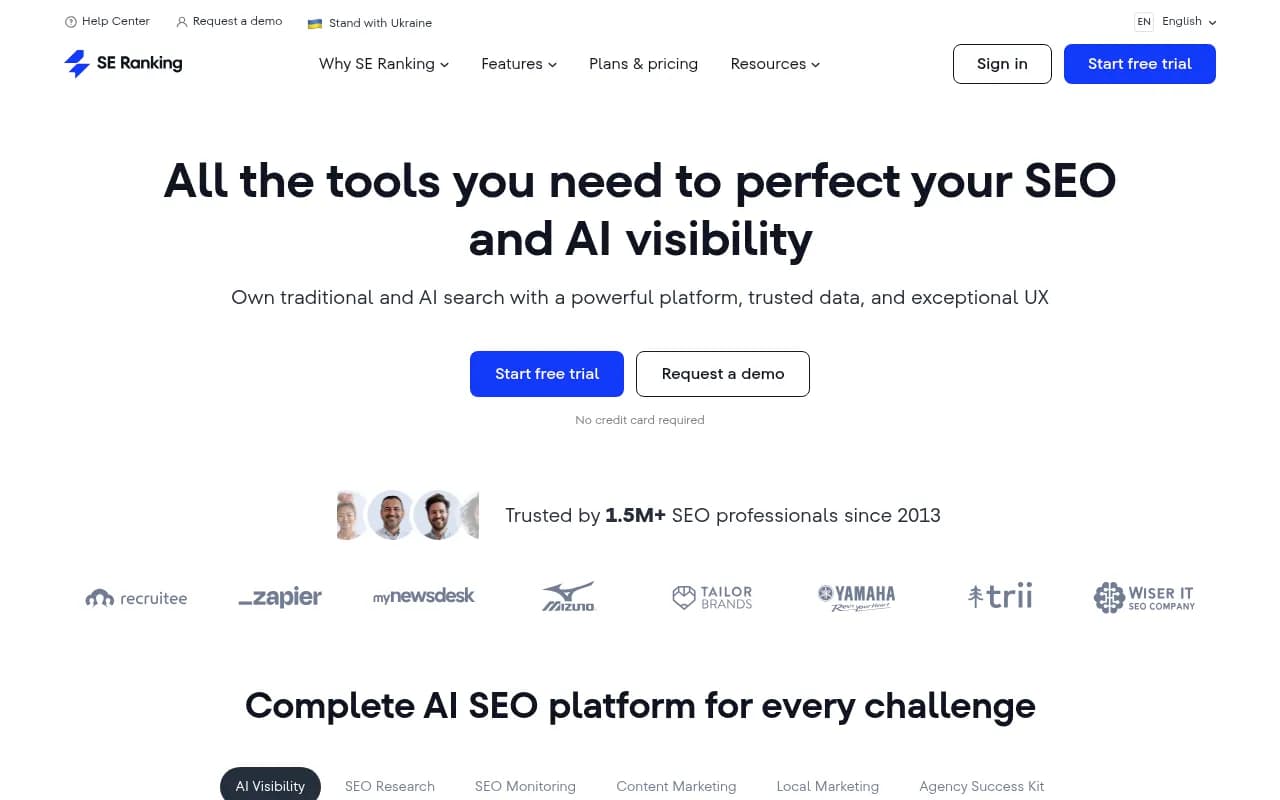
SE Ranking has been a well-regarded mid-market SEO platform for years. It covers keyword research, rank tracking, backlink analysis, site audits, and competitive research -- the full traditional SEO stack. In 2025-2026, it expanded into AI visibility through its SE Visible integration.
What SE Ranking does well
The core SEO toolset is genuinely strong. For teams managing both organic rankings and AI search visibility from a single platform, SE Ranking makes a reasonable case. You're not paying for two separate subscriptions, and the data lives in one place.
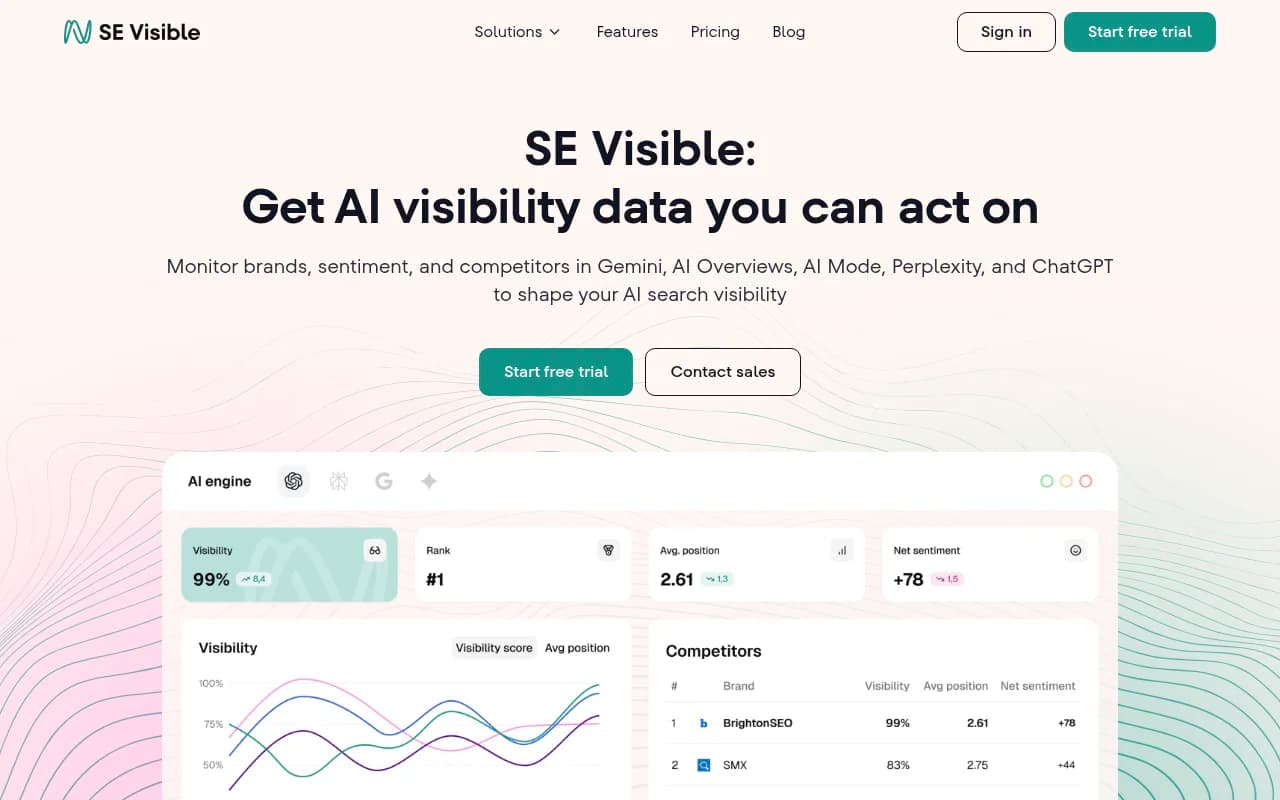
SE Visible, the AI visibility component, tracks brand mentions across AI models including ChatGPT, Perplexity, and Google AI Overviews. It shows mention frequency, sentiment, and competitive share of voice. The interface is clean and the reporting is solid.
For agencies managing multiple clients, SE Ranking's scalability is a real advantage. The platform is built for multi-account workflows in a way that some dedicated AI visibility tools aren't.
Where SE Ranking falls short
The AI visibility features feel like an add-on, because they are. The depth you get from a dedicated AI visibility platform -- crawler logs, prompt volume data, query fan-outs, page-level citation tracking, content gap analysis -- isn't there. SE Visible shows you that you're being mentioned (or not), but it doesn't tell you what to do about it.
If your team is already deep in traditional SEO and wants a basic AI visibility layer without adding another tool, SE Ranking is a reasonable choice. If AI visibility is your primary concern, you'll likely outgrow it.
Pricing sits in the mid-range. The AI visibility features are available on higher-tier plans, which means the effective cost for full access is higher than the entry price suggests.
Searchable: focused AI brand monitoring
Searchable is a dedicated AI visibility tool focused specifically on tracking how brands appear in AI-generated answers. It's narrower in scope than SE Ranking -- no traditional SEO features -- but more focused on the AI monitoring problem.
What Searchable does well
The focus shows in the product. Searchable tracks brand mentions across multiple AI models and presents the data in a clean, accessible way. For teams that want a simple answer to "are we being mentioned in AI search?", it gets the job done without overwhelming complexity.
The setup is fast. You're not configuring a full SEO platform; you're pointing the tool at your brand and competitors and letting it run.
Where Searchable falls short
Searchable is a monitoring tool. It shows you data. What it doesn't do is help you act on that data. There's no content gap analysis, no AI writing capabilities, no crawler logs to understand how AI bots are reading your site, no prompt volume data to help you prioritize. You see the problem; you figure out the solution yourself.
For teams that already have strong content operations and just need visibility data to feed into their existing workflow, that's fine. For teams that want the tool to help them actually improve their AI visibility, it's a significant gap.
The feature set is also narrower than what dedicated optimization platforms offer. No Reddit or YouTube tracking (both of which influence AI citations), no ChatGPT Shopping monitoring, no traffic attribution to connect AI visibility to revenue.
Promptwatch: the optimization platform
Promptwatch is built around a different premise. Monitoring is step one, not the whole product. The platform is designed around a three-step loop: find the gaps, create content that fills them, track whether it worked.
Promptwatch currently monitors 10 AI models -- ChatGPT, Perplexity, Google AI Overviews, Google AI Mode, Claude, Gemini, Meta/Llama, DeepSeek, Grok, and Mistral -- and has processed over 1.1 billion citations, clicks, and prompts.

The action loop
The core differentiator is what happens after you see the data.
Answer Gap Analysis shows you exactly which prompts competitors are visible for that you're not. Not just "your competitor is mentioned more" -- but the specific topics, questions, and angles where AI models want answers and can't find them on your site. That's actionable in a way that a share-of-voice chart isn't.
The built-in AI writing agent then generates content grounded in that citation data. It's not generic SEO content -- it's engineered around what AI models actually cite, using prompt volume data, competitor analysis, and persona targeting. The output is articles, listicles, and comparisons built to get cited by ChatGPT, Claude, and Perplexity.
Then you track whether it worked. Page-level tracking shows which pages are being cited, how often, and by which models. Traffic attribution (via code snippet, Google Search Console integration, or server log analysis) connects AI visibility to actual revenue.
Additional capabilities worth knowing
A few features that go beyond what SE Ranking and Searchable offer:
AI Crawler Logs give you real-time visibility into which AI crawlers are hitting your site, which pages they're reading, and what errors they're encountering. This is how you understand whether AI models can even discover your content -- a foundational question that most monitoring tools ignore entirely.
Prompt Intelligence includes volume estimates and difficulty scores for each prompt, plus query fan-outs that show how one prompt branches into sub-queries. This lets you prioritize high-value, winnable prompts instead of guessing.
Reddit and YouTube tracking surfaces discussions that directly influence AI recommendations. AI models frequently cite Reddit threads and YouTube videos in their responses -- knowing which ones matter for your category is a competitive advantage most tools don't give you.
ChatGPT Shopping tracking monitors when your brand appears in ChatGPT's product recommendations and shopping carousels, a surface that's increasingly important for e-commerce and product brands.
Pricing
- Essential: $99/mo (1 site, 50 prompts, 5 articles)
- Professional: $249/mo (2 sites, 150 prompts, 15 articles, crawler logs, state/city tracking)
- Business: $579/mo (5 sites, 350 prompts, 30 articles)
- Agency/Enterprise: custom pricing
A free trial is available. Annual billing discounts apply.
Head-to-head comparison
| Feature | SE Ranking | Searchable | Promptwatch |
|---|---|---|---|
| Traditional SEO (rankings, backlinks, audits) | Yes -- full suite | No | No |
| AI model monitoring | Yes (via SE Visible) | Yes | Yes -- 10 models |
| Number of AI models covered | Limited | Limited | 10 |
| Content gap analysis | No | No | Yes |
| AI content generation | No | No | Yes |
| AI crawler logs | No | No | Yes |
| Prompt volume & difficulty scoring | No | No | Yes |
| Query fan-outs | No | No | Yes |
| Reddit & YouTube tracking | No | No | Yes |
| ChatGPT Shopping tracking | No | No | Yes |
| Traffic attribution | No | No | Yes (GSC, snippet, logs) |
| Page-level citation tracking | Limited | Limited | Yes |
| Competitor heatmaps | Partial | Partial | Yes |
| Multi-language / multi-region | Yes | Limited | Yes |
| Agency / multi-client support | Yes | Limited | Yes |
| Starting price | ~$65/mo (AI features on higher tiers) | Varies | $99/mo |
| Free trial | Yes | Yes | Yes |
Which tool is right for you?
The honest answer depends on what you're trying to accomplish.
Choose SE Ranking if you're an SEO team or agency that needs a full traditional SEO platform and wants basic AI visibility monitoring included. You're not treating AI visibility as a primary discipline yet, and you don't want to manage multiple tools. The AI features are good enough for awareness; they're not built for optimization.
Choose Searchable if you want a simple, low-friction way to monitor brand mentions in AI search and you already have a content team that can act on what you find. It's a clean monitoring tool that doesn't require much setup or ongoing management.
Choose Promptwatch if improving AI visibility is a real business priority and you want a platform that helps you actually do something about it. The gap analysis and content generation capabilities mean you're not just watching your visibility -- you're working to improve it. For marketing teams, SEO teams, and agencies that are serious about AI search, the action loop is what separates it from the alternatives.
A note on the broader landscape
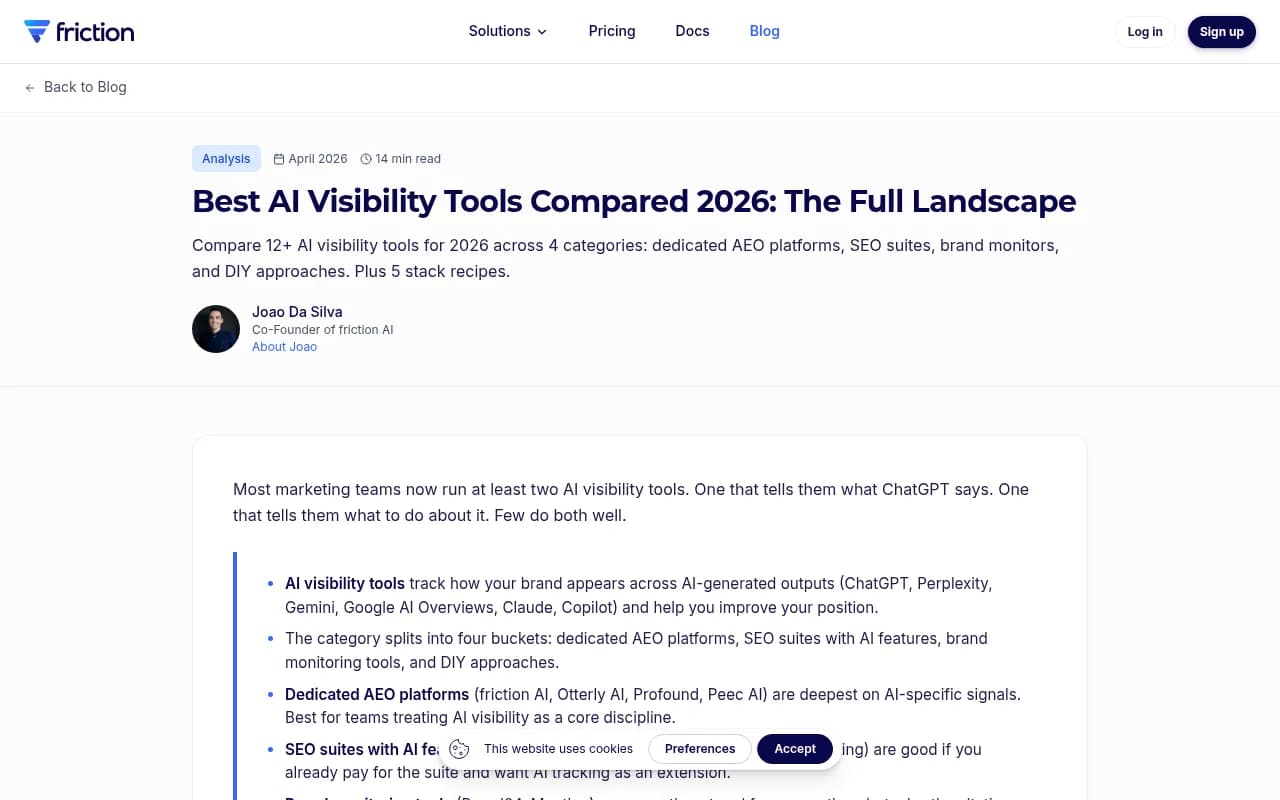
These three tools sit in a market that's moving fast. As the frictionai.co comparison of 12+ AI visibility tools noted, most marketing teams now run at least two tools: one that tells them what ChatGPT says, and one that tells them what to do about it. Few tools do both well.
SE Ranking and Searchable are firmly in the "tells you what ChatGPT says" camp. Promptwatch is one of the few platforms that genuinely covers both sides -- and the only one in this comparison that closes the loop with content generation and traffic attribution.
That doesn't mean SE Ranking or Searchable are bad choices. They're the right choices for specific situations. But if you're evaluating tools because you want to improve your AI search visibility -- not just measure it -- the distinction matters.
The AI search landscape isn't slowing down. Getting cited by ChatGPT or Perplexity when a buyer asks about your category is now a real acquisition channel. The tools you use to manage that channel should match the seriousness with which you're treating it.