Key takeaways
- Otterly.AI and Peec AI are monitoring-only tools -- they show you data but don't help you act on it
- Searchable covers basic brand tracking but lacks content optimization, crawler logs, and traffic attribution
- Promptwatch is the only platform in this group that closes the full loop: find gaps, generate content, track results
- If budget is your main constraint, Otterly.AI's $29/mo Lite plan is the cheapest entry point for pure monitoring
- For teams that want to actually improve their AI visibility (not just watch it), Promptwatch's $99/mo Essential plan is the better investment
AI visibility tools have gone from niche experiment to line item in most marketing budgets. The problem is that the market has flooded with options, and it's genuinely hard to tell which platforms do something useful versus which ones just show you a dashboard and call it a day.
This comparison focuses on four tools that come up constantly in the "affordable AI visibility" conversation: Searchable, Promptwatch, Otterly.AI, and Peec AI. They're not enterprise behemoths like Profound or seoClarity. They're the platforms that smaller marketing teams, SEO agencies, and SaaS brands are actually evaluating.
Here's what separates them -- and which one is worth your budget.
What we're actually comparing
Before getting into the tools, it's worth being clear about what "AI visibility" means in practice. When someone asks ChatGPT "what's the best project management tool for remote teams?" -- does your brand appear in the answer? Does Perplexity cite your blog post? Does Google AI Overviews mention your product?
That's AI visibility. And the tools in this comparison are supposed to help you measure and improve it.
The categories that matter:
- How many AI models does it monitor?
- Does it track prompt volume and difficulty, or just fire queries?
- Can it identify gaps where competitors appear but you don't?
- Does it help you create content to fill those gaps?
- Does it show which of your pages AI crawlers are actually visiting?
- Can you connect AI visibility to real traffic and revenue?
With that framework in mind, let's look at each tool.
Otterly.AI
Otterly.AI is probably the most-mentioned budget option in this space. It's been around since the early days of the GEO category and has built a decent following among agencies and SEO teams who want fast, affordable monitoring.

The pitch is straightforward: track your brand and competitors across AI engines, get alerts when something changes, run GEO audits. The Lite plan at $29/mo covers 15 prompts across 4 engines, which is genuinely cheap for getting started.
Where Otterly.AI works well:
- Quick setup and clean interface
- Good for teams that just want to know "are we showing up?"
- Automated prompt testing saves manual effort
- Reasonable coverage of ChatGPT, Perplexity, Google AI Overviews, and a few others
Where it falls short: Otterly.AI is fundamentally a monitoring dashboard. It tells you what's happening but doesn't tell you what to do about it. There's no content gap analysis, no AI writing tools, no crawler logs showing which pages AI bots are actually reading, and no traffic attribution to connect visibility to revenue. You're left with data and no clear path to improving the numbers.
For teams that just need a pulse check and nothing more, it's fine. For teams that want to grow their AI visibility, it's a starting point that quickly hits a ceiling.
Peec AI
Peec AI targets B2B SaaS and ecommerce brands with a clean dashboard focused on conversational AI visibility. The Starter plan runs around €85/mo (roughly $90-95 depending on exchange rates) and covers 50 prompts across 3 engines.
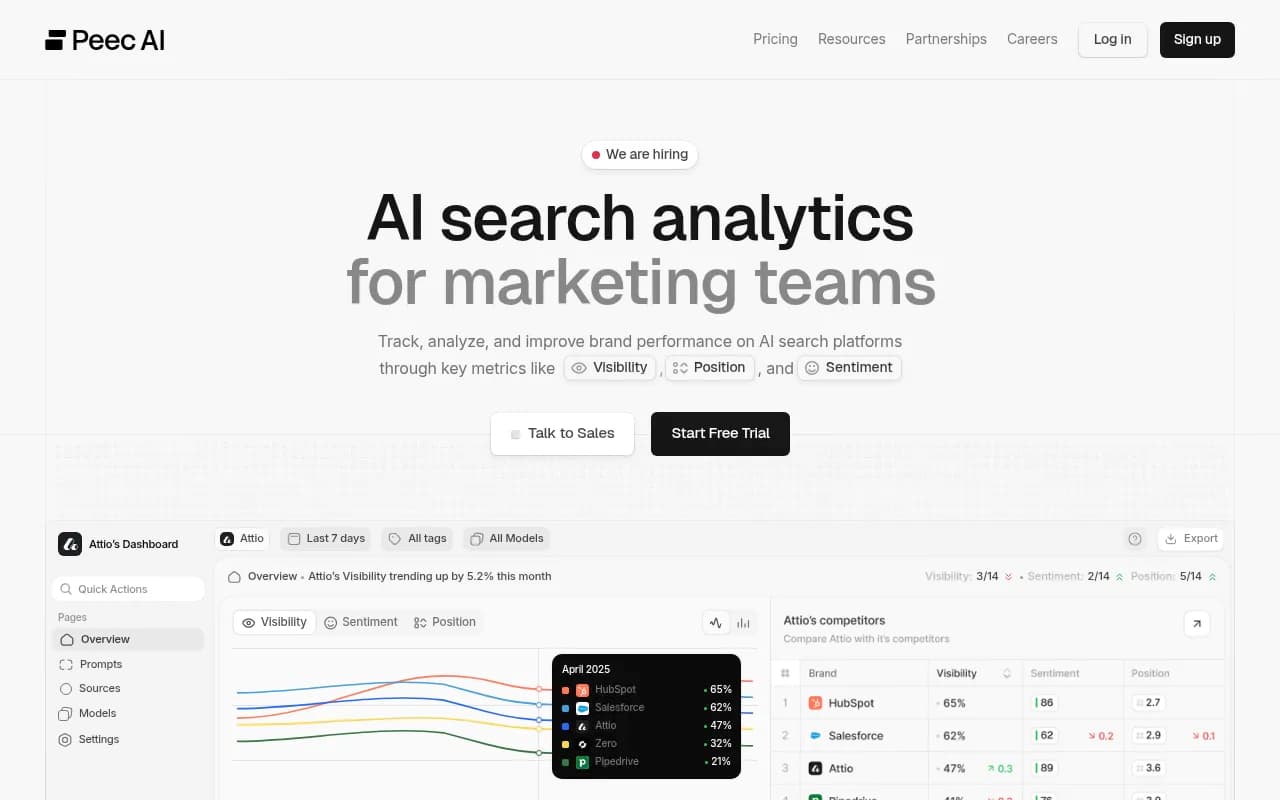
It's a step up from Otterly.AI in terms of polish and competitor benchmarking. The interface makes it easy to see how your brand stacks up against specific competitors for specific prompts, which is useful for executive reporting.
What Peec AI does reasonably well:
- Clean, presentable dashboards that non-technical stakeholders can read
- Competitor share-of-voice comparisons
- Multi-language support, which matters if you're operating in European markets
- Decent prompt management
The limitations are similar to Otterly.AI, just at a higher price point. Peec AI monitors. It doesn't optimize. There's no content generation, no answer gap analysis that shows you which specific prompts you're losing to competitors, no crawler log data, and no way to attribute AI visibility to actual website traffic. You're paying more than Otterly.AI for a nicer interface, but the ceiling is the same.
Searchable
Searchable is a newer entrant that positions itself as a straightforward brand tracking tool for AI search. It's mentioned in several 2026 roundups as a budget-friendly option, particularly for smaller brands that want basic coverage without complexity.
Honest assessment: Searchable is a lighter-weight option that covers the basics. It tracks brand mentions across a handful of AI engines and gives you a visibility score over time. The interface is simple, which is either a feature or a limitation depending on what you need.
What it lacks is depth. Prompt volume data, difficulty scoring, query fan-outs, crawler logs, content generation, Reddit and YouTube citation tracking -- none of these are part of the picture. For a small brand that just wants to know "is ChatGPT mentioning us at all?", it might be enough. For anyone trying to build a systematic AI visibility strategy, it runs out of road quickly.
Promptwatch
Promptwatch is the outlier in this comparison. It monitors the same AI engines as the others -- 10 of them, including ChatGPT, Claude, Perplexity, Gemini, Grok, DeepSeek, and Google AI Overviews -- but the core difference is what happens after you see the data.

Most AI visibility tools show you a gap and leave you there. Promptwatch is built around closing it.
The workflow looks like this: Answer Gap Analysis shows you exactly which prompts competitors rank for that you don't. Not vague categories -- specific questions and topics that AI models are answering with your competitors' content instead of yours. Then the built-in AI writing agent generates articles, listicles, and comparisons grounded in actual citation data (880M+ citations analyzed). Then page-level tracking shows whether those new pages are getting cited, by which models, and how often. And traffic attribution -- via a code snippet, Google Search Console integration, or server log analysis -- connects the visibility gains to actual revenue.
That loop (find gaps, create content, track results) is what separates Promptwatch from the monitoring-only tools in this comparison.
A few other things worth mentioning:
- AI Crawler Logs show you in real time which pages ChatGPT, Claude, and Perplexity bots are reading on your site, how often they return, and what errors they're hitting. This is genuinely rare -- most competitors don't have it at all.
- Prompt Intelligence includes volume estimates and difficulty scores, so you can prioritize high-value, winnable prompts instead of guessing.
- Reddit and YouTube tracking surfaces discussions that directly influence AI recommendations -- a channel the other tools in this comparison ignore.
- ChatGPT Shopping tracking monitors when your brand appears in product recommendation carousels.
Pricing starts at $99/mo for the Essential plan (1 site, 50 prompts, 5 articles). The Professional plan at $249/mo adds crawler logs, city/state-level tracking, and 15 articles per month. There's a free trial available.
Is it the cheapest option? No. Otterly.AI's $29/mo Lite plan beats it on price. But if you're spending money on AI visibility tools, the question isn't "what's cheapest?" -- it's "what actually moves the needle?"
Head-to-head comparison
| Feature | Searchable | Otterly.AI | Peec AI | Promptwatch |
|---|---|---|---|---|
| Starting price | N/A (limited info) | $29/mo | ~€85/mo | $99/mo |
| AI engines monitored | ~4 | 4-6 | 3-5 | 10 |
| Prompt volume & difficulty | No | No | No | Yes |
| Answer gap analysis | No | No | No | Yes |
| AI content generation | No | No | No | Yes |
| Crawler logs | No | No | No | Yes |
| Traffic attribution | No | No | No | Yes |
| Reddit/YouTube tracking | No | No | No | Yes |
| ChatGPT Shopping tracking | No | No | No | Yes |
| Competitor heatmaps | Basic | Basic | Yes | Yes |
| Multi-language support | Limited | Limited | Yes | Yes |
| Free trial | Limited | Yes | Yes | Yes |
The pattern is clear. Searchable, Otterly.AI, and Peec AI are all monitoring tools with different price points and interface styles. Promptwatch is the only one that goes past monitoring into actual optimization.
Which tool should you choose?
The right answer depends on what you're actually trying to do.
Choose Otterly.AI if you have a tiny budget, you're just starting to pay attention to AI visibility, and you mainly want to know whether your brand is showing up at all. The $29/mo entry point is genuinely accessible, and the alerts are useful for staying informed without much setup.
Choose Peec AI if you're a B2B SaaS or ecommerce brand that needs clean competitor benchmarking and multi-language coverage, and you're comfortable with a monitoring-only tool. The dashboards are presentation-ready, which matters if you're reporting to stakeholders who want simple charts.
Skip Searchable unless you have very basic needs and find the interface particularly appealing. It doesn't offer enough differentiation from the other options to justify choosing it over Otterly.AI at the entry level or Peec AI at the mid tier.
Choose Promptwatch if you want to actually improve your AI visibility, not just track it. The gap analysis and content generation tools are what turn monitoring data into something actionable. For teams that are serious about GEO as a growth channel -- not just a reporting metric -- it's the only tool in this group that gives you a complete workflow.
The monitoring trap
One thing worth naming directly: there's a real risk of spending money on AI visibility monitoring and never doing anything with the data. It's easy to set up a dashboard, watch your visibility score fluctuate, and feel like you're "doing AI SEO" without actually moving the needle.
The monitoring-only tools in this comparison (Searchable, Otterly.AI, Peec AI) all have this problem baked in. They give you information. What you do with it is entirely up to you, and most teams don't have a clear process for turning "we're not showing up for this prompt" into "we published content that fixed it."
Promptwatch's value isn't just the data -- it's the workflow that connects the data to action. That's a meaningful difference, especially for lean marketing teams that don't have time to manually translate monitoring reports into content briefs.
Bottom line
If you're choosing between these four tools in 2026, the decision mostly comes down to whether you want to monitor your AI visibility or improve it.
For pure monitoring on a tight budget: Otterly.AI at $29/mo is hard to beat.
For a more polished monitoring experience with better competitor benchmarking: Peec AI is worth considering, though the price-to-capability ratio is less compelling.
For teams that want to actually grow their AI search presence -- find the gaps, create the content, track the results -- Promptwatch is the only tool here that does the full job.
The AI search landscape is moving fast. Brands that are just watching what's happening are going to fall further behind brands that are actively optimizing for it. The tool you choose should reflect which camp you want to be in.