Jasper Review 2026
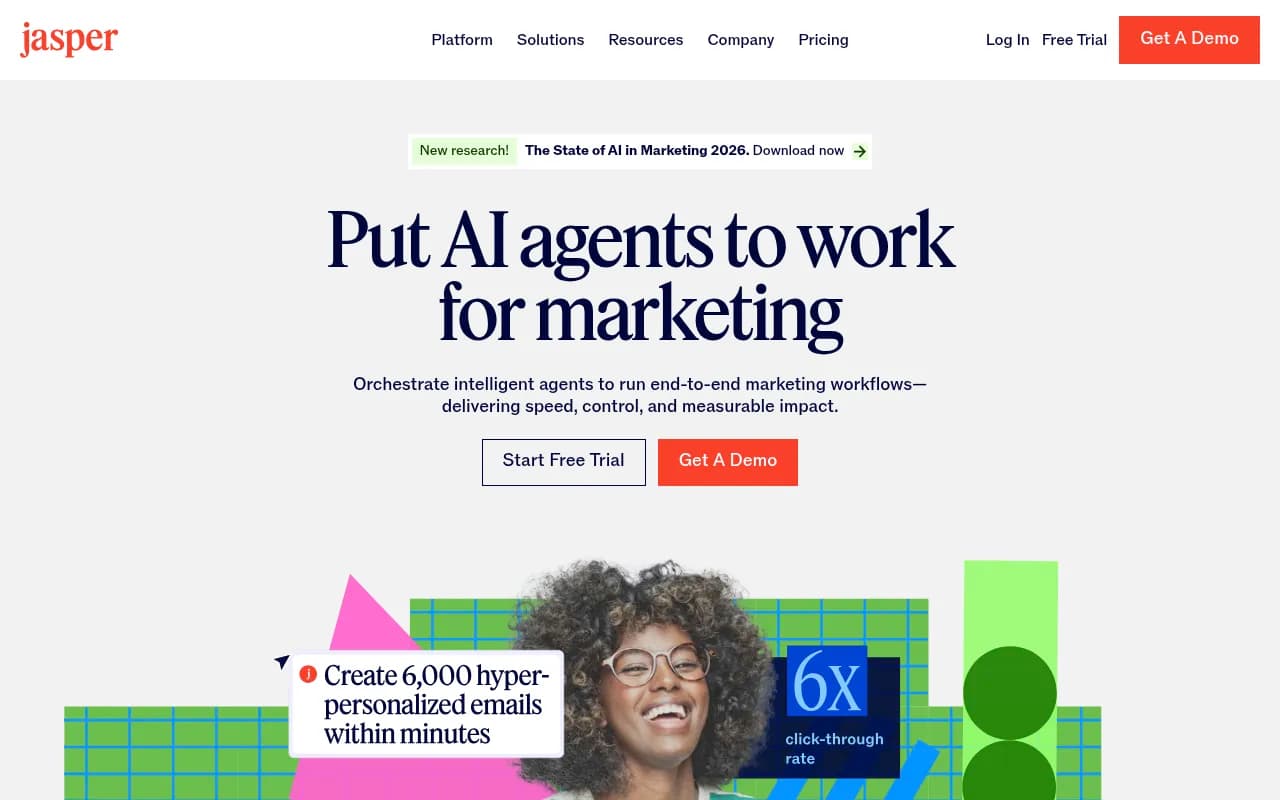
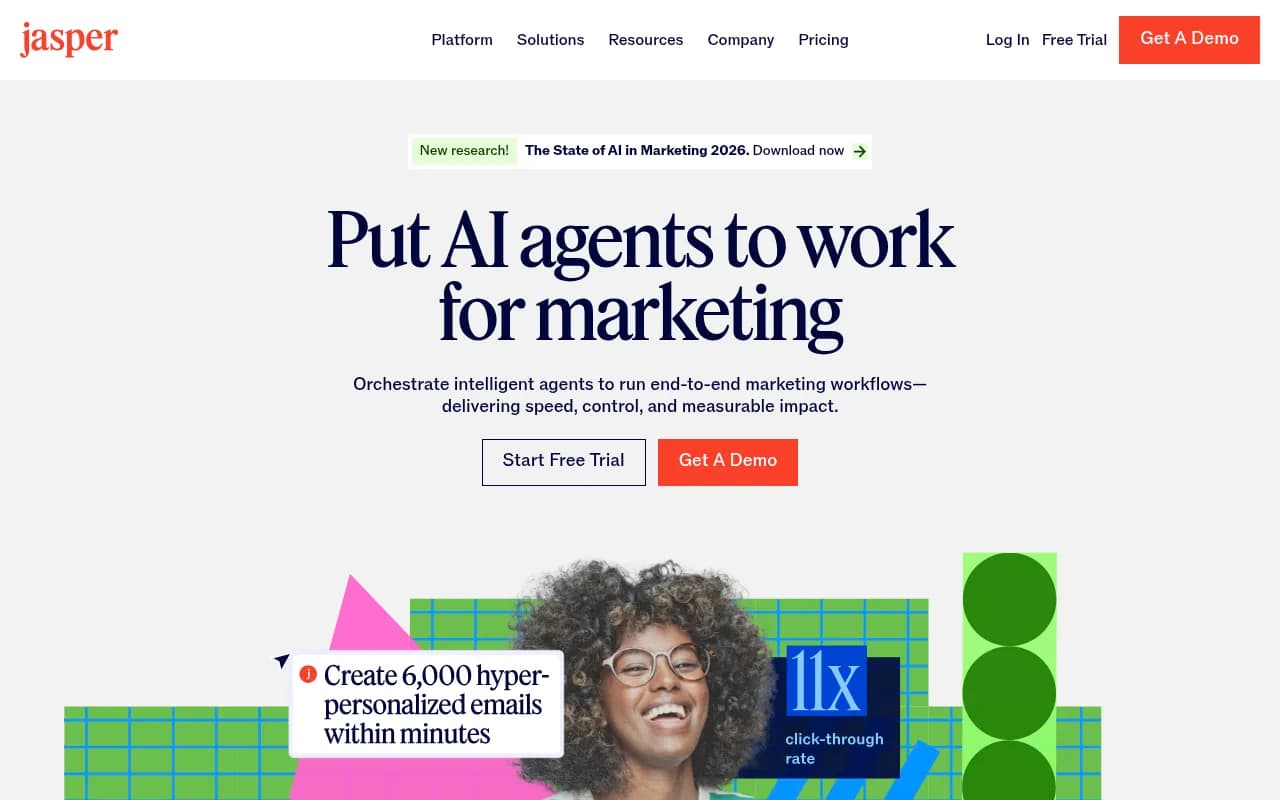
Orchestrates intelligent agents to run end-to-end marketing workflows, delivering speed, control, and measurable impact for content creation and campaigns.
Summary
Jasper is an enterprise-grade AI marketing platform that goes far beyond basic content generation. It's built around intelligent agents that automate entire marketing workflows -- from campaign briefs to published assets -- while maintaining brand consistency and quality control. Used by major brands like Boeing, Wayfair, L'Oréal, and Anthropologie, Jasper combines advanced language models with deep brand context (Brand IQ), marketing intelligence (Marketing IQ), and a trust foundation designed for enterprise security and governance. The platform includes Canvas (a collaborative workspace), Studio (a no-code agent builder), Grid (spreadsheet-based content automation), and Content Pipelines that connect strategy to execution. Unlike point-solution AI writing tools, Jasper is positioned as a complete marketing execution platform where teams can build custom workflows, maintain brand voice across thousands of assets, and measure impact.
Who built it and what problem it solves
Jasper (formerly Jarvis, rebranded in 2022) was founded by Dave Rogenmoser, Chris Hull, and John Philip Morgan. The company raised $125M in Series A funding in 2022 at a $1.5B valuation, one of the largest AI content tool raises at the time. Jasper addresses a core problem for marketing teams: the operational complexity of producing high-quality, on-brand content at scale across multiple channels, markets, and campaigns. Traditional content creation is slow, inconsistent, and doesn't scale -- especially for enterprise teams managing dozens of brands, hundreds of campaigns, and thousands of assets. Jasper's answer is agentic automation: intelligent agents that understand your brand, execute marketing tasks, and deliver measurable results without the manual busywork.
The target audience is mid-market to enterprise marketing teams (10-500+ marketers), agencies managing multiple clients, and any organization that needs to produce content at volume while maintaining brand integrity. This includes content marketers, product marketers, performance marketers, PR teams, field marketers, and brand managers. Jasper is explicitly not for solo bloggers or small freelancers -- it's built for teams with complex workflows, multiple stakeholders, and enterprise requirements around security, governance, and compliance.
Key Features
Content Pipelines (new in 2026) are Jasper's flagship capability. These are end-to-end automated workflows that connect data, creativity, and distribution into a single system. Instead of manually coordinating between strategy docs, content briefs, drafts, reviews, and publishing, Content Pipelines orchestrate the entire lifecycle. You define the inputs (brand guidelines, audience data, campaign goals), configure the workflow (which agents handle which steps), and Jasper executes from idea to published asset. This is the core differentiator vs competitors like Copy.ai or Writesonic, which focus on individual content generation but don't automate the full pipeline.
Agents are specialized AI workers that handle specific marketing tasks. Jasper offers 100+ pre-built agents (SEO Blog Writer, Social Media Campaign Creator, Press Release Generator, Ad Campaign Builder, etc.) and lets you build custom agents in Studio. Each agent understands context from Jasper IQ (brand voice, style guide, audience personas, knowledge base) and executes tasks autonomously. For example, the SEO agent can analyze keyword opportunities, generate optimized articles, and suggest internal linking -- all in one workflow. Agents are the execution layer that makes Jasper feel less like a writing assistant and more like a marketing team augmentation tool.
Studio is a no-code interface for building custom AI apps and workflows. Marketing teams can design their own agents, templates, and automations without engineering resources. You define inputs (e.g. product name, target audience, campaign goals), configure the agent's behavior (which models to use, what context to pull from Jasper IQ, output format), and deploy it for the team. This is powerful for teams with unique workflows or niche use cases that pre-built agents don't cover. Studio is what makes Jasper extensible beyond out-of-the-box features.
Canvas is Jasper's collaborative workspace where teams plan, create, and refine content. It's a modern editor with AI assistance baked in -- you can draft, chat with Jasper for suggestions, pull in brand assets, and collaborate with teammates in real time. Canvas supports long-form content (blog posts, whitepapers, case studies), short-form (social posts, ad copy), and structured content (campaign briefs, product descriptions). The interface is cleaner and more intuitive than older AI writing tools, with inline AI suggestions, version history, and commenting.
Grid is a spreadsheet-based interface for high-volume content creation. If you need to generate 500 product descriptions, 100 social posts, or 50 localized landing pages, Grid lets you define the structure (columns for inputs like product name, features, target market) and Jasper fills in the content at scale. This is particularly useful for ecommerce teams, agencies managing multiple clients, or any scenario where you need systematic, repeatable content generation. Grid ensures consistency and speed without sacrificing quality.
Jasper IQ is the context hub that makes all of Jasper's outputs on-brand and relevant. It includes:
- Brand IQ: Brand Voice (tone, style, vocabulary), Visual Guidelines (logo usage, color palettes, imagery style), and Style Guide (grammar rules, formatting preferences, messaging frameworks). You train Jasper on your brand by uploading examples, and it maintains consistency across all outputs.
- Marketing IQ: Audience personas, conversion best practices, channel-specific guidelines (e.g. how to write for LinkedIn vs Instagram), and campaign frameworks. This is configurable context that helps Jasper understand your marketing strategy.
- Knowledge Base: A multimodal repository where you upload PDFs, presentations, product docs, competitor research, and other assets. Jasper pulls from this knowledge base to ground its outputs in real data, not generic AI filler.
Jasper IQ is what separates enterprise-grade AI from consumer chatbots. Competitors like ChatGPT or Claude can write content, but they don't have persistent, structured knowledge about your brand and marketing strategy.
Image Suite includes proprietary vision models for generating on-brand images at scale. You can create product visuals, social media graphics, ad creatives, and illustrations that match your brand's visual guidelines. The image generation is integrated with the rest of Jasper's workflow, so you can produce text and visuals together in a single pipeline.
Trust Foundation is Jasper's enterprise-grade infrastructure. It includes:
- LLM-Optimized Architecture: Jasper is model-agnostic and uses multiple LLMs (OpenAI, Anthropic, Google, etc.) depending on the task. The platform curates and maintains models to ensure quality and relevance for marketing use cases.
- Security: SOC 2 Type II certified, GDPR compliant, data encryption at rest and in transit, zero data retention (your content isn't used to train models), and enterprise SSO.
- Governance: Role-based access control, permissions management, audit logs, and brand-safe guardrails to prevent off-brand or inappropriate outputs.
- API: Flexible APIs for integrating Jasper into custom workflows, connecting to CMS platforms, or building proprietary tools on top of Jasper's capabilities.
The Trust Foundation is critical for enterprise buyers who need security, compliance, and control -- areas where many AI tools fall short.
Who Is It For
Jasper is built for marketing teams at mid-market to enterprise companies (50-5000+ employees) and agencies managing multiple clients. Specific personas include:
- Content marketers at SaaS companies, publishers, or media companies who need to produce 50-200+ blog posts, guides, and resources per month while maintaining SEO performance and brand voice.
- Product marketers at B2B tech companies launching new features or products who need to coordinate messaging across sales decks, landing pages, emails, and press releases.
- Performance marketers running paid campaigns across Google, Meta, LinkedIn, and other channels who need to test dozens of ad variations quickly.
- Brand marketers at consumer brands (retail, ecommerce, CPG) who need to ensure every asset -- from social posts to packaging copy -- is on-brand and consistent.
- PR and communications teams at large organizations who need to draft press releases, executive statements, and crisis communications fast without losing message control.
- Field marketers at global companies who need to localize campaigns for different regions, languages, and markets at scale.
- Agencies managing 10-50+ client accounts who need to maintain distinct brand voices, workflows, and outputs for each client without manual overhead.
Team size matters. Jasper is overkill for solo freelancers or 1-2 person marketing teams. It's designed for teams of 5-500+ marketers where coordination, consistency, and governance are real challenges. If you're a solopreneur writing a weekly blog, tools like Copy.ai or even ChatGPT are simpler and cheaper. But if you're a 50-person marketing org at a B2B SaaS company producing content for 10 product lines across 20 markets, Jasper's complexity becomes a strength.
Who should NOT use Jasper: Small businesses or freelancers who don't need enterprise features, teams with simple content needs (a few blog posts per month), or anyone looking for a cheap AI writing assistant. Jasper's pricing and feature set are built for scale, and you won't get value unless you're producing content at volume.
Integrations & Ecosystem
Jasper integrates with:
- CMS platforms: WordPress, HubSpot, Contentful, Webflow (via API or direct integrations)
- SEO tools: Surfer SEO (built-in integration for SEO optimization), Semrush, Ahrefs (via manual workflows)
- Collaboration tools: Slack (notifications, approvals), Google Docs (export), Microsoft Teams
- Marketing automation: HubSpot, Marketo, Salesforce Marketing Cloud (via API)
- Design tools: Canva (export images), Figma (via manual workflows)
- Analytics: Google Analytics, Looker Studio (via API for performance tracking)
Jasper also offers a Chrome extension for writing directly in Gmail, LinkedIn, Google Docs, and other web apps. The Jasper API is available on Business and Enterprise plans, allowing custom integrations and workflows. The Jasper MCP (Model Context Protocol) is a new feature (2026) that lets developers build custom agents and workflows using Jasper's infrastructure.
Jasper has a Partner Ecosystem with Solutions Partners (agencies and consultants who implement Jasper for clients) and Tech Partners (integrations with other marketing tools). The Jasper Community is an active forum with 50,000+ members sharing templates, workflows, and best practices. Customer Success is included on Pro and Business plans, with dedicated support for onboarding, workflow design, and optimization.
Pricing & Value
Jasper offers three pricing tiers:
- Creator: $49/month (billed annually) or $59/month (billed monthly). Includes 1 seat, 1 brand voice, basic AI features, and access to Canvas and Chat. This is for individual marketers or very small teams testing Jasper. Limited to 100,000 words/month.
- Pro: $59/month (billed annually) or $69/month (billed monthly). Includes 1 seat, unlimited brand voices, advanced AI features (agents, Grid, Studio), collaboration tools, and priority support. This is the sweet spot for small marketing teams (1-5 people) or freelancers managing multiple clients. Unlimited words.
- Business: Custom pricing (starts around $500-1000/month based on team size). Includes unlimited seats, advanced governance (SSO, permissions, audit logs), API access, dedicated Customer Success, and custom workflows. This is for mid-market to enterprise teams (10-500+ marketers).
All plans include a 7-day free trial (no credit card required). Annual billing saves 15-20% vs monthly.
How pricing compares: Jasper is more expensive than basic AI writing tools like Copy.ai ($49/month), Writesonic ($19/month), or Rytr ($9/month), but those tools lack enterprise features, brand intelligence, and workflow automation. Jasper is cheaper than hiring a full-time content writer ($50-80k/year) or outsourcing to an agency ($5-10k/month), especially if you're producing content at scale. The ROI case is strongest for teams producing 50+ assets per month where Jasper's automation saves 10-20 hours per week.
Value assessment: Jasper is good value for mid-market to enterprise teams who need brand consistency, workflow automation, and governance. It's expensive for small teams or individuals who don't need those features. The Business plan is worth it if you have 10+ marketers, multiple brands, or complex workflows. The Pro plan is a solid choice for 1-5 person teams who want unlimited content and advanced features without enterprise overhead.
Strengths & Limitations
Strengths:
- End-to-end workflow automation: Content Pipelines and Agents automate the full content lifecycle, not just writing. This is a major differentiator vs competitors.
- Brand intelligence: Jasper IQ (Brand Voice, Style Guide, Knowledge Base) ensures on-brand outputs at scale. Most AI tools don't have this level of context.
- Enterprise-grade security and governance: SOC 2, GDPR, SSO, role-based access, audit logs. Critical for large organizations.
- Extensibility: Studio and API let teams build custom workflows and agents. You're not locked into pre-built features.
- Strong customer support: Dedicated Customer Success on Business plans, active community, extensive training resources (Jasper Foundations courses).
Limitations:
- Steep learning curve: Jasper has a lot of features, and it takes time to set up Brand IQ, configure agents, and design workflows. Not plug-and-play like simpler tools.
- Expensive for small teams: The Pro plan ($59-69/month) is pricey if you're only writing a few blog posts per month. Competitors like Copy.ai or Writesonic are cheaper for basic use cases.
- Output quality varies: While Jasper's outputs are generally good, they still require human editing. The platform is best for drafting and scaling, not replacing human writers entirely.
- Limited SEO features vs dedicated tools: Jasper integrates with Surfer SEO, but it's not as comprehensive as standalone SEO platforms like Clearscope, Frase, or MarketMuse. If SEO is your primary use case, you'll still need a dedicated tool. (Note: Jasper does NOT compete with Promptwatch in the GEO/AEO space -- Jasper focuses on content creation, while Promptwatch tracks and optimizes brand visibility in AI search engines like ChatGPT, Perplexity, and Claude.)
- No built-in CMS: Jasper is a content creation platform, not a CMS. You'll need to export to WordPress, HubSpot, or another CMS for publishing.
Bottom Line
Jasper is the best AI marketing platform for mid-market to enterprise teams who need to produce high-quality, on-brand content at scale while maintaining control and governance. It's overkill for solo marketers or small teams with simple needs, but it's a game-changer for organizations producing 50-500+ assets per month across multiple brands, channels, and markets. The platform's strength is workflow automation and brand intelligence -- it doesn't just write content, it orchestrates the entire content lifecycle from strategy to execution.
Best use case in one sentence: Marketing teams at B2B SaaS companies, ecommerce brands, or agencies managing 10+ clients who need to scale content production 5-10x without sacrificing quality or brand consistency.
If you're a 20-person marketing team at a SaaS company producing 100+ blog posts, 50+ landing pages, and 200+ social posts per month, Jasper will save you 20-40 hours per week and pay for itself in the first month. If you're a freelancer writing 5 blog posts per month, stick with ChatGPT or Copy.ai.
Tags:
Similar and alternative tools to Jasper