Key takeaways
- Searchable is a free, one-time snapshot tool -- useful for a quick audit but not a platform you can run an ongoing GEO strategy on.
- Relixir is a paid GEO platform with content generation built in, making it more capable than pure monitoring tools, but it lacks crawler logs, Reddit/YouTube tracking, and deep prompt intelligence.
- Promptwatch is the only platform of the three that closes the full loop: find visibility gaps, generate content engineered to get cited by AI models, track results, and attribute traffic to revenue.
- If you're serious about AI search visibility in 2026, the question isn't just "which tool monitors best" -- it's "which tool helps me actually improve."
The GEO software market has split into two camps, and the gap between them is getting harder to ignore.
On one side: monitoring dashboards. They show you where your brand appears (or doesn't) in ChatGPT, Perplexity, Claude, and Google AI Overviews. They're useful for a weekly check-in. But they stop there. You get a score, maybe a chart, and then you're on your own to figure out what to do next.
On the other side: optimization platforms. These don't just report the problem -- they help you fix it. Content gap analysis, AI-native content generation, crawler log analysis, traffic attribution. The whole stack.
Searchable and Relixir sit at different points on this spectrum. So does Promptwatch. This guide breaks down exactly where each one lands, what you actually get for your money, and which type of tool makes sense depending on what you're trying to accomplish.
What each platform actually is
Searchable
Searchable is a free tool that runs a one-time audit of your brand's visibility across a handful of AI engines. You enter your brand or domain, it queries ChatGPT, Claude, and Perplexity with a set of prompts, and returns a snapshot report.
The value is obvious: zero cost, zero setup, results in minutes. If you've never checked how your brand appears in AI search, Searchable is a reasonable starting point.
The limitation is equally obvious: it's a snapshot, not a platform. There's no ongoing tracking, no historical data, no prompt-level ranking trends, no content recommendations, and no way to measure whether anything you do actually improves your visibility over time. The Attensira comparison table describes it bluntly: "one-time" monitoring, no prompt ranking tracking, no citation tracking, no crawler log analysis.
That's fine if you just want to satisfy curiosity. It's not fine if you're trying to build a GEO strategy.
Relixir
Relixir is a proper paid GEO platform with content generation built in. It monitors your brand across multiple AI engines, surfaces competitive gaps, and includes an AI writing layer to help you create content that targets those gaps.
That puts it meaningfully ahead of pure monitoring tools like Otterly.AI or Peec.ai, which stop at the data layer and leave you to figure out what to write. Relixir at least attempts to close the loop between "here's where you're invisible" and "here's content that might fix it."
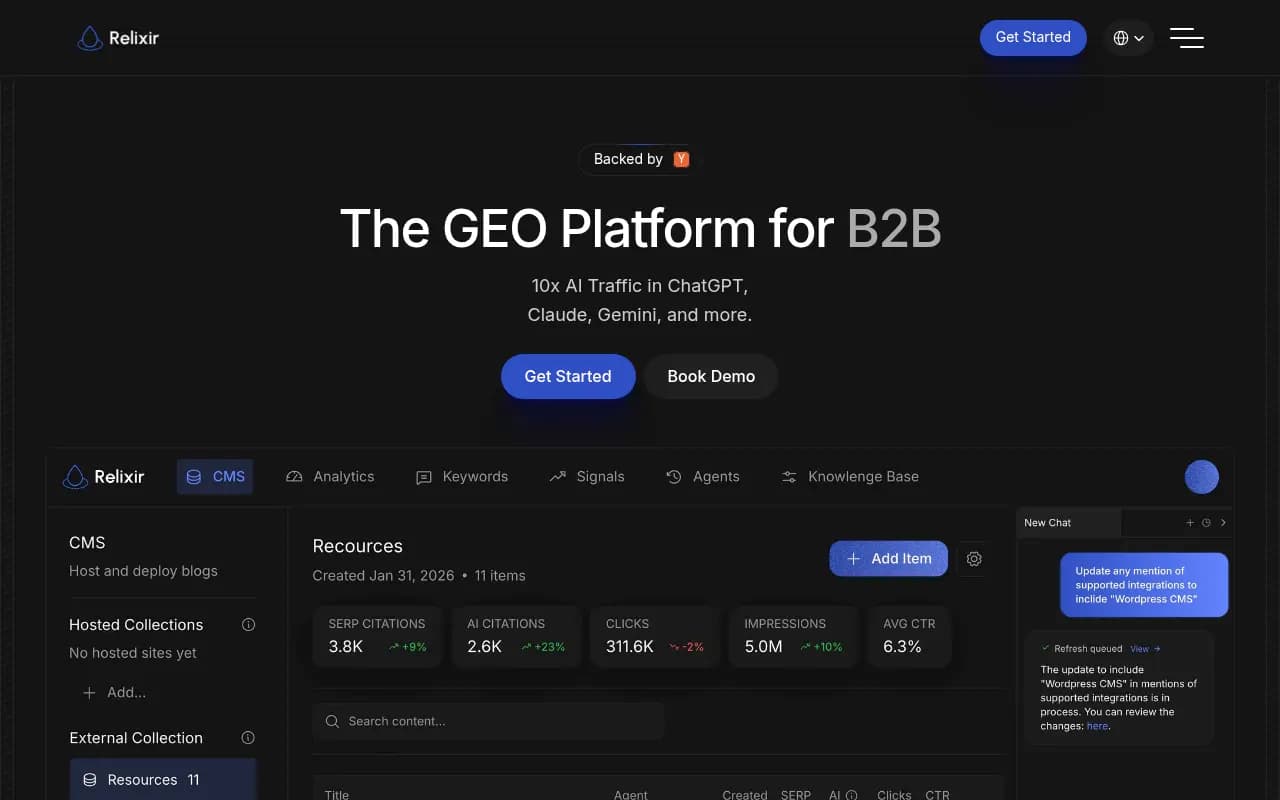
Where Relixir is less clear is in the depth of its analytics. Prompt volume data, query fan-outs, crawler log analysis, Reddit and YouTube citation tracking, and ChatGPT Shopping monitoring are capabilities that matter a lot for teams trying to prioritize which gaps to close first and understand why AI models cite certain sources. Whether Relixir covers these is not well-documented publicly, which itself tells you something about where the product is focused.
Promptwatch
Promptwatch is the platform that most directly competes with the idea of a "complete GEO stack." It monitors 10 AI models (ChatGPT, Claude, Perplexity, Gemini, Google AI Overviews, Google AI Mode, Grok, DeepSeek, Copilot, Mistral), generates content through a built-in AI writing agent trained on 880M+ real citations, tracks which pages are getting cited and by which models, and connects visibility to actual revenue through traffic attribution.

The thing that separates it from most competitors isn't any single feature -- it's the loop. Find the gaps. Create content that fills them. Track whether it worked. Most tools only do step one.
Feature comparison
Here's a direct side-by-side across the capabilities that actually matter for a GEO strategy:
| Feature | Searchable | Relixir | Promptwatch |
|---|---|---|---|
| Ongoing monitoring | No (one-time) | Yes | Yes |
| AI models covered | 3 (one-time) | Multiple | 10 |
| Prompt ranking tracking | No | Yes | Yes |
| Citation tracking | No | Partial | Yes |
| Content gap analysis | No | Yes | Yes |
| AI content generation | No | Yes | Yes (880M+ citation data) |
| Crawler log analysis | No | No | Yes |
| Prompt volume & difficulty | No | No | Yes |
| Query fan-outs | No | No | Yes |
| Reddit & YouTube tracking | No | No | Yes |
| ChatGPT Shopping tracking | No | No | Yes |
| Traffic attribution | No | No | Yes (GSC, snippet, server logs) |
| Competitor heatmaps | No | Partial | Yes |
| Multi-language/region | No | No | Yes |
| Free tier | Yes (one-time) | No | Yes (10 prompts) |
| Starting price | Free | Custom | $99/mo |
The table tells a clear story. Searchable is a diagnostic tool, not a platform. Relixir is a real GEO platform with content generation, but it's missing several of the deeper analytics layers. Promptwatch covers the full stack.
The monitoring-only problem
Here's the thing about monitoring-only tools: the data is only useful if you know what to do with it.
A dashboard that tells you "you appear in 12% of relevant ChatGPT responses and your competitor appears in 34%" is interesting. But it doesn't tell you which specific prompts you're losing. It doesn't tell you what content you'd need to create to close that gap. It doesn't tell you whether the AI models are even crawling your existing pages. And it definitely doesn't tell you whether the traffic you do get from AI search is converting.
This is the gap that separates monitoring tools from optimization platforms. Monitoring tools give you a score. Optimization platforms give you a path.
Searchable doesn't even give you a score you can track over time -- it's a one-time read. That's useful for a first look, but it's not a strategy.
Relixir moves further along the spectrum by pairing monitoring with content generation. That's the right instinct. The question is whether the content generation is grounded in real citation data -- whether it knows which sources AI models actually cite, which topics are getting traction, and which prompts have enough volume to be worth targeting. Generic AI content generation is easy to build. Content generation that's engineered to get cited by ChatGPT and Perplexity is harder.
Where Promptwatch's approach is different
The core of Promptwatch's value proposition is what it calls the "action loop":
- Answer Gap Analysis shows you exactly which prompts your competitors rank for that you don't -- not vague topic suggestions, but specific questions AI models are answering without citing your site.
- The built-in writing agent generates articles, listicles, and comparisons grounded in real citation data. It knows what AI models want to cite because it's analyzed over 880 million citations.
- Page-level tracking shows which specific pages start getting cited after you publish, by which models, and how often. Traffic attribution connects that visibility to actual sessions and revenue.
That's a meaningfully different product than a monitoring dashboard. It's also why Promptwatch is the only platform rated as a "Leader" across all categories in a 2026 comparison of 12 GEO platforms.
A few capabilities worth calling out specifically:
AI Crawler Logs. Most GEO platforms have no visibility into whether AI crawlers are actually visiting your site. Promptwatch shows you real-time logs of ChatGPT, Claude, Perplexity, and other AI crawlers -- which pages they read, how often they return, and any errors they encounter. If your content isn't getting cited, this is often where you find out why.
Prompt Intelligence. Volume estimates and difficulty scores for each prompt, plus query fan-outs that show how one prompt branches into related sub-queries. This lets you prioritize high-value, winnable prompts instead of guessing.
Reddit and YouTube tracking. AI models frequently cite Reddit threads and YouTube videos in their responses. Promptwatch surfaces which discussions are influencing AI recommendations -- a channel most competitors ignore entirely.
Which tool fits which situation
Not everyone needs the full stack. Here's a realistic breakdown:
Use Searchable if: You've never audited your AI visibility and want a free, zero-commitment starting point. It takes five minutes and costs nothing. Just don't mistake the snapshot for a strategy.
Use Relixir if: You want a dedicated GEO platform with content generation and you don't need deep analytics like crawler logs, prompt volume data, or traffic attribution. It's a reasonable mid-tier option for teams that want more than monitoring but aren't ready for a full-stack platform.
Use Promptwatch if: You want to actually move the needle. If your goal is to increase AI search visibility, understand why you're being cited (or not), create content that gets picked up by AI models, and connect that visibility to revenue -- Promptwatch is the platform built for that. The Essential plan at $99/month covers one site with 50 prompts and 5 articles, which is enough to run a real GEO program for a focused brand.
Pricing reality check
| Platform | Free tier | Entry paid plan | What you get |
|---|---|---|---|
| Searchable | Yes (one-time audit) | N/A | One-time snapshot across 3 AI engines |
| Relixir | No | Custom pricing | Monitoring + content generation |
| Promptwatch | Yes (10 prompts, ChatGPT) | $99/mo (Essential) | 1 site, 50 prompts, 5 articles/mo |
| Promptwatch Professional | -- | $249/mo | 2 sites, 150 prompts, 15 articles, crawler logs |
| Promptwatch Business | -- | $579/mo | 5 sites, 350 prompts, 30 articles |
Searchable's free tier is genuinely free and genuinely useful for a first look. Relixir's pricing isn't publicly listed, which makes it harder to evaluate on a budget. Promptwatch's pricing is transparent and tiered by scale -- the Essential plan is accessible for individual brands, and the Professional plan adds crawler logs and city/state tracking, which matters for local or regional businesses.
The broader market context
The GEO platform market in 2026 has a lot of tools that look similar from the outside. Most of them are monitoring dashboards with varying levels of polish. A smaller number have started adding content generation. Very few have closed the full loop to include traffic attribution and crawler-level diagnostics.
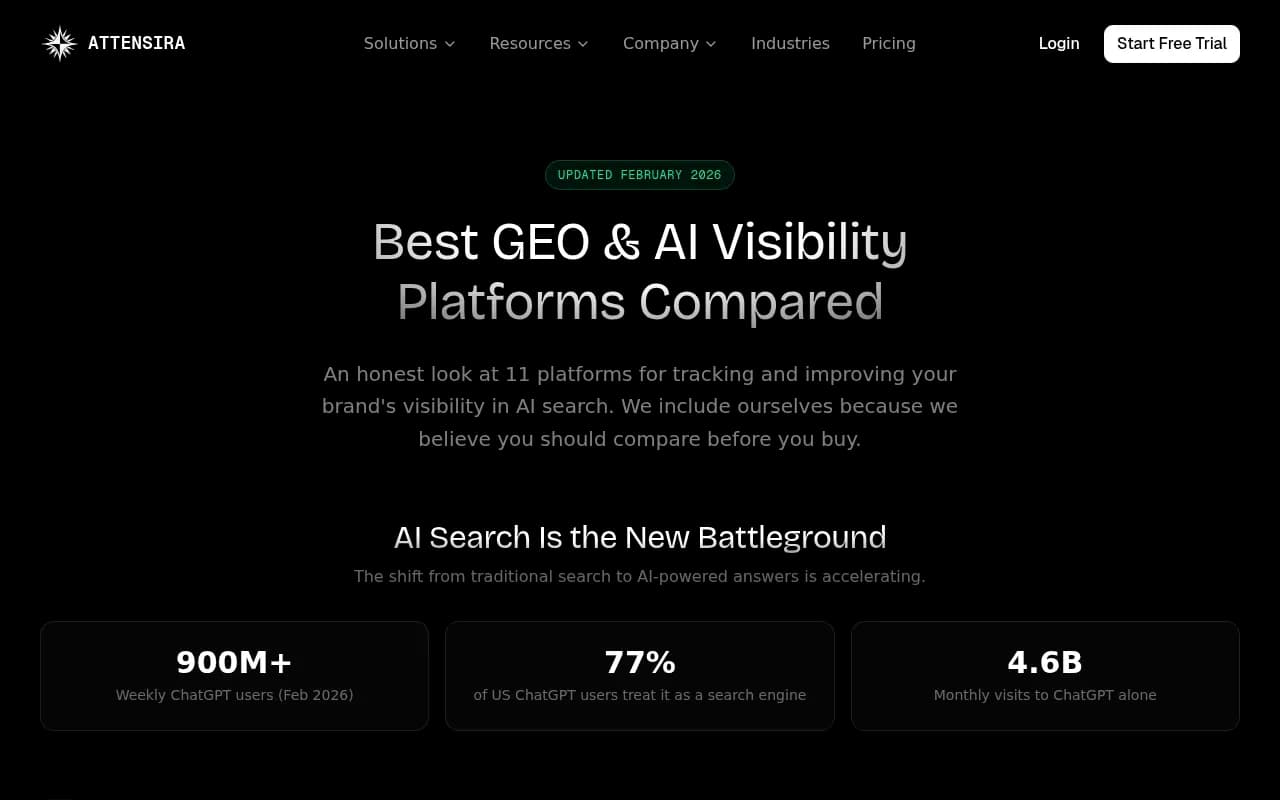
The Attensira comparison table above shows how this plays out across the market. Crawler log analysis, prompt volume data, and citation tracking are the capabilities that separate serious optimization platforms from monitoring dashboards -- and most tools are still missing at least two of the three.
What's clear from the data is that AI search traffic is growing fast. According to research cited by Generate More, AI referral traffic already accounts for 1.08% of all website traffic across major industries, with IT companies seeing 2.80% from AI sources. AI search traffic also converts at 4.4x the rate of traditional organic search. That's not a reason to panic, but it is a reason to take the tooling seriously.
A free one-time audit from Searchable can tell you whether you have a problem. It can't tell you how to fix it, whether your fix worked, or what to prioritize next. That's the gap that platforms like Relixir and Promptwatch are trying to fill -- and the gap between those two is, in turn, about how much of the optimization work you want the platform to carry versus doing yourself.
Bottom line
Searchable, Relixir, and Promptwatch are three different answers to the same question: "How do I know if my brand is visible in AI search?"
Searchable answers it once, for free. Relixir answers it continuously and helps you create content to improve. Promptwatch answers it continuously, helps you create content, tells you exactly why AI models are or aren't citing you, and shows you whether any of it is driving revenue.
The right choice depends on where you are. If you're just starting to think about GEO, Searchable is a fine first step. If you're ready to build a real program, the jump from monitoring-only to optimization platform is where the actual results come from.