ZoomInfo Review 2026
Provides AI-driven audience insights, lead generation, and account-based marketing capabilities for B2B marketers and sales teams.
Summary
- Best for: Mid-market to enterprise B2B sales and marketing teams (10+ employees) who need verified contact data, intent signals, and AI-powered prospecting at scale
- Standout strength: Combines the industry's most comprehensive B2B database (millions of verified contacts) with AI-driven buying signals, org charts, and workflow automation in one platform
- Key limitation: Pricing is seat-based and starts around $75/month per user (basic) with higher tiers requiring annual contracts -- smaller teams or solopreneurs may find it cost-prohibitive compared to lighter alternatives like Apollo or Lusha
- Notable gap: No transparent public pricing -- you must contact sales for a quote, which can slow down evaluation for teams that prefer self-service trials
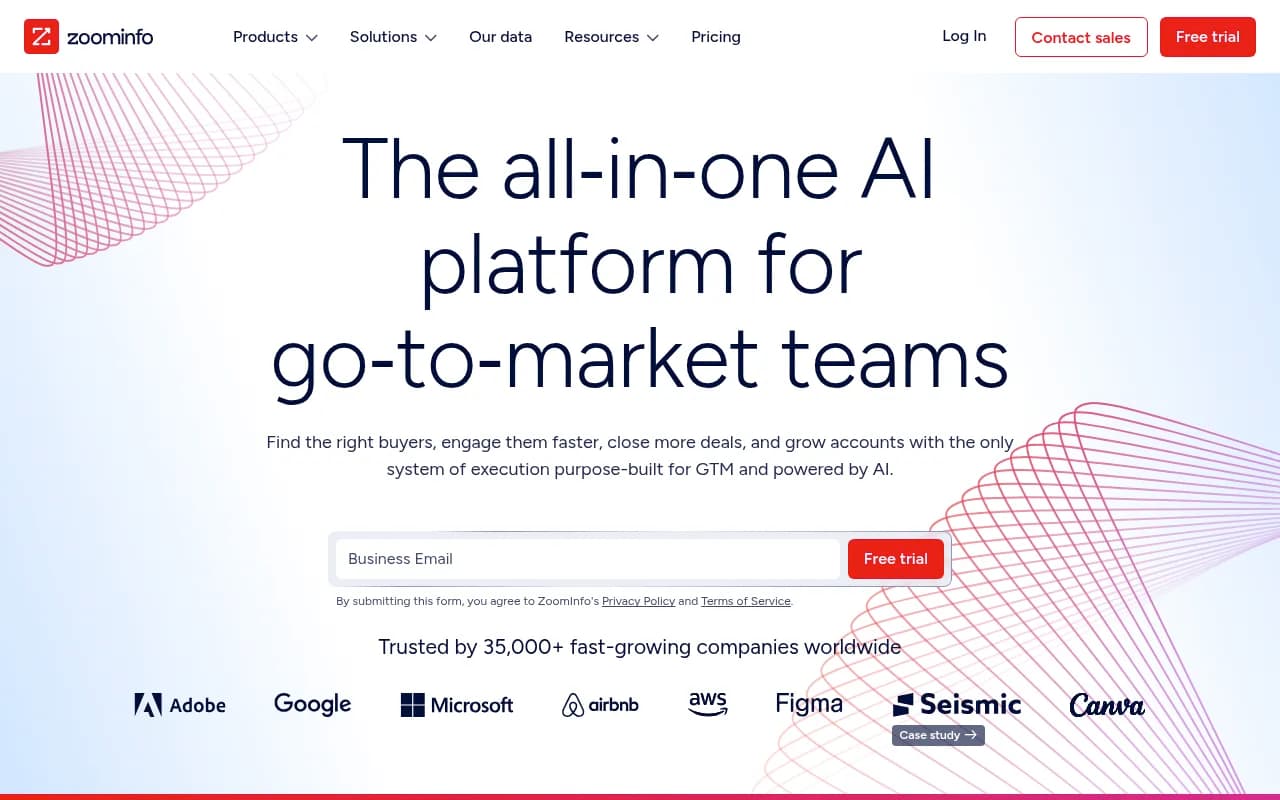
ZoomInfo is the go-to-market intelligence platform that B2B sales and marketing teams turn to when they need more than just a contact database. Launched in 2000 and publicly traded since 2020 (NASDAQ: ZI), it's grown into a $1.3B+ revenue company serving 35,000+ customers worldwide -- including household names like Adobe, Microsoft, AWS, Databricks, and Thomson Reuters. The platform's core promise: help revenue teams find the right buyers, engage them faster, and close more deals by combining verified B2B data with AI-powered insights and automation.
What sets ZoomInfo apart from lighter prospecting tools (Apollo, Hunter, Lusha) is depth and breadth. This isn't a scraper pulling LinkedIn profiles -- it's a proprietary data engine built on machine learning, public sources, and a contributory network that continuously validates millions of contact records. The result is a database that covers not just email addresses and phone numbers, but org charts, technographic data (what software companies use), firmographic details (revenue, employee count, funding), and real-time intent signals that tell you when a prospect is actively researching solutions like yours.
Key Features
Contact & Company Database: ZoomInfo's core asset is its B2B database -- millions of verified contacts across companies worldwide, refreshed continuously. You get direct dials, mobile numbers, work emails, job titles, reporting structures, and detailed company profiles (industry, revenue, employee count, location, tech stack). The data quality is notably higher than scraped alternatives because ZoomInfo uses machine learning to validate records and flags outdated info. You can search by dozens of filters: job title, seniority, department, company size, industry, location, technologies used, funding stage, and more. The depth here is what enterprise teams pay for -- you're not just finding "marketing managers" but "VP of Demand Generation at SaaS companies with 200-500 employees using HubSpot and Salesforce, located in the US, with $10M-50M revenue."
Intent Data & Buying Signals: ZoomInfo tracks buying intent across the web -- which companies are researching topics related to your product, visiting competitor sites, consuming content about your category, or showing signs of active evaluation. This comes from ZoomInfo's proprietary intent network (not just third-party data aggregators). You see intent spikes in real time, scored by topic and recency, so your sales team can prioritize accounts that are in-market right now instead of cold calling everyone. The platform also surfaces "scoops" -- news about funding rounds, executive hires, office expansions, product launches, and other trigger events that signal buying windows. For example: "Company X just raised Series B and hired a new CTO" is a strong signal to reach out with infrastructure or dev tools.
Org Charts & Buying Committees: One of ZoomInfo's most powerful features for enterprise sales is its org chart mapping. You can visualize the entire reporting structure at a target account -- who reports to whom, who the decision-makers are, who influences the budget. This is critical for complex B2B deals where you need to multithread (engage multiple stakeholders). ZoomInfo also identifies "buying committees" by analyzing job roles and relationships, so you know exactly who to loop in at each stage of the deal. Competitors like LinkedIn Sales Navigator show connections but don't map the full hierarchy or flag budget holders as clearly.
AI-Powered Copilot: ZoomInfo Copilot is the platform's generative AI layer, launched in 2023 and continuously improved. It acts as an AI assistant embedded in your workflow -- drafting personalized outreach emails, summarizing account intelligence, suggesting next-best actions, and automating research tasks. For example, Copilot can generate a pre-call brief on a prospect (company background, recent news, pain points inferred from intent data, talking points) in seconds. It can also write cold emails tailored to the recipient's role, company, and recent activity. The AI is trained on ZoomInfo's proprietary data, so it's not just generic ChatGPT output -- it pulls in real signals like "this company just adopted Snowflake" or "the VP of Sales was promoted 3 months ago." Copilot integrates directly into Salesforce, Outreach, Salesloft, and other tools, so reps don't have to context-switch.
Sales Engagement & Automation: ZoomInfo isn't just a data provider -- it includes built-in sales engagement tools (or integrates deeply with Outreach, Salesloft, SalesLoft). You can build multi-channel sequences (email, phone, LinkedIn) directly in the platform, automate follow-ups, track opens/clicks, and log activity back to your CRM. The "Engage" module lets you dial prospects with one click (using ZoomInfo's dialer), send personalized emails at scale, and trigger workflows based on prospect behavior (e.g., if they visit your pricing page, alert the rep and suggest a follow-up). This is a big differentiator vs pure data tools like Clearbit or Cognism, which require you to export data and run campaigns elsewhere.
CRM Enrichment & Data Hygiene: ZoomInfo automatically enriches and cleanses your CRM records in real time. If a contact changes jobs, gets promoted, or a company gets acquired, ZoomInfo updates the record in Salesforce or HubSpot without manual intervention. It also fills in missing fields (phone numbers, emails, job titles) and flags duplicates or outdated records. This "always-on" data hygiene is critical for enterprise teams with thousands of records -- dirty data kills pipeline velocity. The platform integrates natively with Salesforce, HubSpot, Microsoft Dynamics, and dozens of other CRMs, plus marketing automation tools like Marketo, Pardot, and Eloqua.
Technographic Data: ZoomInfo tracks the technology stack at target accounts -- what software they use, when they adopted it, and how much they're likely spending. This is gold for sales teams selling to specific tech ecosystems. For example, if you sell a Salesforce integration, you can filter for companies using Salesforce and target them with relevant messaging. Or if you compete with a specific tool, you can build a list of companies using that competitor and run a displacement campaign. The technographic data covers 20,000+ technologies across categories like CRM, marketing automation, analytics, cloud infrastructure, HR systems, and more.
Account-Based Marketing (ABM) Tools: ZoomInfo's "Marketing" module is built for ABM teams running targeted campaigns. You can build account lists based on intent, firmographics, and engagement, then push those lists to ad platforms (LinkedIn, Google, Facebook) or marketing automation tools. The platform tracks which accounts are engaging with your campaigns, scores them based on activity, and routes hot leads to sales automatically. You also get website visitor identification (de-anonymizing companies visiting your site) and form enrichment (auto-filling lead forms with ZoomInfo data to reduce friction). This competes directly with tools like Demandbase, 6sense, and Terminus.
Conversation Intelligence: ZoomInfo acquired Chorus.ai in 2021, adding call recording and conversation analytics to the platform. Sales leaders can review recorded calls, get AI-generated summaries, track talk-to-listen ratios, identify objections, and coach reps on what's working. The AI flags key moments (pricing discussions, competitor mentions, next steps) and surfaces trends across your team's calls. This is similar to Gong or Fireflies.ai but integrated into the same platform as your prospecting and engagement tools.
Integrations & Ecosystem: ZoomInfo integrates with 100+ tools across sales, marketing, and operations. Native integrations include Salesforce, HubSpot, Microsoft Dynamics, Outreach, Salesloft, Marketo, Pardot, Slack, Gong, LinkedIn Sales Navigator, Zapier, and more. The API is robust and well-documented, so dev teams can build custom workflows or sync data to internal systems. There's also a Chrome extension for prospecting on LinkedIn or company websites, and a mobile app for on-the-go access.
Who Is It For
ZoomInfo is built for mid-market to enterprise B2B companies with dedicated sales and marketing teams. The sweet spot is companies with 50-5000+ employees, selling products with $10K+ ACV (annual contract value), and running account-based or outbound sales motions. Think SaaS companies, tech vendors, professional services firms, staffing agencies, and B2B marketers running ABM campaigns. Specific personas who benefit most: SDRs and BDRs prospecting at scale, account executives managing complex deals, demand gen marketers building targeted campaigns, RevOps teams managing data hygiene and lead routing, and sales leaders coaching teams with conversation intelligence.
It's particularly strong for industries like technology, financial services, healthcare, manufacturing, and professional services -- anywhere you need deep firmographic and technographic data to identify and engage decision-makers. Teams selling into the enterprise (Fortune 500, Global 2000) rely on ZoomInfo's org charts and buying committee insights to navigate complex buying processes.
Who should NOT use ZoomInfo: Solopreneurs, freelancers, or very small teams (1-5 people) will find the pricing prohibitive and the feature set overkill. If you're doing low-volume, highly personalized outreach (e.g., 10 emails a week), you don't need this level of automation. B2C companies or businesses selling to consumers won't find value here -- ZoomInfo is B2B-only. Startups with tight budgets should consider lighter alternatives like Apollo.io (freemium, $49/mo paid plans), Hunter.io (email finding), or Lusha (contact enrichment) before committing to ZoomInfo's enterprise pricing.
Integrations & Ecosystem
ZoomInfo's integration ecosystem is one of its biggest strengths. Native integrations with Salesforce, HubSpot, and Microsoft Dynamics mean data flows bidirectionally -- contacts, accounts, and activity sync automatically. Sales engagement platforms like Outreach, Salesloft, and Groove pull ZoomInfo data directly into their workflows, so reps can prospect without leaving their engagement tool. Marketing automation integrations (Marketo, Pardot, Eloqua, ActiveCampaign) enable ABM teams to enrich leads, build audiences, and trigger campaigns based on ZoomInfo signals.
The platform also integrates with LinkedIn Sales Navigator (surface ZoomInfo data on LinkedIn profiles), Slack (get alerts when key accounts show intent), Zapier (connect to 5000+ apps), and conversation intelligence tools like Gong and Chorus. The Chrome extension works on LinkedIn, company websites, and other prospecting surfaces -- hover over a profile or domain to see ZoomInfo data instantly. The mobile app (iOS/Android) gives reps access to contact data, dialing, and activity logging on the go.
ZoomInfo's API is enterprise-grade and supports custom integrations for teams with unique workflows. Developer docs are solid, and the API covers data enrichment, intent signals, and webhook-based real-time updates. For agencies or large enterprises, ZoomInfo offers white-label options and multi-tenant setups.
Pricing & Value
ZoomInfo does not publish transparent pricing -- you must contact sales for a custom quote. Based on publicly available info and user reports, here's the general structure:
- Basic/Professional Plan: Starts around $75-150/month per user (billed annually). Includes access to the contact database, basic search filters, and CRM integration. Limited credits for contact exports and intent data.
- Advanced Plan: $3,000-5,000+ per user per year. Adds intent data, technographics, org charts, advanced search filters, and sales engagement tools. Most mid-market teams land here.
- Elite/Enterprise Plan: Custom pricing (often $10K-50K+ annually depending on seats and features). Includes conversation intelligence (Chorus), API access, dedicated support, and advanced ABM tools.
Pricing is seat-based, so costs scale with team size. Add-ons like intent data, technographics, and conversation intelligence increase the total. Annual contracts are standard, though some flexibility exists for larger deals. Free trials are available but typically require a demo with a sales rep first.
How does this compare to competitors? Apollo.io offers a freemium model with paid plans starting at $49/month per user -- significantly cheaper but with less data depth and no intent signals. Cognism and Lusha are in the $50-100/month range for basic plans. 6sense and Demandbase (ABM platforms) are similarly priced to ZoomInfo's advanced tiers but focus more on marketing use cases. LinkedIn Sales Navigator is $99/month per user but lacks the data breadth and automation of ZoomInfo.
Is ZoomInfo good value? For enterprise teams running high-volume outbound or ABM campaigns, yes -- the ROI comes from faster prospecting, higher connect rates (thanks to verified phone numbers), and better targeting (intent data). A single closed deal often pays for the annual subscription. For smaller teams or companies with limited budgets, the cost-to-value ratio is harder to justify, especially if you're only using 10-20% of the features.
Strengths & Limitations
Strengths:
- Data quality and coverage: ZoomInfo's database is the most comprehensive in the B2B space -- millions of verified contacts, deep firmographic/technographic data, and real-time updates. The accuracy is notably higher than scraped alternatives.
- Intent data and buying signals: Proprietary intent tracking and trigger events (funding, hires, tech adoption) give sales teams a competitive edge by surfacing in-market accounts.
- All-in-one platform: Unlike point solutions, ZoomInfo combines data, engagement, enrichment, and analytics in one system. You're not stitching together 5 tools.
- AI-powered workflows: Copilot and automation features save reps hours per week on research, email drafting, and data entry.
- Enterprise-grade integrations: Native CRM, sales engagement, and marketing automation integrations make adoption seamless for large teams.
Limitations:
- Opaque pricing: No public pricing or self-service trials make it hard to evaluate cost upfront. You're locked into a sales process.
- Overkill for small teams: If you're a 3-person startup or solopreneur, ZoomInfo's feature set and price point are excessive. Lighter tools like Apollo or Hunter are better fits.
- Learning curve: The platform is feature-rich, which means new users face a steeper onboarding process compared to simpler tools. Training and ramp time are required.
- Data coverage gaps outside the US: While ZoomInfo covers global markets, data depth and accuracy are strongest in North America and Western Europe. APAC and emerging markets have thinner coverage.
Bottom Line
ZoomInfo is the gold standard for B2B sales and marketing teams that need verified contact data, intent signals, and AI-powered automation at scale. If you're a mid-market or enterprise company running outbound sales, ABM campaigns, or complex deal cycles, and you can justify the investment, ZoomInfo delivers measurable ROI through faster prospecting, better targeting, and higher connect rates. It's the platform you choose when data quality and workflow integration matter more than cost.
Best use case in one sentence: Enterprise B2B sales teams (50+ reps) running high-volume outbound or ABM motions who need the most accurate contact data, intent signals, and AI-powered workflows in one platform.
If you're a smaller team, bootstrapped startup, or doing low-volume personalized outreach, start with Apollo.io, Lusha, or Hunter.io and graduate to ZoomInfo when you hit scale.
Tags:
Similar and alternative tools to ZoomInfo