Key takeaways
- AthenaHQ is a dedicated AEO monitoring platform with strong AI citation tracking and broad model coverage, but it stops at insights -- it won't help you act on what it finds.
- SE Ranking is a full SEO suite that added AI visibility through its SE Visible product; useful if you want traditional and AI tracking in one place, but the AI features are less deep.
- Promptwatch is the only one of the three built around a complete action loop: find gaps, generate content that gets cited, and track the results -- all in one platform.
- If your primary goal is improving AI visibility (not just measuring it), Promptwatch is the clearest choice. If you need a broad SEO platform with some AI monitoring bolted on, SE Ranking makes sense. AthenaHQ sits in between.
The AI search visibility space has gotten crowded fast. In early 2025, most marketing teams had never heard of "GEO" or "AEO." By mid-2026, there are dozens of tools claiming to track your brand across ChatGPT, Perplexity, Gemini, and the rest.
Three names come up constantly in comparisons: AthenaHQ, SE Ranking, and Promptwatch. They're often lumped together, but they're solving meaningfully different problems. This guide breaks down what each one actually does, where each one falls short, and which type of team should use which tool.
What problem are we actually solving here?
Before comparing features, it's worth being clear on the underlying problem.
When someone asks ChatGPT "What's the best CRM for a small agency?" or Perplexity "Which project management tool should I use?", AI models generate answers that may or may not mention your brand. Traditional SEO tools -- rank trackers, backlink analyzers, keyword tools -- are completely blind to these interactions.
AI visibility tools fill that gap. They query AI models with prompts your customers are likely using, then analyze the responses: Is your brand mentioned? Is it cited positively? Which competitors are getting recommended instead? Which pages on your site are being cited?
That's the monitoring layer. But monitoring alone doesn't move the needle. The harder question is: once you know you're invisible, what do you do about it?
That's where these three tools diverge significantly.
AthenaHQ: deep AEO monitoring, limited action
AthenaHQ positions itself as a dedicated Answer Engine Optimization platform. Its core strength is breadth of AI model coverage -- it tracks 8+ AI platforms and gives you granular citation intelligence: which sources AI models are citing, how often your brand appears, and where your competitors are winning.
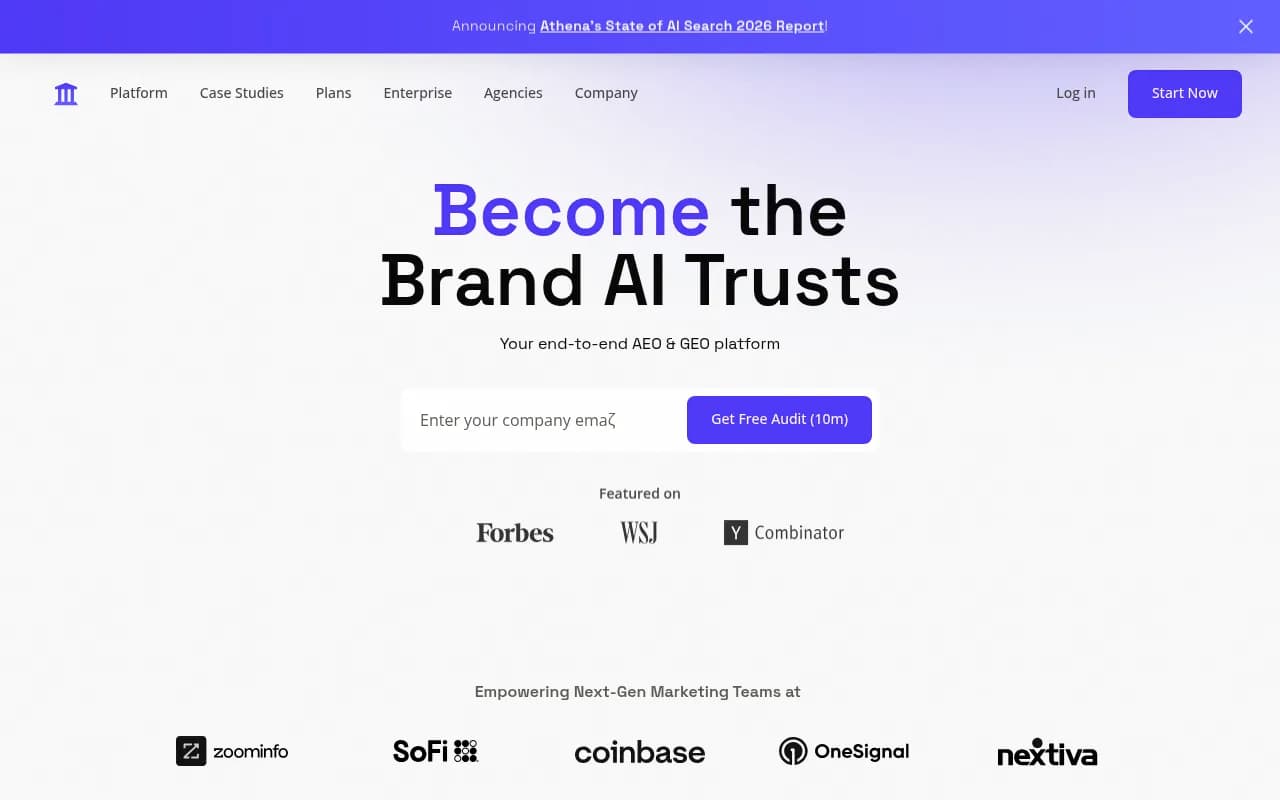
The platform has real traction. Customers include SoFi, ZoomInfo, and Wix, and it holds a 4.9 rating on G2. Its "State of AI Search 2026" report found that only 17.2% of AI responses mention any particular brand on average -- but teams actively optimizing for AI search can reach up to 56.7% of AI answers.
That's a compelling data point, and AthenaHQ does a good job of showing you where you stand relative to that benchmark.
Where it gets harder is the "now what?" question. AthenaHQ's workflow is oriented toward discovery and analysis: audit your AI visibility, see where competitors are cited, identify blindspots. The platform surfaces what's missing but doesn't have built-in tools to help you fix it. You're expected to take those insights and act on them separately -- in your content team, your CMS, your writing workflow.
For enterprise teams with dedicated content operations and a need for unlimited-seat pricing, that's workable. For marketing teams that need to move from insight to action without a lot of manual handoff, it creates friction.
SE Ranking: full SEO suite with AI monitoring added on
SE Ranking is a different kind of tool entirely. It's been a well-established SEO platform for years -- keyword tracking, backlink analysis, site audits, competitor research. In 2025, it expanded into AI visibility through its SE Visible product, which tracks brand mentions and sentiment across AI search engines.
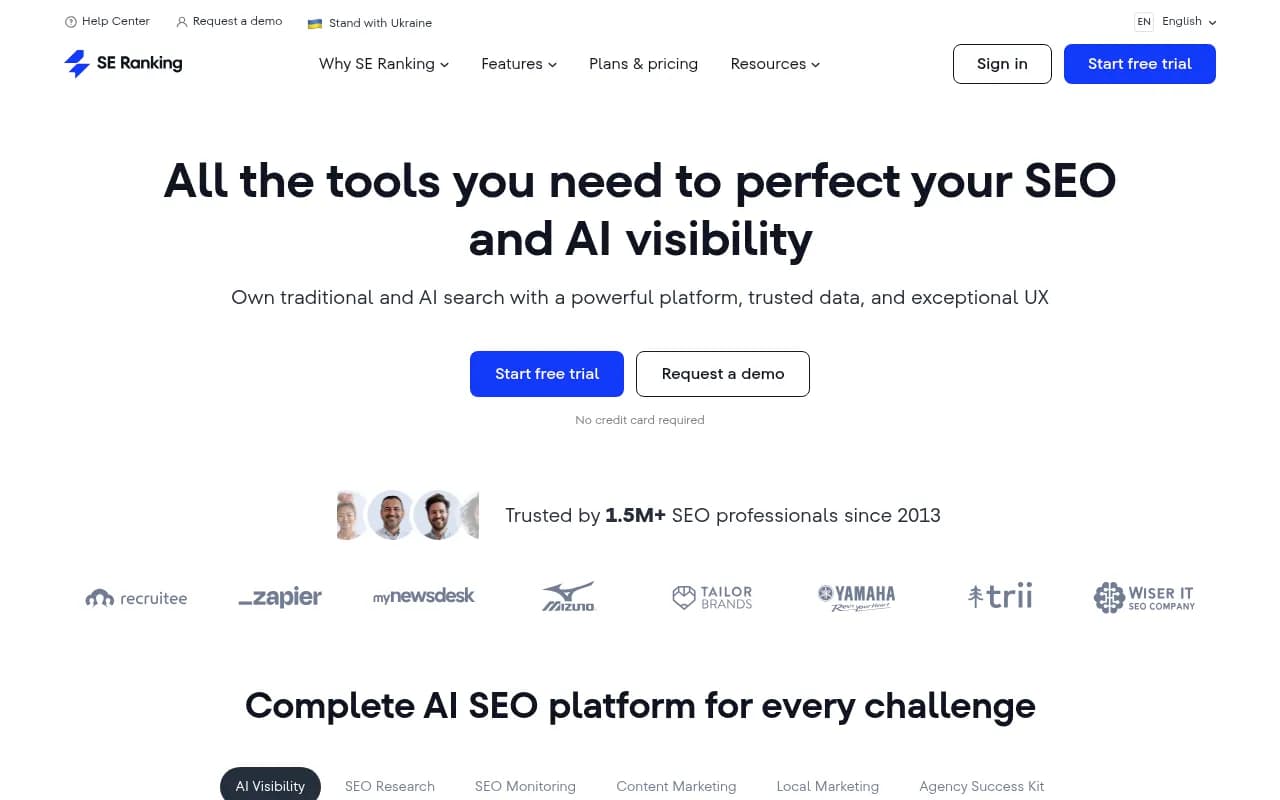
The appeal here is consolidation. If you're already paying for SE Ranking to manage traditional SEO, getting AI visibility data in the same platform is genuinely convenient. You don't need a separate login, a separate dashboard, or a separate budget line.
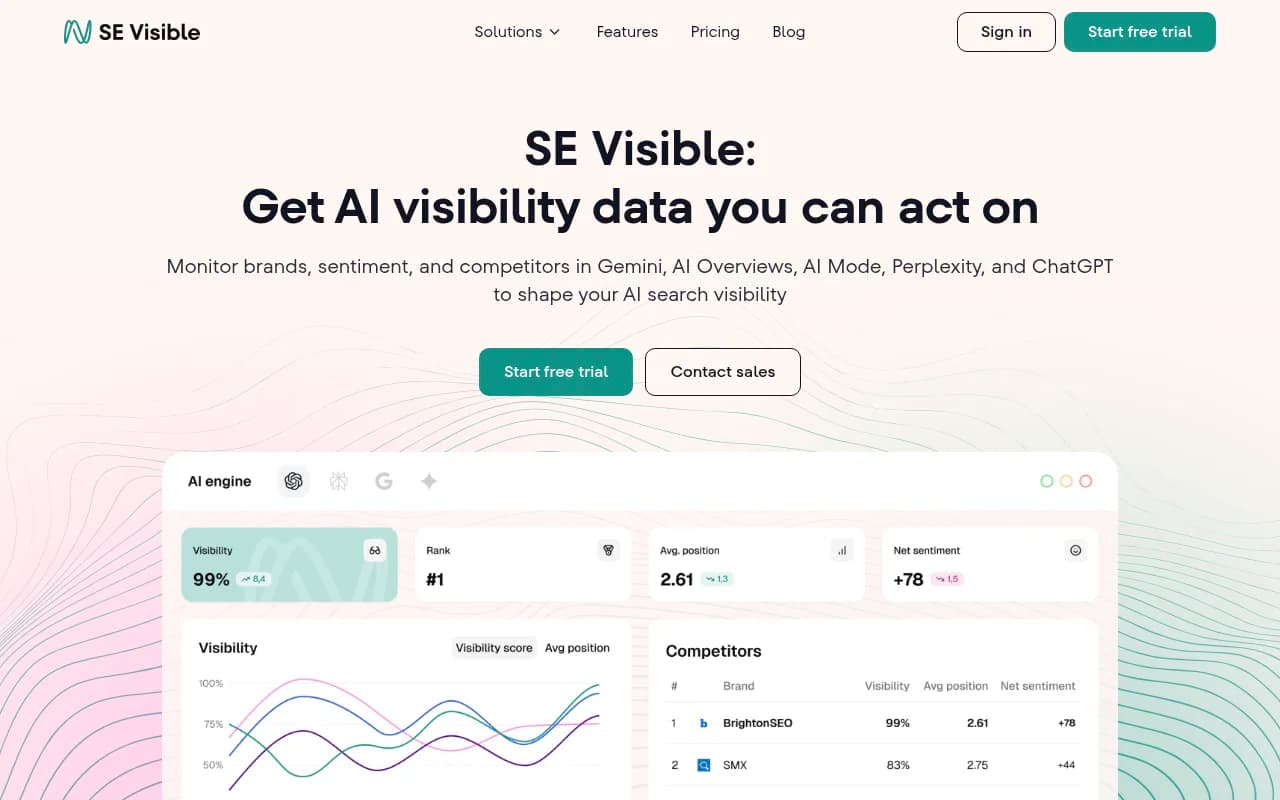
The tradeoff is depth. SE Ranking's AI visibility features are solid for what they are -- brand mention tracking, sentiment analysis, share of voice -- but they're not as granular as a purpose-built AI visibility tool. Model coverage is narrower, prompt volume data is less detailed, and there's no content generation or optimization layer.
That's not a knock on SE Ranking as a product. It's a great SEO platform. But if AI visibility is your primary concern in 2026, you're getting a secondary feature set, not a primary one. Teams that are mostly doing traditional SEO with some curiosity about AI search will find it useful. Teams that are seriously trying to improve their AI citation rates will probably outgrow it quickly.
Promptwatch: the action loop
Promptwatch takes a different approach to the problem. Where AthenaHQ and SE Ranking are primarily monitoring tools, Promptwatch is built around what it calls an action loop: find the gaps, create content that gets cited, track whether it worked.

The gap analysis piece works like this: Promptwatch shows you exactly which prompts your competitors are visible for that you're not. Not vague category-level data -- specific prompts, with visibility scores, prompt volume estimates, and difficulty ratings. You can see the precise questions AI models are answering where your content isn't showing up.
From there, the built-in AI writing agent generates articles, listicles, and comparison pages grounded in citation data from 880M+ analyzed citations. The content isn't generic -- it's engineered around what AI models actually cite, which topics they want authoritative sources for, and which angles competitors are already covering.
Then you track whether the content works. Page-level tracking shows which specific pages are being cited by which AI models, how often, and with what sentiment. Traffic attribution (via a code snippet, Google Search Console integration, or server log analysis) connects AI visibility to actual website traffic and revenue.
A few other capabilities worth knowing about: Promptwatch logs real-time AI crawler activity on your site (which pages ChatGPT, Claude, and Perplexity are reading, how often they return, any errors they hit), tracks Reddit and YouTube discussions that influence AI recommendations, and monitors ChatGPT Shopping carousels for product-level visibility.
It covers 10 AI models: ChatGPT, Perplexity, Google AI Overviews, Google AI Mode, Claude, Gemini, Meta/Llama, DeepSeek, Grok, Mistral, and Copilot.
Head-to-head comparison
| Feature | AthenaHQ | SE Ranking | Promptwatch |
|---|---|---|---|
| AI model coverage | 8+ models | Limited (via SE Visible) | 10 models |
| Prompt tracking | Yes | Basic | Yes, with volume + difficulty scores |
| Citation analysis | Deep | Basic | Deep (880M+ citations) |
| Content gap analysis | Limited | No | Yes (Answer Gap Analysis) |
| AI content generation | No | No | Yes (built-in writing agent) |
| AI crawler logs | No | No | Yes |
| Reddit/YouTube tracking | No | No | Yes |
| ChatGPT Shopping tracking | No | No | Yes |
| Traffic attribution | No | No | Yes (snippet, GSC, server logs) |
| Traditional SEO features | No | Yes (full suite) | No |
| Best for | Enterprise AEO monitoring | SEO teams wanting AI data too | Teams wanting to improve AI visibility |
| Starting price | Custom/enterprise | ~$65/mo (SE Ranking core) | $99/mo |
Which tool fits which situation?
You should consider AthenaHQ if...
Your team is enterprise-scale, you need unlimited seats, and your primary goal is understanding AI citation patterns at a granular level. AthenaHQ's citation intelligence is genuinely strong, and if you have a content team that can act on the insights independently, the monitoring depth is valuable. It's also worth considering if you're doing competitive research on AI search and need broad model coverage.
You should consider SE Ranking if...
You're already embedded in a traditional SEO workflow and want AI visibility data without adding another tool to your stack. SE Ranking's AI features won't satisfy a team that's seriously focused on GEO, but for a marketing team that's primarily doing keyword research, rank tracking, and site audits -- and wants a basic read on AI brand mentions -- it's a reasonable add-on.
You should consider Promptwatch if...
Your goal is actually improving AI visibility, not just measuring it. The action loop -- gap analysis, content generation, result tracking -- is what separates Promptwatch from monitoring-only tools. It's also the right choice if you want to understand how AI crawlers interact with your site, track Reddit and YouTube influence on AI recommendations, or connect AI visibility to revenue attribution.
For marketing teams, SEO teams, and agencies that want to move from "we're invisible in AI search" to "we're being cited regularly," Promptwatch is the most complete path.
A note on the broader market
It's worth stepping back for a second. The research from AthenaHQ's own State of AI Search report makes a useful point: the average brand appears in only 17.2% of relevant AI responses. That's a massive visibility gap for most companies.
The tools in this comparison all address that gap differently. AthenaHQ shows you the gap clearly. SE Ranking gives you a rough sense of it alongside your traditional SEO data. Promptwatch shows you the gap and then helps you close it.
That distinction matters more than any individual feature comparison. A monitoring dashboard that tells you you're invisible is only useful if you can do something about it. The tools that will win in 2026 are the ones that connect insight to action.
Pricing overview
| Tool | Entry price | What you get |
|---|---|---|
| AthenaHQ | Custom (enterprise-focused) | AI citation monitoring, broad model coverage, unlimited seats |
| SE Ranking | ~$65/mo (core SEO platform) | Full SEO suite + basic AI visibility via SE Visible |
| Promptwatch Essential | $99/mo | 1 site, 50 prompts, 5 articles, 10 AI models |
| Promptwatch Professional | $249/mo | 2 sites, 150 prompts, 15 articles, crawler logs, city tracking |
| Promptwatch Business | $579/mo | 5 sites, 350 prompts, 30 articles, full feature set |
Promptwatch offers a free trial. SE Ranking has a trial period. AthenaHQ pricing is typically negotiated at the enterprise level.
Final take
These three tools aren't really competing for the same customer.
SE Ranking is for SEO teams that want everything in one place and are happy with surface-level AI monitoring. AthenaHQ is for enterprise teams that need deep AEO citation intelligence and have the resources to act on it separately. Promptwatch is for teams that want to actually move the needle on AI visibility -- find the gaps, create the content, prove the results.
If you're trying to decide between them, the honest question to ask is: do you need to understand your AI visibility, or do you need to improve it? The answer points pretty clearly to which tool fits.