Key takeaways
- Past 50 locations, pricing model matters more than feature lists. Local Falcon charges credits, BrightLocal charges per location band, and Yext and Birdeye quote custom deals.
- Local-specific tools (Local Falcon, BrightLocal, Yext Scout, Birdeye) track locations on a map. Generic AI visibility platforms track brands and prompts. Most agencies need one of each.
- AI answers are crowded. Promptwatch Data found 47.6% of ChatGPT responses with citations name 10 or more domains, so a location is rarely the only option shown.
- Several vendor claims conflict with each other (model counts, price lists, AI coverage). Verify on the live pricing page before you sign.
Why 50+ locations changes the buying decision
At 10 locations you can get away with almost anything. A spreadsheet, a few logins, a monthly screenshot. At 50 or more, the workload compounds. Every location has its own Google Business Profile, its own review stream, its own competitors, and now its own presence (or absence) in ChatGPT, Gemini, and Google AI Overviews.
Three things break first:
- Cost per location. A tool that looks cheap for 5 clients can get expensive at 60.
- Reporting. Assembling white-label reports by hand eats whole afternoons.
- Measurement. AI answers vary by prompt, so one spot check tells you almost nothing.
That last point deserves attention. According to Promptwatch Data on unique domains per ChatGPT response (Sep 28 to Oct 4, 2026), 47.6% of responses with citations cite 10 or more domains, and 52.5% of organic prompts where no brand is named do the same. Your client's location is almost always one of many options. So track its position and how the answer describes it, not just whether it appears. And measure across lots of prompts.
Two kinds of platform, and why you probably need both
The category is muddled, so here is the split I use.
Local-first platforms start from the location. They run geo-grid scans, sync listings, manage reviews, and have bolted AI visibility on top. Local Falcon, BrightLocal, Yext Scout, Birdeye, Uberall, and Synup live here.
Brand-level AI visibility platforms start from the prompt. They track how a brand shows up across ChatGPT, Perplexity, Gemini, and others, and many go on to help you fix it. They are usually weaker at per-location, per-neighbourhood detail.
For a 50+ location account, the local-first tool is your operating system and the AI visibility platform is your strategy layer.
Comparison table
| Platform | Type | Pricing model | AI coverage | Best for |
|---|---|---|---|---|
| Local Falcon | Local-first | Credits, unlimited locations | ChatGPT, Gemini, AI Overviews, AI Mode | Agencies who want geo-grid data at any scale |
| BrightLocal | Local-first | Per-location bands | Local AI Visibility Tracker (ChatGPT and Google AIs) | Agencies that want predictable per-location cost |
| Yext Scout | Local-first, enterprise | Custom | Vendor says 4-5 AI models, up to 20 competitors per scan | Brands with large location counts |
| Birdeye | Local-first, enterprise | Custom | Gemini, ChatGPT, Perplexity at location level | 100 to 10,000+ locations |
| Uberall | Local-first | Add-on (GEO Studio) | Nine models listed in Yext's comparison | Listings-heavy brands |
| Promptwatch | AI visibility and optimization | Tiered, from $95/mo | Real UI tracking across 10+ AI engines | The strategy and content layer |
Local Falcon: best for geo-grid AI tracking at scale
Local Falcon runs the same geo-grid scan it uses for Google Maps and Apple Maps on ChatGPT, Gemini, AI Overviews, and AI Mode. It reports Share of AI Voice, which competitors were named, and which sources were cited. Note that Gemini tracking for multiple locations works for locations connected to a Google account.
The pricing is where it gets interesting. Every plan has unlimited locations and keywords. You pay for credits, not locations. Monthly plans run from $24.99 (Starter, 7,500 credits) to $199.99 (Premium, 63,000 credits), and Enterprise packages run $499 to $4,999 per month.
The vendor's own worked examples:
- A 7x7 grid scan uses 49 credits.
- 500 locations with 5 keywords scanned once a month uses 122,500 credits, which fits Enterprise 1 at $499 per month.
- 15 locations with 5 keywords scanned four times a month uses 14,700 credits, which fits the $49.99 Basic plan.
The pitfall is obvious once you do the math. Cost scales with scan frequency x grid size x keywords x locations, and competitor scans burn credits too. A 21x21 grid is 441 points per scan. Decide on grid sizes up front or you will blow through a plan in a week.
Extras worth knowing: Falcon Agent can reply to reviews, schedule GBP posts, and update listings across connected locations. Falcon Guard costs $0.10 per location per month. There is a Looker Studio connector, a remote MCP server, and locations can be grouped by region, brand, or franchisee, which matters for franchise clients.
BrightLocal: best for predictable per-location pricing
BrightLocal is the opposite model. You pay by location band, and the AI tracker is included.
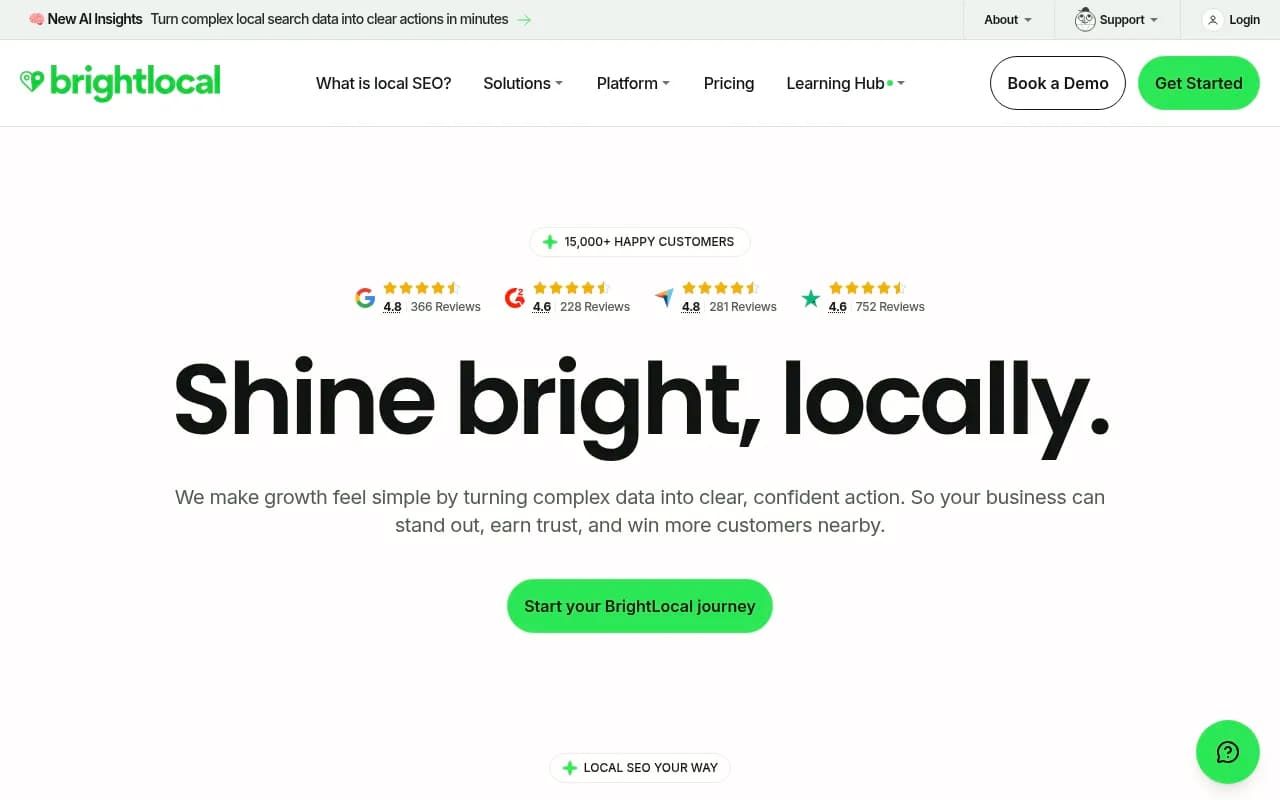
Per BrightLocal's pricing page (annual rates, per month):
| Locations | Track | Manage | Grow |
|---|---|---|---|
| 41 to 50 | $196 | $288 | $370 |
| 51 to 60 | $236 | $346 | $445 |
| 91 to 100 | $393 | $577 | $742 |
Monthly billing at 51 to 60 locations runs $314, $461, and $593 for the three tiers. The Local AI Visibility Tracker (ChatGPT and Google's AIs) is in all plans, and the page lists AI Insights, an AI Insights API, and an MCP server. The GBP Post Scheduler and review monitoring sit in the Grow tier. At 250+ locations, it is quote-led.
A caution: third-party pages disagree on BrightLocal's prices. One competitor guide lists older rates and claims BrightLocal has no AI tracking, which BrightLocal's own page contradicts. Trust the live page, and check which line item is a managed service before budgeting.
Yext Scout and Uberall: enterprise listings plus AI visibility
Yext markets Scout with figures like 10B signals, 150 visibility metrics, and 20 competitors per scan. It reports brand-level share of voice and location-level Win Rate, and an Action Center executes fixes. Public pricing is not listed, so expect an enterprise quote.
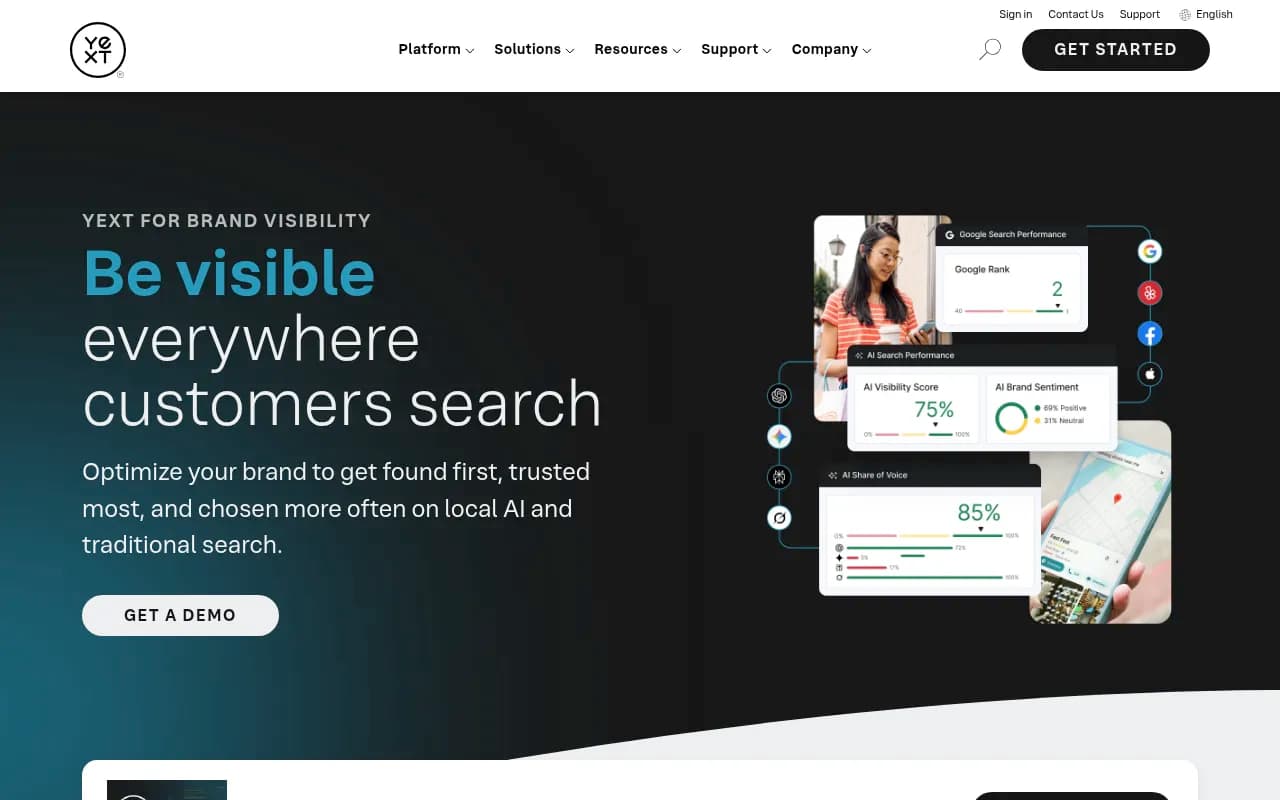
One discrepancy to flag: Yext's own comparison page says four AI models, while a GMBapi roundup lists ChatGPT, Gemini, Perplexity, and AI Overviews, and the Scout page says five. Ask for the current list in a demo.
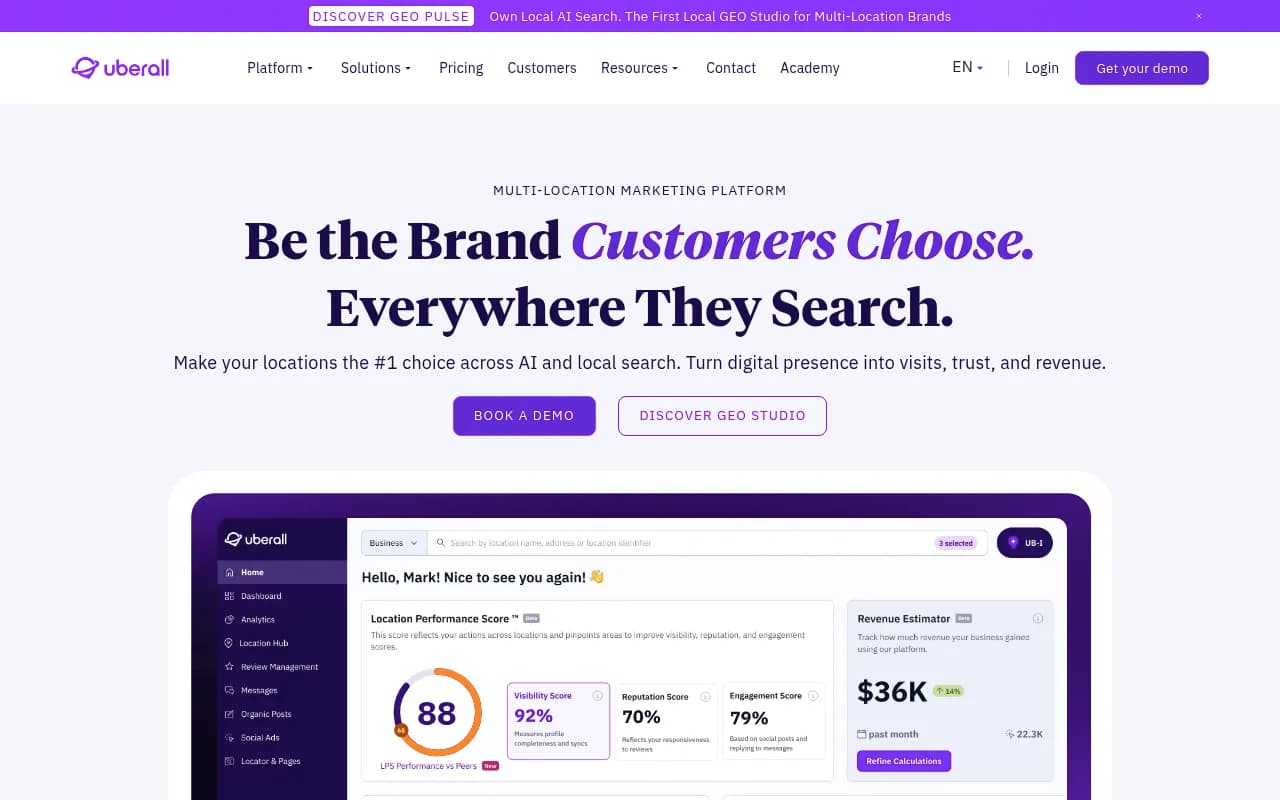
Uberall sells GEO Studio as an add-on. Per Yext's description of it (so verify on Uberall's site), it lists nine AI models, source breakdowns including Reddit, TikTok, and YouTube, and hallucination detection.
Birdeye, Synup and the reputation-led options
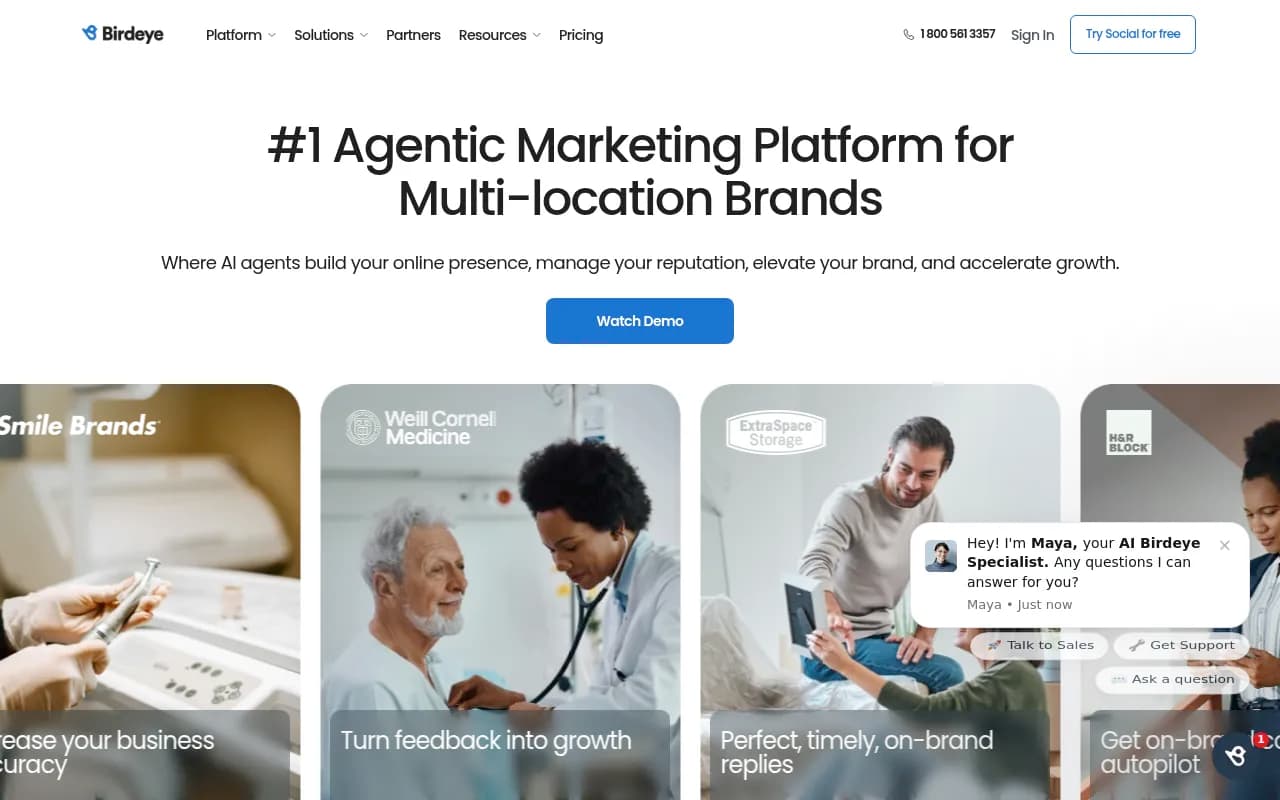
Birdeye positions its Search AI for 100 to 10,000+ locations, with custom pricing based on locations and modules. It tracks Gemini, ChatGPT, and Perplexity at location level. Birdeye also claims Yext Scout is mostly brand and category scanning. Treat that as competitor marketing, and test both on a real client.
Synup is a listings and reputation platform with an AI agent angle. Pricing was not verified here, so ask for a quote.
If reviews are your main bottleneck, look at Chatmeter, Reputation.com, and Vendasta for the agency resale model.
Adding the strategy layer: brand-level AI visibility
Geo-grids tell you where a location shows up. They do not tell you why a competitor gets named instead, or which pages the AI is actually reading. That is the job of an AI visibility platform.
Promptwatch is the one I would put next to a local-first tool. It tracks the real interfaces of ChatGPT, Google AI Overviews, AI Mode, Gemini, Perplexity, and Copilot by country (and by state or city from the Business plan), and shows the AI crawler logs and citation data behind the results. For agencies, the Kick-off, Growth, and Scale plans start at $199 per month with unlimited projects, white-label reporting, and a client portal. Confirm current pricing at promptwatch.com/pricing.

It is not a local-pack tool. Promptwatch does not run Maps geo-grids, and there is no Promptwatch Data report specific to Maps citations. What it does well is the part local tools skip: which pages get cited, which crawlers hit errors, and what content to publish to close the gap.
Budget and alternative options in our catalog, none of them local-specific:
- Otterly.AI at $29 to $489 per month
- Nightwatch from $32 per month
- Tibly, which targets local businesses


For more options, the GEO software directory at bestgeosoftware.com is a decent place to compare.
What to optimize once you can measure
Measurement only helps if you change something. Promptwatch Data gives some direction for location pages.
In its content type report (Sep 28 to Oct 4, 2026), product pages were 22.4% of classified ChatGPT citations and landing pages 16.8%, so about 39% of citations go to pages describing what a company sells. For commercial prompts, the "best plumber near me" type, product pages hit 26.0% and landing pages 20.6%. Reviews are 1.7% overall but 5.6% on branded prompts.
Practical takeaways for each location:
- Keep location and service pages factual and complete.
- Add FAQ sections.
- Collect reviews on the sites trusted in the category.
Social presence also differs by engine. In Promptwatch's October 2026 social citation data, social platforms were 0.46% of ChatGPT citations but 12.2% for Google AI Overviews, where YouTube (4.28%), Facebook (2.38%), and Instagram (1.61%) all show up. So public Facebook pages and YouTube matter for AI Overviews, and barely for ChatGPT. ChatGPT's Reddit citations also collapsed on August 14, 2026, so a Reddit-heavy local plan is risky.
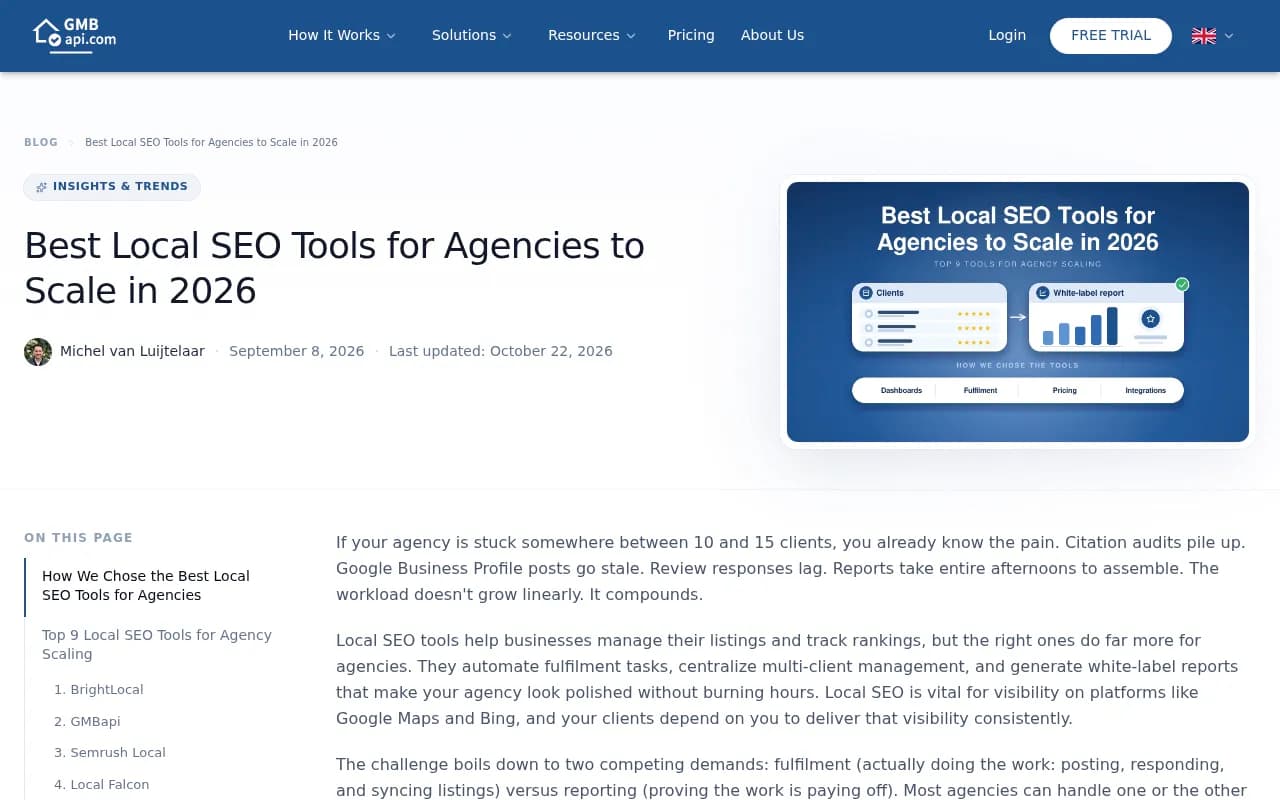
GMBapi's roundup is useful for a quick overview of agency-focused tools, but it is vendor-authored. Its claim that Local Falcon tracks eight AI platforms conflicts with Local Falcon's own pages, which name four. Use the vendor's list.
How to pick: a 50+ location decision framework
- Count scans, not just locations. If you want weekly geo-grid data, model the credits in Local Falcon before comparing prices.
- Price at your real count. BrightLocal at 51 to 60 locations on annual Grow is $445 per month. At 91 to 100 it is $742. Check where your book of business will be in a year.
- Decide who does fulfilment. If you want automated review replies and post scheduling, check which tier unlocks them. In BrightLocal that is Grow.
- Ask about white-label limits. GMBapi's white-label pricing is aimed at 500+ locations, so smaller agencies should check carefully.
- Test AI coverage on a known client. Pick a location you know ranks in ChatGPT and see whether the tool agrees.
- Pair with a content layer. Visibility data without a publishing workflow just creates more reports.
A sensible stack by agency size
| Agency situation | Suggested stack |
|---|---|
| 50 to 100 locations, hands-on team | BrightLocal (Manage or Grow) plus Promptwatch Kick-off or Growth |
| 100 to 500 locations, geo-grid heavy | Local Falcon Enterprise credits plus Promptwatch for strategy and content |
| Franchise or enterprise brand, 500+ | Yext Scout or Birdeye on a custom quote, with an AI visibility platform for content gaps |
| Tight budget | Local Falcon Basic or Starter plus a low-cost tracker like Otterly.AI |
Pitfalls to avoid
- Trusting vendor-written comparisons. Local Dominator, Birdeye, Yext, Lighthouse Local, and GMBapi each favour their own product. Read them for ideas, not verdicts.
- Reporting a single prompt. One answer is an anecdote. Aggregate across many prompts.
- Ignoring crawler access. If AI bots cannot read a location page, no listing tool fixes that.
- Forgetting model-specific behaviour. ChatGPT, AI Overviews, and Perplexity cite very different sources.
If you would rather hand the work off than assemble the stack, a specialist like 1001 SEO Media runs local SEO and GEO programs for multi-location brands.
Bottom line
For 50+ locations, start with the pricing model that fits your scan habits (Local Falcon credits or BrightLocal bands), add an enterprise option only if the client base demands it, and bolt on an AI visibility platform for the content work. Verify every price and model list on the live vendor page, because several of the public claims above contradict each other. More tool options are in the AI rank tracking directory at ai-rank-tools.com.