Key Takeaways
- LLM Pulse is AI-only: Tracks brand visibility across ChatGPT, Perplexity, Gemini, and Google AI Mode exclusively. No traditional SEO rank tracking. Starts at €49/month for 40 prompts.
- Nightwatch does both: Combines traditional keyword rank tracking (Google, Bing, Yahoo, DuckDuckGo) with AI search monitoring (ChatGPT, Gemini, Claude, Perplexity). Starts at $32/month.
- Price difference matters at scale: LLM Pulse's €299/month Scale plan covers 300 prompts across 5 projects. Nightwatch's pricing structure is built around keyword tracking volume, not prompt counts.
- LLM Pulse has deeper AI analytics: Citation analysis, sentiment tracking, and AI-powered content recommendations are core features. Nightwatch's AI tracking is newer and less developed.
- Nightwatch is better for agencies: If you're managing traditional SEO campaigns alongside AI visibility, Nightwatch's unified dashboard saves you from juggling two tools.
- LLM Pulse is better for pure AI search optimization: If your entire strategy revolves around how AI models describe your brand, LLM Pulse's focus gives you more depth.
Overview
LLM Pulse
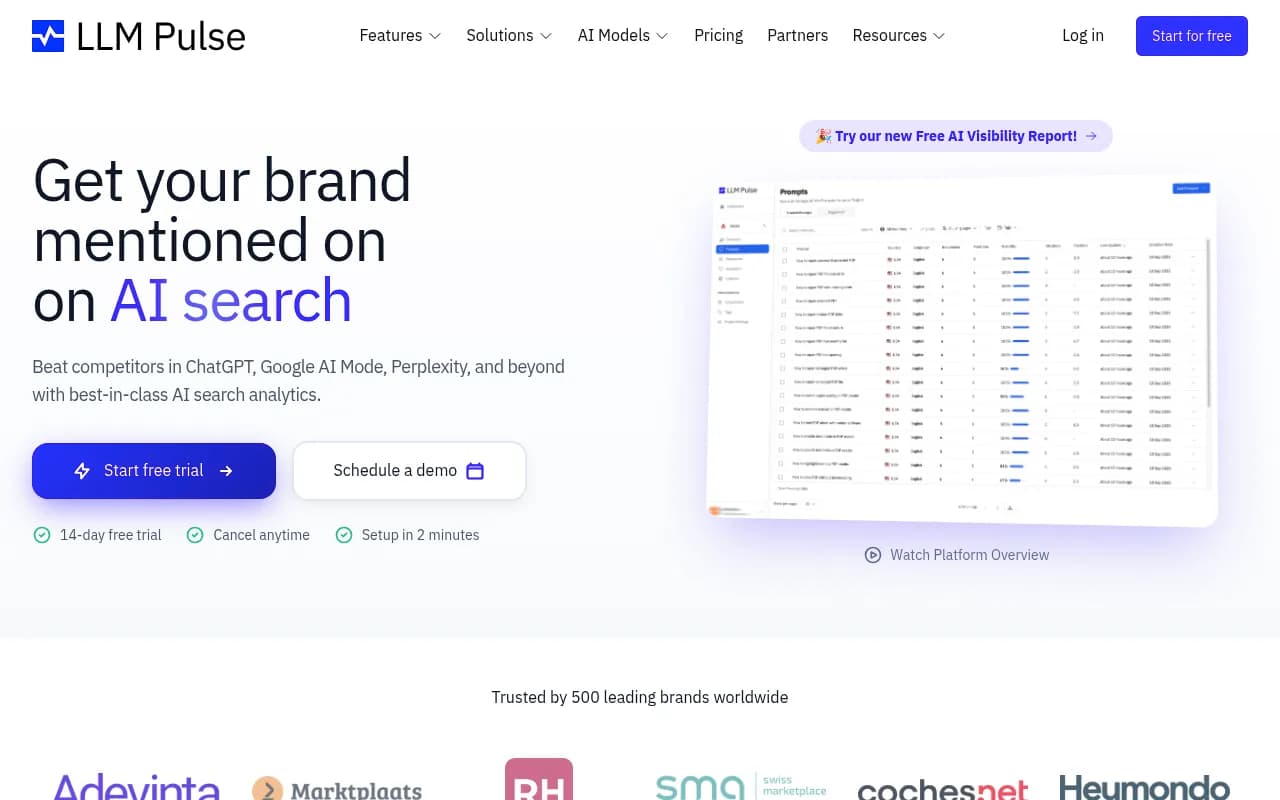
LLM Pulse launched as a dedicated AI search visibility tracker. It monitors how ChatGPT, Perplexity, Gemini, and Google AI Mode describe your brand when users ask questions in your industry. The platform tracks prompts weekly, measures visibility scores, analyzes which sources AI models cite, and benchmarks your performance against competitors. 500+ brands use it to understand their AI search presence.
The tool is built around three steps: track key prompts, analyze your visibility and citation rates, and get AI-powered recommendations to improve how you appear in LLM responses. It's a monitoring and optimization platform, not just a tracker.
Nightwatch
Nightwatch started as a traditional SEO rank tracker and added AI search monitoring in 2024-2025. It positions itself as "the most evolved SEO performance tracker" that covers both traditional search engines (Google, Bing, Yahoo, DuckDuckGo) and generative AI platforms (ChatGPT, Gemini, Claude, Perplexity).
The pitch is unified visibility: don't settle for partial coverage when you can track everything in one dashboard. Nightwatch emphasizes data accuracy, real-time updates, and precise localization (107,000+ locations down to zip code level). It's built for agencies and teams managing large-scale SEO campaigns who also need to monitor AI search.
Side-by-Side Comparison
| Feature | LLM Pulse | Nightwatch |
|---|---|---|
| AI models tracked | ChatGPT, Perplexity, Gemini, Google AI Mode, AI Overviews (5 base + 5 enterprise) | ChatGPT, Gemini, Claude, Perplexity (4 models) |
| Traditional SEO tracking | None | Yes (Google, Bing, Yahoo, DuckDuckGo) |
| Starting price | €49/month (40 prompts) | $32/month |
| Mid-tier price | €149/month (150 prompts, 3 projects) | Not disclosed (custom based on keywords) |
| High-tier price | €299/month (300 prompts, 5 projects) | Not disclosed (enterprise custom) |
| Free trial | 14 days | 14 days |
| Citation analysis | Yes (core feature) | Limited |
| Sentiment tracking | Yes | Not mentioned |
| Content recommendations | Yes (AI-powered) | Via SEO Agent (separate feature) |
| Competitor benchmarking | Yes (share of voice) | Yes |
| Prompt research | Yes | Yes |
| Real-time updates | Weekly tracking | On-demand refresh for critical keywords |
| Location targeting | Not specified | 107,000+ locations |
| Best for | Pure AI search optimization | Unified SEO + AI tracking |
Head-to-head feature breakdown
AI model coverage
LLM Pulse tracks 10 AI models total: ChatGPT, Perplexity, Gemini, Google AI Mode, and AI Overviews are available on all plans. DeepSeek, Grok, Claude, Copilot, and Meta AI require an Enterprise plan. The focus is depth over breadth -- each model gets detailed tracking with citation analysis and sentiment scoring.
Nightwatch covers 4 AI models: ChatGPT, Gemini, Claude, and Perplexity. The AI tracking feature is newer and less mature than LLM Pulse's. Nightwatch's strength is combining AI tracking with traditional rank tracking, not being the deepest AI-only tool.
Verdict: LLM Pulse wins on AI model coverage and depth of AI-specific analytics. Nightwatch covers the essentials but doesn't go as deep.
Traditional SEO tracking
LLM Pulse doesn't do traditional SEO rank tracking at all. It's purely focused on AI search visibility.
Nightwatch is built on traditional rank tracking. It monitors keyword positions across Google, Bing, Yahoo, and DuckDuckGo with real-time updates, precise localization, and on-demand refresh for critical keywords. The platform emphasizes data accuracy and can scale to millions of keywords.
Verdict: Nightwatch wins by default. If you need traditional SEO tracking, LLM Pulse isn't an option.
Pricing structure
LLM Pulse uses prompt-based pricing:
- Starter: €49/month (1 project, 40 prompts)
- Growth: €149/month (3 projects, 150 prompts)
- Scale: €299/month (5 projects, 300 prompts)
- Enterprise: Custom pricing
Annual billing saves 17%. The pricing is transparent and scales with the number of prompts you want to track.
Nightwatch starts at $32/month but doesn't publish a full pricing grid. The pricing is based on keyword tracking volume, not prompt counts. For traditional SEO campaigns tracking thousands of keywords, Nightwatch's pricing can scale quickly. The $32/month entry point is lower than LLM Pulse, but comparing apples-to-apples is hard because they measure different things.
Verdict: LLM Pulse has clearer pricing for AI-only tracking. Nightwatch's pricing is opaque but starts cheaper.
Citation and source analysis
LLM Pulse makes citation analysis a core feature. You see which sources AI models reference when they mention your brand or competitors. This helps you understand which content AI trusts and whether your own content is being cited.
Nightwatch mentions "prompt analysis" but doesn't emphasize citation tracking the way LLM Pulse does. The AI tracking feature is more about visibility scores than deep source analysis.
Verdict: LLM Pulse is significantly better for understanding which sources shape AI responses.
Content optimization and recommendations
LLM Pulse includes AI-powered content recommendations as part of the core workflow. After analyzing your visibility and citations, it suggests how to improve your content to get cited more often by AI models.
Nightwatch has an "SEO Agent" feature that automates SEO workflows, but it's positioned as a separate capability, not tightly integrated with the AI tracking. The focus is more on traditional SEO optimization than AI-specific content recommendations.
Verdict: LLM Pulse has a tighter loop between tracking and optimization for AI search specifically.
Competitor benchmarking
Both tools offer competitor benchmarking. LLM Pulse tracks "share of voice" -- how often you're mentioned vs competitors across AI models. You can see which competitors are winning for specific prompts and track changes over time.
Nightwatch also benchmarks competitors but within the context of traditional SEO metrics (keyword rankings, search visibility) alongside AI visibility.
Verdict: Tie. Both handle competitor benchmarking, just in different contexts.
Dashboard and reporting
LLM Pulse's dashboard is built around prompt tracking. You see visibility scores, citation rates, sentiment, and share of voice for each prompt you're monitoring. The interface is focused on AI search metrics exclusively.
Nightwatch's dashboard is more complex because it's handling both traditional SEO data and AI tracking. The platform emphasizes customization and real-time data. It also integrates with Looker Studio for custom reporting.
Verdict: Depends on your needs. LLM Pulse's dashboard is cleaner if you only care about AI search. Nightwatch's is more powerful if you're managing a full SEO operation.
Ease of setup
LLM Pulse claims "setup in 2 minutes." You create a project, add prompts you want to track, and the platform starts monitoring. It's straightforward.
Nightwatch requires more setup because you're configuring keyword tracking, locations, search engines, and AI models. The learning curve is steeper if you're using the full feature set.
Verdict: LLM Pulse is faster to get started with.
Pricing comparison
| Plan | LLM Pulse | Nightwatch |
|---|---|---|
| Entry | €49/month (40 prompts, 1 project) | $32/month (details not public) |
| Mid-tier | €149/month (150 prompts, 3 projects) | Not disclosed |
| High-tier | €299/month (300 prompts, 5 projects) | Not disclosed |
| Enterprise | Custom | Custom |
| Free trial | 14 days | 14 days |
| Annual discount | 17% off | Not specified |
Direct comparison is difficult because LLM Pulse prices by prompts tracked while Nightwatch prices by keyword volume. If you're tracking 100 prompts in AI search and 5,000 keywords in traditional search, Nightwatch might be more expensive overall. If you're only tracking AI search, LLM Pulse's pricing is transparent and predictable.
Pros and cons
LLM Pulse pros
- Deep AI search analytics (citations, sentiment, visibility scores)
- AI-powered content recommendations built in
- Transparent prompt-based pricing
- Tracks 10 AI models (5 base + 5 enterprise)
- Fast setup and focused dashboard
- Weekly tracking keeps you informed without overwhelming you
LLM Pulse cons
- No traditional SEO rank tracking at all
- Weekly tracking might be too slow if you need real-time data
- Smaller feature set overall (it does one thing well, not many things)
- Enterprise models (DeepSeek, Grok, Claude, Copilot, Meta AI) require custom pricing
Nightwatch pros
- Unified dashboard for traditional SEO + AI search
- Real-time updates and on-demand keyword refresh
- Precise localization (107,000+ locations)
- Lower starting price ($32/month)
- Scales to millions of keywords
- Looker Studio integration for custom reporting
Nightwatch cons
- AI tracking is less mature than LLM Pulse's
- Pricing is opaque -- hard to predict costs at scale
- Steeper learning curve due to broader feature set
- Citation analysis and AI-specific optimization are weaker
- Only tracks 4 AI models vs LLM Pulse's 10
Who should pick which tool
Pick LLM Pulse if:
- Your entire strategy revolves around AI search visibility (ChatGPT, Perplexity, Gemini)
- You want deep citation analysis to understand which sources AI models trust
- You need AI-powered content recommendations to improve your visibility
- You're tracking a defined set of prompts (40-300) and want predictable pricing
- You don't care about traditional SEO rank tracking
- You're a brand, PR team, or content marketer focused on how AI describes you
Pick Nightwatch if:
- You're managing traditional SEO campaigns and want to add AI tracking without switching tools
- You need to track thousands of keywords across multiple search engines
- Real-time rank updates and precise location targeting matter to you
- You're an agency managing multiple clients with mixed SEO + AI needs
- You want one unified dashboard instead of juggling separate tools
- You're comfortable with custom pricing and want to scale to millions of keywords
If you're also looking to track how your brand shows up in AI search results and optimize content specifically for AI visibility, Promptwatch is worth checking out. It combines monitoring with content gap analysis and an AI writing agent that generates articles grounded in real citation data.

Final verdict
LLM Pulse and Nightwatch solve different problems. LLM Pulse is the better choice if AI search visibility is your primary concern and you want the deepest analytics available. Nightwatch is the better choice if you're running a full SEO operation and want to add AI tracking without managing a second tool.
The decision comes down to focus vs breadth. LLM Pulse does one thing exceptionally well. Nightwatch does many things competently. If you're a brand trying to understand how ChatGPT describes you, go with LLM Pulse. If you're an agency tracking 10,000 keywords and want to add AI visibility on top, go with Nightwatch.
Neither tool is a bad choice. They're just built for different users with different priorities.