Key takeaways
- Bluefish AI costs roughly $4,000+/month (quote-based) and targets Fortune 500 brands. Nightwatch starts at $32/month with a free trial -- they're not really competing for the same customer.
- Nightwatch is a hybrid tool: traditional SEO rank tracking plus AI visibility in one platform. Bluefish AI is a pure GEO/AI marketing platform with no traditional SEO features.
- Bluefish AI goes deeper on brand influence, AI commerce tracking, and custom audience segmentation. Nightwatch covers the basics of AI monitoring but doesn't offer content gap analysis or optimization workflows.
- Nightwatch onboards in days; Bluefish AI averages four weeks due to custom configuration requirements.
- If you're an SMB, agency, or mid-market team, Nightwatch is the practical choice. If you're a large enterprise brand that needs deep AI influence control and can justify the spend, Bluefish AI is in a different league.
- Neither tool offers built-in AI content generation to close the gaps they find -- for that, you'd need a platform like Promptwatch that combines monitoring with actual content optimization.
Overview
Bluefish AI
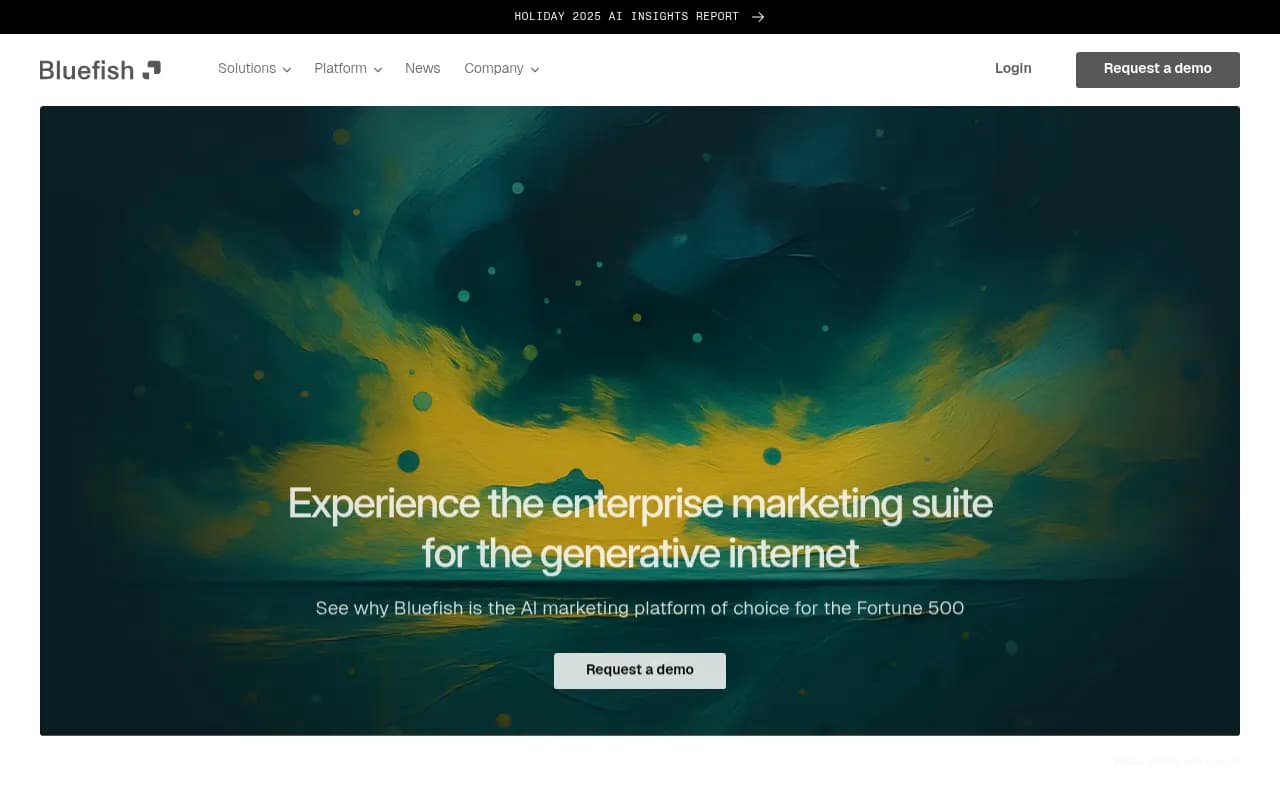
Bluefish AI positions itself as the enterprise GEO platform for Fortune 500 brands. The pitch is "authority, influence, and control" -- not just tracking where your brand shows up in AI responses, but understanding how AI models "think" about your brand and actively shaping that. It covers AI monitoring, GEO optimization, measurement, and AI commerce (agentic shopping). The platform is built around custom configurations: tailored prompts, custom audiences, and bespoke measurement frameworks. Onboarding takes about four weeks, and pricing is quote-based with estimates starting around $4,000/month. It's not a self-serve tool.
Nightwatch
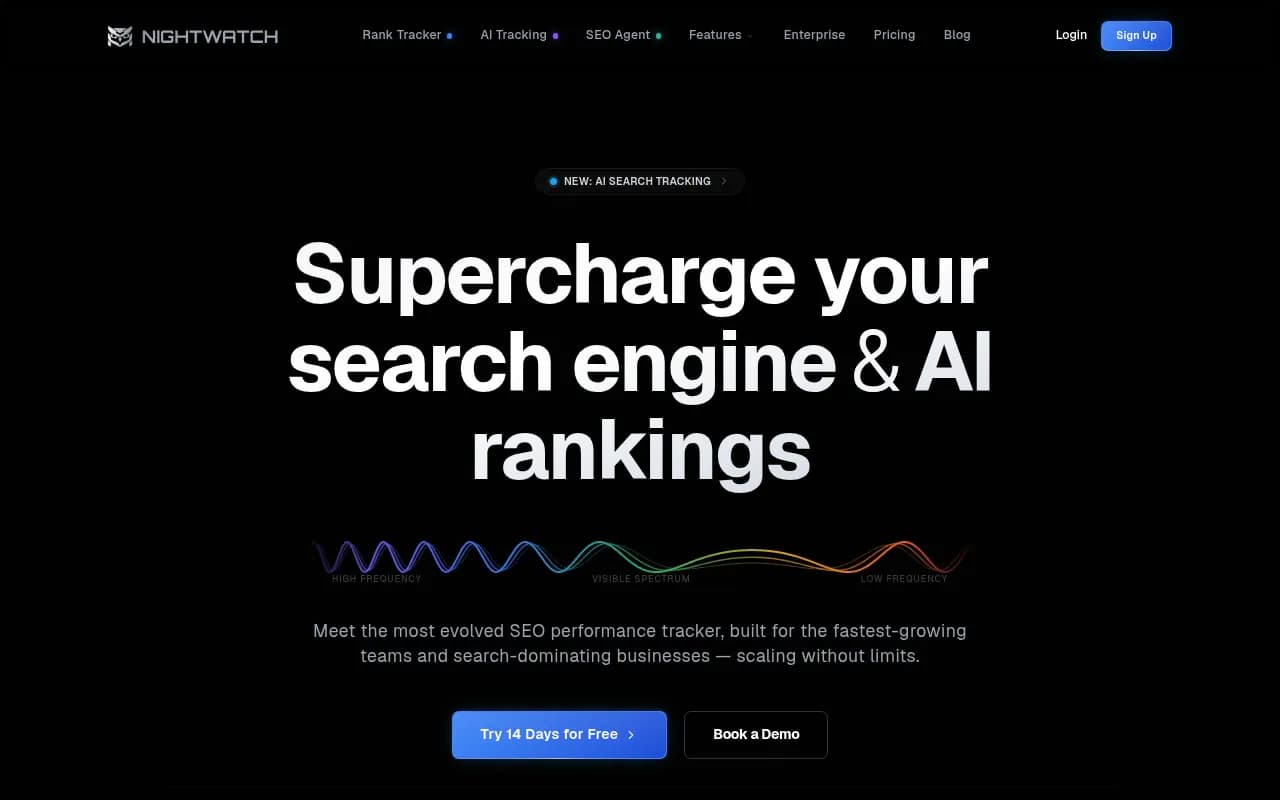
Nightwatch started as a precision SEO rank tracker and has expanded into AI visibility monitoring. It tracks keyword rankings across Google, Bing, Yahoo, and DuckDuckGo, while also covering AI engines like ChatGPT, Gemini, Claude, and Perplexity. The platform includes site audit, keyword research, prompt research, an SEO agent for workflow automation, and Looker Studio integration. Pricing starts at $32/month with a 14-day free trial. It's self-serve, fast to set up, and aimed at data-focused marketing teams, SEO professionals, and agencies who want unified search and AI tracking without managing two separate tools.
Side-by-side comparison
| Feature | Bluefish AI | Nightwatch |
|---|---|---|
| Starting price | ~$4,000+/month (quote) | $32/month |
| Free trial | No (demo only) | 14-day free trial |
| Target audience | Fortune 500 / enterprise | SMBs, agencies, SEO teams |
| Traditional SEO tracking | No | Yes (Google, Bing, Yahoo, DuckDuckGo) |
| AI search monitoring | Yes (deep) | Yes (basic-to-moderate) |
| AI engines covered | ChatGPT, Gemini, Perplexity, others | ChatGPT, Gemini, Claude, Perplexity |
| Content gap analysis | Limited | No |
| AI content generation | No | No |
| AI commerce / agentic tracking | Yes | No |
| Brand influence analysis | Yes (deep) | No |
| Prompt research | No | Yes |
| Site audit | No | Yes |
| Keyword research | No | Yes |
| Custom audience segmentation | Yes | No |
| Looker Studio integration | No (custom reporting) | Yes |
| White-label reporting | No | Yes (agency plans) |
| Onboarding time | ~4 weeks | Days |
| Infosec / enterprise compliance | Yes (passes reviews) | Standard |
| API access | Yes (enterprise) | Yes |
Head-to-head feature deep-dive
Pricing and accessibility
This is where the two tools diverge most sharply. Nightwatch has transparent, tiered pricing starting at $32/month, scaling up through mid-range plans and into enterprise custom pricing. You can sign up, start a free trial, and be tracking rankings within an hour. Bluefish AI doesn't publish pricing -- you request a demo, go through a sales process, and come out the other side with a contract that reportedly starts around $4,000/month for enterprise clients.
That's not a criticism of Bluefish AI specifically -- enterprise software often works this way. But it does mean the two tools are effectively in different markets. A 10-person agency or a growth-stage startup isn't Bluefish AI's customer. A Fortune 500 brand with a dedicated AI marketing budget isn't going to find Nightwatch's feature depth sufficient.
Verdict: Nightwatch wins on accessibility and price-to-value for any team that isn't enterprise. Bluefish AI's pricing reflects its positioning, not a flaw.
AI visibility monitoring
Both tools track brand visibility across major AI engines, but the depth is very different.
Bluefish AI's monitoring goes beyond "did your brand appear?" to analyze how AI models characterize your brand, what attributes they associate with it, and how that compares to competitors. The "Collections" feature (launched February 2026) lets you measure the ROI of specific marketing campaigns in the AI channel -- so you can see whether a Super Bowl ad actually moved the needle on how ChatGPT talks about your brand. That's a genuinely interesting capability.
Nightwatch tracks AI visibility at the prompt/keyword level. You can see whether your brand or pages appear in AI overviews and responses for specific queries, track changes over time, and compare against competitors. It's solid monitoring for most use cases, but it doesn't get into brand attribute analysis or campaign-level measurement.
Verdict: Bluefish AI is meaningfully deeper for enterprise brand monitoring. Nightwatch covers the basics well enough for most teams.
Traditional SEO capabilities
Nightwatch has them. Bluefish AI doesn't.
Nightwatch tracks rankings across 107,000+ locations down to zip code level, runs site audits, does keyword research, and has been doing this longer than it's been doing AI tracking. If you need a single tool that handles both your Google rankings and your AI visibility, Nightwatch is a real option.
Bluefish AI is purely focused on the AI channel. It doesn't track traditional search rankings, run technical audits, or do keyword research in the SEO sense. If you're a Bluefish AI customer, you presumably have separate SEO tooling.
Verdict: Nightwatch wins here by default -- it's a core part of the product. Not relevant to Bluefish AI's use case.
Content optimization and gap analysis
Neither tool is strong here, which is worth being direct about.
Bluefish AI talks about "actionability" and "optimization workflows," but the platform is primarily a monitoring and measurement tool. It helps you understand where you stand and what's happening, but it doesn't generate content or give you a specific list of articles to write.
Nightwatch has prompt research, which helps you find the queries people are using in AI engines -- useful for content planning. But it doesn't analyze which prompts your competitors rank for that you don't, and it doesn't generate content.
If closing content gaps in AI search is your primary goal, both tools leave you doing the heavy lifting yourself. Platforms like Promptwatch are built specifically around this loop -- finding gaps, generating content engineered for AI citation, and tracking whether it worked.

Verdict: Neither tool wins here. Both are monitoring-first platforms.
Onboarding and ease of use
Nightwatch is self-serve. You sign up, connect your site, add keywords and prompts, and you're running. The dashboard is clean and customizable, and the learning curve is manageable for anyone familiar with SEO tools.
Bluefish AI requires a sales process, a demo, and then a four-week onboarding period to configure custom audiences, alert rules, and measurement frameworks. That's not unusual for enterprise software, but it's a real time investment. The upside is that you get a configured platform tailored to your specific brand and competitive set rather than a generic setup.
Verdict: Nightwatch is faster and easier to get started. Bluefish AI's longer onboarding is a trade-off for deeper customization.
Reporting and integrations
Nightwatch has Looker Studio integration, white-label reporting for agencies, and a customizable dashboard. It's built for teams that want to share data with clients or stakeholders without a lot of manual work.
Bluefish AI has custom measurement frameworks and enterprise-grade data exports, but the reporting is more bespoke -- you work with their team to define what you're measuring. It's more powerful for complex enterprise reporting needs, but less plug-and-play.
Verdict: Nightwatch is better for agencies and teams that need quick, shareable reports. Bluefish AI suits enterprises with dedicated analytics teams.
AI commerce and agentic tracking
This is a Bluefish AI exclusive. As AI models increasingly handle product discovery and purchasing (think ChatGPT's shopping features), Bluefish AI tracks how brands appear in these agentic commerce contexts. This is a forward-looking capability that most GEO tools, including Nightwatch, don't have at all.
Verdict: Bluefish AI wins outright. Nightwatch doesn't play here.
Pricing comparison
| Plan | Bluefish AI | Nightwatch |
|---|---|---|
| Free tier | No | No (14-day trial) |
| Entry plan | ~$4,000+/month (est.) | $32/month |
| Mid-tier | Quote-based | ~$99-$199/month (est.) |
| Enterprise | Custom | Custom |
| Billing | Annual contract (est.) | Monthly or annual |
| Trial | Demo only | 14-day free trial |
Nightwatch's exact mid-tier pricing isn't fully published in the live data, but entry-level plans are confirmed at $32/month with scaling tiers. Bluefish AI's $4,000+/month estimate comes from third-party comparisons; actual pricing depends on brand size, number of prompts, and features required.
Pros and cons
Bluefish AI
Pros:
- Deep brand influence and attribute analysis that goes beyond simple visibility tracking
- AI commerce and agentic shopping tracking -- a capability most competitors lack
- Custom audience segmentation and tailored prompt sets for competitive markets
- Enterprise-grade infosec compliance and data security
- Campaign-level ROI measurement in the AI channel (Collections feature)
- Built for scale: handles complex, multi-brand enterprise setups
Cons:
- No transparent pricing -- requires a sales process
- ~$4,000+/month estimated cost puts it out of reach for most teams
- Four-week onboarding is a real time commitment
- No traditional SEO features -- you need separate tooling
- No content generation or gap analysis to act on what you find
- No free trial or self-serve option
Nightwatch
Pros:
- Affordable entry point at $32/month with a free trial
- Combines traditional SEO rank tracking with AI visibility in one platform
- Fast self-serve onboarding -- up and running in hours
- Covers 107,000+ locations for precise local tracking
- Prompt research helps with AI content planning
- Looker Studio integration and white-label reporting for agencies
- SEO agent for workflow automation
Cons:
- AI monitoring is less deep than dedicated GEO platforms
- No brand influence or attribute analysis
- No AI commerce or agentic tracking
- No content gap analysis or AI content generation
- Not built for enterprise-scale custom configurations
- Weaker competitive intelligence for AI search specifically
Who should pick which tool
Choose Bluefish AI if:
- You're at a large enterprise or Fortune 500 brand with a dedicated AI marketing budget
- You need to understand not just where your brand appears in AI, but how AI models characterize it
- AI commerce and agentic shopping are strategic priorities for your business
- You need enterprise-grade infosec compliance and custom data segmentation
- You have the time and resources for a four-week onboarding process
- You already have SEO tooling and just need deep AI channel coverage
Choose Nightwatch if:
- You're an SMB, agency, or mid-market team that can't justify $4,000+/month
- You want traditional SEO tracking and AI visibility in a single platform
- You need to get started quickly without a sales process
- You manage multiple client accounts and need white-label reporting
- You want prompt research to inform your content strategy
- You're exploring AI visibility for the first time and want a low-risk entry point
Final verdict
Bluefish AI and Nightwatch aren't really competing for the same customer, which makes this comparison less of a "which is better" question and more of a "which is right for your situation" one.
Bluefish AI is a serious enterprise platform with capabilities -- AI commerce tracking, brand attribute analysis, campaign-level measurement -- that Nightwatch simply doesn't have. If you're a large brand that needs that depth and can afford it, Bluefish AI is a legitimate choice.
Nightwatch is the practical option for everyone else. It's affordable, fast to set up, and covers both traditional SEO and basic AI visibility without forcing you to choose between them. For most marketing teams, that's the better trade-off.
The honest gap for both tools: neither helps you act on what you find. They show you the problem; you still have to solve it yourself.