Key takeaways
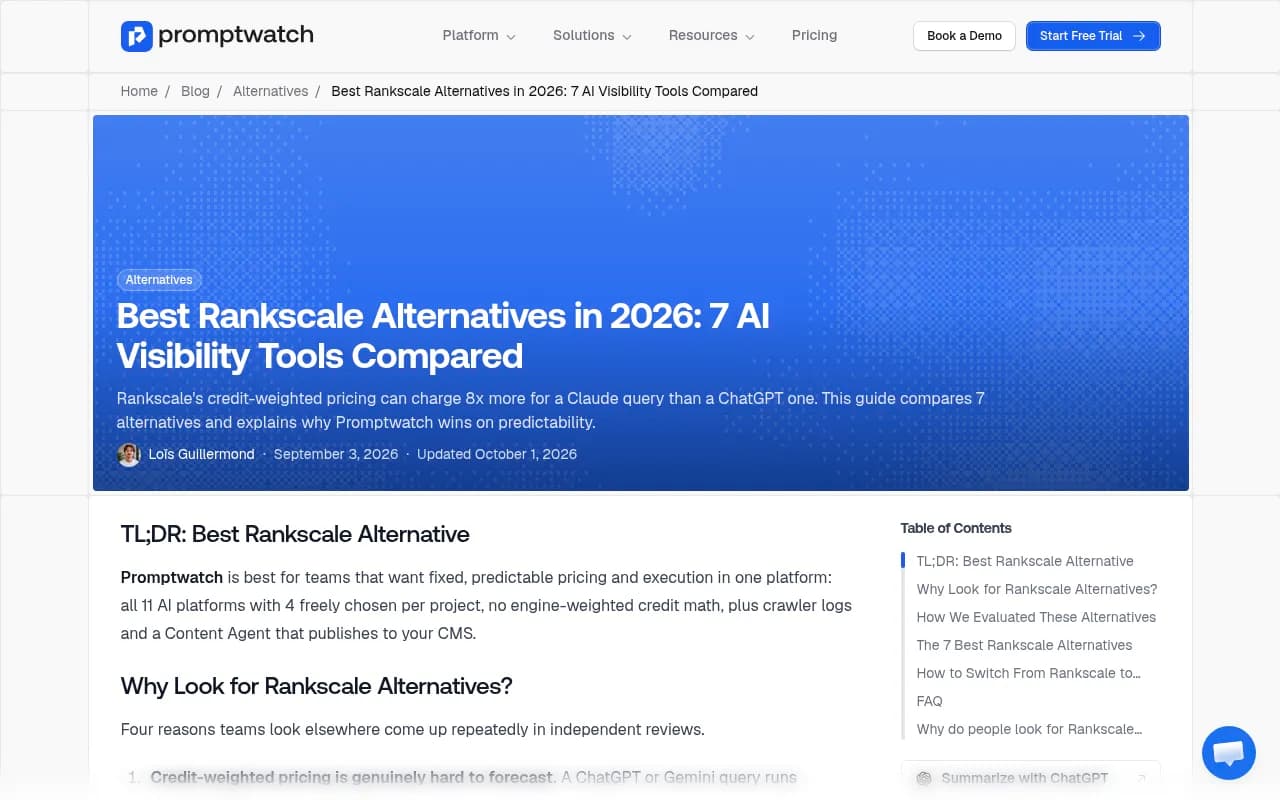
- Rankscale's credit system charges up to 8x more for a Claude query than a ChatGPT one, which makes monthly cost genuinely hard to predict if your prompt mix leans toward Claude or DeepSeek.
- Nightwatch is the cheapest entry point (Starter at 79 euros/month) and gives unlimited seats on every plan, but it caps AI tracking at 6 engines regardless of tier and has no server-side crawler log product.
- Promptwatch uses flat prompt and response allowances instead of credits, covers 11 AI surfaces with 4 freely chosen per project on every plan, and is the only one of the three with crawler logs and a Content Agent that publishes to a CMS.
- None of the three is strictly "the cheapest," the right pick depends on whether your team needs rank tracking bundled in (Nightwatch), unlimited seats and agency reselling (Rankscale), or a fixed line item plus execution (Promptwatch).
- If your team is two people with no dedicated content or dev resource, the deciding factor usually isn't the dashboard, it's whether the tool turns a citation gap into a published page by itself.
Why this comparison matters for small teams specifically
A five-person growth team at a funded startup can absorb pricing surprises and manual publishing workflows. A two-person marketing team at a 40-person company cannot. Every dollar of software spend has to justify itself against a channel budget that's already stretched, and every hour spent manually exporting a content brief from one tool and pasting it into another is an hour not spent on something else.
That's the lens I'm using here. Not "which tool has the most features" but "which tool actually reduces the workload for a team that doesn't have a dedicated AI SEO function." Omnia's own roundup of Rankscale alternatives makes this point directly: lean teams need "specific content and outreach tasks you can execute," not another dashboard to babysit.
The three tools, in plain terms
Rankscale, Nightwatch, and Promptwatch solve overlapping but not identical problems.
Rankscale is a credit-based AI visibility tracker built to appeal to solo marketers and agencies juggling multiple client brands. It advertises 17+ AI engines on every tier and unlimited seats at no extra charge, which is genuinely useful if you're reselling reports to clients.
Nightwatch started life as a traditional SEO rank tracker (Google, Bing, YouTube, Maps) and bolted AI visibility on top, branded as "Citation Intelligence." If your team still cares about classic SERP rankings and wants AI monitoring folded into the same subscription, this is the obvious fit.
Promptwatch is a GEO-first platform built around a different premise: tracking is step one, not the whole job. It pairs prompt and citation monitoring with crawler logs, content generation, and CMS publishing.
Pricing: the part that actually trips teams up
This is where the three diverge hardest, and it's worth spending real time on because sticker price is misleading for at least one of them.
Rankscale's credit math is the catch
Rankscale's headline pricing looks cheap: Essentials around $20/month, Pro at $99/month with 1,200 credits. But credits aren't spent evenly across engines. ChatGPT, Gemini, Perplexity, and Google AI Mode queries cost 0.25 credits each. DeepSeek and Google AI Overviews cost 1 credit. Claude, Perplexity Pro, and Mistral Large cost 2 credits. The heaviest API models run as high as 4 credits.
Run the numbers on a realistic lean-team setup and it gets uncomfortable fast. Geoptie's review walks through an example: 50 prompts a week tracked across 4 base engines comes to roughly 217 credits a month, comfortably inside the Pro plan's 1,200-credit pool. Add Claude at the same cadence and that single engine adds about 433 credits, pushing total usage to roughly 650, over half the entire pool consumed by one model. If your buyer persona or competitive set makes Claude answers matter, your real cost per prompt just doubled, invisibly.
Independent reviews also flag that Rankscale's own published details aren't consistent across sources, some cite the $99 Pro tier unlocking REST API access, others point to a tier closer to $385/month, and free trial length is reported as both 7 and 30 days depending on where you read it. Confirm both directly with Rankscale before you commit a budget line to it.
Nightwatch is flat and genuinely cheap at the low end
Nightwatch's Starter tier is 79 euros/month (948 euros/year if you prepay, saving 240 euros), covering 500 keywords, 50 AI prompts, 1,500 AI answers a month, 5 websites, and unlimited team seats. Professional at 159 euros/month is the popular tier and adds API access, Looker Studio integration, and white-label reports. There's a 14-day free trial with no credit card required, and a 30% Black Friday discount was live on the pricing page as of this writing.
The unlimited-seats detail matters more than it sounds. Promptwatch meters seats at 1, 2, or 5 depending on tier; Nightwatch doesn't charge extra no matter how many people log in. For a lean team that still wants a few stakeholders to have dashboard access without paying per seat, that's a real advantage.
The catch: AI platform coverage is fixed at 6 surfaces on every single tier, ChatGPT, Claude, Gemini, Perplexity, AI Mode, and AI Overview, it never widens no matter how much you pay, and it doesn't cover Grok, Meta Llama, or DeepSeek at all.
Promptwatch's allowances are flat, not credit-weighted
Promptwatch's three self-serve tiers are published at $95/month (Essential), $245/month (Professional), and $579/month (Business). Essential includes 50 prompts, 6,000 responses, 1 project, and tracking across 4 models per project, freely chosen from a pool of 11 engines (ChatGPT, Claude, Gemini, Google AI Overviews, Google AI Mode, Perplexity, Grok, DeepSeek, Meta Llama, OpenCode, and Claude Code). There's no credit multiplier based on which model you pick; a Claude prompt costs the same as a ChatGPT prompt in your allowance.
That predictability is the whole pitch. You know your monthly number before you sign up, and it doesn't change based on which engines your audience happens to use most. Unit economics work out to roughly 1.6 cents per recorded response on Essential, dropping to about 1.4 cents on the higher tiers.
The tradeoff versus Nightwatch: seats are metered (1 on Essential, 2 on Professional, 5 on Business), and it's priced above Nightwatch's Starter tier at the entry level.
| Tool | Entry price | Engines covered | Pricing model | Seats | Free trial |
|---|---|---|---|---|---|
| Promptwatch | $95/mo (Essential) | 11 total, 4 per project, freely chosen | Flat prompts/responses | 1 / 2 / 5 by tier | 7 days (Essential, Professional) |
| Nightwatch | 79 euros/mo (Starter) | 6 fixed, same on every tier | Flat keywords + AI answers | Unlimited on every tier | 14 days, no card required |
| Rankscale | ~$20/mo (Essentials, annual only) | 17+ advertised | Credit-weighted, 0.25x to 4x per query | Unlimited on every tier | Reported as 7 or 30 days, confirm directly |
Coverage and depth: what you actually get to track
Prompt count and engine count are only half the story. What matters for a lean team is whether the data tells you something you can act on without a research project of your own.
Rankscale's strongest selling point is breadth: 17+ engines advertised on every tier, unlimited search terms, and a query fanout feature on every plan that shows the internal searches an AI engine runs while answering your tracked prompts, coverage, phrasing variants, probed domains, wins and losses. That's genuinely useful for understanding why you're missing from an answer. But CSV export of that fanout data is gated to Pro and above, and the platform stops at reporting. There's no content generation, no content-gap-to-draft workflow, and no CMS publishing built in.
Nightwatch's differentiator is that it ties classic rank tracking to AI visibility in one dashboard, with claims of 99.9% rank-tracking accuracy and ZIP-code-level local precision across more than 107,000 locations. Its Content Studio will draft and score content, but it doesn't publish; briefs have to be exported and handed off manually. There's also no server-side crawler-log product, its Site Audit crawls your own site for technical SEO, it doesn't verify whether GPTBot or ClaudeBot actually requested your pages.
Promptwatch's structural difference is that it doesn't stop at the report. Three things stand out for a lean team specifically:
First, server-side AI crawler logs via direct CDN integrations (Cloudflare, Fastly, Vercel, Netlify, Akamai, AWS CloudFront, Google Cloud CDN) show whether an AI bot actually requested a given page, separate from whether it later got cited. Promptwatch's own data shows why this matters right now: OpenAI's share of verified AI crawler requests fell from 94.8% in early June 2026 to 79.8% by early September as Anthropic, Google, Perplexity, and Mistral picked up share. A tool that only tracks ChatGPT citations is increasingly missing where the other crawlers are already showing up on your site.
Second, Content Agents draft and publish directly to Webflow or Framer through an approval workflow, closing the loop from "we're not cited for this prompt" to "here's a page live on the site" without a separate content tool in the chain.
Third, state and city-level prompt targeting is included on every plan, including the entry-level Essential tier, which matters for any team running local or regional campaigns and wanting granular AI visibility data without upgrading.
| Capability | Promptwatch | Nightwatch | Rankscale |
|---|---|---|---|
| Engines tracked | 11 total, 4/project | 6, fixed on every tier | 17+ advertised |
| Server-side crawler logs | Yes, 7+ CDN integrations | No | No |
| Content generation to CMS | Yes, Webflow/Framer with approval flow | Drafts only, manual export | No |
| Query fanout analysis | Via Agent Chat and prompt data | Not a core feature | Yes, on every plan; CSV export Pro+ |
| Off-site mention tracking (Reddit, YouTube) | Yes | No | Not highlighted |
| Classic SERP rank tracking | No | Yes, Google/Bing/YouTube/Maps | No |
| Unlimited team seats | No, metered by tier | Yes, every tier | Yes, every tier |
Content type matters more than most teams assume
One thing lean teams tend to underweight: what kind of content actually gets cited matters as much as how many prompts you're tracking. Promptwatch's own citation data for late September and early October 2026 shows product pages leading ChatGPT citations at 22.4%, with landing pages at 16.8%, meaning nearly 39% of all citations go to pages whose whole purpose is describing what a company sells. Listicles follow at 13.6%, how-tos at 8.7%. On commercial-intent prompts specifically, product pages, landing pages, and listicles combine for roughly 70% of citations.
That's a useful filter when deciding what a two-person team should actually build first if the chosen tool flags a content gap: don't start with another blog post, start with the product or comparison page the AI engines are already favoring for that query type.
Which one actually fits a lean team
There isn't one universal answer here, it depends on what your two or three person team is already doing.
If your team still runs classic rank tracking and local SEO alongside AI visibility, and you want one subscription instead of two, Nightwatch's bundled approach and unlimited seats make a lot of sense, especially at the Starter tier's 79 euro entry point. You'll live with only 6 AI engines and manual publishing, but you won't be paying for two separate tools.
If your prompt tracking needs to stay cheap on paper but you're mostly testing ChatGPT and a handful of mainstream engines, Rankscale's low entry price and unlimited seats work, provided you keep your prompt mix away from Claude-heavy or API-tier models that eat credits fast. It also makes sense if you're an agency reselling to several small clients and want seat flexibility without per-seat fees.
If your team has no dedicated content or dev resource and the real bottleneck is turning "we're invisible for this prompt" into a published page without a second tool and a manual handoff, Promptwatch's flat pricing and Content Agent workflow close more of that gap in-house. The metered seats and higher entry price are the tradeoff for not needing a separate content pipeline.
A quick note on broader research
Independent testers echo a version of this split. One widely cited 15-tool comparison places Promptwatch specifically for "AI-native SaaS & technical teams," while framing Nightwatch as better suited to "traditional SERP + AIO tracking." A separate LinkedIn roundup of Promptwatch alternatives frames the tool as best for "smaller businesses and lean marketing teams that need straightforward AI search monitoring without an extensive workflow layer," worth keeping in mind if your team genuinely wants monitoring only and plans to handle content separately with a tool like Clearscope or Surfer SEO.
If you want to see where either Nightwatch or Rankscale land against a wider field, the GEO software directory at bestgeosoftware.com has side-by-side listings across more than a dozen platforms, and ai-rank-tools.com is worth a look if rank tracking depth is your primary decision factor rather than AI visibility specifically.
The bottom line
For a lean marketing team, the deciding question isn't "which tool tracks the most prompts." It's "which tool leaves us with the least manual work after the report lands in our inbox." Rankscale's pricing rewards teams that stick to mainstream engines and punishes teams that need Claude or API-tier coverage. Nightwatch rewards teams that want AI visibility bundled with classic SEO and don't mind exporting briefs manually. Promptwatch rewards teams willing to pay a bit more up front for flat pricing and a content workflow that doesn't require a second tool in the stack.
None of these is wrong. They're built for different versions of "lean."