RankUp Review 2026
A team of AI agents handling content strategy, writing and refreshes for SEO and GEO, built for SaaS founders and lean marketing teams.
Key takeaways
- RankUp is a content workforce, not a tracker: agents handle strategy, drafting and refreshes for B2B SaaS, and learn from your edits and results.
- It lacks what Promptwatch offers: IP-verified AI crawler logs, prompt volumes and difficulty, query fan-outs, Reddit/YouTube/LinkedIn citation tracking, AI Shopping and Ads Radar, and a prioritized Action Board.
- Pricing is modular and usage-based. Strategy is $35/mo, 15 new articles cost $300/mo, and refreshes run about $2.50 to $10 each. No free tier or trial turned up.
- Only SaaS and tech companies with English sites qualify, and you have to enter your domain to see a plan.
- Best fit: lean SaaS teams that want a hands-off content engine. Poor fit for agencies, e-commerce or non-English sites.
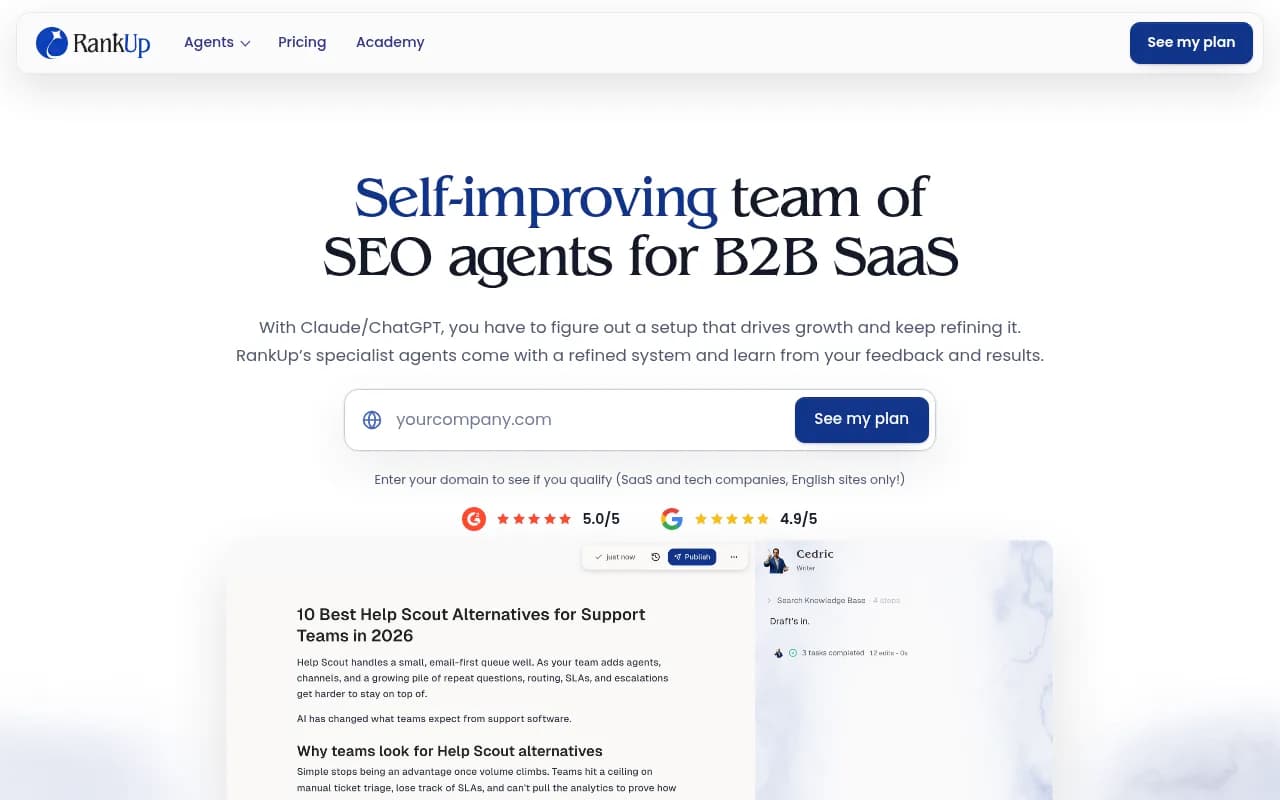
RankUp is an AI-agent platform for SEO and GEO content, built for B2B SaaS startups. Instead of one writing assistant, you get a cast of named specialists. Magnus is the strategist, Cedric the writer, and Lyra the content manager who handles refreshes and prioritization. The pitch is that you skip building your own prompt stack in ChatGPT or Claude and get a system that has already been refined and keeps learning from your feedback.
The company's target is clear: SaaS founders and small marketing teams who want to rank on Google and get recommended by ChatGPT or Perplexity but lack the time or SEO depth to run it. Its customer wall includes Featurebase, Whatfix, Capsule CRM, Qminder, Bouncer and Guardian Home. The homepage shows a 5.0/5 G2 rating and 4.9/5 on Google, though I could not verify the review counts and found no independent third-party reviews.
What stands out is the loop. Strategy feeds writing, performance feeds refreshes, and refreshes feed the next plan. Plenty of tools do one of those steps. Few try to connect all three.
Key features
Strategy and topical mapping (Magnus). Magnus reads your site, your product and your competitors, then builds a topical map with keyword volumes and priority scores. The demo shows a Monthly Buyer-Led Plan with buyer guides, best-of pages and competitor comparisons, such as zendesk alternatives scored 92.0. It leans toward bottom-of-funnel pages, which is the right call for SaaS. Data comes from DataForSEO, and the team warns that volumes may differ from other SEO platforms.
Article creation with expert interviews (Cedric). The writer researches live search results, plans each section, drafts from your company knowledge and reviews the piece before it reaches you. The interesting part is the question round. Cedric asks things only your team knows, like what made you leave a competitor or what a rival still does better. Those answers go into sections such as when a competitor is still the right choice. This is the best answer to the generic AI content problem I saw in the demo.
Knowledge Base and learning. A shared knowledge base stores positioning, customer language, objections, proof points and approved claims. Style guides update from your edits, so a correction applies to later articles. Whether that holds up over hundreds of articles is something only long-term use can show.
Content refresh (Lyra). You can tell Lyra what changed, for example a product launch, and she finds every page that still describes the old version and queues edits. Refreshes come in light, deep and quick-touch tiers, and each shows a change count for review. I like the diff-style review with Keep and Undo controls. Fixing the same outdated claim across several pages is the kind of tedious work that rarely gets done manually.
Performance measurement. Changes appear on the same chart as clicks and impressions from Search Console. A before-and-after panel compares 28 days either side of an update. The demo is honest about it: one refresh doubled clicks while average position slipped 0.4 places, and the tool notes everything else that moved is in the numbers too. That kind of caveat is refreshing.
Business signals. With PostHog connected, RankUp shows visits from AI assistants (ChatGPT and Perplexity referrals) and signups from your site. A visibility trend shows how often AI mentions you across 7 engines, including ChatGPT, Google AI Overviews, AI Mode and Claude. It is a summary view. It is not a deep prompt-level monitoring suite.
Action plan. Lyra turns the data into a prioritized list of pages: deep refresh, refresh or quick touch-up, with current and target positions. You select pages and she implements the changes.
Content audit. The pricing page has an audit and optimization slider from None up to 5K pages. I could not tell what the steps measure, and no prices for higher steps were visible.
Who is it for
The sweet spot is a SaaS founder or a one-to-three-person marketing team with no dedicated SEO writer. Think a seed-stage startup publishing 10 to 30 articles a month on comparisons, alternatives and category guides, and wanting leads within the first couple of months. Guardian Home's co-founder says leads started arriving in about the first month, and it is now a main channel. That is one testimonial from the vendor's own page, so treat it as a data point, not a benchmark.
It also suits founders who dislike spreadsheet keyword management. One reviewer on the site praises exactly that, with the map showing which keywords you have already covered.
Skip it if you run an agency, since there are no client workspaces mentioned and no white-label reporting. Skip it if you are in e-commerce, healthcare, finance, or any non-SaaS vertical, or if your site is not in English. The domain form checks eligibility and will turn you away. Also skip it if you want to deeply study the AI search channel itself. RankUp creates content. It is not an analytics platform for AI answers.
Integrations and ecosystem
The homepage says it works with your CMS, PostHog and Google Search Console. Search Console access is read-only, per section 16 of the Terms of Service. The pages I read do not name specific CMS integrations, so confirm publishing support for your platform (WordPress, Webflow, Framer and so on) on a call before you commit.
I found no public API, MCP server, browser extension or mobile app. Data comes from DataForSEO. There are no official X, LinkedIn, Discord or GitHub accounts that I could verify, and unrelated Discord bot projects named rankup should not be confused with it.
Pricing and value
Pricing is a configurable monthly plan rather than named tiers. The components:
- Content strategy and planning: $35/mo, covering keyword research, topical map, content plan and performance reports.
- Content production: $300/mo for 15 new pieces, with a slider from 0 to 30. That works out to about $20 an article.
- Content refreshes: slider from 0 to 250. Light refresh $2.50 to $5, deep refresh $5 to $10, average about $5.
- Content audit and optimization: $0 at default, with a slider up to 5K and no visible prices for higher steps.
Agent cost depends on tool calls, actions and context size, and the writer, content manager and strategy agents draw from the same balance. I saw no free tier or trial. Before committing, the founders offer a competitor analysis and a call to size your plan.
At roughly $20 per article, it is much cheaper than freelancers, and in line with other AI writers, but you are paying for the system, not just words. The unpredictability is the catch. A usage-based balance shared across agents makes monthly spend harder to forecast than a flat plan. For comparison, Promptwatch's paid plans start at $95/mo (Essential) with a free Explore tier, but they cover a different job: visibility measurement and optimization.
Strengths and limitations
What it does well
- The expert question round pulls in first-party knowledge, which is what separates it from plain AI drafting.
- Refresh workflows that propagate a product change across all affected pages.
- Honest change-versus-outcome reporting that ties edits to Search Console data.
- Low cost per article and per refresh.
- A focused strategy layer built around buyer-intent SaaS pages.
Limitations
- Narrow eligibility: SaaS and tech, English only, domain gate before you see pricing.
- Opaque total pricing and no visible trial.
- No independent reviews. The one ranking of AI SEO agents I found is on RankUp's own site, where it places itself first.
What it lacks compared to Promptwatch
RankUp touches GEO, but its AI visibility layer is a trend summary. Promptwatch is the full stack, and these are gaps:
- No IP-verified AI crawler logs or crawl-to-citation tracking, so you cannot see when GPTBot or ClaudeBot visits and what errors they hit.
- No prompt volumes, difficulty scores or query fan-outs for choosing what to target.
- No Reddit, YouTube or LinkedIn citation reports, and no offsite mentions tracking.
- No AI Shopping or Ads Radar.
- No real-UI tracking across 15+ engines, including coding agents like Codex and Claude Code.
- No Agent Chat over live data or standalone Action Board covering site health, sentiment and Reddit.
- Visitor analytics depend on a PostHog connection, whereas Promptwatch tracks AI traffic and conversions natively and joins Search Console and Bing data.
Promptwatch also has a Content Agent with publishing to WordPress, Webflow and Framer, so it competes directly on content, while adding the measurement layer. This matters because AI citation behavior shifts. Promptwatch Data found ChatGPT's social citations at 0.46% versus 12.2% for AI Overviews in one week (social media citations by AI model), and that product pages take 22.4% of ChatGPT citations (content type share). Content tools need that kind of data to aim at.
Bottom line
RankUp is a credible pick for a SaaS team that wants content strategy, drafting and refreshes handled by one system, with real company knowledge injected through the interview step. The pricing is modular, which rewards small, steady volumes, but you will want the sizing call and a CMS confirmation first.
If you want to measure and optimize your presence in AI answers, not just publish content, Promptwatch is the stronger choice. It shows why you are or are not cited, where AI finds you, what traffic it drives, and then helps fix it. For more options, see the GEO software directory at bestgeosoftware.com.

Best use case: a lean B2B SaaS team that needs a steady stream of comparison and buyer-guide content without hiring an SEO writer.
Frequently asked questions
What is RankUp?
Who can use RankUp?
How much does RankUp cost?
How is RankUp different from using ChatGPT or Claude?
Does RankUp track AI search visibility?
Which integrations does RankUp support?
Similar and alternative tools to RankUp