Key Takeaways
- Promptwatch is an optimization platform with content generation and gap analysis built in -- Nightwatch is primarily a monitoring dashboard that extends traditional SEO tracking into AI search
- AI model coverage differs significantly: Promptwatch tracks 10 AI models including ChatGPT Shopping, DeepSeek, Grok, and Meta AI -- Nightwatch covers 4 models (ChatGPT, Gemini, Claude, Perplexity) but bundles them with traditional search engine rank tracking
- Pricing structure reflects different value propositions: Promptwatch starts at $99/mo for pure AI visibility tracking -- Nightwatch starts at $32/mo but positions AI tracking as an add-on to its core SEO rank tracking product
- Action vs monitoring: Promptwatch's Answer Gap Analysis shows exactly which prompts competitors rank for that you don't, then generates optimized content to close those gaps -- Nightwatch shows you the data but leaves content creation to you
- Crawler visibility is a Promptwatch exclusive: Real-time logs of AI crawlers hitting your site (which pages, how often, errors) help you understand indexing -- Nightwatch doesn't offer this
- Choose Promptwatch if AI search visibility is your primary goal and you want an end-to-end platform that helps you create content that ranks -- choose Nightwatch if you're already doing traditional SEO rank tracking and want to add AI monitoring to your existing workflow
Overview
Promptwatch: AI search visibility and optimization platform

Promptwatch is built specifically for tracking and optimizing brand visibility across AI search engines. It monitors 10 AI models -- ChatGPT, Perplexity, Google AI Overviews, Google AI Mode, Claude, Gemini, Meta/Llama, DeepSeek, Grok, Mistral, and Copilot. The platform is used by 7,000+ brands including Booking.com, Center Parcs, and Typeform.
What sets Promptwatch apart is the action loop: it doesn't just show you where you're invisible in AI search -- it helps you fix it. Answer Gap Analysis identifies exactly which prompts competitors are visible for that you're not, then the built-in AI writing agent generates articles, listicles, and comparisons engineered to get cited by AI models. You can track results with page-level citation tracking and connect visibility to revenue through traffic attribution.
Additional capabilities include AI crawler logs (see which AI bots are reading your site and when), prompt intelligence (volume estimates and difficulty scores), citation and source analysis, Reddit and YouTube insights, ChatGPT Shopping tracking, competitor heatmaps, and multi-language/multi-region monitoring.
Nightwatch: AI search monitoring for marketers
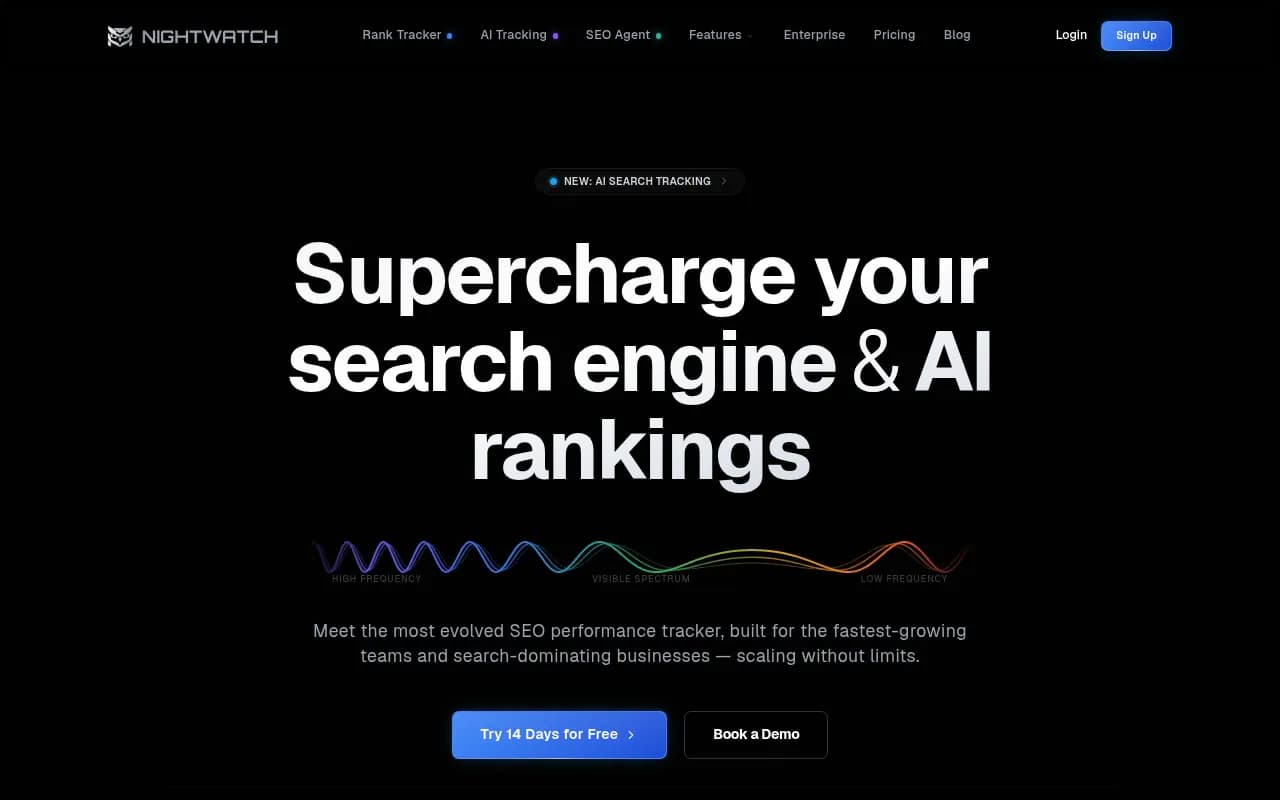
Nightwatch started as a traditional SEO rank tracking platform and has expanded into AI search monitoring. It positions itself as a unified solution that tracks both traditional search engine rankings (Google, Bing, Yahoo, DuckDuckGo) and AI model visibility (ChatGPT, Gemini, Claude, Perplexity).
The core value proposition is "complete SEO spectrum coverage" -- one dashboard for all your search visibility data, whether that's Google rankings or ChatGPT citations. Nightwatch emphasizes data accuracy and real-time updates, with the ability to refresh critical keywords on demand and track 107,000+ locations down to the zip code.
The platform includes traditional SEO features like keyword research, site audit, reporting, and Looker Studio integration. AI tracking is presented as an extension of these core capabilities rather than a standalone product. Nightwatch targets marketing teams and agencies that are already doing SEO and want to add AI visibility monitoring without switching platforms.
Side-by-Side Comparison
| Feature | Promptwatch | Nightwatch |
|---|---|---|
| AI Models Tracked | 10 (ChatGPT, Perplexity, Google AI Overviews, Google AI Mode, Claude, Gemini, Meta/Llama, DeepSeek, Grok, Mistral, Copilot) | 4 (ChatGPT, Gemini, Claude, Perplexity) |
| Traditional Search Tracking | No -- AI search only | Yes -- Google, Bing, Yahoo, DuckDuckGo |
| Content Generation | Yes -- AI writing agent included | No |
| Answer Gap Analysis | Yes -- shows competitor prompts you're missing | No |
| AI Crawler Logs | Yes -- real-time logs of AI bots crawling your site | No |
| ChatGPT Shopping Tracking | Yes | No |
| Reddit/YouTube Insights | Yes | No |
| Prompt Intelligence | Yes -- volume estimates, difficulty scores, query fan-outs | Prompt research tool available |
| Citation Analysis | Yes -- page-level tracking with source breakdown | Yes -- entity and citation tracking |
| Traffic Attribution | Yes -- code snippet, GSC integration, server logs | Not specified |
| Multi-language Support | Yes -- any language, any region | Yes |
| Starting Price | $99/mo (Essential plan) | $32/mo (includes traditional SEO + AI tracking) |
| Free Trial | 7 days | 14 days |
| API Access | Yes | Not specified |
| Target Audience | Brands focused on AI search visibility | SEO teams adding AI monitoring to existing workflow |
Platform focus and positioning
The fundamental difference between these platforms is what they're built to do.
Promptwatch is a pure-play AI search visibility platform. Every feature is designed around one goal: help you understand how AI models see your brand, then optimize your content to improve that visibility. The platform assumes you care about AI search specifically -- whether that's ChatGPT recommendations, Perplexity citations, or Google AI Overviews. If you're not actively working on AI visibility, Promptwatch isn't for you.
Nightwatch is a traditional SEO platform that has added AI tracking. The core product is still keyword rank tracking across search engines -- the kind of daily ranking reports SEO teams have been using for years. AI monitoring is positioned as a natural extension of that workflow. The pitch is "don't switch tools, just add AI visibility to what you're already tracking."
This positioning difference shows up everywhere. Promptwatch's dashboard is organized around prompts, citations, and AI model performance. Nightwatch's dashboard shows keyword rankings, search visibility scores, and click potential -- with AI tracking as one module among many.
For teams that are already invested in traditional SEO and want to add AI monitoring without disrupting their workflow, Nightwatch's unified approach makes sense. For teams where AI search visibility is the primary focus -- or where traditional SEO isn't relevant -- Promptwatch's specialized platform is a better fit.
AI model coverage
Promptwatch tracks 10 AI models:
- OpenAI/ChatGPT (including ChatGPT Shopping)
- Perplexity
- Google AI Overviews
- Google AI Mode
- Claude
- Gemini
- Meta/Llama
- DeepSeek
- Grok
- Mistral
- Copilot
Nightwatch tracks 4 AI models:
- ChatGPT
- Gemini
- Claude
- Perplexity
The coverage gap is significant. Promptwatch includes newer models like DeepSeek and Grok, plus niche but growing platforms like Meta AI and Mistral. It also tracks ChatGPT Shopping separately -- a critical channel for e-commerce brands that want to appear in ChatGPT's product recommendations.
Nightwatch focuses on the four most established AI search engines. This is a reasonable choice if you're just getting started with AI visibility tracking and want to focus on the platforms with the most user adoption. But it means you're blind to what's happening in newer AI models that might be gaining traction with your audience.
Both platforms support multi-language and multi-region tracking, so you can monitor AI responses in any language and from any country. Promptwatch adds customizable personas that let you simulate how different types of users might prompt AI models -- useful for understanding how AI responds to your target audience specifically.
Content optimization and gap analysis
This is where the platforms diverge most sharply.
Promptwatch's Answer Gap Analysis is the core feature that turns it from a monitoring tool into an optimization platform. Here's how it works:
- You add competitors to track
- Promptwatch shows you exactly which prompts those competitors are getting cited for, but you're not
- For each gap, you see the specific content angle or topic your website is missing
- The built-in AI writing agent can generate articles, listicles, or comparison pages optimized to fill those gaps
- You publish the content, then track whether AI models start citing it
The content generation is grounded in real citation data -- Promptwatch has analyzed 880M+ citations to understand what kinds of content AI models prefer to cite. The writing agent isn't producing generic SEO filler. It's creating content engineered to answer the specific prompts where you're currently invisible.
Nightwatch doesn't have an equivalent feature. It will show you which prompts you're ranking for and which entities AI models are associating with your brand. But identifying content gaps and creating optimized content to fill them is left to you. You can export the data and use it to inform your content strategy, but the platform doesn't help you execute on that strategy.
For teams with dedicated content writers and a clear process for turning insights into articles, this might be fine. For teams that want an end-to-end solution -- identify gaps, generate content, track results -- Promptwatch's integrated approach is more efficient.
AI crawler visibility and indexing
Promptwatch includes real-time AI crawler logs -- a feature that's unique among AI search tracking platforms. You can see exactly when AI models like ChatGPT, Claude, or Perplexity send their crawlers to your website, which pages they read, how often they return, and any errors they encounter.
This matters because AI models need to crawl and index your content before they can cite it. If you're publishing great content but AI crawlers aren't finding it, you won't see visibility improvements. The crawler logs help you diagnose indexing issues -- maybe certain pages are blocked by robots.txt, maybe crawlers are hitting 404 errors, maybe they're not returning frequently enough to pick up new content.
Nightwatch doesn't offer crawler logs. You can see whether AI models are citing your content in their responses, but you can't see whether they're successfully crawling your site in the first place. This makes it harder to troubleshoot visibility problems.
For technical SEO teams that want deep visibility into how AI models interact with their website, Promptwatch's crawler logs are valuable. For teams that just want to track citations and don't need infrastructure-level insights, the absence of this feature in Nightwatch isn't a dealbreaker.
Citation and source analysis
Both platforms track citations -- instances where AI models mention your brand or link to your content in their responses.
Promptwatch's citation analysis shows:
- Which specific pages are being cited
- Which AI models are citing them
- The prompts that triggered those citations
- Competing sources cited in the same responses (Reddit threads, YouTube videos, competitor pages)
- Citation trends over time
The competing sources view is particularly useful. If AI models are citing a Reddit thread or a competitor's blog post instead of your content for a specific prompt, you can see exactly what content you're competing against. This informs your content strategy -- maybe you need to create a more comprehensive guide, maybe you need to get active in relevant Reddit communities, maybe you need to optimize for a different angle.
Nightwatch's citation tracking focuses on entity recognition -- which brands and concepts AI models associate with your prompts. You can see when your brand appears in AI responses and track visibility trends. The platform includes prompt analysis that shows which queries are driving citations.
The main difference is depth. Promptwatch gives you page-level granularity and shows you the full competitive landscape for each prompt. Nightwatch gives you brand-level visibility and tracks overall trends. Both are useful, but for different purposes.
Reddit and YouTube tracking
Promptwatch includes dedicated Reddit and YouTube insights -- surfaces that show which Reddit threads and YouTube videos AI models are citing in their responses. This is important because AI models frequently cite these sources, especially for product recommendations, how-to questions, and opinion-based prompts.
If you see that AI models are citing a Reddit thread about your product category instead of your website, that's actionable intelligence. You might decide to participate in those Reddit communities, create content that addresses the same questions, or optimize your existing content to be more conversational and opinion-driven (the style that AI models seem to prefer from Reddit).
Nightwatch doesn't break out Reddit or YouTube as separate tracking categories. You'll see these sources if they appear in citation analysis, but there's no dedicated view for understanding how these platforms influence AI recommendations in your space.
For B2C brands, SaaS companies, and any category where Reddit and YouTube discussions heavily influence purchase decisions, Promptwatch's dedicated tracking is valuable. For B2B brands in categories where these platforms are less relevant, it's less critical.
ChatGPT Shopping and e-commerce tracking
Promptwatch tracks ChatGPT Shopping separately -- the product recommendation and shopping carousel features that OpenAI has been rolling out. If you're an e-commerce brand, this is a critical channel. When someone asks ChatGPT "what's the best running shoe for marathon training," you want your product to appear in that response.
The ChatGPT Shopping tracking shows:
- Which product prompts trigger shopping results
- Whether your products appear in those results
- Your position in the shopping carousel
- Competing products that appear alongside yours
Nightwatch doesn't have a dedicated ChatGPT Shopping tracker. You can see if your brand appears in ChatGPT responses generally, but there's no specific focus on product recommendations or shopping features.
For e-commerce brands, DTC companies, and any business selling physical products, Promptwatch's ChatGPT Shopping tracking is a significant advantage. For service businesses and B2B companies where shopping features aren't relevant, this feature doesn't matter.
Traditional SEO integration
Nightwatch's core strength is the integration of AI tracking with traditional SEO rank tracking. If you're already monitoring keyword rankings in Google, Bing, and other search engines, Nightwatch lets you add AI visibility tracking without switching platforms or managing multiple dashboards.
The unified dashboard shows:
- Traditional keyword rankings across search engines
- AI model citations and visibility
- Search visibility scores
- Click potential estimates
- Keyword distribution
You can see how your traditional SEO performance correlates with your AI visibility. Maybe you're ranking well in Google but invisible in ChatGPT -- that's a signal to optimize your content for AI citations. Maybe you're getting cited by AI models but not ranking in traditional search -- that suggests your content is good but your technical SEO needs work.
Promptwatch doesn't track traditional search engine rankings at all. It's purely focused on AI search visibility. If you want to monitor both traditional SEO and AI visibility, you'll need to use Promptwatch alongside a traditional rank tracker like Ahrefs, Semrush, or (ironically) Nightwatch.
For teams that are already invested in SEO and want to extend their visibility tracking into AI search, Nightwatch's unified approach is more convenient. For teams that are purely focused on AI visibility or that already have a traditional SEO stack they're happy with, Promptwatch's specialized focus is fine.
Reporting and integrations
Both platforms offer reporting capabilities, but with different emphases.
Promptwatch includes:
- Looker Studio integration for custom dashboards
- API access for building custom workflows
- Traffic attribution through code snippet, Google Search Console integration, or server log analysis
- Export functionality for raw data
The traffic attribution is particularly valuable -- it connects AI visibility to actual website traffic and revenue. You can see which AI citations are driving visitors to your site and how those visitors convert. This closes the loop between visibility and business outcomes.
Nightwatch includes:
- Looker Studio integration
- White-label reporting for agencies
- Customizable dashboards
- Scheduled reports
The white-label reporting is designed for agencies that need to deliver client reports with their own branding. Nightwatch's agency focus shows up in features like multi-client management and team collaboration tools.
Both platforms support team access and collaboration. Promptwatch is used by agencies like IO Digital and Monks, while Nightwatch explicitly targets agency workflows with features like client management and white-label reports.
Pricing comparison
| Plan | Promptwatch | Nightwatch |
|---|---|---|
| Entry Level | Essential: $99/mo (1 site, 50 prompts, 5 AI-generated articles, basic tracking) | Starter: $32/mo (includes traditional SEO + AI tracking, specific limits not detailed on public site) |
| Mid Tier | Professional: $249/mo (2 sites, 150 prompts, 15 articles, crawler logs, state/city tracking) | Plans scale based on keywords tracked and features needed |
| High Tier | Business: $579/mo (5 sites, 350 prompts, 30 articles, full feature set) | Enterprise: Custom pricing |
| Free Trial | 7 days | 14 days |
| Annual Discount | Yes (discount amount not specified) | Yes (30% off during promotional periods) |
The pricing structures reflect different value propositions. Promptwatch's pricing is based on the number of prompts you're tracking and the number of AI-generated articles you can create per month. You're paying for AI visibility tracking plus content optimization capabilities.
Nightwatch's pricing is based on the number of keywords you're tracking across both traditional search and AI models. You're paying for a unified SEO + AI tracking platform. The entry price is lower, but you're getting a different product -- traditional rank tracking with AI monitoring added on.
For pure AI visibility tracking, Promptwatch's $99/mo entry point is reasonable if you need the content generation and gap analysis features. If you just want to monitor AI citations without the optimization tools, you might find Promptwatch's pricing high relative to monitoring-only alternatives.
For teams that need both traditional SEO tracking and AI monitoring, Nightwatch's bundled approach might be more cost-effective than paying for separate tools. But if you're already using Ahrefs or Semrush for traditional SEO, adding Nightwatch just for AI tracking means you're paying for features you don't need.
Prompt intelligence and research
Promptwatch's Prompt Intelligence feature provides:
- Volume estimates for each prompt (how many people are asking this question)
- Difficulty scores (how hard it is to get cited for this prompt)
- Query fan-outs (how one prompt branches into related sub-queries)
- Trending prompts in your category
This helps you prioritize which prompts to optimize for. A high-volume, low-difficulty prompt is an easy win. A low-volume, high-difficulty prompt might not be worth the effort. The query fan-outs show you how to structure content to capture multiple related prompts with a single piece.
Nightwatch includes a prompt research tool that helps you discover relevant prompts in your category. The focus is on finding prompts to track rather than prioritizing them based on volume and difficulty.
Both approaches are useful. Promptwatch's intelligence layer helps you make strategic decisions about where to invest content resources. Nightwatch's research tool helps you build a comprehensive list of prompts to monitor.
User interface and ease of use
Promptwatch's interface is organized around the optimization workflow:
- Dashboard shows overall visibility trends across AI models
- Prompts view lists all tracked prompts with citation status
- Answer Gap Analysis highlights opportunities
- Content generation interface for creating optimized articles
- Crawler logs for technical diagnostics
The interface assumes you're actively working to improve AI visibility. Everything is designed to surface actionable insights and help you execute on them.
Nightwatch's interface is organized around the monitoring workflow:
- Dashboard shows keyword rankings and visibility scores across traditional search and AI
- Keywords view lists all tracked keywords with position data
- AI tracking module shows citations and entity recognition
- Reports section for generating client deliverables
The interface assumes you're tracking performance over time and reporting on trends. The focus is on comprehensive visibility data rather than optimization actions.
Both interfaces are clean and modern. Promptwatch feels more like a content optimization platform. Nightwatch feels more like a traditional SEO tool with AI features added.
Data accuracy and update frequency
Nightwatch emphasizes data accuracy and real-time updates as core differentiators. The platform claims to access more data points more frequently than competitors, with the ability to refresh critical keywords on demand. This is important for traditional SEO where rankings can fluctuate daily.
For AI search tracking, update frequency is less critical because AI model responses change more slowly than traditional search rankings. An AI model's response to a specific prompt might stay consistent for weeks or months. Real-time updates matter less than comprehensive coverage and accurate citation tracking.
Promptwatch updates AI visibility data regularly but doesn't emphasize real-time refresh as a key feature. The focus is on tracking trends over time and identifying optimization opportunities rather than monitoring minute-by-minute fluctuations.
Both platforms provide accurate data for their respective use cases. Nightwatch's real-time capabilities are more relevant for traditional SEO tracking. Promptwatch's comprehensive AI model coverage is more relevant for AI visibility optimization.
Support and documentation
Promptwatch is used by major brands like Booking.com and Center Parcs, which suggests enterprise-level support is available. The platform offers demos and onboarding for new customers. Documentation covers the optimization workflow and how to use features like Answer Gap Analysis and content generation.
Nightwatch targets agencies and marketing teams with features like white-label reporting and multi-client management. Support includes demo calls and onboarding. The platform has been around longer as a traditional SEO tool, so documentation for core rank tracking features is mature.
Both platforms offer free trials (Promptwatch 7 days, Nightwatch 14 days) so you can test the interface and features before committing.
Pros and cons
Promptwatch pros
- Tracks 10 AI models including newer platforms like DeepSeek and Grok
- Answer Gap Analysis shows exactly which prompts competitors rank for that you don't
- Built-in AI content generation creates optimized articles to fill gaps
- AI crawler logs provide infrastructure-level visibility into how AI models index your site
- ChatGPT Shopping tracking for e-commerce brands
- Reddit and YouTube insights show social sources influencing AI recommendations
- Traffic attribution connects visibility to actual website traffic and revenue
- Pure-play AI visibility platform -- every feature is designed for this use case
Promptwatch cons
- No traditional search engine rank tracking -- you'll need a separate tool for SEO
- Higher entry price ($99/mo) compared to Nightwatch's $32/mo starting point
- Shorter free trial (7 days vs 14 days)
- Content generation limits on lower-tier plans might be restrictive for high-volume content teams
- Overkill if you just want basic AI citation monitoring without optimization features
Nightwatch pros
- Unified platform for traditional SEO and AI visibility tracking
- Lower entry price ($32/mo) makes it accessible for small teams
- 14-day free trial gives you more time to evaluate
- Real-time keyword refresh for time-sensitive tracking
- White-label reporting and agency features for client management
- Mature traditional SEO features (rank tracking, site audit, keyword research)
- Tracks 107,000+ locations for hyper-local SEO
Nightwatch cons
- Only tracks 4 AI models (ChatGPT, Gemini, Claude, Perplexity) vs Promptwatch's 10
- No content generation or Answer Gap Analysis -- monitoring only
- No AI crawler logs or infrastructure-level insights
- No dedicated ChatGPT Shopping tracking for e-commerce
- No Reddit or YouTube tracking as separate categories
- AI tracking feels like an add-on to traditional SEO rather than a core focus
Who should choose Promptwatch
Promptwatch is the right choice if:
- AI search visibility is your primary goal -- you're specifically trying to get cited by ChatGPT, Perplexity, Claude, and other AI models
- You want an optimization platform, not just a monitoring dashboard -- the Answer Gap Analysis and content generation features help you actually improve visibility, not just track it
- You need comprehensive AI model coverage -- tracking 10 models including newer platforms like DeepSeek, Grok, and Meta AI matters to your strategy
- You're an e-commerce brand -- ChatGPT Shopping tracking is critical for product visibility
- You want infrastructure-level insights -- AI crawler logs help you diagnose indexing issues and understand how AI models interact with your site
- You already have a traditional SEO stack -- you're using Ahrefs, Semrush, or another tool for keyword rankings and don't need Nightwatch's SEO features
- You're a content-driven brand -- the built-in AI writing agent and citation data help you create content that AI models prefer to cite
- Reddit and YouTube influence your category -- dedicated tracking for these sources helps you understand the full competitive landscape
Promptwatch is used by brands like Booking.com, Center Parcs, Typeform, and Yelp -- companies where AI visibility directly impacts customer acquisition and revenue.
Who should choose Nightwatch
Nightwatch is the right choice if:
- You're already doing traditional SEO -- you need keyword rank tracking across Google, Bing, and other search engines, and you want to add AI monitoring to that workflow
- You want one unified dashboard -- managing traditional SEO and AI visibility in separate tools feels inefficient
- You're an agency -- white-label reporting, multi-client management, and agency-focused features make client deliverables easier
- Budget is a primary constraint -- the $32/mo entry point is more accessible than Promptwatch's $99/mo starting price
- You want to start simple -- tracking 4 established AI models (ChatGPT, Gemini, Claude, Perplexity) is enough for now, you don't need coverage of newer platforms
- You have your own content process -- you don't need built-in content generation, you just want data to inform your existing content strategy
- Real-time data matters -- you need the ability to refresh keyword rankings on demand for time-sensitive campaigns
- You're focused on local SEO -- tracking 107,000+ locations down to the zip code is valuable for multi-location businesses
Nightwatch works well for marketing teams and agencies that are extending their traditional SEO practice into AI search monitoring.
Final verdict
These platforms serve different needs. Promptwatch is an AI visibility optimization platform -- it helps you identify gaps, create content, and track results in a closed loop. Nightwatch is a traditional SEO platform that has added AI monitoring -- it gives you unified visibility across search engines and AI models in one dashboard.
Choose Promptwatch if AI search visibility is a strategic priority and you want a platform that helps you take action, not just monitor performance. The Answer Gap Analysis, content generation, and comprehensive AI model coverage (10 models vs 4) make it the stronger choice for teams focused on AI optimization. The higher price ($99/mo vs $32/mo) reflects the additional capabilities -- you're paying for optimization tools, not just tracking.
Choose Nightwatch if you're already invested in traditional SEO and want to add AI monitoring without switching platforms. The unified dashboard and lower entry price make it a practical choice for teams that need both traditional rank tracking and AI visibility monitoring. Just understand that you're getting monitoring capabilities, not optimization tools -- you'll need to build your own process for turning insights into action.
For most teams serious about AI visibility, Promptwatch's optimization-focused approach delivers more value. The ability to identify content gaps and generate optimized articles to fill them is the difference between knowing you're invisible and actually fixing it.