Salesforce Review 2026
Comprehensive CRM solution with advanced automation capabilities for large enterprises managing complex sales processes and customer relationships.
Summary
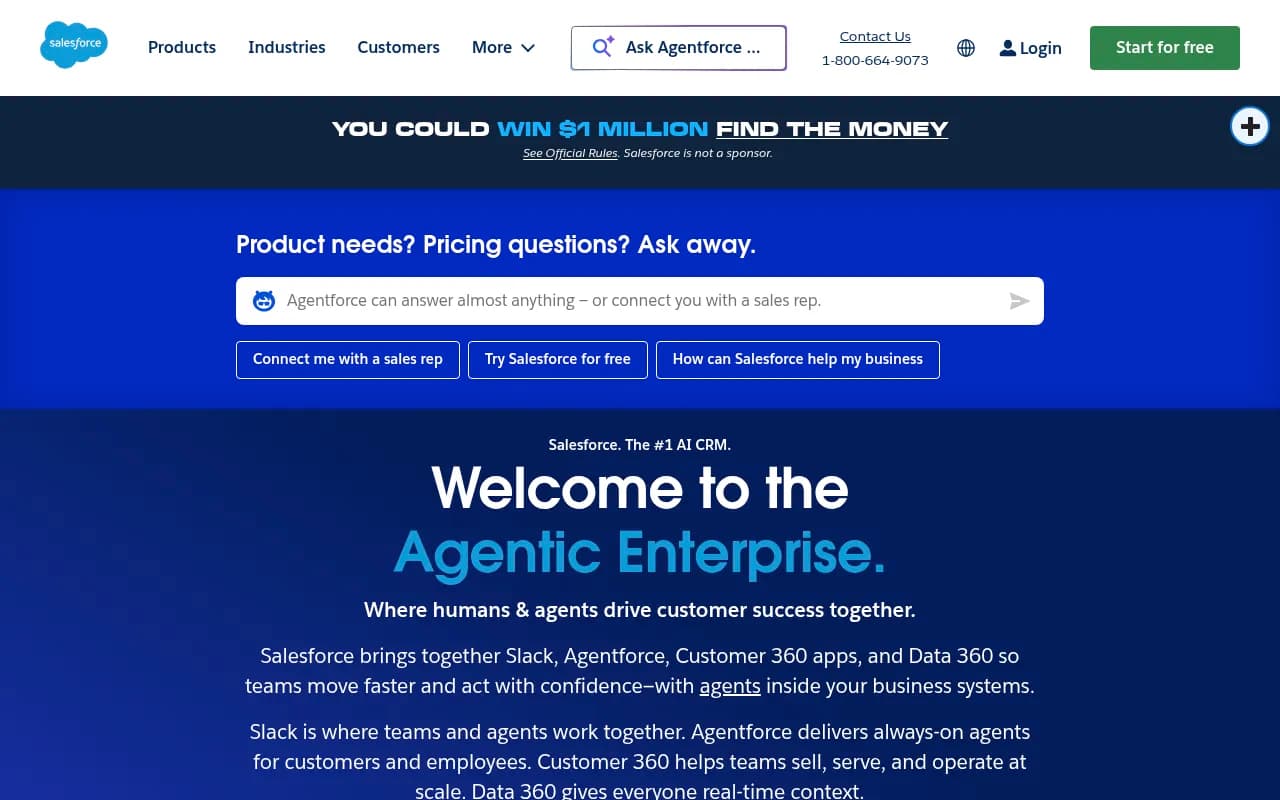
Strengths: Salesforce is the most comprehensive, battle-tested CRM on the market with unmatched ecosystem depth (AppExchange has 7,000+ apps), enterprise-grade security and compliance, and the industry's most advanced AI capabilities through Agentforce. It scales from small businesses to global enterprises and integrates with virtually every business tool. The platform's unified data model (Customer 360) gives you a single source of truth across all customer touchpoints.
Limitations: Salesforce is expensive compared to alternatives like HubSpot or Zoho — expect $25-$300+ per user per month depending on edition and products. The platform has a steep learning curve and often requires dedicated admins or consultants to configure properly. Customization flexibility can lead to over-engineering if not managed carefully. Smaller businesses may find the feature set overwhelming and pay for capabilities they don't use.
Best for: Mid-market to enterprise companies (50+ employees) with complex sales processes, multiple departments needing CRM functionality, or businesses planning significant growth. Particularly strong for B2B sales teams, financial services, healthcare, retail, and any organization prioritizing AI-driven automation and deep customization.
Skip if: You're a solo founder or team under 10 people with simple sales needs — tools like Pipedrive, Copper, or HubSpot's free tier will serve you better at a fraction of the cost and complexity.
Salesforce has been the dominant force in CRM since Marc Benioff founded the company in 1999 with a radical idea: deliver enterprise software through the cloud instead of on-premise installations. Twenty-seven years later, Salesforce is a $34 billion revenue company serving over 150,000 customers across every industry. The platform has evolved from a sales-focused CRM into a complete customer engagement suite spanning sales, service, marketing, commerce, analytics, and now autonomous AI agents through Agentforce.
What sets Salesforce apart is its platform approach. You're not just buying a CRM — you're buying into an ecosystem. The core platform includes workflow automation, custom app development (through Lightning and Apex), AI capabilities, data integration, and security infrastructure that other vendors bolt on as afterthoughts. This foundation supports a massive marketplace (AppExchange) where third-party developers have built thousands of pre-integrated apps, from DocuSign for e-signatures to Gong for conversation intelligence.
The company's latest bet is Agentforce, launched in 2024 as Salesforce's answer to the AI agent revolution. Unlike chatbots or copilots that assist humans, Agentforce agents can autonomously handle end-to-end workflows — qualifying leads, resolving service cases, personalizing marketing campaigns — with minimal human intervention. A Valoir report found Agentforce delivers 16x faster agent deployment and 75% higher accuracy compared to DIY AI approaches. This matters because most enterprises struggle to operationalize AI beyond proof-of-concept demos.
Key Features
Sales Cloud is the flagship product that made Salesforce famous. It handles lead management, opportunity tracking, forecasting, and pipeline visibility. The interface centers around the "opportunity" object — each potential deal with stages, close dates, and associated contacts. Sales reps log calls, emails, and meetings directly in Salesforce (or via integrations with Gmail, Outlook, and calendar apps). Managers get real-time dashboards showing team performance, deal velocity, and win rates. The Einstein AI layer predicts which deals are likely to close and surfaces next-best actions. Sales Cloud integrates tightly with LinkedIn Sales Navigator, Outreach, SalesLoft, and other sales engagement tools. Pricing starts at $25/user/month (Essentials for small teams) up to $500/user/month (Unlimited with premium support).
Service Cloud powers customer support operations. It includes case management, knowledge bases, omnichannel routing (phone, email, chat, social, SMS), and self-service portals. The standout feature is Einstein Bots and now Agentforce Service Agents that can resolve common issues autonomously — password resets, order status checks, basic troubleshooting — before escalating to human agents. Service Cloud tracks SLAs, automates case escalation, and provides agents with a unified view of customer history across all touchpoints. It integrates with telephony systems (Five9, Talkdesk, Genesys), chat platforms (Slack, WhatsApp), and help desk tools. Companies like FedEx and Heathrow use Service Cloud to handle millions of customer interactions. Pricing mirrors Sales Cloud tiers.
Marketing Cloud (now called Marketing Cloud Engagement) is Salesforce's enterprise marketing automation platform. It handles email campaigns, SMS, push notifications, social media advertising, and customer journey orchestration. You build multi-step journeys triggered by customer behavior — someone abandons a cart, they get an email, then an SMS, then a retargeting ad. The platform includes AI-powered send-time optimization, content recommendations, and predictive analytics. Marketing Cloud integrates with advertising platforms (Google Ads, Facebook, LinkedIn) and analytics tools (Google Analytics, Adobe Analytics). It's powerful but complex — most companies need a dedicated Marketing Cloud admin. Pricing starts around $1,250/month for basic email and scales to six figures annually for enterprise deployments.
Commerce Cloud powers e-commerce experiences for B2C and B2B businesses. It includes storefront management, product catalogs, shopping carts, checkout, order management, and inventory tracking. The platform supports headless commerce architectures where you decouple the frontend (your website or mobile app) from the backend (Salesforce's commerce engine). This flexibility lets you build custom shopping experiences while leveraging Salesforce's order processing, payment handling, and fulfillment logic. Commerce Cloud integrates with payment gateways (Stripe, PayPal, Adyen), shipping providers (FedEx, UPS), and ERP systems (SAP, Oracle, NetSuite). Brands like Puma and Volkswagen run their online stores on Commerce Cloud. Pricing is typically a percentage of gross merchandise value (GMV) — expect 1-3% of online sales.
Data Cloud (formerly Customer Data Platform) is Salesforce's answer to the fragmented data problem. It ingests data from any source — your website, mobile app, point-of-sale systems, data warehouses, third-party APIs — and unifies it into a single customer profile. Data Cloud uses AI to resolve identities across devices and channels, so you know that the person who browsed your website, called support, and made a purchase in-store is the same individual. This unified profile powers personalization across all Salesforce products. Data Cloud supports real-time data streaming (not just batch imports), so you can trigger actions instantly based on customer behavior. It integrates with Snowflake, Databricks, AWS, Google Cloud, and Azure. Pricing starts around $12,500/month for 1 million customer profiles.
Agentforce is Salesforce's autonomous AI agent platform. Unlike traditional chatbots that follow scripted decision trees, Agentforce agents use large language models (LLMs) to understand context, reason through problems, and take actions across multiple systems. You define the agent's role (sales development rep, customer service agent, marketing analyst), give it access to relevant data and tools, and set guardrails for what it can and cannot do. The agent then operates autonomously — qualifying inbound leads, answering customer questions, generating personalized content — escalating to humans only when necessary. Agentforce includes pre-built agents for common use cases (SDR Agent, Service Agent, Personal Shopper Agent) and a low-code builder for custom agents. Pricing starts at $2/conversation for out-of-the-box agents.
Einstein AI is Salesforce's predictive and generative AI layer that runs across all products. Einstein Lead Scoring predicts which leads are most likely to convert. Einstein Opportunity Insights surfaces risks and opportunities in your sales pipeline. Einstein Next Best Action recommends what to do next for each customer. Einstein Bots handle routine customer service inquiries. Einstein Content Generation writes email subject lines, product descriptions, and social media posts. The AI is trained on your Salesforce data, so predictions improve over time as you use the platform. Einstein capabilities are included in higher-tier editions (Enterprise, Unlimited) or available as add-ons for lower tiers.
AppExchange is Salesforce's app marketplace with 7,000+ pre-built integrations and extensions. Need advanced CPQ (configure-price-quote) functionality? Install Salesforce CPQ or Conga. Want conversation intelligence? Add Gong or Chorus. Need document generation? Install Conga Composer or Nintex. AppExchange apps install directly into your Salesforce org and inherit your security, permissions, and data model. This ecosystem is Salesforce's moat — no other CRM comes close to this level of third-party support. Most apps offer free trials, and pricing ranges from $5/user/month for simple utilities to $100+/user/month for enterprise solutions.
Lightning Platform is Salesforce's low-code/no-code development environment. You can build custom apps, workflows, and automations without writing code using point-and-click tools (Flow Builder, Process Builder, Lightning App Builder). For more complex requirements, developers can write custom code using Apex (Salesforce's Java-like language) and Lightning Web Components (modern JavaScript framework). The platform includes version control, testing frameworks, and deployment tools. Companies use Lightning Platform to build industry-specific solutions — loan origination systems for banks, patient management for healthcare, project tracking for agencies — all integrated with core Salesforce data. Platform licenses start at $25/user/month.
Slack (acquired by Salesforce in 2021 for $27.7 billion) is now deeply integrated into the Salesforce ecosystem. You can surface Salesforce records in Slack channels, get notifications when deals close or cases are escalated, and collaborate on opportunities without leaving Slack. The new Slackbot (powered by Agentforce) acts as a personal AI assistant — you can ask it to summarize a customer's history, draft an email, or update a record using natural language. Slack is included free with some Salesforce editions or available standalone starting at $8.75/user/month.
Who Is It For
Salesforce is built for mid-market to enterprise companies with complex, multi-departmental customer engagement needs. The sweet spot is companies with 50-5,000+ employees that have outgrown simpler CRMs like Pipedrive or HubSpot Starter. You're a good fit if you have multiple teams (sales, service, marketing) that need to share customer data, if you require deep customization to match unique business processes, or if you're in a regulated industry (financial services, healthcare, government) that demands enterprise-grade security and compliance.
Specific personas that thrive on Salesforce: B2B sales teams managing long, complex sales cycles with multiple stakeholders. SaaS companies tracking product usage data alongside CRM data to drive expansion revenue. Retail brands running omnichannel commerce (online, in-store, mobile) and needing unified customer profiles. Financial advisors managing client portfolios and compliance requirements. Healthcare providers coordinating care across multiple departments. Agencies managing client relationships, projects, and billing in one system.
Salesforce also works for small businesses through the Starter Suite (formerly Essentials), which bundles Sales Cloud, Service Cloud, and Marketing Cloud basics for $25/user/month. But honestly, most startups and small teams will find better value in HubSpot, Zoho, or Pipedrive until they hit 20-30 employees. The complexity and cost of Salesforce only make sense when you need its scale and flexibility.
Who should NOT use Salesforce: Solo founders and very small teams (under 10 people) with straightforward sales processes. If you're just tracking leads and deals without needing automation, integrations, or multi-department coordination, you're paying for a Ferrari when you need a Honda. Salesforce's learning curve and admin overhead will slow you down. Similarly, if you're extremely price-sensitive and need a CRM for under $15/user/month, look at Zoho, Freshsales, or HubSpot's free tier.
Integrations & Ecosystem
Salesforce integrates with virtually every business tool through native connectors, AppExchange apps, or APIs. Native integrations include Gmail, Outlook, Google Calendar, Microsoft Teams, Slack, DocuSign, Zoom, LinkedIn Sales Navigator, Mailchimp, QuickBooks, and hundreds more. The Salesforce API is RESTful and well-documented, so developers can build custom integrations with internal systems, data warehouses, or niche tools.
The AppExchange marketplace is the real differentiator. You'll find apps for every use case: CPQ (Salesforce CPQ, Conga, DealHub), document generation (Conga Composer, Nintex, PandaDoc), e-signature (DocuSign, Adobe Sign), telephony (Five9, Talkdesk, RingCentral), conversation intelligence (Gong, Chorus, Wingman), marketing automation (Pardot, Marketo, HubSpot), analytics (Tableau, Domo, Looker), project management (Asana, Monday.com, Wrike), and more. Most apps install in minutes and inherit your Salesforce permissions and security.
Salesforce also offers MuleSoft (acquired in 2018) for enterprise integration. MuleSoft connects Salesforce to legacy systems (SAP, Oracle, mainframes) and modern cloud apps using pre-built connectors and API management. This matters for large enterprises with decades of technical debt.
Data import/export is straightforward. You can use Data Loader (Salesforce's desktop tool) to bulk import/export records via CSV. For ongoing data syncs, use tools like Zapier, Workato, or Fivetran. Salesforce supports both REST and SOAP APIs for programmatic access. Developers can query data using SOQL (Salesforce Object Query Language) and manipulate records using Apex.
Browser extensions include Salesforce Anywhere (Chrome, Edge) for accessing records without opening Salesforce, and Einstein Activity Capture for syncing emails and calendar events. Mobile apps (iOS, Android) provide full CRM functionality on the go — log calls, update opportunities, view dashboards, approve requests.
Pricing & Value
Salesforce pricing is complex and varies by product, edition, and user count. Here's the breakdown:
Sales Cloud: Essentials $25/user/month (up to 10 users), Professional $100/user/month, Enterprise $165/user/month, Unlimited $330/user/month. Enterprise and Unlimited include advanced features like workflow automation, API access, and premium support.
Service Cloud: Same pricing tiers as Sales Cloud. Add-ons like Einstein Bots and omnichannel routing cost extra.
Marketing Cloud Engagement: Starts at $1,250/month for 10,000 contacts and basic email. Scales to $3,750/month (50,000 contacts) and up. Enterprise deployments often exceed $100,000/year.
Commerce Cloud: Pricing is typically 1-3% of gross merchandise value (GMV) with a minimum annual contract. Expect $60,000-$500,000+ per year depending on sales volume.
Data Cloud: Starts at $12,500/month for 1 million customer profiles. Scales based on data volume and API calls.
Agentforce: $2/conversation for out-of-the-box agents. Custom agents require Enterprise or Unlimited editions.
Slack: Free tier available. Paid plans start at $8.75/user/month (Pro) and $15/user/month (Business+).
All prices are billed annually. Monthly billing is available at a premium. Salesforce offers discounts for non-profits (up to 10 free licenses, then 50% off) and educational institutions.
How does this compare to competitors? HubSpot's Sales Hub starts at $20/user/month (Starter) and $100/user/month (Professional), similar to Salesforce but with fewer features. Zoho CRM is $14-$52/user/month, significantly cheaper but less powerful. Microsoft Dynamics 365 is $65-$135/user/month, comparable to Salesforce but with tighter Microsoft ecosystem integration. Pipedrive is $14-$99/user/month, much simpler and cheaper for small sales teams.
Is Salesforce good value? For enterprises, absolutely. The platform's flexibility, ecosystem, and AI capabilities justify the cost when you're managing thousands of customers and complex processes. For mid-market companies, it depends — if you're using multiple products (Sales + Service + Marketing) and leveraging automation, the ROI is strong. For small businesses, probably not unless you're in a high-growth phase and need a platform that scales.
Salesforce offers a 30-day free trial for most products. No credit card required. You get a fully functional sandbox environment to test features and integrations.
Strengths & Limitations
Strengths:
Ecosystem depth: No other CRM comes close to Salesforce's 7,000+ AppExchange apps, thousands of consulting partners, and millions of trained professionals (Trailblazers). If you need a feature, someone has built it.
Customization flexibility: Salesforce adapts to your business processes, not the other way around. You can customize objects, fields, workflows, page layouts, and business logic to match exactly how your company operates.
AI leadership: Agentforce is the most advanced autonomous AI agent platform in the CRM space. Competitors like HubSpot and Zoho offer AI assistants, but nothing matches Salesforce's ability to automate end-to-end workflows autonomously.
Enterprise-grade security: Salesforce is SOC 2, ISO 27001, HIPAA, and GDPR compliant. It offers field-level encryption, role-based permissions, IP restrictions, and audit trails. This matters for regulated industries.
Unified data model: Customer 360 gives you a single source of truth across sales, service, marketing, and commerce. No more data silos or conflicting customer records.
Limitations:
Steep learning curve: Salesforce is not intuitive out of the box. New users need training (Trailhead offers free courses), and most companies hire dedicated admins or consultants to configure the platform properly. Expect 2-3 months to get fully operational.
High cost: Salesforce is expensive, especially when you add multiple products, premium features, and AppExchange apps. A mid-sized company (100 users) running Sales Cloud Enterprise, Service Cloud, and Marketing Cloud can easily spend $200,000-$500,000 per year.
Over-engineering risk: Salesforce's flexibility is a double-edged sword. It's easy to over-customize and build overly complex workflows that become hard to maintain. Many orgs accumulate technical debt from years of customizations.
Performance issues at scale: Large Salesforce orgs (millions of records, hundreds of custom objects) can experience slow page loads and report generation times. Proper data architecture and indexing are critical.
Marketing Cloud complexity: Marketing Cloud Engagement is powerful but notoriously difficult to use. The interface is clunky, and the learning curve is steeper than competitors like HubSpot or Marketo.
Bottom Line
Salesforce is the best CRM for mid-market to enterprise companies that need a flexible, scalable platform with deep AI capabilities and a massive ecosystem. It's particularly strong for B2B sales teams, multi-department organizations, and regulated industries. The platform's unified data model (Customer 360) and autonomous AI agents (Agentforce) set it apart from competitors.
Best use case in one sentence: Complex B2B sales organizations (50+ reps) managing long sales cycles with multiple stakeholders, needing deep customization, automation, and AI-driven insights.
If you're a small team (under 20 people) with simple sales processes, start with HubSpot, Pipedrive, or Zoho and migrate to Salesforce when you outgrow them. If you're mid-market or enterprise and serious about customer engagement, Salesforce is the industry standard for a reason.
Tags:
Similar and alternative tools to Salesforce