Key takeaways
- Sitecore acquired Scrunch in June 2026 for a reported ~$225 million, and reviewers now warn that the standalone roadmap will likely bend toward Sitecore's DXP over the next two to three years. If you're not a Sitecore customer, that's a real risk to weigh.
- Scrunch documents new features through occasional blog posts rather than a dated, running changelog. Competitors like Profound and Peec AI ship granular updates weekly.
- Release velocity matters more than it sounds. AI search platforms change their behavior overnight, sometimes without warning. ChatGPT's site: operator usage jumped ~46x in a single day in August 2026, and average citations per response dropped ~27% after the GPT-5.3 rollout in March.
- The strongest alternatives combine fast shipping with execution features, so you're not just watching a dashboard, you're fixing what it shows you.
Why release velocity suddenly matters in AI search
Here's the uncomfortable truth about GEO tooling in 2026: the platforms you're tracking change faster than most vendors can keep up with.
On August 8, 2026, ChatGPT Search started using the site: operator at scale. Overnight, domain-scoped fanout queries went from roughly 0.4% to nearly 17% of all fanout queries, and the average number of searches per response nearly doubled. A tool that hadn't updated its tracking logic within days of that shift was suddenly reporting against a different reality than what users actually see. Promptwatch's data on the ChatGPT site: operator shift documents the change in detail.
That's not an isolated event. Around the GPT-5.3 rollout on March 4, 2026, average citations per ChatGPT response dropped from about 6.4 to somewhere between 4.7 and 4.9, across all models simultaneously, with no recovery a month later. If your visibility tool didn't recalibrate its benchmarks, your March reports were quietly wrong. The citation drop after GPT-5.3 is worth reading if you want to see how abrupt these shifts are.
And it's not just the answer engines. Meta-WebIndexer went from about 2% to nearly 38% of all tracked AI crawler requests between mid-July and August 9, 2026, a ~17x jump in under a month, as Promptwatch's Meta web indexer data shows. Tools that hadn't added Meta's crawler to their logs were blind to a huge chunk of AI traffic hitting their customers' sites.
The baseline behavior varies wildly by engine too. ChatGPT averages around 5 sources per response, Google AI Overviews around 10, and Microsoft Copilot has swung from under 2 to nearly 17 sources per response within weeks, according to Promptwatch's average sources per response data. Any tool with a fixed model of how AI search works is going to drift out of date.
So when we talk about "faster feature releases," it's not a vanity metric. It's a proxy for whether the vendor will still be accurate the next time an AI platform changes its behavior on a random Tuesday.
What happened to Scrunch AI in 2026
Scrunch AI built a genuinely good product. It pioneered multi-engine AI visibility tracking, covers 10+ platforms including newer engines like Grok and DeepSeek, and served 500+ brands and agencies including Lenovo, Skims, and Crunchbase. This isn't a hit piece.
But three things happened in 2026 that pushed teams to look around:
The Sitecore acquisition. On June 3, 2026, Sitecore acquired Scrunch in a deal Bloomberg reported at roughly $225 million. Scrunch says it will keep selling standalone and that existing contracts are unaffected, which may well be true today. The concern is the horizon. As one reviewer put it bluntly: the buyer acquired Scrunch to make Sitecore more valuable, and over a two-to-three-year horizon, roadmaps tend to follow that logic. If you're evaluating Scrunch now and you're not a Sitecore shop, it's reasonable to ask for standalone roadmap commitments in writing.
Pricing that keeps climbing. Scrunch's entry point sits at $250/month (billed annually) or $300/month monthly, with Growth at $417 to $500 per month. Independent pricing comparisons put Scrunch at #20 of 26 tools by price, roughly 181% above the category median of $89/month. Multi-brand tracking requires the Enterprise tier, which prices out many agencies before they even get to a demo. There's no free plan, only a 7-day trial.
Batched, blog-style updates. Scrunch announces features through periodic blog posts rather than a dated public changelog. Its June 2025 update, for instance, bundled AI bot traffic monitoring, expanded geo support, a redesigned prompt UI, domain-level analytics, and export tools into one monthly post. Compare that to Profound's changelog, which logs named releases with multiple shipped features per entry, sometimes weekly. When platforms shift overnight, that difference compounds.
One more wrinkle: independent reviewers found in July 2026 that Scrunch was serving different plan lineups to different visitors, including a four-engine "Core" plan alongside a separate Starter/Growth ladder. Any review of Scrunch more than a month or two old may describe a lineup that has since moved. That instability is itself a signal.
The best Scrunch AI alternatives with faster feature releases
We evaluated these on release cadence (public, dated changelogs), engine coverage at entry price, whether the tool collects data from real chat interfaces versus APIs, and whether it closes the loop from insight to action.
1. Profound
Profound is the clearest example of what a fast shipping culture looks like in this category. Its public changelog reads like a proper engineering log: Aim (a background AI agent), Pages (a unified view of citations, bot activity, and content quality), Reports API v2, an official Anthropic connector, Ads Studio for ChatGPT Ads, SCIM provisioning, GA4 integration, hourly-granularity reporting endpoints, YouTube social reports, and Drupal and Directus CMS integrations, all shipped and dated across 2026.
Its Prompt Volumes feature expanded to 35 countries this year, which matters if you track visibility across regions. Pricing starts around $99/month (billed annually) for one brand, 50 prompts, and ChatGPT only, with Growth at roughly $399/month unlocking three engines. Enterprise gets up to nine engines, SSO, and SOC 2.
The catch: costs climb quickly as you add engines and prompts, and the entry tier is ChatGPT-only. If your buyers live in Perplexity or Gemini, you're paying Growth prices from day one.
2. Promptwatch

Promptwatch earns a spot here for a different reason than Profound: it ships fast because it has to. Its own research operation, Promptwatch Data, analyzes 26B+ citations, prompts, and responses, and surfaces platform shifts like the site: operator jump and the Meta-WebIndexer surge within days of them happening. A vendor that publishes that kind of research can't afford a slow product cycle, and its feature set reflects that: crawler logs for 400+ AI bots, Reddit and YouTube citation tracking, ChatGPT Shopping and Ads Radar, and query fan-out analysis are all live in the product today.
What separates it from most tools on this list is that it goes beyond monitoring. Content Agents plan, write, and publish GEO-optimized content directly to Webflow, Framer, or WordPress, and Unified Actions turns visibility, citation, and crawler data into a prioritized to-do list. It monitors the actual user interfaces of ChatGPT, Gemini, AI Overviews, AI Mode, Perplexity, and Claude, not just API outputs, which matters because user-facing answers and citations can differ from what APIs return.
The numbers back it up: 1,840+ customers including Duolingo, Yelp, and Shutterstock, 4.7/5 on G2, and 4.5 billion citations analyzed. Pricing runs from a free tier to $95/month (Essential, all LLM tracking included) up to $579/month (Business, five sites, 100M crawler logs), with agency plans starting at $199/month. It's among the lowest cost-per-response platforms in the category.
If your frustration with Scrunch is "dashboards that show problems without solving them," this is the alternative built for exactly that complaint.
3. Peec AI
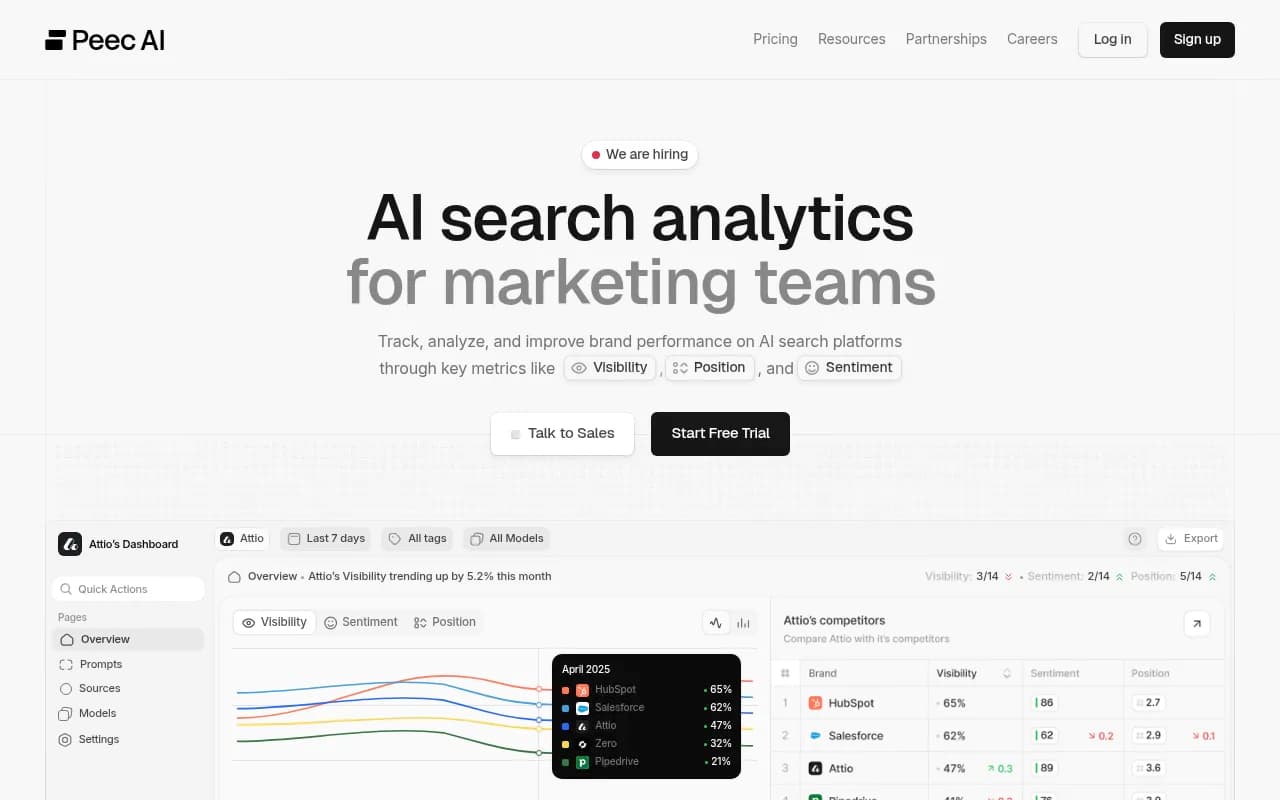
Peec AI is Scrunch's most direct competitor on price and scope, and its 2026 moves show a team shipping quickly. Its changelog logged AI Shopping Analytics (June 2026, tracking product-level visibility, price, and placement inside AI answers), a Brand Perception module, a Query Fanouts page, Crawl Insights with WordPress, AWS CloudFront, and Google Cloud log connectors, bulk tag management, and new tracked models including Gemini 3 Flash and Qwen 3.7.
The company reports 2,500+ customers. Pricing starts at $95/month for 50 prompts across three engines of your choosing, with Pro at $245/month and Advanced at $495/month adding multi-country tracking and Looker Studio integration. Enterprise unlocks unlimited projects, API, SSO, and MCP.
The honest limitation: Peec is a monitoring tool first. The tagline on its own directory listing says it plainly, "AI search monitoring without the optimization." If you want content generation and execution workflows, you'll pair it with something else.
4. AthenaHQ

AthenaHQ's 2026 launches are visible right on its pricing page, flagged "New feature": the Athena AI agent, the Athena Citation Engine (ACE), Oracle discrepancy detection, and a Knowledge Base with claim review. That's a genuinely fast clip for a platform at this price point.
Pricing starts at $295/month ($245/month billed annually) for 3,600 credits, three seats, and 8+ engines, with a lower intro offer for the first month. Enterprise runs custom, reportedly from around $2,000/month. The credit system (one credit equals one AI response) is transparent, but watch your consumption if you track many prompts across many engines.
5. Otterly.AI

Otterly.AI is the budget option, starting at $29/month for 15 prompts. It's not the most feature-rich platform here, but it covers the four core engines (ChatGPT, AI Overviews, Perplexity, Copilot) at every tier, and for small teams that just need to know whether they're showing up in AI answers, it does the job.
The trade-off is structural: Claude, Gemini, and AI Mode are paid add-ons ($9 to $439/month depending on tier), and the feature set is tracking-focused. Don't expect content tooling or crawler analytics. But at a fraction of Scrunch's entry price, it's a legitimate starting point.
6. LLM Pulse
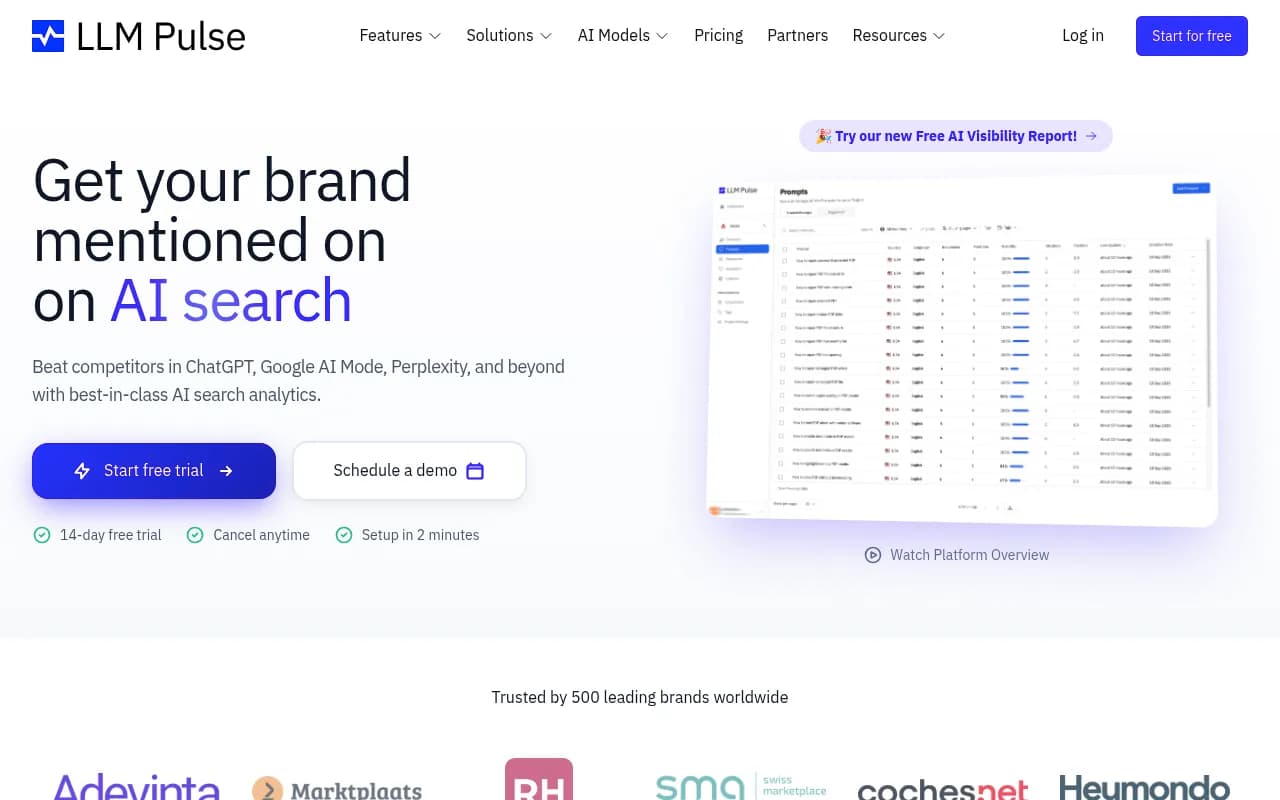
LLM Pulse takes a volume-first approach: five standard models (ChatGPT, Perplexity, Gemini, AI Mode, AI Overviews) included on every tier, starting at €49/month for 50 prompts and scaling to €1,199/month for 2,400 prompts. Claude, Copilot, Grok, and DeepSeek are add-ons at every tier, and the default refresh is weekly unless you opt into daily tracking.
It's a solid pick if prompt volume is your bottleneck and you want predictable pricing. Like Peec, it's monitoring-focused rather than execution-focused.
Comparison at a glance
| Tool | Entry price | Release cadence evidence | Execution features | Best for |
|---|---|---|---|---|
| Profound | ~$99/mo (annual) | Detailed public changelog, weekly-ish named releases | Aim agent, CMS integrations, Ads Studio | Enterprise analytics teams |
| Promptwatch | Free tier; $95/mo Essential | Fast shipping tied to its own 26B+ data point research operation | Content Agents with CMS publishing, Unified Actions, Agent Chat | Teams that want monitoring and fixing in one platform |
| Peec AI | $95/mo | Public changelog: AI Shopping Analytics, Crawl Insights, new models in 2026 | Limited; monitoring-first | Budget-conscious multi-engine tracking |
| AthenaHQ | $295/mo ($245/mo annual) | Multiple 2026 launches flagged on its own pricing page | Athena AI agent, ACE, Knowledge Base | Mid-market teams wanting newer features |
| Otterly.AI | $29/mo | Steady but smaller scope | None to speak of; tracking only | Small teams and solo marketers |
| LLM Pulse | €49/mo | Active but monitoring-scoped | None; tracking only | High prompt volume on a budget |
| Scrunch AI | $250/mo (annual) | Blog-style batched updates; no dated public changelog | Page audits, Site Diagnostics | Existing Sitecore customers |
How to choose
A few questions that cut through the noise:
Do you need execution or just visibility? If your team has writers and wants a platform that tells them what to fix and can publish the fix, Promptwatch and Profound are the serious options. If you already have a content workflow and just need tracking, Peec AI or LLM Pulse will cost you less.
How many engines matter to your buyers? Read the fine print on engine coverage at each tier. Otterly locks Claude and Gemini behind add-ons; Profound's entry tier is ChatGPT-only; Promptwatch and AthenaHQ include broad multi-model coverage earlier in their ladders. Also check whether the tool monitors real chat interfaces or just APIs, because the answers users see can differ from API outputs.
Do the prompt math before comparing sticker prices. A "100 prompts" plan tracked across five engines can mean 500 tracked responses. Credits, response counts, and engine multipliers vary wildly between vendors, and prompt math decides your bill more than the headline price does.
Check the changelog before you commit. This is the cheapest due diligence you'll ever do. If a vendor publishes a dated, granular changelog, you can see exactly how fast they move. If they announce features through occasional blog posts, you're trusting their internal priorities. Given that ChatGPT can change its retrieval behavior overnight, as the site: operator shift proved, vendor speed is your insurance policy.
If you want to browse the full category rather than shortlist from this page, the GEO software directory at bestgeosoftware.com covers the broader landscape, and ai-rank-tools.com focuses specifically on rank tracking tools.
The bottom line
Scrunch AI remains a capable platform, and the Sitecore acquisition could ultimately give it more resources, not fewer. But if you're not a Sitecore customer, the combination of a $250/month floor, batched updates, and a roadmap that will increasingly answer to a corporate parent makes this a reasonable moment to evaluate alternatives.
The tools shipping fastest in 2026, Profound and Promptwatch at the top end, Peec AI and AthenaHQ in the mid-market, all share one trait: they treat AI search as a moving target and update accordingly. Given that the target moved three separate times in 2026 without warning, that trait is worth paying for.