Key Takeaways
- Pricing gap: LLM Pulse starts at €49/mo (40 prompts) vs Scrunch at $250/mo (100 prompts) -- LLM Pulse is 5x cheaper for small teams
- Feature depth: Scrunch includes an Agent Experience Platform (AXP) for serving AI-optimized content directly to bots; LLM Pulse focuses purely on monitoring and analysis
- Model coverage: Both track 10+ AI models including ChatGPT, Perplexity, Gemini, and Google AI Mode. Scrunch adds Claude tracking at all tiers; LLM Pulse gates Claude/Copilot/Meta AI behind Enterprise
- Optimization approach: Scrunch provides actionable tips and error detection for crawl issues; LLM Pulse offers AI-powered content recommendations
- Best for startups/SMBs: LLM Pulse wins on affordability and ease of setup (2 minutes). Best for brands just starting to track AI visibility.
- Best for enterprises: Scrunch wins if you need the AXP to serve custom content to AI bots, or if you want deeper crawl diagnostics and optimization insights
Overview
Scrunch
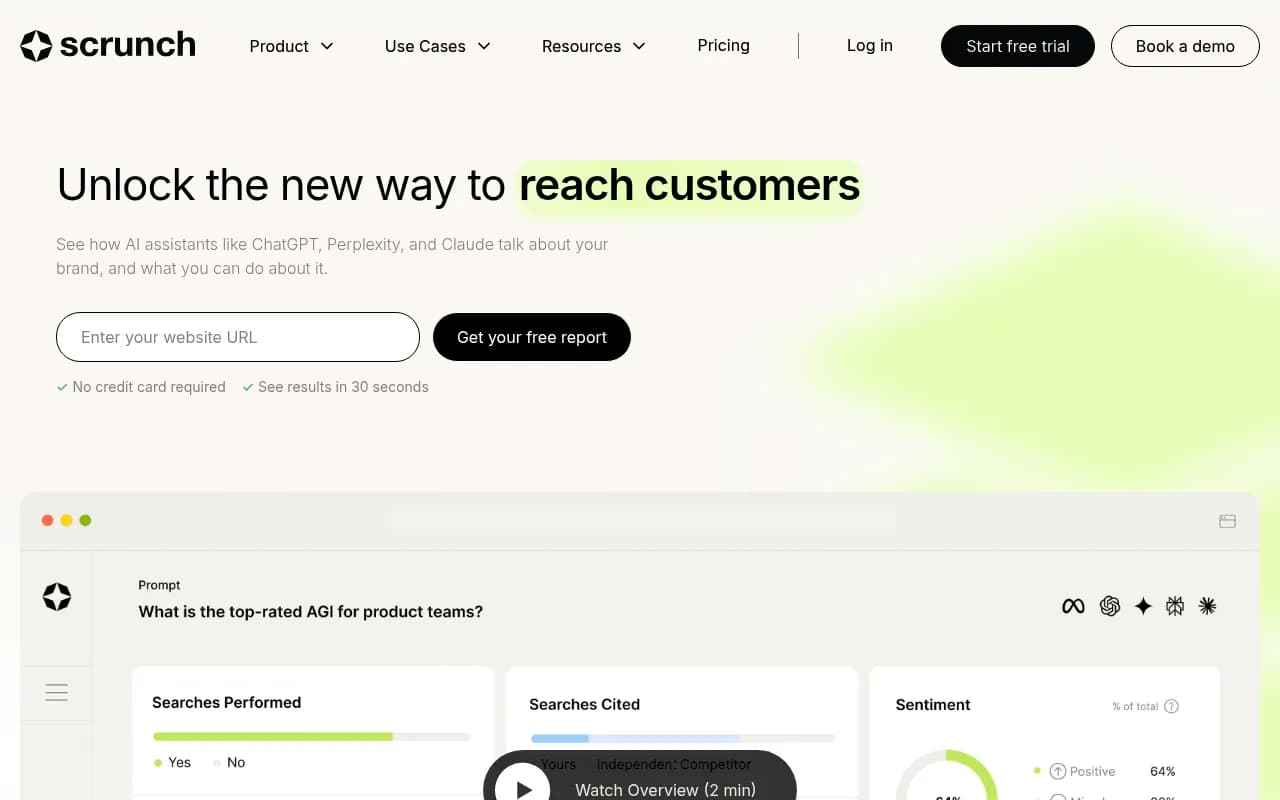
Scrunch positions itself as an "AI Customer Experience Platform" -- not just a monitoring tool. It tracks brand visibility across ChatGPT, Perplexity, Claude, Gemini, and other LLMs, but goes further by offering an Agent Experience Platform (AXP) that lets you serve AI-optimized content directly to AI bots. Think of it as creating a parallel version of your site translated for AI traffic. Used by 500+ companies including Lenovo, Skims, and Penn State University. Pricing starts at $250/mo (Starter tier, billed annually) with a 7-day free trial.
LLM Pulse
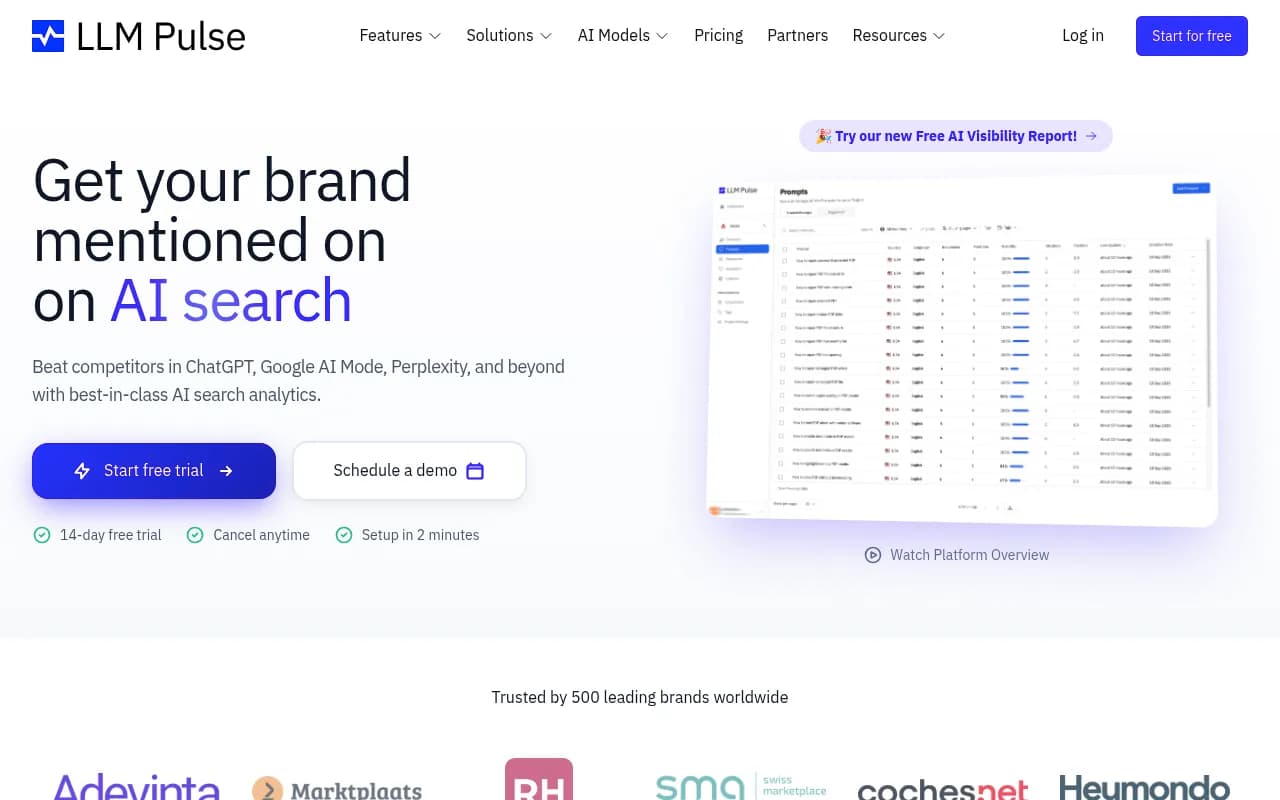
LLM Pulse is a straightforward AI search visibility tracker. It monitors how ChatGPT, Perplexity, Gemini, and Google AI Mode describe your brand, tracks prompts weekly, measures visibility scores and citation rates, and benchmarks you against competitors. The platform emphasizes simplicity -- setup takes 2 minutes, and the interface is built around three steps: track, analyze, optimize. Used by 500+ brands. Pricing starts at €49/mo (Starter: 1 project, 40 prompts) with a 14-day free trial and 17% discount on annual billing.
If you're also looking to understand how AI search visibility fits into a broader content optimization strategy, Promptwatch covers that angle with content gap analysis and AI-powered article generation grounded in citation data.

Side-by-Side Comparison
| Feature | Scrunch | LLM Pulse |
|---|---|---|
| Starting price | $250/mo (annual) | €49/mo (~$54) |
| Free trial | 7 days | 14 days |
| Prompts (starter tier) | 100 | 40 |
| Projects (starter tier) | 1 | 1 |
| AI models tracked | 10+ (ChatGPT, Perplexity, Gemini, Claude, Google AI Mode, DeepSeek, Grok, Copilot, Meta AI, AI Overviews) | 10+ (ChatGPT, Perplexity, Gemini, Google AI Mode, AI Overviews, Claude/Copilot/Meta AI on Enterprise only) |
| Citation analysis | ✓ Yes | ✓ Yes |
| Competitor benchmarking | ✓ Yes | ✓ Yes (share of voice) |
| AI bot crawl logs | ✓ Yes (real-time feed) | ✗ No |
| Error detection | ✓ Yes (crawl errors) | ✗ No |
| Content optimization | ✓ Actionable tips | ✓ AI-powered recommendations |
| Agent Experience Platform | ✓ Yes (serve custom content to AI bots) | ✗ No |
| Looker Studio integration | ✗ No | ✓ Yes |
| Setup time | Not specified | 2 minutes |
| Target audience | Mid-market to enterprise | Startups to mid-market |
Pricing comparison
| Plan | Scrunch | LLM Pulse |
|---|---|---|
| Starter | $250/mo (annual) -- 1 project, 100 prompts | €49/mo (~$54) -- 1 project, 40 prompts |
| Growth/Scale | $417/mo (annual) -- details not public | €299/mo (~$330) -- 5 projects, 300 prompts |
| Enterprise | Custom pricing | Custom pricing |
| Annual discount | Included in listed prices | 17% off monthly rate |
| Free trial | 7 days | 14 days |
The price gap is significant. LLM Pulse's starter tier is roughly one-fifth the cost of Scrunch's, though Scrunch includes 2.5x more prompts. On a per-prompt basis, LLM Pulse costs ~$1.35/prompt vs Scrunch at $2.50/prompt. If you're tracking 40 prompts or fewer, LLM Pulse is the clear winner on cost. If you need 100+ prompts and the AXP feature, Scrunch's pricing makes more sense.
Feature deep-dive
AI model coverage
Both platforms track the major AI models that matter in 2026: ChatGPT, Perplexity, Gemini, Google AI Mode, and Google AI Overviews. Scrunch includes Claude, DeepSeek, Grok, Copilot, and Meta AI at all tiers. LLM Pulse gates Claude, Copilot, and Meta AI behind its Enterprise plan, which could be a dealbreaker if you need comprehensive coverage on a budget.
Verdict: Scrunch wins on model coverage at lower price tiers.
Prompt tracking and analytics
Scrunch tracks prompts and provides "prompt analytics" -- trends, citations, competitors, and rankings for any prompt. You can filter by competitor, persona, topic, and geography. LLM Pulse tracks prompts weekly and shows visibility scores, citation rates, sentiment, and share of voice. Both platforms let you see the exact responses AI models generate.
The difference: Scrunch emphasizes real-time tracking and granular filtering. LLM Pulse emphasizes weekly snapshots and share-of-voice metrics, which are useful for competitive benchmarking. If you want to track daily fluctuations, Scrunch is better. If weekly trends and competitor comparisons are enough, LLM Pulse works fine.
Verdict: Tie, depending on your tracking cadence preference.
Citation analysis
Both platforms show which sources AI models cite when answering prompts. Scrunch surfaces "the sites that AI loves to cite" and lets you explore citation patterns. LLM Pulse emphasizes finding out "which sources AI trusts in your space" and whether your content gets cited vs competitors.
Neither platform provides citation volume estimates or difficulty scoring for prompts (features you'd find in tools like Promptwatch). Both are descriptive rather than prescriptive -- they show you what's happening, but don't quantify how hard it is to break into a citation set.
Verdict: Tie. Both offer citation analysis; neither goes deep on citation volume or difficulty.
AI bot crawl monitoring
Scrunch includes a real-time feed of AI bot traffic -- you can see when ChatGPT, Perplexity, Claude, and other bots crawl your site, which pages they hit, and whether they encounter errors. This is a unique feature. LLM Pulse does not offer crawl log monitoring.
If you're debugging why AI models aren't citing your content, Scrunch's crawl logs are invaluable. You can spot 404s, slow pages, or robots.txt blocks that prevent AI bots from indexing your site. LLM Pulse assumes your site is already crawlable and focuses on the output side (what AI models say).
Verdict: Scrunch wins decisively. Crawl logs are a major differentiator.
Optimization and content recommendations
Scrunch provides "actionable tips to move up the ranks" and error detection for crawl issues. The platform tells you when AI bots can't access your site and suggests fixes. It's more diagnostic -- focused on technical issues that block visibility.
LLM Pulse offers "AI-powered content recommendations to improve how you appear in LLM responses." This is more strategic -- it suggests topics or angles to cover based on what AI models are citing. The platform frames this as "closing the loop" after tracking and analysis.
Neither platform generates content for you (that's where tools like Promptwatch come in with AI writing agents). Both give you recommendations, but Scrunch leans technical while LLM Pulse leans editorial.
Verdict: Tie. Choose based on whether you need technical diagnostics (Scrunch) or content strategy (LLM Pulse).
Agent Experience Platform (AXP)
This is Scrunch's standout feature. The AXP lets you create a parallel version of your site optimized for AI traffic. Instead of serving the same HTML to humans and bots, you can serve AI-friendly content (structured data, concise answers, key facts) directly to AI crawlers. Scrunch frames this as "your most important visitor isn't human."
LLM Pulse has no equivalent. It's purely a monitoring and analysis tool.
If you're serious about optimizing for AI search and have the resources to maintain a separate content layer for bots, the AXP is powerful. If you just want to track what's happening without changing your site, you don't need it.
Verdict: Scrunch wins. The AXP is a unique capability that justifies the higher price for enterprises.
Integrations and reporting
LLM Pulse offers a Looker Studio connector, which is useful if you're building custom dashboards or combining AI visibility data with other marketing metrics. Scrunch does not mention Looker Studio or API access in its public materials.
Both platforms likely offer CSV exports and basic reporting, but LLM Pulse explicitly markets its Looker Studio integration as a feature.
Verdict: LLM Pulse wins on integrations.
Ease of use and setup
LLM Pulse emphasizes "setup in 2 minutes" and a simple three-step workflow (track, analyze, optimize). The platform is designed for speed and simplicity. Scrunch does not specify setup time, and its feature set (AXP, crawl logs, error detection) suggests a steeper learning curve.
If you want to start tracking AI visibility today without a lot of configuration, LLM Pulse is faster. If you're willing to invest time in setup to unlock deeper features, Scrunch rewards that effort.
Verdict: LLM Pulse wins on ease of use.
Pros and cons
Scrunch pros
- Agent Experience Platform lets you serve custom content to AI bots
- Real-time AI bot crawl logs and error detection
- Tracks Claude, DeepSeek, Grok, Copilot, and Meta AI at all tiers
- Actionable technical optimization tips
- Trusted by recognizable brands (Lenovo, Skims, Penn State)
Scrunch cons
- 5x more expensive than LLM Pulse at the starter tier
- Shorter free trial (7 days vs 14 days)
- Steeper learning curve due to feature depth
- No Looker Studio integration mentioned
LLM Pulse pros
- Much cheaper starting price (€49/mo vs $250/mo)
- Longer free trial (14 days)
- Fast setup (2 minutes)
- Looker Studio connector for custom reporting
- Strong share-of-voice metrics for competitive benchmarking
- 17% discount on annual billing
LLM Pulse cons
- No AI bot crawl logs or error detection
- Fewer prompts on starter tier (40 vs 100)
- Claude, Copilot, and Meta AI gated behind Enterprise plan
- No Agent Experience Platform or content serving features
- Less depth on technical optimization
Who should pick which tool
Choose Scrunch if:
- You're a mid-market or enterprise brand with budget for a $250+/mo tool
- You need to serve custom content to AI bots via the Agent Experience Platform
- You want real-time crawl logs to debug why AI models aren't citing your site
- You need comprehensive model coverage (Claude, DeepSeek, Grok, etc.) without upgrading to Enterprise
- You have technical resources to act on crawl error diagnostics
Choose LLM Pulse if:
- You're a startup or SMB with a limited budget
- You want to start tracking AI visibility quickly (2-minute setup)
- You need Looker Studio integration for custom dashboards
- You care more about competitive benchmarking (share of voice) than technical diagnostics
- You're tracking 40 prompts or fewer and don't need the AXP
Choose neither if:
- You need content generation tools, not just monitoring (look at Promptwatch or similar)
- You're only interested in traditional SEO, not AI search visibility
- You don't have the resources to act on the insights either platform provides
Final verdict
LLM Pulse wins on affordability, ease of use, and speed to value. It's the better choice for startups and small teams who want to understand their AI search presence without a big investment. Scrunch wins on feature depth and enterprise capabilities -- the Agent Experience Platform and crawl logs are genuinely differentiated features that justify the higher price if you need them. For most teams just starting to track AI visibility, LLM Pulse is the smarter pick. For brands ready to actively optimize how AI bots consume their content, Scrunch is worth the premium.