Key takeaways
- Bluefish AI is enterprise-only with estimated pricing of $4,000+/month and no self-serve option -- you need a sales call just to see the product. LLM Pulse starts at €49/month with a 14-day free trial and 2-minute setup.
- Both tools track 10+ AI models, but Bluefish AI has a dedicated AI Commerce module for agentic shopping visibility that LLM Pulse doesn't match.
- LLM Pulse is a monitoring and analytics tool with optimization recommendations. Bluefish AI adds custom audience segmentation, campaign ROI measurement (Collections), and deeper workflow automation -- but only at enterprise scale.
- Neither platform includes built-in AI content generation. If you want to close the full loop from gap analysis to content creation to tracking, you'll need to look beyond both tools.
- LLM Pulse is trusted by 500+ brands and is accessible to any team with a credit card. Bluefish AI targets Fortune 500 companies and consistently passes enterprise infosec reviews -- a real differentiator for large organizations with strict security requirements.
- For most marketing teams and agencies, LLM Pulse delivers 80% of what Bluefish AI offers at a fraction of the cost. Bluefish AI's premium is justified mainly for enterprises that need custom data segmentation, dedicated support, and AI commerce tracking.
Overview
Bluefish AI
Bluefish AI positions itself as the AI marketing platform for the Fortune 500. The pitch is authority and control -- not just knowing where your brand appears in AI responses, but understanding how AI models "think" about your category and influencing that over time. The platform covers AI monitoring, GEO optimization, measurement, and AI commerce in a single suite. It's built to pass enterprise infosec reviews, handle custom audience segmentation, and integrate with data teams that need more than a dashboard. The February 2026 launch of "Collections" -- a feature that measures the ROI of digital marketing campaigns in the AI channel -- shows the product is moving toward full-funnel attribution, not just visibility scores.
The catch: there's no pricing page, no free trial, and no self-serve signup. Everything goes through a demo request. That's a deliberate choice for an enterprise product, but it means Bluefish AI is essentially invisible to anyone who isn't already running a Fortune 500 marketing budget.
LLM Pulse
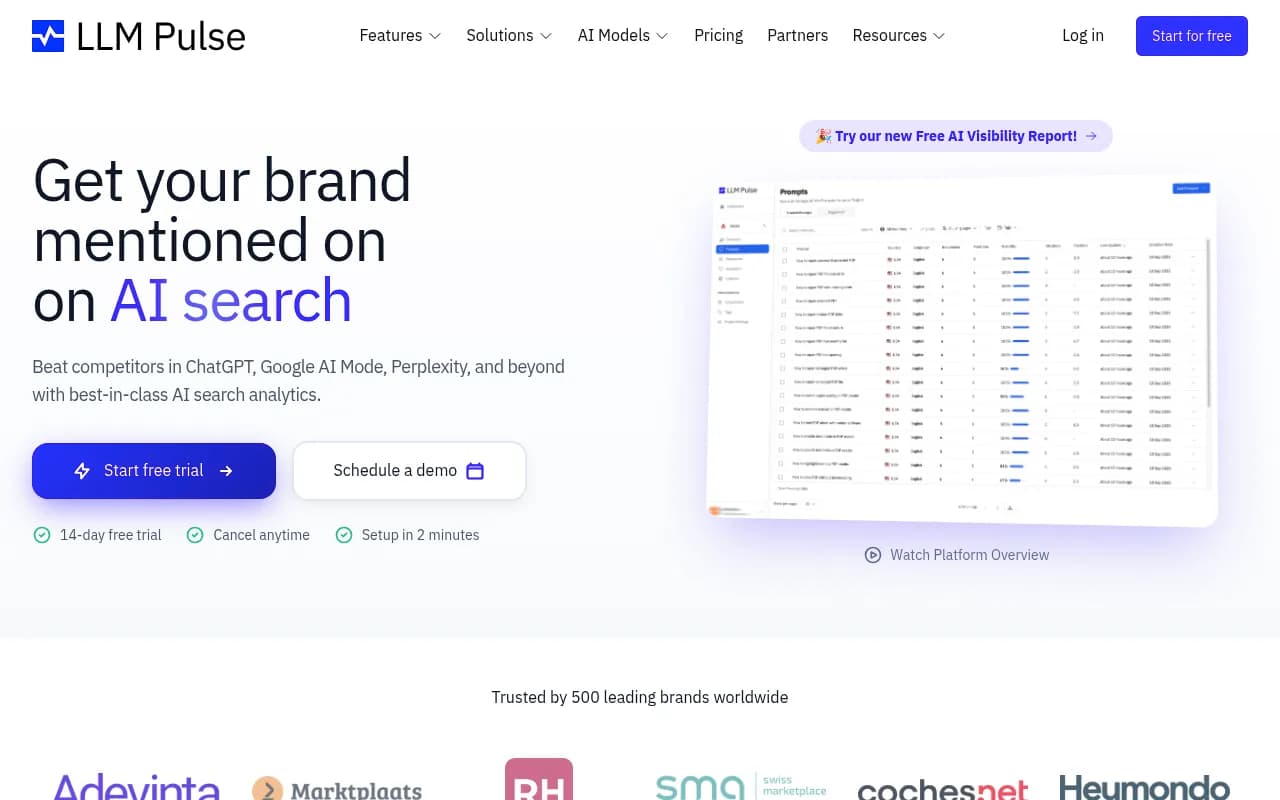
LLM Pulse takes the opposite approach. It's a self-serve AI visibility tracker that you can set up in two minutes and start using the same day. The core loop is simple: track prompts weekly, measure your visibility score and citation rate, benchmark against competitors, and get recommendations to improve. It covers ChatGPT, Perplexity, Gemini, Google AI Mode, AI Overviews, and -- on Enterprise plans -- DeepSeek, Grok, Claude, Copilot, and Meta AI.
500+ brands use it, and the pricing is transparent: €49/month for a starter setup, scaling to €299/month for 5 projects and 300 prompts. It's not trying to be an enterprise suite. It's trying to be the fastest, most accessible way for a marketing team to understand what AI says about their brand.
Side-by-side comparison
| Feature | Bluefish AI | LLM Pulse |
|---|---|---|
| Target audience | Fortune 500 / enterprise | SMB, mid-market, agencies |
| Pricing model | Quote-based (est. $4,000+/mo) | €49–€299/mo + Enterprise custom |
| Free trial | No (demo required) | 14-day free trial |
| Self-serve signup | No | Yes |
| AI models tracked | 10+ (ChatGPT, Perplexity, Gemini, etc.) | 10+ (ChatGPT, Perplexity, Gemini, etc.) |
| Prompt tracking | Yes, custom | Yes, weekly |
| Visibility scoring | Yes | Yes |
| Citation analysis | Yes | Yes |
| Competitor benchmarking | Yes | Yes |
| Sentiment analysis | Yes | Yes |
| AI Commerce / shopping tracking | Yes (dedicated module) | No |
| Campaign ROI measurement | Yes (Collections) | No |
| Content optimization recommendations | Yes | Yes (AI-powered) |
| Built-in content generation | No | No |
| Custom audience segmentation | Yes | Limited |
| Enterprise infosec compliance | Yes | Not specified |
| API access | Yes (enterprise) | Not specified |
| Setup time | Weeks (sales process) | 2 minutes |
Head-to-head feature deep-dive
Pricing and accessibility
This is where the two tools diverge most sharply. LLM Pulse publishes its pricing clearly:
| Plan | Price | Projects | Prompts |
|---|---|---|---|
| Starter | €49/month | 1 | 40 |
| Growth | €149/month | 3 | 150 |
| Scale | €299/month | 5 | 300 |
| Enterprise | Custom | Custom | Custom |
Annual billing saves 17% across all plans. There's a 14-day free trial with no credit card required and no sales call needed.
Bluefish AI has no public pricing. Based on available market data, enterprise clients are looking at $4,000+ per month. There's no trial, no freemium tier, and no way to explore the product without going through a sales process. For a Fortune 500 brand, that's normal. For a 10-person marketing team, it's a non-starter.
Verdict: LLM Pulse wins for accessibility and transparency. Bluefish AI's pricing structure is appropriate for its target market but excludes everyone else.
AI model coverage
Both platforms track the major AI models that matter for most brands:
| AI model | Bluefish AI | LLM Pulse |
|---|---|---|
| ChatGPT | Yes | Yes |
| Perplexity | Yes | Yes |
| Gemini | Yes | Yes |
| Google AI Mode | Yes | Yes |
| Google AI Overviews | Yes | Yes |
| DeepSeek | Yes | Enterprise only |
| Grok | Yes | Enterprise only |
| Claude | Yes | Enterprise only |
| Copilot | Yes | Enterprise only |
| Meta AI | Yes | Enterprise only |
On paper, coverage is similar. The difference is that LLM Pulse gates several models behind its Enterprise plan, while Bluefish AI includes them across its (single, enterprise) tier. For most teams on LLM Pulse's Growth or Scale plans, you're working with ChatGPT, Perplexity, Gemini, and Google -- which covers the majority of AI search traffic anyway.
Verdict: Roughly equal for the models that matter most. Bluefish AI has a slight edge for teams that need comprehensive coverage across all models without upgrading.
Monitoring and analytics
Both tools cover the core monitoring stack: prompt tracking, visibility scores, citation analysis, sentiment, and competitor benchmarking. Where they differ is depth and customization.
Bluefish AI is built for teams that need to slice data by custom audiences, tailor prompts to specific market segments, and build measurement frameworks that go beyond standard dashboards. The platform explicitly positions itself around helping marketers understand how AI "thinks" -- not just what it says. That's a meaningful distinction for category leaders trying to influence AI narratives, not just track them.
LLM Pulse gives you clean, actionable dashboards. You see your visibility score over time, which sources AI cites in your category, how competitors compare, and the exact language AI uses to describe your brand. It's well-designed for a team that wants to check in weekly and act on clear signals. What it doesn't offer is the deep custom segmentation that Bluefish AI provides.
Verdict: Bluefish AI for enterprises that need custom data architecture. LLM Pulse for teams that want clear, actionable monitoring without complexity.
AI commerce and campaign measurement
This is Bluefish AI's clearest differentiator. The platform has a dedicated AI Commerce module for tracking brand visibility in agentic shopping experiences -- the kind of product recommendations that AI assistants make when users ask "what's the best X to buy?" The February 2026 Super Bowl research (showing that TV ads influence AI recommendations) came directly from Bluefish's data, which suggests the platform has real depth in this area.
The Collections feature, launched in February 2026, lets marketers measure the ROI of digital marketing campaigns specifically in the AI channel. That's a capability most GEO platforms don't have yet.
LLM Pulse doesn't have a dedicated AI commerce module or campaign attribution feature. It focuses on organic AI search visibility rather than paid or campaign-driven influence.
Verdict: Bluefish AI wins clearly here. If AI commerce and campaign ROI in AI channels matter to your business, LLM Pulse doesn't cover it.
Optimization and content recommendations
Neither platform includes built-in AI content generation -- a gap worth noting. Both offer optimization guidance, but the approach differs.
LLM Pulse provides AI-powered recommendations to improve how you appear in LLM responses. These are actionable suggestions based on what the platform observes in AI citations and responses. It's useful, but it stops at the recommendation stage. You still need to create the content yourself.
Bluefish AI automates optimization workflows and offers deeper GEO tooling, but again, content creation isn't part of the platform. The focus is on measurement frameworks and workflow automation rather than generating the actual content.
If you're looking for a platform that goes from gap analysis to content creation to tracking results in one loop, both tools fall short. Promptwatch covers that full cycle -- including a built-in AI writing agent that generates content grounded in citation data -- which is worth knowing if content production is a bottleneck for your team.

Verdict: Bluefish AI has more sophisticated optimization workflows for enterprise teams. LLM Pulse's recommendations are simpler but immediately actionable. Neither generates content.
Enterprise readiness and security
Bluefish AI explicitly calls out that it "consistently passes infosec reviews with ease" -- a real selling point for large organizations with strict vendor security requirements. Enterprise data teams get custom segmentation, API access, and integration options that smaller tools don't offer. The Fortune 500 positioning isn't just marketing; the product is genuinely built for that environment.
LLM Pulse doesn't publish information about security certifications or enterprise compliance. For a startup or mid-market company, that's probably fine. For a regulated industry or a company with a rigorous vendor review process, it's a question worth asking before committing.
Verdict: Bluefish AI wins for enterprise security and compliance. LLM Pulse is appropriate for most teams but hasn't published the documentation that large enterprises typically require.
Pricing comparison
| Plan | Bluefish AI | LLM Pulse |
|---|---|---|
| Free trial | No | 14 days (no credit card) |
| Entry-level | ~$4,000+/month (est.) | €49/month |
| Mid-tier | Custom | €149/month |
| Scale | Custom | €299/month |
| Enterprise | Custom | Custom |
| Annual discount | Not published | 17% |
| Self-serve | No | Yes |
The pricing gap is enormous. LLM Pulse's Scale plan at €299/month covers 5 projects and 300 prompts -- a solid setup for a mid-sized marketing team or agency. Bluefish AI's entry point is roughly 13x higher, and that's before you factor in the time cost of a sales process.
Pros and cons
Bluefish AI
Pros:
- Dedicated AI Commerce module for agentic shopping visibility
- Campaign ROI measurement (Collections) -- rare in this category
- Custom audience segmentation and tailored measurement frameworks
- Passes enterprise infosec reviews -- important for large organizations
- Deep GEO optimization workflows beyond basic monitoring
- Backed by original research (Super Bowl AI influence study)
Cons:
- No public pricing -- requires a demo just to understand costs
- No free trial or self-serve option
- Estimated $4,000+/month puts it out of reach for most teams
- Onboarding takes weeks, not minutes
- No built-in content generation
LLM Pulse
Pros:
- Transparent pricing starting at €49/month
- 14-day free trial, no credit card required, 2-minute setup
- Covers 10+ AI models (with full coverage on Enterprise)
- Clean dashboards with visibility scores, citations, sentiment, and competitor benchmarking
- Accessible to any team regardless of size
- 500+ brands already using it
Cons:
- No AI Commerce or agentic shopping tracking
- No campaign ROI measurement
- Limited custom segmentation compared to Bluefish AI
- No built-in content generation
- Enterprise security certifications not published
- Optimization recommendations stop short of content creation
Who should pick which tool
Choose Bluefish AI if:
- You're at a Fortune 500 or large enterprise brand with a meaningful AI marketing budget
- AI commerce and agentic shopping visibility are part of your strategy
- You need to measure the ROI of marketing campaigns in the AI channel
- Your organization has strict infosec requirements that vendors need to pass
- You need custom audience segmentation and tailored measurement frameworks
- You have a dedicated team to manage a complex platform and a sales relationship
Choose LLM Pulse if:
- You're a startup, SMB, mid-market company, or agency
- You want to start tracking AI visibility today without a sales process
- Your budget is under $500/month
- You need clean, actionable monitoring across ChatGPT, Perplexity, Gemini, and Google AI
- You want to benchmark against competitors and track citation sources
- You're new to GEO and want a low-friction way to understand the space
Final verdict
These two tools are aimed at completely different buyers, which makes a direct "winner" less useful than it sounds. Bluefish AI is a serious enterprise platform with capabilities -- AI commerce tracking, campaign ROI measurement, custom segmentation -- that LLM Pulse simply doesn't have. If you're running AI marketing at a Fortune 500 brand and need a vendor that can pass infosec reviews and handle complex data requirements, Bluefish AI is worth the conversation.
For everyone else, LLM Pulse is the practical choice. It covers the monitoring fundamentals well, the pricing is honest, and you can be up and running in the time it takes to read this page. The gap between what these tools offer narrows considerably once you move past the enterprise-specific features -- and for most teams, those features aren't what they need anyway.
The honest summary: Bluefish AI is built for the 1% of companies that can afford it and need what it offers. LLM Pulse is built for the rest.