Key takeaways
- ChatGPT only surfaces around 5 sources per web-search response, far fewer than Google AI Overviews or Perplexity (roughly 10 each), so every citation slot for a dev tool comparison is heavily contested.
- ChatGPT now fires off
site:operator queries at scale (jumping from 0.4% to 17% of fanout queries on August 8, 2026), so it's worth checking whether it can even crawl and index your docs, GitHub, and comparison pages. - Stack Overflow and GitHub routinely outrank marketing sites in technical AI citations, which means your audit needs to look past your own website and check developer-community presence.
- Reddit's citation share on ChatGPT can collapse within days (it dropped from ~3.8% to under 1% between August 7-14, 2026), so don't build your competitive audit around a single social source.
- A proper audit is a repeatable spreadsheet exercise: same prompts, same settings, fresh sessions, run monthly, with results logged for you, your top three competitors, and the specific pages ChatGPT cites.
Why this is worth an afternoon of your time
If you build developer tools, ChatGPT is probably the single most important discovery channel you're not tracking. According to the 2025 Stack Overflow Developer Survey, 81.7% of developers use ChatGPT out of the box, well ahead of GitHub Copilot (67.9%) and Gemini (47.4%). When a developer types "best headless CMS for a Next.js project" or "lightweight alternative to Postman," ChatGPT gives a short, specific answer naming two or three tools. If your tool isn't one of them, you don't lose a click, you lose the sale before you knew there was a chance to make it.
The annoying part is that this isn't the same competition you're used to. A tool ranking #12 on Google for "best API testing tool" can be the answer ChatGPT gives every time, because LLMs weigh signals Google doesn't: how often you show up in Stack Overflow answers, GitHub READMEs, comparison posts, and G2 reviews, not just backlinks and on-page keywords. So the first job of an audit is figuring out if your Google competitors are even the same as your ChatGPT competitors. Often they aren't.
Step 1: lock down your test environment
Before you run a single prompt, strip out anything that could bias the answer. ChatGPT's personalization features will happily tell you what it thinks you want to hear if it remembers you work at the company you're auditing.
- Go to Settings > Personalization and turn off "Reference saved memories" and "Reference chat history."
- Use Temporary Chat for every test prompt. It's not full zero-retention (OpenAI's own help docs note data can still be used briefly for safety review), but it keeps the conversation out of your history and stops it from influencing future answers.
- Log out of any account tied to your company, or use a separate browser profile, if you want a genuinely neutral read.
Skip this step and you'll spend weeks "fixing" problems that were never real, just your own chat history talking back to you.
Step 2: build a prompt set that mirrors real developer intent
Generic prompts give you generic, useless results. You need three categories of prompts, and you need to write them the way a developer actually types, not the way a marketer writes a headline.
- Direct recommendation prompts - "best [category] for [use case]", e.g. "best open source feature flag tool for a Django app"
- Comparison prompts - "[your tool] vs [competitor]" and "[competitor] alternatives"
- Problem-first prompts - the way developers actually search when they haven't picked a category yet, e.g. "how do I run background jobs in a serverless Node app without managing infra"
One detail worth knowing: Promptwatch's data on ChatGPT query fanouts shows the internal search queries ChatGPT generates have gotten much shorter, down from around 117 characters last December to about 53 characters by April 2026. It's increasingly typing keyword fragments internally, like "best CRM for small agencies 2026," rather than full sentences. Write your test prompts as questions, but expect the retrieval behind the scenes to look more like a Google keyword search than a conversation.
Aim for 15-20 prompts across the three categories, and keep them in a spreadsheet so you can rerun the exact same list next month.
Step 3: run every prompt, and record more than "were we mentioned"
For each prompt, open a fresh Temporary Chat and record:
- Was your tool mentioned at all, and in what position (first, buried in a list, footnote)
- Which competitors were mentioned, and in what order
- What sources ChatGPT actually cited (hover over or click the citation markers)
- The tone: neutral description, enthusiastic recommendation, or a caveat like "but check pricing first"
Don't stop at ChatGPT. Run the same prompts through Perplexity, Google AI Overviews, and Gemini, because the pattern of who cites what differs a lot by engine. A tool that dominates AI Overviews because of strong Google rankings can be nearly invisible in ChatGPT if it has no Stack Overflow or GitHub footprint.
Step 4: map the citation sources, not just the mentions
This is the step most audits skip, and it's the one that actually tells you what to fix.
With only about 5 sources per ChatGPT response on average, according to Promptwatch's analysis of average sources per response, a single citation slot is worth fighting for. Compare that to Perplexity's steady 10 sources and you can see why ChatGPT visibility for a niche dev tool is genuinely harder to win but also more winnable once you're in, because there's less noise diluting your presence.
For developer tools specifically, the sources that actually get cited skew away from typical marketing content. Third-party analysis from a Q2 2026 review of over 5,000 queries across five AI engines found Stack Overflow and GitHub ranked as the 5th and 6th most-cited domains overall, ahead of most SaaS marketing sites (source: digitalapplied.com, via maxaeo.ai). Technical queries also tend to pull from just 3-6 domains total, versus roughly 10 in a Google results page, so one well-placed Stack Overflow answer or GitHub README section can carry outsized weight.
When you log citations, tag each one by type:
| Source type | Why it matters for dev tools |
|---|---|
| GitHub (README, issues, discussions) | High trust signal, frequently quoted by ChatGPT for setup and comparison questions |
| Stack Overflow answers | Models cite specific passages, not whole pages; one accepted answer can generate citations for years |
| G2 / Trustpilot | The review platforms ChatGPT actually cites for vendor-selection prompts; Capterra trails, Clutch barely registers |
| Your own docs / product pages | Product pages are now ChatGPT's most-cited content type overall (about a third of citations in July 2026) |
| Comparison ('X vs Y') pages | Still a small share of citations but growing fast, and less contested than listicles |
| Reddit threads | Historically strong but volatile; its ChatGPT citation share crashed from near 4% to under 1% in a matter of days in August 2026 |
That product-page and comparison-page data comes from Promptwatch's breakdown of ChatGPT citation types in July 2026, which found product pages made up roughly 32.8% of daily citations, nearly double their share back in March, while comparison pages grew from about 2.5% to 3.2% over the same window. If your pricing and product pages read like marketing copy instead of specific, quotable statements about what your tool does, that's a gap worth closing before you touch anything else.
Step 5: check whether ChatGPT can actually reach your content
An audit that only looks at chat outputs misses the technical layer underneath. ChatGPT started using the site: operator at scale on August 8, 2026, jumping from about 0.4% to 17% of all fanout queries overnight, according to Promptwatch's report on the ChatGPT site operator rollout. That means it may now be running queries like site:github.com yourtool as part of building an answer, so if your GitHub org, docs subdomain, or changelog is blocked or badly structured, you're cutting yourself out of a retrieval path you didn't know existed.
Check your robots.txt and CDN/WAF rules against the current crawler mix. OpenAI's crawlers accounted for about 79.8% of verified AI crawler requests between August 31 and September 6, 2026, down from 94.8% in early June, which tells you the traffic is shifting toward Anthropic, Google, Perplexity, and Mistral crawlers too. If a rule that felt harmless a year ago is now blocking a provider that's grown its share, you won't show up no matter how good your content is.
Tools like Promptwatch track this crawler activity directly through log integrations with Cloudflare, AWS CloudFront, Fastly, and similar providers, showing you exactly when each AI crawler visits, what it reads, and whether it hits errors, which is a faster way to catch this than manually diffing robots.txt rules against a research report every quarter.

Step 6: score yourself against competitors on a simple grid
Once you've run the prompts and logged citations for a month or two, build a comparison grid. Keep it simple enough that you'd actually update it again next quarter.
| Audit dimension | Your tool | Competitor A | Competitor B |
|---|---|---|---|
| Mention rate across prompt set | |||
| Average position when mentioned | |||
| Sentiment (positive / neutral / negative) | |||
| Cited on GitHub / Stack Overflow | |||
| Cited on G2 / Trustpilot | |||
| Cited from own docs or product pages |
This single table usually surfaces the real story faster than a paragraph of narrative. If a competitor is winning almost entirely off Stack Overflow answers and you have none, that's your priority, not a redesign of your homepage.
Step 7: decide manual tracking versus a monitoring platform
Manual audits work, but they're slow. A full cycle across five prompt categories, five engines, and a dozen competitors realistically takes 4-8 hours if you're doing it by hand and doing it properly. That's fine quarterly. It's not fine if you want to catch a shift like the Reddit citation collapse mentioned earlier, which happened within a single week.
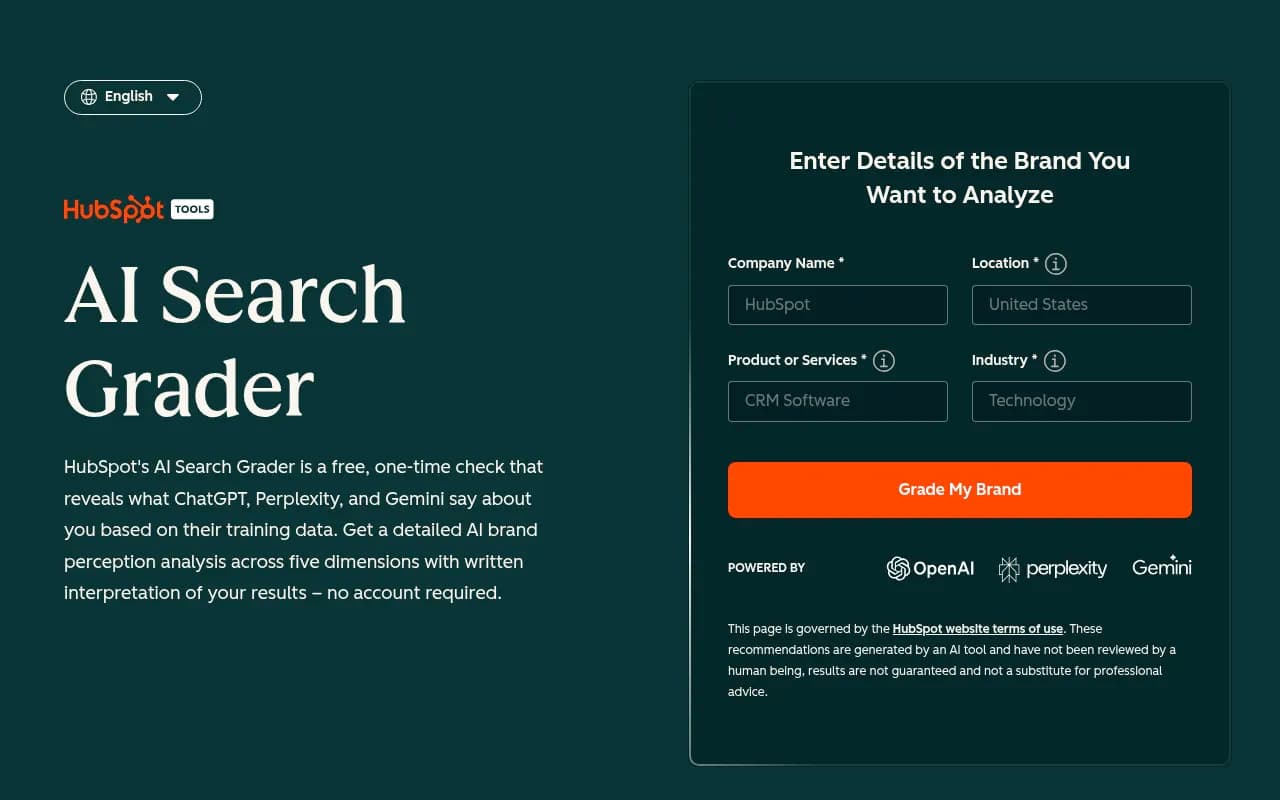
For ongoing tracking, several categories of tool exist. Free, one-off checks like HubSpot's AI Search Grader give a snapshot but no history.
Dedicated AI visibility platforms go further by tracking mentions, citations, and sentiment on a schedule. Otterly.AI is a lower-cost entry point that covers ChatGPT, Google AI Overviews, Perplexity, and Copilot on its base tier, with Claude and Gemini as paid add-ons.

Profound is positioned at the enterprise end, with pricing that scales up fast per engine and per prompt.

What separates a platform like Promptwatch from most of these is that it doesn't stop at monitoring. Beyond prompt tracking, it shows AI crawler logs so you can see exactly why you're invisible (not just that you are), tracks citations from Reddit and YouTube specifically since those channels shift fast and most trackers ignore them, and includes a content gap analysis and Content Agent that can draft and publish GEO-optimized comparison pages straight to your CMS. For a dev tool trying to close the gap between "we know we're missing citations" and "we've actually published the comparison page that gets cited," that closing-the-loop piece matters more than another dashboard.
| Tool | Starting price | Engines covered | Best for |
|---|---|---|---|
| Otterly.AI | $29/mo (Lite) | ChatGPT, AI Overviews, Perplexity, Copilot (others as add-ons) | Budget-conscious teams starting out |
| Mentionable | 79 EUR/mo | 7 engines, no per-engine add-on fees | Teams wanting all engines without upsells |
| Profound | $99/mo (Starter) | 3+ engines | Enterprise reporting needs |
| Promptwatch | $95/mo (Essential) | All major LLMs plus AI crawler logs, Reddit/YouTube citations | Teams that want monitoring and content fixes in one platform |
Step 8: turn findings into a short action list
An audit that ends in a spreadsheet and nothing else was a waste of an afternoon. Once you've mapped where you stand, the fixes tend to fall into a short list:
- Answer real questions on Stack Overflow honestly, without link-dropping. It violates community norms and gets removed, and it doesn't produce durable citations anyway.
- Keep your GitHub README specific about what the tool does and doesn't do, since ChatGPT quotes passages, not whole pages.
- Write or fix comparison pages ('yourtool vs competitor') with concrete, factual differences instead of marketing language, since that content type is growing in citation share while still being relatively uncontested.
- Get your G2 and Trustpilot profiles complete and current, since those are the two review platforms ChatGPT actually cites for vendor-selection prompts.
- Re-check robots.txt and CDN rules against the current AI crawler mix, since it shifts every few months.
- Rerun the exact same prompt set monthly and log the delta, not just the current state.
Run this cycle for two or three quarters and you'll start to see whether you're closing the gap on competitors or whether they're pulling further ahead. Either way, you'll know, which beats finding out from a lost deal that mentions "we asked ChatGPT and it recommended someone else."