Key Takeaways
- Completely different purposes: LLM Pulse monitors how AI chatbots describe your brand across ChatGPT, Perplexity, and other models. Levity AI automates high-volume email classification and phone workflows for logistics companies. They don't compete.
- Target audiences couldn't be more different: LLM Pulse is for marketing teams, SEO professionals, and brands tracking AI search visibility. Levity AI is built specifically for freight forwarders, 3PLs, and supply chain operations teams.
- Pricing reflects the use case: LLM Pulse starts at €49/month for small teams tracking brand mentions. Levity AI starts around $99/month but enterprise deployments run $50k-100k+ annually for high-volume automation.
- If you're deciding between these two, you're probably in the wrong comparison: Pick LLM Pulse if you care about AI search visibility and brand monitoring. Pick Levity AI if you're drowning in logistics emails and need workflow automation.
- Integration ecosystems are worlds apart: LLM Pulse connects to marketing and analytics tools. Levity AI integrates with TMS, WMS, and logistics platforms.
Overview
This is an unusual comparison because these tools serve entirely different markets. But if you landed here, let's clear up what each one actually does.
LLM Pulse: AI search visibility tracking
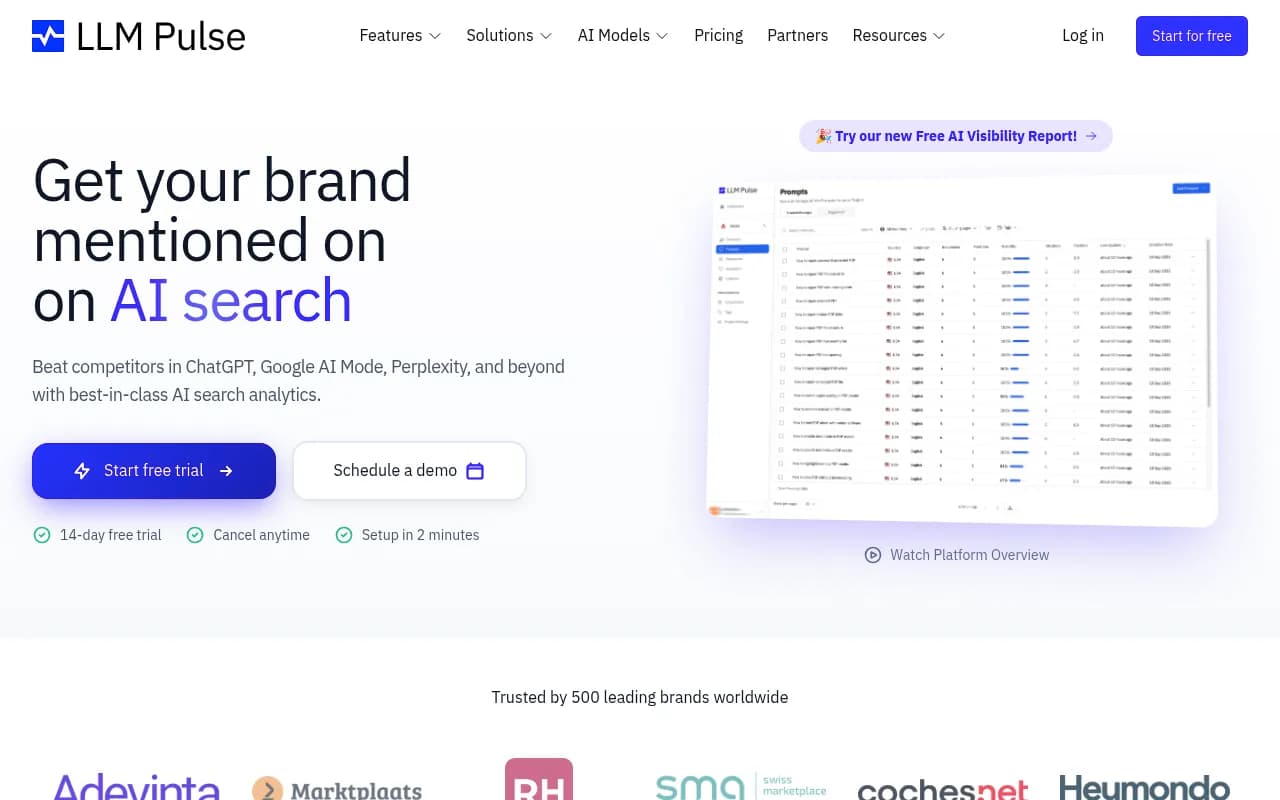
LLM Pulse monitors how AI chatbots like ChatGPT, Perplexity, Gemini, and Google AI Mode describe your brand. You define the prompts that matter to your business ("best CRM for small teams", "top project management tools"), and LLM Pulse tracks those queries weekly across 10+ AI models. You get visibility scores, citation analysis, sentiment tracking, and competitor benchmarking. The goal is to understand and improve how AI search engines recommend your brand. Used by 500+ brands including marketing teams and agencies who need to know what AI says about them before customers ask.
Levity AI: Logistics workflow automation
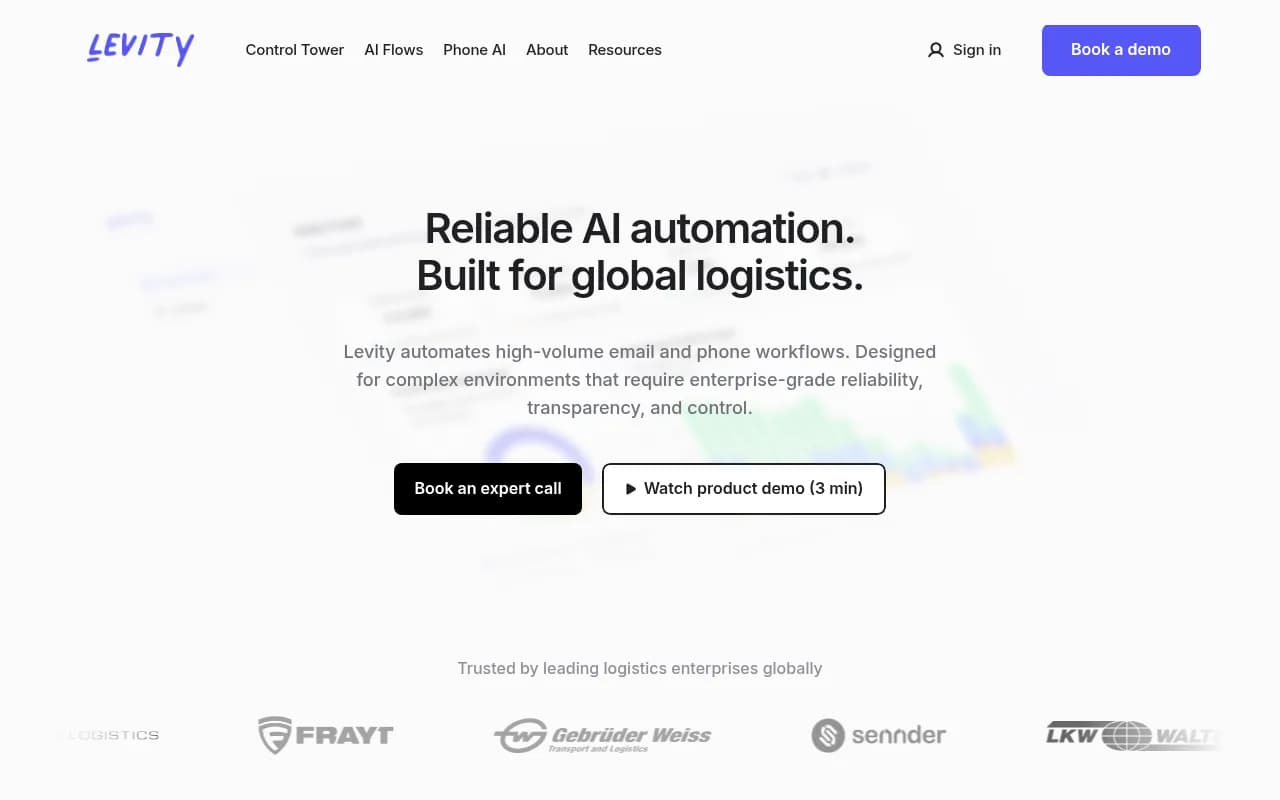
Levity AI automates email classification, document processing, and phone workflows for global logistics companies. If you're a freight forwarder or 3PL handling thousands of daily emails -- booking requests, shipment updates, customs documents, exception alerts -- Levity AI uses AI plus rule-based logic to sort, route, and prioritize them automatically. It's designed for complex, high-volume operations that need enterprise-grade reliability. The platform includes a Control Tower analytics layer that turns your operations from a black box into measurable workflows, so you can identify bottlenecks and quantify ROI before automating. Trusted by leading logistics enterprises globally.
Side-by-Side Comparison
| Feature | LLM Pulse | Levity AI |
|---|---|---|
| Primary use case | AI search visibility tracking | Logistics email/phone automation |
| Target audience | Marketing teams, SEO, agencies | Freight forwarders, 3PLs, supply chain ops |
| AI models tracked | ChatGPT, Perplexity, Gemini, Google AI Mode, DeepSeek, Grok, Claude, Copilot, Meta AI, AI Overviews | N/A -- uses AI for classification, not tracking |
| Starting price | €49/month (Starter: 1 project, 40 prompts) | ~$99/month basic, $50k-100k+ enterprise |
| Free trial | 14 days | Custom (contact sales) |
| Key metrics | Visibility score, citation rate, sentiment, share of voice | Email volume, processing time, automation rate, ROI |
| Integrations | Marketing/analytics tools | TMS, WMS, logistics platforms |
| Setup complexity | 2 minutes (self-service) | Weeks to months (requires implementation) |
| Typical deployment | SaaS, immediate start | Enterprise implementation with onboarding |
| Best for | Tracking brand mentions in AI search | Automating repetitive logistics workflows |
| Not suitable for | Workflow automation, operations | Brand monitoring, SEO, marketing |
Use case comparison
What LLM Pulse is built for
LLM Pulse solves a specific problem: millions of people now ask ChatGPT and Perplexity instead of Googling. If you're a brand, you need to know what these AI models say when someone asks about your industry. LLM Pulse tracks the exact prompts that matter to your business and shows you:
- Whether your brand gets mentioned at all
- How often you're cited vs competitors
- Which sources AI models trust (your content, competitor sites, third-party reviews)
- Sentiment and positioning in AI responses
- Trends over time as AI recommendations shift
You define the prompts ("best email marketing tools", "top CRMs for startups"), and LLM Pulse runs them weekly across 10+ models. The dashboard shows visibility scores, citation breakdowns, and competitor benchmarking. You can spot problems -- negative framing, missed mentions, competitor dominance -- before customers see them.
The platform also suggests content optimizations to improve how you appear in AI responses. If competitors are getting cited because they have comparison pages or feature breakdowns that you lack, LLM Pulse surfaces those gaps.
What Levity AI is built for
Levity AI tackles a completely different problem: logistics companies drown in unstructured communication. A single freight forwarder might process 10,000+ emails daily -- booking requests, shipment exceptions, customs documents, carrier updates, customer inquiries. Manually sorting and routing these emails eats hours and introduces errors.
Levity AI automates the classification and routing. You train the AI on your specific categories ("urgent shipment exception", "booking request", "invoice query", "customs hold"), and it sorts incoming emails automatically. The system combines AI with rule-based logic, so you get the flexibility of machine learning plus the reliability of deterministic workflows.
The Control Tower layer is what makes Levity different from generic AI tools. Before you automate anything, Control Tower analyzes your email volume, identifies bottlenecks, and quantifies the cost of manual processes. You see exactly which workflows are slowing your team down and what the ROI of automation would be. Then you build AI Flows -- automated workflows that handle classification, data extraction, routing, and responses.
Levity integrates with TMS, WMS, and other logistics systems, so automated actions can trigger updates in your core platforms. It's designed for global deployments with multi-language support and complex routing rules.
Head-to-head feature comparison
Monitoring and analytics
LLM Pulse: The entire platform is built around monitoring. You track specific prompts across 10+ AI models, get weekly updates, and see historical trends. The analytics dashboard shows visibility scores (how often you're mentioned), citation rates (which sources AI trusts), sentiment analysis, and share of voice vs competitors. You can drill into individual responses to see the exact wording AI uses to describe your brand.
Levity AI: Monitoring here means operational analytics, not brand tracking. Control Tower shows email volume, processing times, automation rates, and ROI metrics. You're measuring workflow efficiency, not brand visibility. The goal is to identify which manual processes are costing you the most time and money, then automate them.
Verdict: Apples and oranges. LLM Pulse monitors external AI responses about your brand. Levity AI monitors internal operational workflows.
Automation capabilities
LLM Pulse: Limited automation -- the platform suggests content optimizations based on what's working for competitors, but you still create and publish content manually. LLM Pulse doesn't automate responses or workflows. It's a monitoring and analysis tool.
Levity AI: Automation is the entire point. AI Flows let you build multi-step workflows that classify emails, extract data, route to the right team, trigger actions in connected systems, and even generate responses. The platform combines AI classification with rule-based logic, so you can handle complex scenarios ("if urgent shipment exception AND customer is VIP, route to priority queue AND notify account manager").
Verdict: Levity AI wins on automation by a mile, but that's because LLM Pulse isn't trying to automate anything. Different goals.
AI model coverage
LLM Pulse: Tracks 10+ AI models including ChatGPT, Perplexity, Gemini, Google AI Mode, AI Overviews, DeepSeek, Grok, Claude, Copilot, and Meta AI. Enterprise plans include all models; lower tiers cover the core ones (ChatGPT, Perplexity, Gemini, Google AI Mode, AI Overviews).
Levity AI: Uses AI for classification and data extraction, but doesn't track external AI models. The AI here is applied to your internal workflows, not monitoring what ChatGPT says about your brand.
Verdict: LLM Pulse is the only option if you care about AI search visibility. Levity AI doesn't play in this space at all.
Integration ecosystem
LLM Pulse: Integrates with marketing and analytics tools. The focus is on feeding insights into your existing SEO, content, and brand monitoring workflows.
Levity AI: Integrates with TMS (Transportation Management Systems), WMS (Warehouse Management Systems), email platforms, CRMs, and other logistics software. Built for complex enterprise environments where automation needs to trigger actions across multiple systems.
Verdict: Each tool integrates with the ecosystem its users actually need. LLM Pulse connects to marketing tools. Levity AI connects to logistics platforms.
Ease of use and setup
LLM Pulse: Self-service setup takes about 2 minutes. You create a project, add the prompts you want to track, and the platform starts monitoring. The interface is straightforward -- dashboards show visibility scores, citation breakdowns, and competitor comparisons. No technical implementation required.
Levity AI: Enterprise implementation that takes weeks to months. You need to define your categories, train the AI on your specific workflows, integrate with existing systems, and test before going live. Levity's team helps with onboarding, but this isn't a plug-and-play tool. The complexity reflects the use case -- you're automating mission-critical operations, not just tracking metrics.
Verdict: LLM Pulse is dramatically easier to get started with, but again, the complexity difference reflects what each tool does. Monitoring prompts is simpler than automating global logistics workflows.
Pricing structure
LLM Pulse: Transparent SaaS pricing. Starter at €49/month (1 project, 40 prompts), Professional at €149/month (2 projects, 120 prompts), Scale at €299/month (5 projects, 300 prompts). Enterprise custom pricing. 14-day free trial. Annual billing saves 17%.
Levity AI: Custom pricing based on volume and integrations. Basic plans start around $99/month, but enterprise deployments typically run $50k-100k+ annually. The pricing reflects the complexity and ROI -- if you're processing 100,000 emails per month and automation saves 5,000 manual hours, the cost justifies itself.
Verdict: LLM Pulse is affordable for small teams and scales predictably. Levity AI is enterprise software with enterprise pricing.
Pricing comparison
| Plan | LLM Pulse | Levity AI |
|---|---|---|
| Entry tier | €49/month (1 project, 40 prompts) | ~$99/month (basic automation) |
| Mid tier | €149/month (2 projects, 120 prompts) | Custom (volume-based) |
| High tier | €299/month (5 projects, 300 prompts) | Custom (typically $50k-100k+/year) |
| Enterprise | Custom pricing | Custom (high-volume deployments) |
| Free trial | 14 days | Custom (contact sales) |
| Annual discount | 17% off | N/A (custom contracts) |
Pros and cons
LLM Pulse pros
- Tracks 10+ AI models including ChatGPT, Perplexity, Gemini, and Google AI Mode
- Transparent, affordable pricing starting at €49/month
- Self-service setup in 2 minutes
- Clear visibility scores and citation analysis
- Competitor benchmarking built in
- 14-day free trial, no credit card required
- Used by 500+ brands with proven track record
LLM Pulse cons
- Limited to monitoring -- doesn't automate content creation or responses
- Prompt limits on lower tiers (40-300 depending on plan)
- No workflow automation capabilities
- Focused solely on AI search visibility (not a general marketing tool)
Levity AI pros
- Purpose-built for logistics with deep industry expertise
- Control Tower analytics quantify ROI before you automate
- Combines AI flexibility with rule-based reliability
- Integrates with TMS, WMS, and logistics platforms
- Handles multi-language, global deployments
- Trusted by leading logistics enterprises
- Scales to handle 100,000+ emails per month
Levity AI cons
- Enterprise pricing ($50k-100k+/year for typical deployments)
- Complex implementation taking weeks to months
- Overkill for small operations or non-logistics use cases
- No self-service trial -- requires sales engagement
- Narrow focus (logistics only, not a general automation platform)
Who should pick which tool
Pick LLM Pulse if you:
- Run marketing, SEO, or brand monitoring for a company
- Need to track how AI chatbots describe your brand
- Want to benchmark your AI search visibility against competitors
- Care about what ChatGPT, Perplexity, and Gemini say when people ask about your industry
- Have a limited budget (€49-299/month range)
- Want a tool you can start using today without implementation
- Work at an agency managing multiple client brands
Pick Levity AI if you:
- Run operations for a freight forwarder, 3PL, or logistics company
- Process thousands of emails daily and need automation
- Want to quantify the cost of manual workflows before automating
- Need enterprise-grade reliability for mission-critical operations
- Have budget for a $50k-100k+ annual investment
- Can commit to a multi-week implementation process
- Need integrations with TMS, WMS, and logistics platforms
Pick neither if you:
- Need general workflow automation (not logistics-specific) -- look at Zapier, Make, or n8n
- Want AI content generation -- look at Jasper, Copy.ai, or Writer
- Need traditional SEO tracking -- look at Ahrefs, Semrush, or Moz
- Want customer support automation -- look at Intercom, Zendesk, or Freshdesk
If you're tracking AI search visibility and also need logistics automation, you'd use both tools for completely different purposes. They don't overlap.
Worth noting: if you're exploring AI search visibility more broadly, Promptwatch goes beyond monitoring to help you actually fix visibility gaps. It shows you which prompts competitors rank for but you don't, then generates content optimized for AI search engines. The platform tracks 880M+ citations and includes crawler logs, Reddit/YouTube insights, and page-level attribution. It's the action-oriented complement to monitoring tools like LLM Pulse.
Final verdict
This comparison is a bit like asking "should I buy a thermometer or a forklift?" Both use technology, but they solve completely unrelated problems.
Choose LLM Pulse if you're a marketer, SEO professional, or brand manager who needs to track AI search visibility. It's affordable, easy to use, and gives you clear insights into how ChatGPT and other AI models describe your brand. The 14-day trial makes it risk-free to test.
Choose Levity AI if you're a logistics operator drowning in email volume and need industrial-strength automation. The Control Tower analytics and AI Flows are purpose-built for freight forwarding and supply chain operations. The price tag reflects the ROI -- if manual email processing costs you $200k/year in labor, a $75k automation investment pays for itself quickly.
If you somehow need both -- tracking your brand's AI visibility AND automating logistics workflows -- you'd use them side by side for entirely different functions. But realistically, most people reading this comparison are in the wrong place. Figure out whether you're solving a marketing problem (LLM Pulse) or an operations problem (Levity AI), then compare within that category.