Key takeaways
- MentionBird ($79-$299+/mo) is a citation tracker with a ranking-advice agent, not an outreach or link-building tool. It tells you what's cited; it doesn't get you cited.
- CrowdReply ($79-$399+/mo) is the only one of the three running managed outreach and a paid backlinks marketplace, including a new Citation Outreach feature that contacts pages AI already cites on your behalf.
- Wellows ($29-$497/mo) sits in between: it finds outreach targets and drafts the emails, but you send them and you build the pages yourself, backed by content-scoring and generation tools.
- Paid placements and managed community posting carry real platform risk. Google's SpamBrain hunts link networks, and Reddit explicitly bans coordinated inauthentic activity, the exact mechanic CrowdReply's persona-based engagement relies on.
- None of these tools change the fact that AI engines cite pages, not brands. Citation outreach can accelerate visibility on a page that already deserves to be cited; it cannot manufacture that page for you.
Why citation outreach became its own category
Somewhere around 2025, a bunch of AI-visibility vendors noticed the obvious next question. Once you can see that ChatGPT cites some competitor's roundup instead of your product page, the natural follow-up is: can I just get into that roundup? That's citation outreach. It's PR and link building repackaged for a world where the target isn't Google's index, it's the retrieval layer behind ChatGPT, Perplexity, and Google AI Overviews.
Three tools have built distinct products around this idea: MentionBird, CrowdReply, and Wellows. They get grouped together constantly, but they do genuinely different things, and confusing them will cost you money. I spent time going through pricing pages and feature docs for all three, and the differences are sharper than the marketing copy suggests.
MentionBird: a tracker wearing an outreach tool's clothes
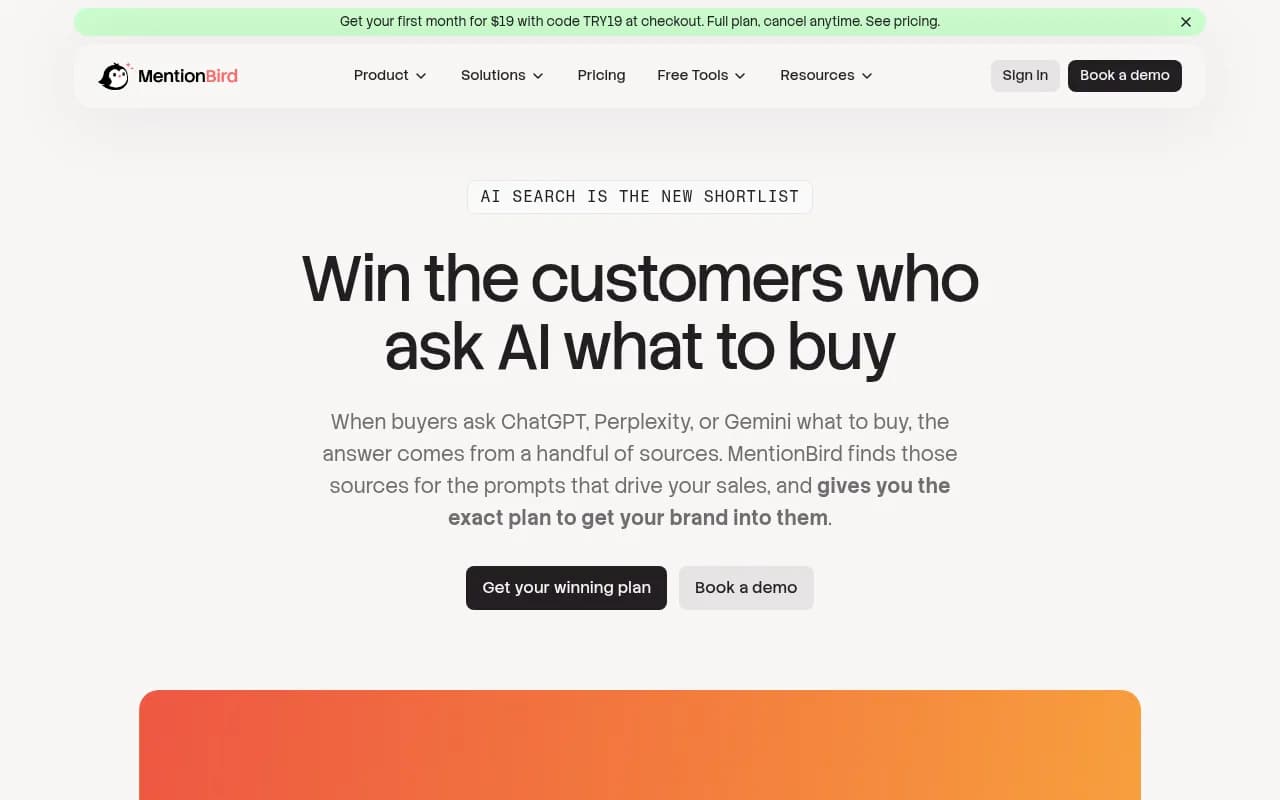
MentionBird's pitch is "see which sources AI cites in your category," and that's exactly what it does. It tracks visibility and prominence scores, share of voice, and a breakdown of citation sources by content type (listicle, comparison, how-to, review) and by domain authority. It has a ranking-advice agent that tells you what to change to earn a citation for a given prompt, and a separate agent that can summarize cited YouTube videos.
What it doesn't have is any execution layer. No backlink marketplace, no managed outreach, no contact database. If MentionBird tells you that a competitor is cited in 40% of "best project management software" answers because of a G2 comparison page, getting into that comparison page is entirely on you.
Pricing starts at $79/mo for Starter (100 daily prompt runs, ChatGPT and Gemini only, 1 brand, 5 competitors), jumps to $299/mo for Growth (400 runs, adds Perplexity and Claude), and goes custom for full 8-platform coverage including Grok, AI Overviews, Copilot, and DeepSeek. There's no free plan; the vendor is upfront that every prompt run and crawl costs them money, so access stays paid from day one. Extra prompt capacity and "agent credits" (used for ranking plans and video summaries) are metered separately, which can push real spend above the sticker price fast if you lean on the agent features.
CrowdReply: outreach and paid placements, end to end
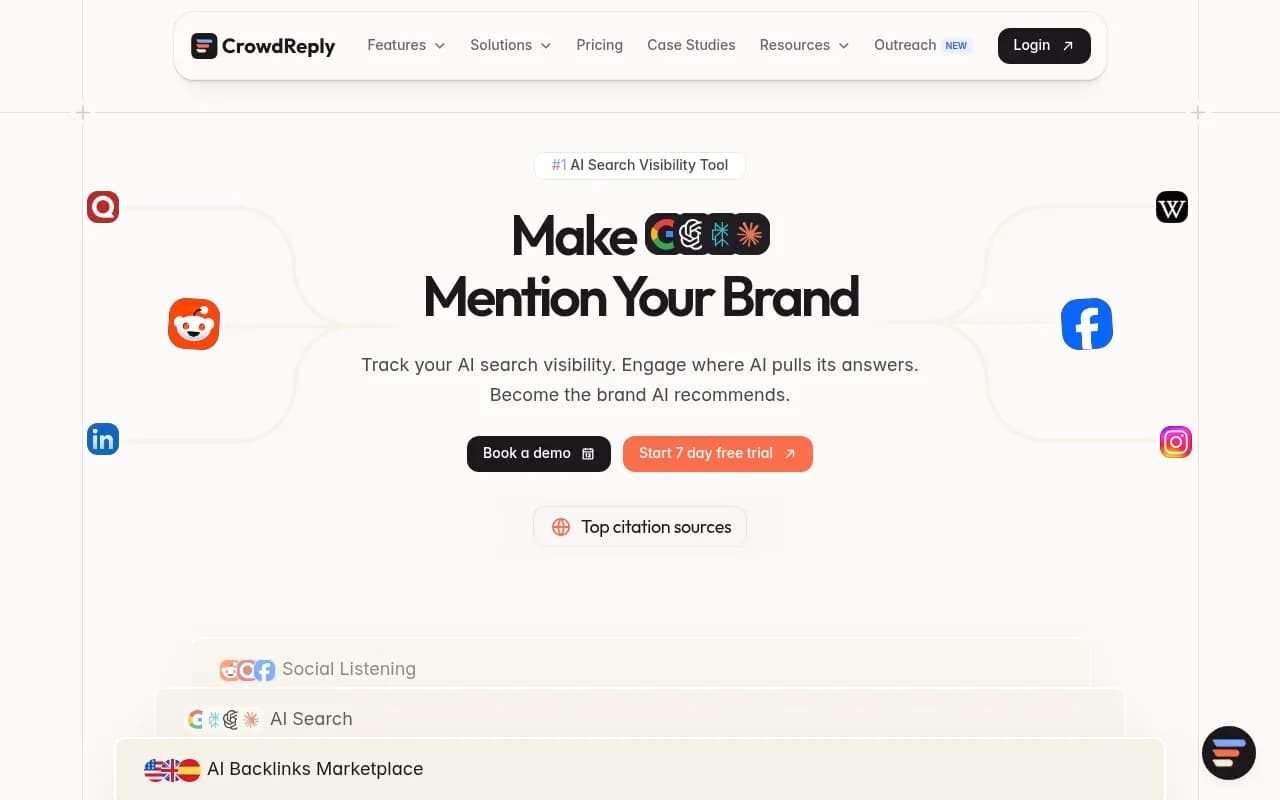
CrowdReply is the most execution-heavy of the three, and also the one carrying the most platform risk. Its core Citation Outreach feature, launched in 2026, maps every page ChatGPT, Gemini, and other models cite for your tracked prompts, then runs outreach on your behalf: finding contacts, pitching sites, negotiating placement, all without anything going out from your own inbox. You approve the placement and the price before it's billed, and CrowdReply advertises an "Unpublished Charge: $0" model, meaning you pay only once the mention goes live. The company claims 240+ brands worked with, 1,860+ offsite mentions secured, and 22,400+ cited pages contacted, with first mentions typically landing within two weeks.
Alongside outreach, CrowdReply runs a straight-up AI Backlinks Marketplace: 40,000+ vetted publishers, filterable by Domain Rating, traffic, and citation rate, with a 12-month replacement policy if a placement gets pulled. This is the "skip outreach entirely, just buy the placement" option.
CrowdReply also does social listening and managed engagement on Reddit, Quora, and Facebook, posting through what it calls "established community accounts that blend naturally into the conversation." Read that sentence again: that's paid, managed posting through accounts that aren't the brand's own, designed to look organic. Reddit's policies explicitly prohibit coordinated inauthentic activity, and a third-party review from ToolFountain flags exactly this as CrowdReply's biggest risk, citing user reports of comments getting removed or flagged.
Pricing runs $79/mo Starter (1 brand, 20 prompts, 2 AI models, Reddit-only listening, $600/yr engagement credits included, marketplace access), $239/mo Growth (3 brands, 75 prompts, 4 models, Reddit/Quora/Facebook listening), and Enterprise from $399/mo (10 brands, 200 prompts, all 7 models). Note that a third-party review cites noticeably higher figures from earlier in 2026 ($99/$299/$499), so the vendor appears to have cut prices recently; treat the live pricing page as the source of truth. CrowdReply's own site claims a 4.9 G2 rating, but the actual public G2 page shows 4.6/5 from just 17 reviews, too small a sample to lean on heavily.
Wellows: finds the targets, drafts the pitch, leaves execution to you (and pairs it with content tools)
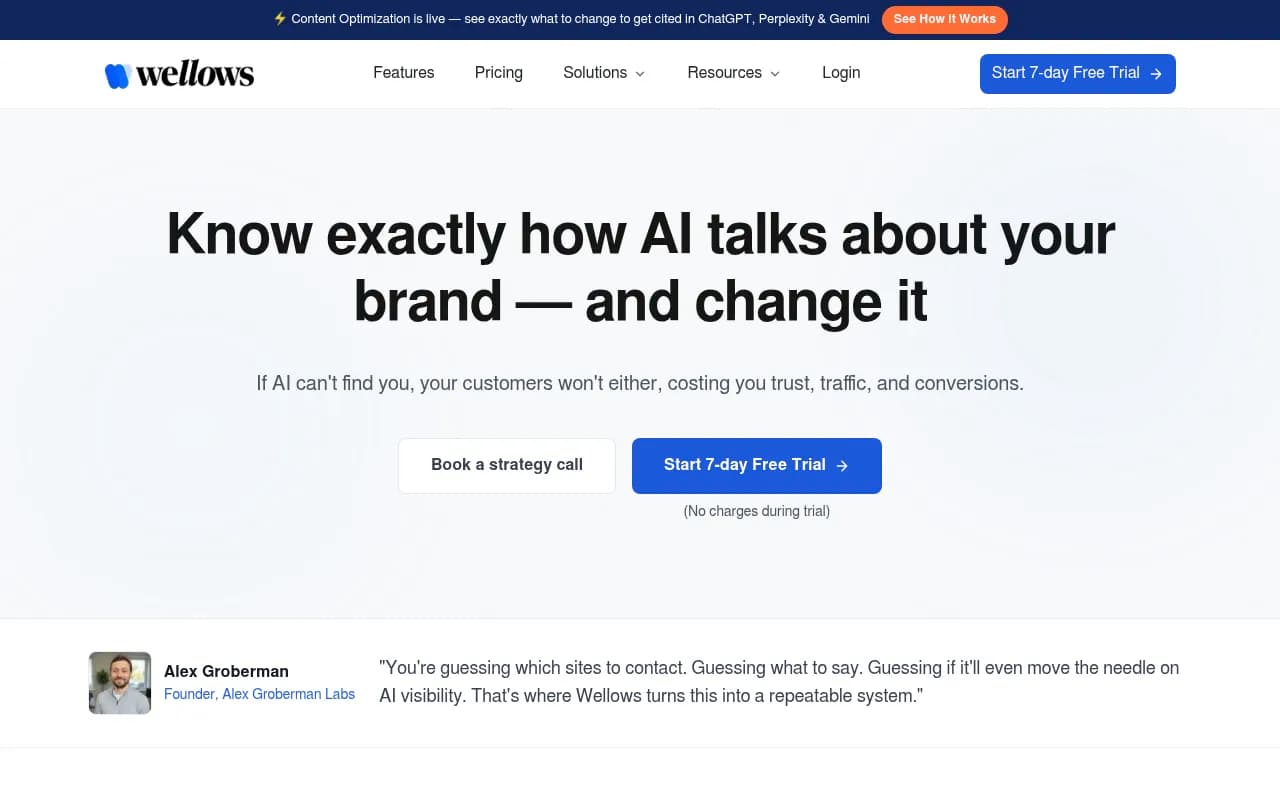
Wellows takes a middle path. Its dashboard tracks AI visibility score, citation score, and sentiment across all five major engines (ChatGPT, Gemini, Perplexity, Google AI Overviews, and AI Mode) on every plan, including the $29/mo entry tier. It splits opportunities into two buckets: Explicit Opportunities, which show content topics where competitors are getting cited instead of you, and Implicit Opportunities, which surface missed brand mentions and the publishers behind them.
The Outreach feature attached to Implicit Opportunities finds verified publisher contacts and drafts ready-to-send emails, but it stops there. You send the email, you negotiate, you decide whether the placement is worth it. There's no marketplace, no managed posting, no pay-per-mention billing.
Where Wellows differs from both MentionBird and CrowdReply is that it pairs outreach with a content workflow: content scoring, line-level optimization suggestions pulled from LLM-cited URLs, cannibalization checks, and a content-generation agent that drafts pages against Search Console data. The framing, according to Wellows' own materials, is content "written to earn a citation rather than to exist." Whether or not that particular phrase lands for you, the structural point is right: outreach without a citable page to point to doesn't accomplish much.
Wellows' pricing is credit-pool based rather than tiered by feature: Basic $29/mo (1,800 credits, roughly 12 prompts/day across all five engines), Standard $97/mo (6,500 credits), Growth $249/mo (18,000 credits), Scale $497/mo (36,000 credits), with a 7-day free trial on every tier. Every plan gets all five engines and unlimited projects; only the credit pool changes.
Side-by-side comparison
| MentionBird | CrowdReply | Wellows | |
|---|---|---|---|
| Core job | Citation tracking + ranking advice | Managed outreach + paid backlinks marketplace | Tracking + contact discovery + content workflow |
| Engines tracked | Up to 8 (tiered) | Up to 7 (tiered) | 5, all plans |
| Executes outreach for you | No | Yes, fully managed | No, drafts emails only |
| Paid placement marketplace | No | Yes, 40,000+ publishers | No |
| Community/Reddit engagement | No | Yes, managed persona accounts | No |
| Content generation/optimization | No | No | Yes, scoring + generation |
| Entry price | $79/mo | $79/mo | $29/mo |
| Free trial/plan | None | 30-day money-back guarantee | 7-day free trial |
| Platform risk | Low (monitoring only) | Higher (paid links, managed posting) | Low (you control the outreach) |
The risk nobody puts in the pricing table
Here's the part vendors don't lead with. Buying placements and running managed community engagement isn't a gray area, it's explicitly against the rules on the platforms involved. Google's spam policy treats paid links that pass authority without a rel="sponsored" or nofollow tag as a direct violation, and SpamBrain doesn't just catch individual links, it identifies entire networks: the sites selling links, the buyers, and the middlemen. Manual action recovery, once you're flagged, is not quick; removing or disavowing links and filing reconsideration can take weeks or months.
And yet 74.3% of link builders surveyed by Authority Hacker admit to buying backlinks anyway, at an average cost of $83 per link, with quality placements on high-authority sites running $300 to $500 or more. People do this because it can work in the short term. The question is whether it's worth the exposure.
Reddit's own policy is just as explicit about coordinated inauthentic activity, which is precisely the mechanic behind managed persona-based commenting. CrowdReply's own FAQ acknowledges the underlying risk directly, stating that "the risk with paid links comes from spammy sites and unnatural patterns, which is exactly what the vetting exists to prevent." That's an honest admission, but vetting a publisher's Domain Rating doesn't remove the policy risk of the posting itself.
For GEO specifically, there's an added wrinkle. Analyze AI's research on this notes that AI search engines evaluate brand authority partly by looking at the quality of sources that mention you as a whole; buying links or mentions from thin or irrelevant sites doesn't just risk a Google penalty, it can pollute the association graph AI models use to judge whether you're a trustworthy entity to cite at all. That risk applies whether the link comes from a marketplace or from an outreach email that got a little too aggressive.
Why none of this replaces content
This is the part that gets buried under outreach-tool marketing, so it's worth saying plainly: getting cited on someone else's page is not the same as being the page AI cites, and citation itself isn't the same as being recommended.
Lily Ray's 2026 B2B software study, referenced in Profound's GEO roundup, found that Google AI Overviews cited self-promotional "best of" listicles and then excluded the very publisher of that listicle from its own recommendation 69% of the time. Her point stands as the cleanest summary of the outreach ceiling: being cited is not the same as being chosen. You can win a mention through outreach and still lose the actual shortlist.
There's also a durability problem that outreach tools can't solve, because it's structural to how AI retrieval works. Dejan AI ran one identical query through Google, OpenAI, and Anthropic on the same day and found wildly different citation behavior: Gemini cited all 7 pages it retrieved, GPT-5.5 retrieved 39 pages but cited only 2 of them, and Claude cited 9 of 14. Retrieval and citation are two separate decisions, and the ratio between them shifts by engine and by model update. A citation you buy today through a placement or outreach pitch can simply stop counting the next time a model changes how aggressively it cites what it retrieves.
And the citation landscape itself moves faster than any outreach campaign. Promptwatch's data on Reddit citations shows how abruptly a channel can disappear: in early September 2025, Reddit made up roughly 10 to 14% of all ChatGPT citations, then collapsed to about 1% within days after Reddit changed its data-access terms, and never recovered in the tracked window. A near-identical drop happened again, from roughly 4% to 0.5% in a single day in August 2026, per Promptwatch's Reddit citation tracking. If your entire citation-outreach strategy leaned on Reddit threads, both of those days would have wiped out the investment overnight, with no warning and nothing you could have done differently.

That volatility is exactly why platforms that separate citation tracking from execution and treat content as the durable asset tend to hold up better. Cracklepr's framing of the difference between SEO and GEO is useful here: traditional SEO leans heavily on backlinks and on-page keyword work, while GEO leans on earned-media authority, clear entity signals, and content structured in a way models find easy to quote directly, TL;DR blocks, FAQ sections, defined-term callouts, attributed pull quotes. Outreach can amplify a page built like that. It can't substitute for one.
Aleyda Solis's mid-2026 SaaS analysis, also referenced in Profound's expert roundup, found that most of a brand's AI citation weight comes from outside its own website, which is the strongest honest case for outreach as part of the mix. But "part of the mix" is the operative phrase. If the underlying page a publisher would link to doesn't exist, or isn't structured well enough to be quotable, outreach just gets you a mention pointing at something thin.
What I'd actually do
If you're choosing among these three, the decision comes down to how much you want to own the outreach motion yourself, and how much appetite you have for platform-policy risk.
MentionBird makes sense if you just want clean visibility on which competitors are getting cited and why, without paying for or running any outreach at all. Pair it with your existing PR or content team.
CrowdReply makes sense if you want speed and are comfortable with the risk profile, understanding that managed community posting and paid placements sit closer to the line Google and Reddit actively police. Read the ToolFountain review's caution notes before committing budget.
Wellows is the more balanced pick if you want tracking, target discovery, and content generation under one roof, and you're willing to send your own outreach emails. At $29/mo for all five engines with unlimited projects, it's also the cheapest entry point of the three by a wide margin.
Whatever you pick, treat outreach as a distribution tactic for content that already deserves the citation, not as a substitute for making that content. For more head-to-head comparisons across the wider AI-visibility category, the GEO software directory at bestgeosoftware.com is worth a browse before you commit budget to any single vendor.