Key Takeaways
- LLM Pulse is a monitoring tool ($49-299/month) that tracks how AI chatbots describe your brand -- think brand tracking dashboard for ChatGPT, Perplexity, and Gemini
- Search Party is a consultancy ($100K-500K+ engagements) that embeds engineering teams to build custom AI automation systems across your entire business
- They solve different problems: LLM Pulse answers "what do AI models say about us?" while Search Party answers "how do we eliminate busywork with AI?"
- LLM Pulse is self-serve with a 14-day trial and takes 2 minutes to set up. Search Party requires a cohort application and 90-minute validation session before engagement.
- Neither tool generates content or optimizes for AI search -- both are monitoring/implementation focused. If you need content gap analysis and AI-optimized article generation, Promptwatch covers that angle with its built-in AI writing agent and Answer Gap Analysis.
- Pick LLM Pulse if you want affordable brand monitoring across AI chatbots. Pick Search Party if you have budget for custom AI workflow engineering across departments.
Overview
LLM Pulse: AI brand monitoring dashboard
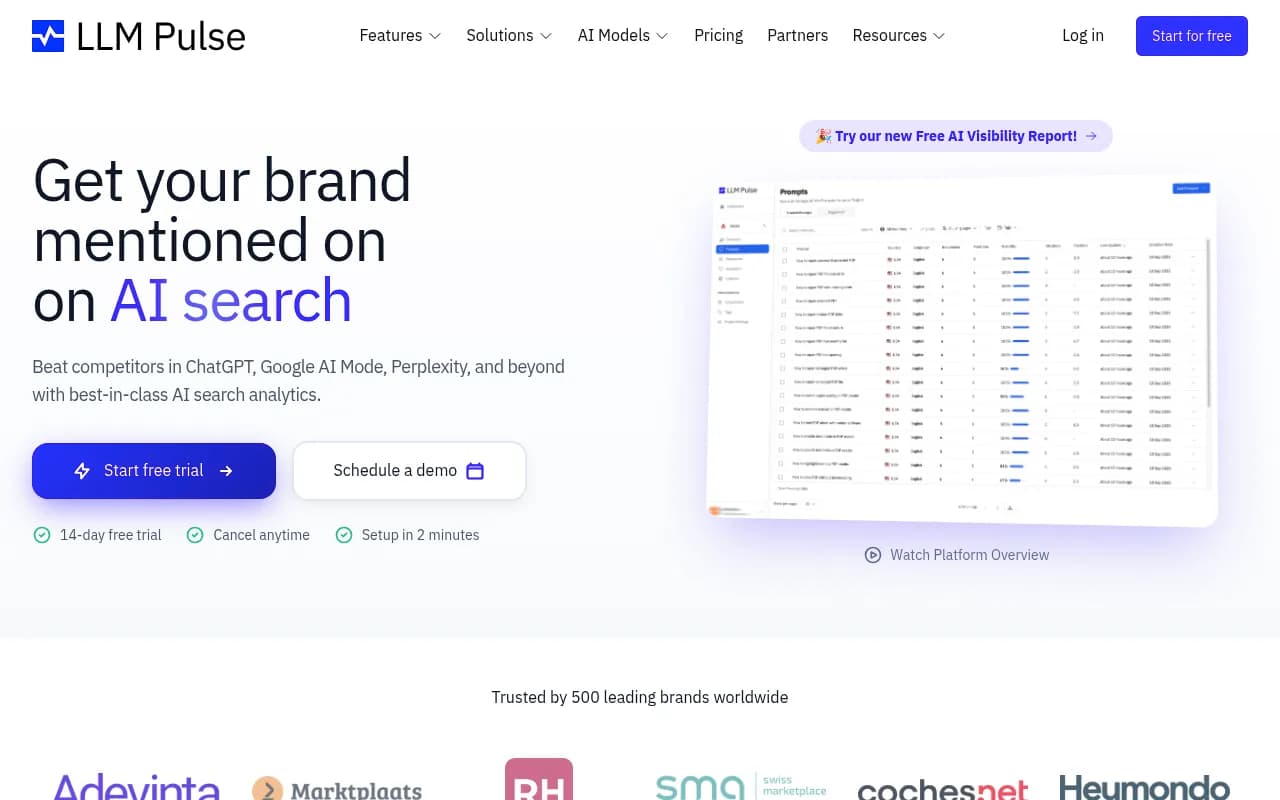
LLM Pulse is a SaaS platform that tracks what AI chatbots say about your brand. You add prompts ("best CRM software", "top marketing automation tools"), and it queries ChatGPT, Perplexity, Gemini, Google AI Mode, and AI Overviews weekly. You get visibility scores, citation tracking, sentiment analysis, and competitor benchmarking. It's used by 500+ brands who want to know how they're being described in AI search results.
The pitch: millions of people now ask ChatGPT instead of Googling. LLM Pulse shows you what those people see when they ask about your industry.
Search Party: Custom AI implementation consultancy
Search Party
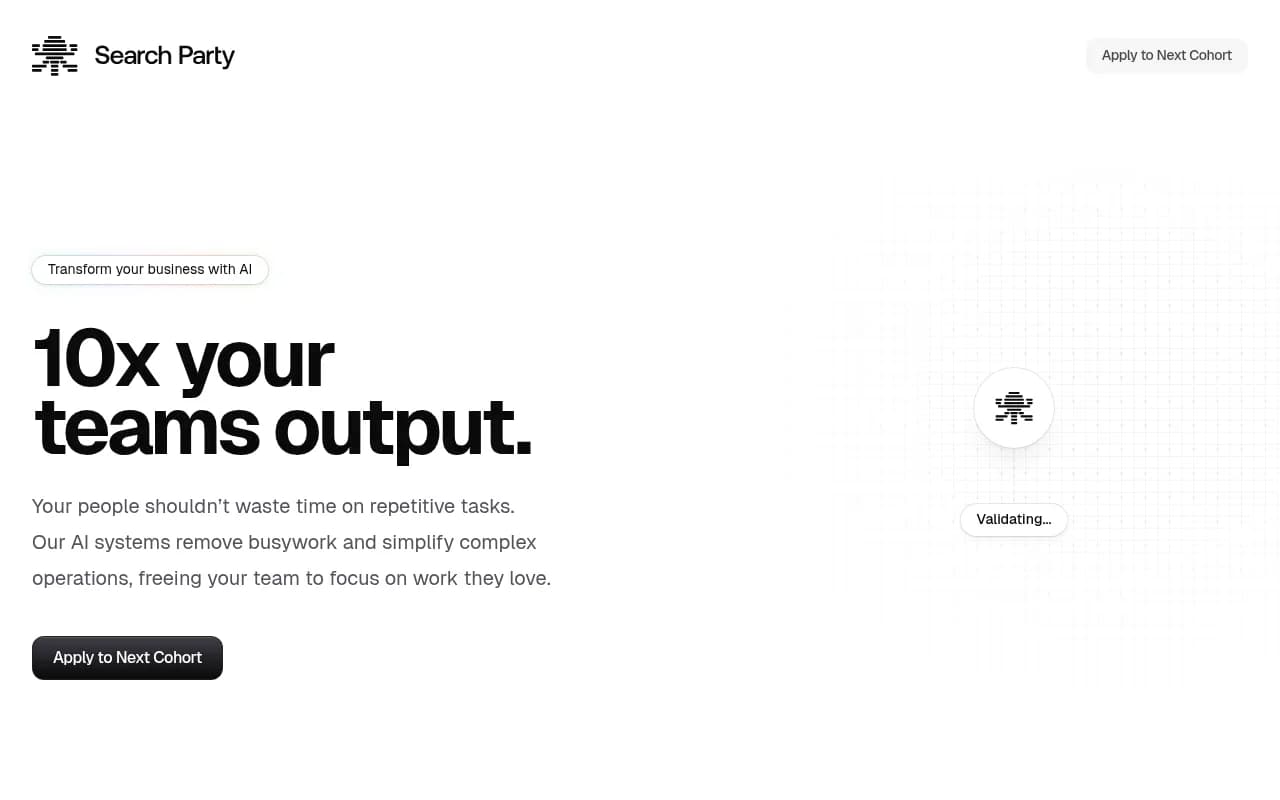
Search Party is not a tool you buy -- it's a team you hire. They embed engineers into your business to diagnose workflow bottlenecks, then build custom AI automation systems using their "DOE Framework" (Directives, Orchestration, Execution). The goal is eliminating repetitive tasks across sales, marketing, ops, and R&D. They run a cohort-based engagement model with custom pricing, likely starting around $100K.
The pitch: most companies are drowning in AI tools but seeing no productivity gains. Search Party builds tailored agentic workflows that actually move the needle on output and margins.
Side-by-Side Comparison
| Feature | LLM Pulse | Search Party |
|---|---|---|
| Product type | SaaS monitoring dashboard | Custom AI consultancy + engineering |
| Primary use case | Track brand mentions in AI chatbots | Build custom AI automation systems |
| Setup time | 2 minutes (self-serve) | 90-minute validation + weeks of implementation |
| Pricing | €49-299/month | $100K-500K+ per engagement (estimated) |
| Free trial | 14 days | No (application + validation required) |
| AI models tracked | ChatGPT, Perplexity, Gemini, AI Mode, AI Overviews (+ 5 more on Enterprise) | Not applicable (builds custom systems) |
| Prompt tracking | Yes (40-300 prompts depending on plan) | No |
| Citation analysis | Yes | No |
| Competitor benchmarking | Yes | No |
| Custom automation | No | Yes (core offering) |
| Content recommendations | Basic AI-powered suggestions | No |
| Team embedding | No | Yes (engineers work directly with your team) |
| Target audience | Marketing/SEO teams, brands | Operations leaders, C-suite |
| Deployment model | Cloud SaaS | Custom implementation |
What you're actually buying
LLM Pulse: Weekly snapshots of AI responses
LLM Pulse runs your prompt list against AI models once a week. For each prompt, you see:
- The full AI response (preserved verbatim)
- Whether your brand was mentioned
- Citation sources (which URLs the AI referenced)
- Visibility score (how prominently you appeared)
- Sentiment (positive/neutral/negative framing)
- Competitor mentions in the same response
You can track trends over time, compare performance across models (ChatGPT vs Perplexity vs Gemini), and export data. The "Optimize" feature gives AI-generated content recommendations, though it's not clear how actionable these are compared to platforms with deeper content gap analysis.
What you don't get: real-time monitoring, AI crawler logs, traffic attribution, or content generation tools. It's a weekly snapshot dashboard, not a live feed.
Search Party: Custom-built AI workflow systems
Search Party doesn't sell software. They sell outcomes. The process:
- Validation session (90 minutes): They review your workflows, margins, and goals. If they don't see a clear path to ROI, they don't take the engagement.
- Bottleneck Mining: They analyze your metrics to find where headcount is outpacing revenue, then survey and interview your team to identify repetitive work.
- Custom system design: Using their DOE Framework, they architect agentic workflows tailored to your specific bottlenecks.
- Implementation: Their engineering team builds and deploys the system, integrating with your existing tools and data.
Examples from their site: automating sales workflows, eliminating admin tasks, simplifying complex operations. The goal is measurable ROI -- they claim 3.2x projected returns in their case study snippet.
What you don't get: a dashboard you can log into, off-the-shelf features, or anything you can deploy yourself. This is a high-touch consultancy model.
Pricing comparison
| Plan | LLM Pulse | Search Party |
|---|---|---|
| Entry point | €49/month (Starter: 1 project, 40 prompts) | ~$100K+ (estimated, custom pricing) |
| Mid-tier | €299/month (Scale: 5 projects, 300 prompts) | ~$250K-500K+ (estimated) |
| Enterprise | Custom (adds DeepSeek, Grok, Claude, Copilot, Meta AI) | Custom (likely $500K+) |
| Free trial | 14 days | No |
| Annual discount | 17% off | Not applicable |
| Billing model | Monthly or annual subscription | Cohort-based engagement (likely milestone-based) |
LLM Pulse is transparent and affordable. Search Party is opaque and expensive. The price gap reflects what you're buying: a monitoring tool vs. a custom engineering engagement.
Who should pick which tool
Pick LLM Pulse if:
- You're a marketing or SEO team that needs to monitor brand mentions in AI chatbots
- Your budget is under $500/month
- You want a self-serve tool you can set up in minutes
- You care about tracking specific prompts over time ("best project management software", "top CRMs for small business")
- You need competitor benchmarking to see who's winning in AI search results
- You're comfortable with weekly snapshots rather than real-time data
Pick Search Party if:
- You're a C-suite leader or operations exec with budget for a major AI transformation project
- You have identified workflow bottlenecks that are killing productivity across departments
- You need custom automation systems, not off-the-shelf tools
- You're willing to go through a validation process and cohort application
- You want an embedded engineering team, not a dashboard
- You have $100K+ to invest in a multi-month engagement
Don't pick either if:
- You need content gap analysis showing which prompts competitors rank for but you don't
- You want AI-generated articles optimized for citation by ChatGPT and Claude
- You need AI crawler logs showing which pages OpenAI and Perplexity are reading on your site
- You want page-level tracking with traffic attribution to connect visibility to revenue
For those needs, Promptwatch is built around the action loop: find gaps, generate content, track results. It's the only platform that goes beyond monitoring to actually help you create content that ranks in AI search.

Pros and cons
LLM Pulse pros:
- Affordable entry point (€49/month)
- Clean, focused feature set
- Tracks 5 major AI models on all plans (10+ on Enterprise)
- Preserves full AI responses, not just summaries
- 14-day free trial with no credit card required
- Quick setup (2 minutes)
- Used by 500+ brands (decent social proof)
LLM Pulse cons:
- Weekly tracking only (no real-time monitoring)
- Limited prompt volume on lower tiers (40-300 prompts)
- Content recommendations are vague (no content generation)
- No AI crawler logs or traffic attribution
- No Reddit or YouTube citation tracking
- Prompt intelligence (volume estimates, difficulty scores) not mentioned
Search Party pros:
- Custom solutions tailored to your specific bottlenecks
- Embedded engineering team (not just advice)
- ROI-focused validation process (they turn down bad fits)
- Addresses the "AI tool fatigue" problem (builds systems, not more SaaS)
- Cohort model suggests they're selective about clients
Search Party cons:
- Extremely high cost (likely $100K+ minimum)
- No public pricing or self-serve option
- Requires cohort application and validation session
- Long implementation timeline (weeks to months)
- No dashboard or tool you can use independently
- Limited transparency about past results or case studies
- Not scalable for small businesses or solo operators
The real difference: monitoring vs. building
LLM Pulse and Search Party aren't competitors. They're solving different problems for different buyers.
LLM Pulse is a monitoring tool. It tells you what's happening in AI search results. You log in, see your visibility scores, check which competitors are mentioned alongside you, and export some data. It's useful if you're tracking brand reputation in AI chatbots or need to report on AI visibility to stakeholders. But it doesn't help you fix the problems it surfaces. You're on your own for content creation, optimization, and closing the loop.
Search Party is a consultancy. It doesn't care about AI search visibility -- it cares about eliminating busywork across your entire organization. They build custom agentic workflows for sales, marketing, ops, R&D. The output is a deployed system that automates repetitive tasks, not a dashboard you check weekly. It's useful if you have serious budget and serious workflow problems, but it's overkill if you just want to track brand mentions.
Neither tool is a complete AI visibility platform. LLM Pulse shows you the problem but doesn't help you solve it. Search Party solves workflow problems but doesn't touch AI search visibility. If you need both monitoring and optimization -- content gap analysis, AI-optimized article generation, crawler logs, traffic attribution -- you're looking at a different category of tool entirely.
Final verdict
These tools don't compete. LLM Pulse is a $49-299/month brand monitoring dashboard for AI chatbots. Search Party is a $100K+ consultancy that builds custom AI automation systems. Pick based on your budget and whether you need monitoring (LLM Pulse) or custom workflow engineering (Search Party). If you need content optimization and generation to actually improve your AI search visibility, neither tool delivers -- that's a different problem requiring a different solution.