Demandbase Review 2026
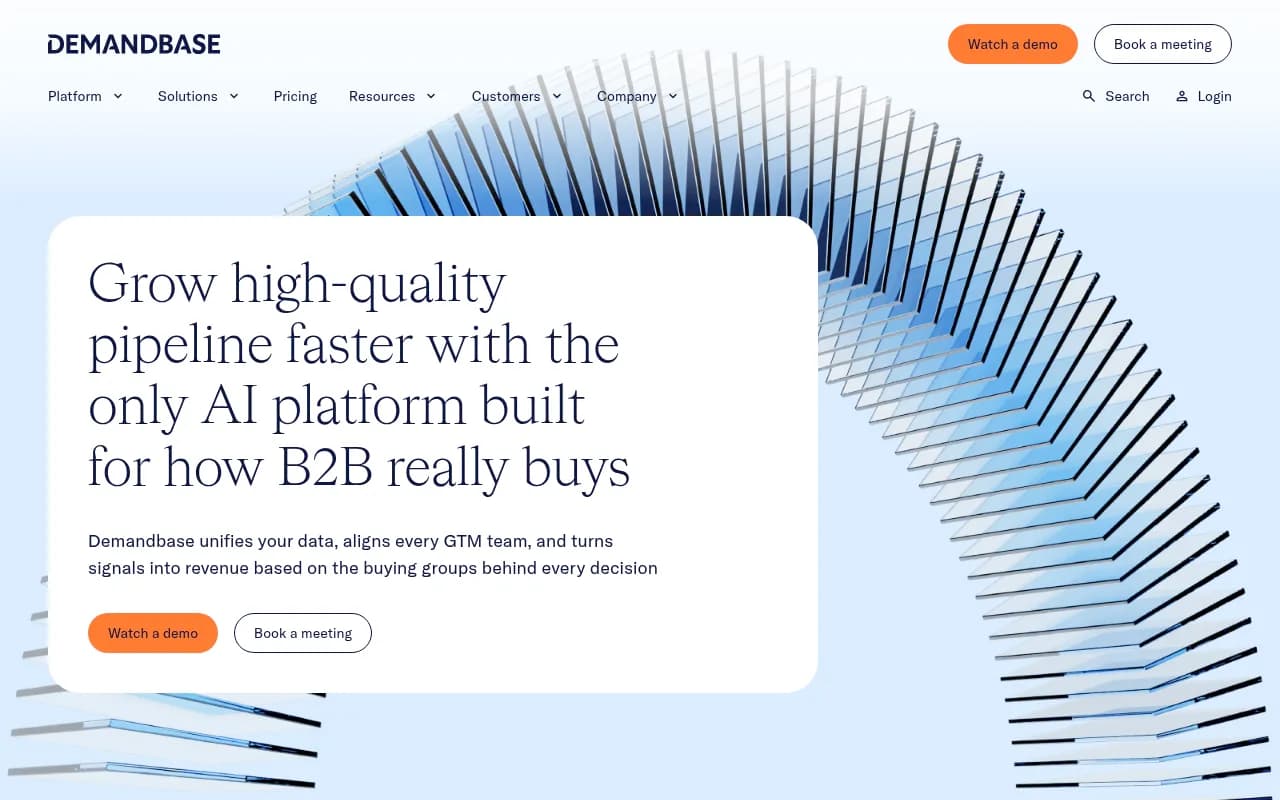
Connects advertising, sales intelligence, and account-based engagement in one platform, using AI to identify and prioritize high-intent accounts.
Key Takeaways
- Enterprise-grade ABM platform built for B2B teams managing complex, multi-stakeholder sales cycles -- think companies selling to buying committees of 6-10 people, not individual buyers
- Combines account intelligence, advertising, sales engagement, and web personalization in one platform -- eliminates the need to stitch together 4-5 separate tools
- Buying group identification is the standout feature: maps entire decision-making committees within target accounts, not just individual contacts
- Pricing is custom-quoted and starts around $18K/year for small teams, scaling to $300K+ for enterprise deployments -- this is not a self-serve product
- Best for mid-market to enterprise B2B companies ($10M+ revenue) with sales cycles over 3 months and average deal sizes above $50K
Demandbase is one of the oldest and most established players in the account-based marketing space, founded in 2006 when "ABM" wasn't even a widely recognized term. The company has evolved from a simple account identification tool into a full-stack go-to-market platform that now serves over 1,000 enterprise customers including Adobe, SAP Concur, Thermo Fisher Scientific, IBM, and Salesforce. In 2021, Demandbase acquired Engagio (ABM orchestration) and InsideView (B2B data), consolidating multiple ABM capabilities under one roof. The platform processes billions of intent signals monthly and claims to maintain data on over 50 million companies globally.
What sets Demandbase apart in 2026 is its focus on buying groups rather than individual leads. Most B2B purchases involve 6-11 stakeholders, but traditional marketing automation treats each person as an isolated lead. Demandbase maps the entire buying committee -- identifying who's involved, their roles, engagement levels, and where they are in the buying journey. This shift from lead-centric to account-centric marketing is the core value proposition.
Account Intelligence & Data Foundation: Demandbase ingests first-party data (your CRM, marketing automation, website activity, email engagement, calendar data) and blends it with proprietary third-party data covering firmographics, technographics, intent signals, and contact information. The platform uses IP address resolution to identify anonymous website visitors at the company level, even if they don't fill out a form. Intent data comes from a network of B2B publishers and content syndication partners, tracking which accounts are researching topics related to your product. The data layer also includes technographic information (what software a company uses) and organizational charts showing reporting structures. Demandbase claims 95%+ accuracy on company identification for North American traffic, though accuracy drops for smaller companies and international visitors. The platform refreshes firmographic data quarterly and intent signals daily.
Buying Group Identification: This is where Demandbase differentiates from competitors like 6sense or ZoomInfo. The platform doesn't just show you that "Acme Corp is researching your category" -- it identifies the specific people involved in the purchase decision, their roles (economic buyer, technical evaluator, end user, champion), and their engagement levels. You can see that the VP of Sales visited your pricing page, the IT Director downloaded a security whitepaper, and the CFO attended a webinar, then score the entire buying group's readiness. The system auto-suggests buying group members based on job titles, engagement patterns, and organizational structure, but you can manually adjust. This feature requires deep CRM integration and works best when you have existing contact data to enrich.
AI-Powered Insights (Agentbase): Demandbase's AI layer, branded as Agentbase, analyzes account behavior to surface next-best actions. It scores accounts based on fit (do they match your ICP?), intent (are they researching?), and engagement (have they interacted with you?). The AI recommends which accounts to prioritize, which channels to use, and what messaging to deploy. For example, it might flag that a target account's buying group is 70% engaged, three key stakeholders visited your site last week, and intent signals spiked 40% -- suggesting it's time for sales to reach out. The AI also automates routine tasks: updating CRM fields, triggering email sequences, adjusting ad targeting, personalizing website content. Demandbase claims the AI is "transparent and tunable" -- you can see why it made a recommendation and adjust the scoring model. In practice, the AI works well for surfacing obvious opportunities but still requires human judgment for complex deals.
Advertising & Demand Generation: Demandbase includes a built-in B2B advertising platform that runs display, video, and social ads (LinkedIn, Facebook) targeted at specific accounts or buying groups. You upload your target account list, and Demandbase serves ads only to people at those companies. The platform uses IP targeting for display ads and integrates with LinkedIn's Campaign Manager for social. You can personalize ad creative by industry, company size, or buying stage -- showing different messages to early-stage researchers vs. late-stage evaluators. Reporting shows which accounts saw ads, clicked, and later converted. The advertising module competes with dedicated ABM ad platforms like Terminus or RollWorks. Demandbase's advantage is tight integration with the rest of the platform (intent data informs ad targeting, ad engagement feeds back into account scoring), but the ad creative tools are less sophisticated than standalone platforms.
Sales Intelligence & Engagement: Sales reps get a dashboard showing which target accounts are showing intent, who's in the buying group, recent engagement activity, and recommended next steps. The platform integrates with Salesforce, HubSpot, and Microsoft Dynamics to surface this data directly in the CRM. Reps can see that a prospect visited the pricing page yesterday, downloaded a case study last week, and matches your ICP -- all without leaving Salesforce. Demandbase also includes sales engagement features: email templates, call scripts, and automated sequences triggered by account behavior. For example, when a buying group member visits your site, the system can auto-enroll them in a nurture sequence or alert the assigned rep. The sales engagement features are solid but not as deep as dedicated tools like Outreach or SalesLoft. Most customers use Demandbase for intelligence and a separate tool for execution, though the integration is tight.
Website Personalization: Demandbase can dynamically change your website content based on the visitor's company, industry, role, or buying stage. A visitor from a healthcare company might see healthcare case studies and compliance messaging, while a visitor from a tech startup sees product innovation and speed-to-value. You can personalize headlines, CTAs, images, case studies, and entire page sections. The personalization engine uses the same account intelligence that powers the rest of the platform, so a known buying group member sees content tailored to their stage in the journey. Setup requires embedding Demandbase's JavaScript tag and building content variants in their visual editor or via API. The editor is drag-and-drop but less flexible than dedicated personalization tools like Mutiny or Dynamic Yield. Most customers start with simple personalizations (swap a logo, change a headline) and expand over time.
Orchestration & Automation: Demandbase includes workflow automation to coordinate actions across marketing and sales. You can build "plays" -- multi-step campaigns triggered by account behavior. For example: when an account hits a certain intent score, add them to an ad campaign, personalize the website, alert the sales rep, and enroll key contacts in an email sequence. Plays can span multiple channels and teams, ensuring coordinated outreach instead of random, disconnected touches. The orchestration engine competes with tools like Metadata.io or 6sense Orchestration. Demandbase's version is tightly integrated with its own data and channels but less flexible for external tools. You can trigger actions in third-party systems via API or native integrations (Salesforce, Marketo, HubSpot, Outreach, Salesloft, Slack, etc.), but complex workflows require custom development.
Reporting & Analytics: The platform includes dashboards for account engagement, pipeline influence, campaign performance, and ROI. You can track metrics like accounts influenced, buying group engagement, pipeline velocity, and revenue attribution. Demandbase uses multi-touch attribution models (first-touch, last-touch, linear, time-decay, custom) to assign credit across touchpoints. The reporting is account-centric, not lead-centric -- you see how many target accounts engaged, not how many leads converted. This aligns with ABM philosophy but requires a mindset shift for teams used to MQL-based reporting. The dashboards are customizable but not as flexible as BI tools like Tableau or Looker. Most enterprise customers export data to their own analytics stack for deeper analysis. Demandbase provides APIs and a data warehouse connector for this.
Integrations & Ecosystem: Demandbase integrates with 100+ tools across CRM (Salesforce, HubSpot, Microsoft Dynamics), marketing automation (Marketo, Eloqua, Pardot, HubSpot), sales engagement (Outreach, SalesLoft, Groove), advertising (LinkedIn, Google Ads, Facebook), analytics (Google Analytics, Tableau, Looker), and collaboration (Slack, Microsoft Teams). The Salesforce integration is the deepest -- Demandbase data appears natively in Salesforce records, and you can trigger Demandbase actions from Salesforce workflows. The platform also offers APIs for custom integrations and a data warehouse connector (Snowflake, BigQuery, Redshift) for syncing raw data. Most integrations are pre-built and require minimal technical setup, though complex use cases need developer involvement.
Who Is It For: Demandbase is built for mid-market to enterprise B2B companies with complex sales cycles and high deal values. The ideal customer is a company selling software, technology, or professional services with average deal sizes above $50K, sales cycles over 3 months, and multiple stakeholders involved in purchase decisions. Think SaaS companies selling to IT departments, consulting firms selling to C-suite, or manufacturers selling to procurement teams. The platform works best when you have a defined target account list (not trying to sell to everyone) and a sales team that can follow up on warm accounts. It's overkill for transactional B2B (e-commerce, low-touch sales) or B2C. Company size matters: Demandbase is designed for teams of 10+ marketers and sellers. Smaller teams (under 5 people) will struggle to use the full platform and should consider simpler tools like HubSpot ABM or Metadata.io. Industries where Demandbase is strong: technology, financial services, healthcare, manufacturing, professional services. Less common in retail, hospitality, or consumer goods.
Pricing & Value: Demandbase does not publish pricing. All deals are custom-quoted based on company size, number of users, data volume, and modules purchased. Based on third-party research and user reports, pricing starts around $18,000/year for small teams (under 50 employees, basic features) and scales to $300,000+/year for enterprise deployments (1,000+ employees, full platform, premium data). The platform is sold in modules: you can buy just advertising, just sales intelligence, or the full suite. Most customers start with 2-3 modules and expand. Implementation fees are separate and typically range from $10K to $50K depending on complexity. Annual contracts are standard, with discounts for multi-year commitments. Compared to competitors: Demandbase is more expensive than 6sense or ZoomInfo but includes more capabilities out of the box. It's cheaper than stitching together separate tools for advertising (Terminus), intent data (Bombora), sales intelligence (ZoomInfo), and personalization (Mutiny), but only if you use most of the platform. For teams that only need one or two capabilities, standalone tools are more cost-effective.
Strengths: Buying group identification is genuinely differentiated -- most ABM platforms still focus on accounts or individual contacts, not the full committee. The data quality is strong, especially for North American mid-market and enterprise accounts. Integration depth with Salesforce is best-in-class. The platform is mature and stable, with fewer bugs than newer competitors. Customer support is responsive, with dedicated customer success managers for enterprise accounts. The AI recommendations are helpful for prioritizing accounts, even if not groundbreaking.
Limitations: The platform is complex and has a steep learning curve. Expect 2-3 months to fully onboard and see results. Smaller companies (under 100 employees) often find it overwhelming. The advertising module is solid but not as feature-rich as dedicated platforms like Terminus or Metadata.io. Website personalization is functional but less flexible than Mutiny or Optimizely. Reporting is account-centric, which is philosophically correct for ABM but frustrating for teams used to lead-based metrics. The pricing is opaque and negotiation-heavy, which some buyers find off-putting. International data coverage is weaker than North America -- accuracy drops significantly outside the US, Canada, and UK. The platform works best when you already have a target account list and existing contact data; it's less useful for prospecting net-new accounts from scratch.
Bottom Line: Demandbase is the right choice for mid-market to enterprise B2B companies with complex sales cycles, high deal values, and the resources to implement a full ABM program. If you're selling to buying committees of 6+ people, have a defined target account list, and need to coordinate marketing and sales around those accounts, Demandbase delivers. The buying group identification and orchestration capabilities are genuinely valuable for teams ready to move beyond lead-based marketing. However, smaller companies, teams with limited resources, or businesses with transactional sales should look elsewhere -- the platform is too complex and expensive for simple use cases. Best use case in one sentence: B2B companies with $10M+ revenue, 3+ month sales cycles, and $50K+ deal sizes that need to identify and engage entire buying committees across multiple channels.
Tags:
Similar and alternative tools to Demandbase