Clearbit Review 2026
Provides real-time company and contact data enrichment for GTM teams, helping identify and qualify leads with accurate firmographic information.
Key Takeaways:
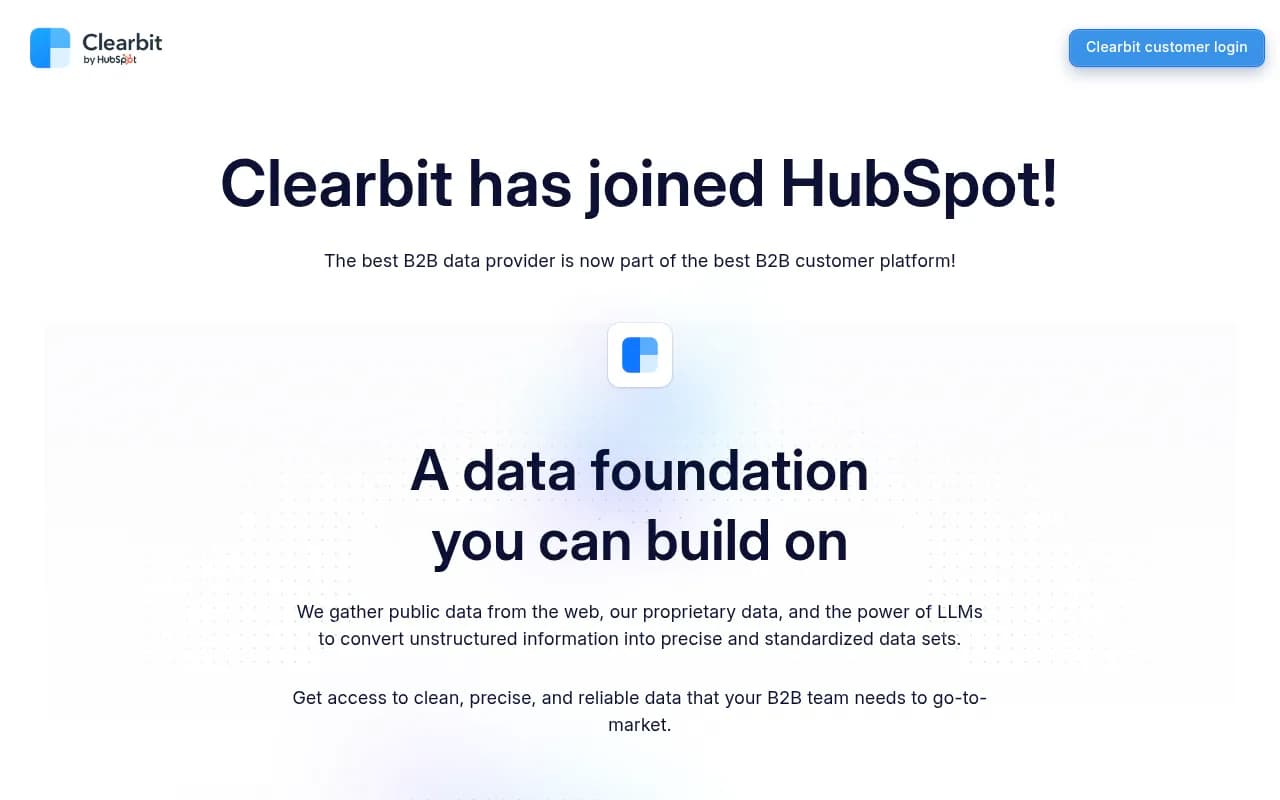
- HubSpot acquisition changes everything: Clearbit was acquired by HubSpot in late 2023 and now operates as HubSpot's native data provider -- meaning it's deeply integrated into the HubSpot ecosystem but less accessible as a standalone product for non-HubSpot users
- Best for HubSpot customers: If you're already using HubSpot CRM, Clearbit is the most seamless data enrichment option available -- native integration, no third-party connectors, AI-powered enrichment built directly into your workflows
- Limited standalone availability: Post-acquisition, Clearbit's API and standalone products are less emphasized -- the focus is now on serving HubSpot's customer base, which may leave non-HubSpot users looking for alternatives
- Strong data quality with AI enhancement: Combines public web data, proprietary datasets, and LLMs to deliver precise firmographic enrichment -- industry categorization (6-digit NAICS, GICS, SIC), corporate hierarchies, normalized roles and seniorities
- Visitor identification and intent signals: Reveals anonymous website traffic using IP intelligence, helping sales teams prioritize outbound efforts on companies showing buying intent
Clearbit started as one of the leading B2B data enrichment APIs, used by thousands of SaaS companies, agencies, and sales teams to automatically append company and contact information to leads. In late 2023, HubSpot acquired Clearbit and repositioned it as "the first HubSpot Native Data Provider" -- a move that fundamentally changed who the product serves and how it's delivered. If you're a HubSpot customer, this is great news. If you're not, you'll need to evaluate whether Clearbit still fits your stack or if you should look at alternatives like ZoomInfo, Apollo.io, or Cognism.
What Clearbit does (and how it works now)
Clearbit enriches your CRM records with firmographic and demographic data -- company size, industry, revenue, employee count, technologies used, social profiles, normalized job titles, and more. You feed it an email address or domain, and it returns a structured data payload with everything it knows about that person or company. The data comes from three sources: public web scraping, Clearbit's proprietary datasets (built over years of API usage and partnerships), and now AI models (LLMs) that parse unstructured information into standardized fields.
Post-acquisition, Clearbit is no longer positioned as a general-purpose API. It's now a HubSpot-native feature, meaning the primary way to use it is through HubSpot CRM. The enrichment happens automatically when leads enter your system -- no Zapier, no middleware, no custom API calls. HubSpot customers get access to Clearbit's data directly in their contact and company records, with AI-powered enrichment running in the background.
For non-HubSpot users, the path forward is less clear. Clearbit's API still exists (the GitHub org is active, and some documentation remains), but the company's marketing and product focus has shifted entirely to HubSpot integration. If you're evaluating Clearbit in 2026 and you're not a HubSpot customer, you're essentially looking at a legacy product that may not receive the same level of investment or support.
Core features (HubSpot-native version)
Data Enrichment (Leads, Contacts, Accounts): Clearbit enriches every record in your HubSpot CRM with firmographic and demographic data. This includes company name, domain, industry (with 6-digit NAICS, GICS, and SIC codes for granular categorization), employee count, revenue estimates, location, technologies used, social profiles, and more. For contacts, it normalizes job titles into standardized roles and seniorities -- so "VP of Growth" and "Head of Marketing" both map to "Marketing" + "VP-level" in your segmentation. This normalization is critical for lead scoring and routing because it eliminates the chaos of freeform title fields.
The enrichment runs automatically when a lead is created or updated. If Clearbit finds a match, the data populates instantly. If not, it queues the record for periodic re-enrichment as new data becomes available. The AI layer (LLMs) helps parse unstructured data from sources like LinkedIn, company websites, and press releases -- turning messy text into clean, structured fields.
Corporate Hierarchies: Clearbit maps parent companies and subsidiaries, so you can route leads correctly and avoid duplicate outreach. If someone from a subsidiary fills out a form, Clearbit identifies the parent company and routes the lead to the rep who owns that account. This is especially valuable for enterprise sales teams managing complex org structures -- you don't want three reps reaching out to different divisions of the same company.
Lead Scoring & Routing: With enriched data in place, you can build sophisticated lead scoring models based on firmographics (company size, industry, revenue) and demographics (role, seniority). Clearbit's data feeds directly into HubSpot's native scoring and workflow tools, so you can automatically route high-fit leads to sales, send low-fit leads to nurture campaigns, or flag accounts that match your Ideal Customer Profile (ICP). The real-time enrichment means scoring happens instantly -- no lag between form submission and lead assignment.
Visitor Identification (Reveal): Clearbit's IP intelligence identifies anonymous website visitors by matching their IP address to a company. The Visitor Dashboard in HubSpot shows which companies are browsing your site, which pages they viewed, and how often they return. This creates intent signals -- if a company matching your ICP visits your pricing page three times in a week, that's a warm outbound opportunity. Sales teams can prioritize outreach to companies already showing interest instead of cold calling random lists.
The IP-to-company matching works best for mid-sized and large companies with dedicated IP ranges. Small businesses and remote workers often share IPs with ISPs or coworking spaces, so identification accuracy drops. Clearbit claims "best-in-class" IP intelligence, but this is a known limitation across all visitor identification tools.
Form Shortening: Clearbit's Dynamic Form Shortening reduces form friction by hiding fields that can be enriched from an email address alone. If someone enters their work email, Clearbit enriches company name, industry, size, and location in the background -- so you don't need to ask for those fields. If enrichment fails (e.g., personal email or unknown domain), the form dynamically shows the missing fields to ensure 100% data coverage. This improves conversion rates by reducing the number of fields users see, while still capturing all the data you need for scoring and routing.
Form shortening is a HubSpot-native feature now, built directly into HubSpot forms. It's not available as a standalone JavaScript snippet for non-HubSpot sites (unlike the old Clearbit Reveal product).
AI-Powered Data Quality: Clearbit uses LLMs to parse unstructured data and fill gaps in its datasets. For example, if a company's website lists "We help mid-market SaaS companies scale their sales teams," the AI extracts "SaaS" as the industry and "mid-market" as the target segment. This is a step beyond traditional web scraping, which only captures structured data like meta tags or schema markup. The AI layer improves coverage for newer companies, international businesses, and niche industries where structured data is sparse.
Who is it for (and who should look elsewhere)
Clearbit is now built for HubSpot customers -- specifically B2B companies using HubSpot CRM for sales, marketing, or customer success. If you're already in the HubSpot ecosystem, Clearbit is the most seamless data enrichment option available. No third-party integrations, no API keys, no Zapier workflows -- just native enrichment that works out of the box. This is ideal for mid-market B2B SaaS companies (50-500 employees), agencies managing multiple HubSpot portals, and enterprise teams that have standardized on HubSpot as their CRM.
The best use case: sales teams that need real-time lead qualification and routing. If you're running inbound campaigns and need to instantly score and assign leads based on firmographics, Clearbit's HubSpot integration is hard to beat. The combination of enrichment, scoring, and routing happens in milliseconds, so your reps can follow up on high-fit leads while they're still hot.
Clearbit also works well for marketing teams running account-based marketing (ABM) programs. The visitor identification feature surfaces target accounts that are already engaging with your content, so you can trigger personalized outreach or retargeting campaigns. If you're targeting enterprise accounts with long sales cycles, knowing which companies are researching your product (even if they haven't filled out a form) is valuable intent data.
Who should NOT use Clearbit: If you're not a HubSpot customer, Clearbit is no longer the obvious choice. The API still exists, but the product roadmap and support are now focused on HubSpot integration. Non-HubSpot users should evaluate alternatives like Apollo.io (built-in prospecting + enrichment), ZoomInfo (enterprise-grade data with broader coverage), Cognism (strong in Europe and GDPR compliance), or Lusha (affordable for small teams). These tools offer standalone APIs, native integrations with Salesforce, Pipedrive, and other CRMs, and active product development outside the HubSpot ecosystem.
Clearbit is also not ideal for early-stage startups with limited budgets. Pricing starts at $45/month for 100 enrichment credits (see pricing section below), but most B2B teams will burn through that quickly. If you're enriching thousands of leads per month, costs add up fast. Freemium alternatives like Hunter.io, Snov.io, or Apollo.io's free tier may be better fits for bootstrapped teams.
Finally, if you need international coverage outside North America and Western Europe, test Clearbit's accuracy before committing. B2B data providers generally have weaker coverage in Asia, Latin America, Africa, and Eastern Europe. Clearbit's data quality is strong for US and UK companies, but drops off in other regions. Cognism and Lusha have better international datasets.
Integrations & ecosystem
Clearbit's primary integration is now HubSpot CRM -- it's a native data provider, meaning it's built directly into HubSpot's platform. No setup required beyond enabling the feature in your HubSpot account. Enrichment, scoring, routing, and visitor identification all happen within HubSpot's interface.
For non-HubSpot users, Clearbit historically offered integrations with Salesforce, Marketo, Segment, and Zapier, plus a REST API for custom integrations. These integrations still exist (the API documentation is live, and the GitHub org has active repos), but it's unclear how much support and development they're receiving post-acquisition. If you're building on Clearbit's API in 2026, you're taking on some risk that HubSpot may deprecate or de-prioritize these features in favor of the native HubSpot product.
Clearbit also offered JavaScript snippets for website visitor identification (Reveal) and form shortening, which could be embedded on any site. These features are now HubSpot-native, so if you're not using HubSpot forms or HubSpot tracking code, you may not have access to them.
The API is still available for developers who want to build custom enrichment workflows. You can call the Enrichment API with an email or domain and get back a JSON payload with company and contact data. The API is well-documented and has client libraries for Python, Ruby, Node.js, and Go. However, the API is no longer the focus of Clearbit's product strategy, so expect slower updates and less community support compared to pre-acquisition.
Pricing & value
Clearbit's pricing has always been opaque, and the HubSpot acquisition hasn't changed that. Based on available information, pricing starts at $45/month for 100 enrichment credits (billed annually). Larger packs are estimated at $450/month for 1,000 credits and $4,500/month for 10,000 credits, though these numbers are not publicly confirmed. Each enrichment (looking up a person or company) consumes one credit.
For context, if you're enriching 1,000 leads per month, you're looking at roughly $450/month or $5,400/year. That's competitive with ZoomInfo's mid-tier plans but more expensive than Apollo.io (which includes prospecting and enrichment in one platform starting at $49/user/month) or Lusha (which offers pay-as-you-go credits starting at $0.10 per credit).
The value proposition depends on your CRM. If you're a HubSpot customer, Clearbit's native integration saves engineering time and eliminates the need for middleware like Zapier. The seamless enrichment, scoring, and routing workflows justify the cost for teams that prioritize speed and simplicity. If you're not a HubSpot customer, the value is less clear -- you're paying for a premium data provider without the integration benefits, and you may find better ROI with a tool that integrates natively with your CRM.
Clearbit does not offer a free tier or free trial (at least not publicly). You'll need to contact sales for a demo and custom quote. This is standard for enterprise data providers, but it's a barrier for small teams that want to test the product before committing.
Strengths & limitations (honest take)
Strengths:
- HubSpot-native integration is unbeatable: If you're a HubSpot customer, Clearbit's native enrichment, scoring, and routing workflows are the smoothest experience available. No API keys, no Zapier, no custom code -- just turn it on and it works.
- High data quality for US/UK companies: Clearbit's data accuracy is strong for North American and Western European businesses, especially mid-market and enterprise companies. The AI-powered enrichment helps fill gaps in newer or niche industries.
- Visitor identification creates intent signals: The IP intelligence feature surfaces companies that are already engaging with your content, giving sales teams warm outbound opportunities instead of cold lists.
- Form shortening improves conversion rates: Reducing form fields without sacrificing data coverage is a proven way to increase lead capture, and Clearbit's dynamic form shortening handles this elegantly.
Limitations:
- HubSpot lock-in: The acquisition has effectively turned Clearbit into a HubSpot-exclusive product. If you're not a HubSpot customer, you're using a legacy API with uncertain long-term support. Non-HubSpot users should seriously consider alternatives.
- Pricing is expensive and opaque: Starting at $45/month for 100 credits is steep for small teams, and the lack of transparent pricing makes it hard to budget. Competitors like Apollo.io and Lusha offer clearer pricing and better value for high-volume enrichment.
- Weaker international coverage: Like most B2B data providers, Clearbit's accuracy drops outside North America and Western Europe. If you're targeting companies in Asia, Latin America, or Africa, test coverage before committing.
- No free tier or trial: You can't test the product without talking to sales, which is a barrier for small teams and individual users. Competitors like Apollo.io and Hunter.io offer free tiers that let you evaluate data quality before paying.
- Visitor identification has known limitations: IP-to-company matching works well for mid-sized and large companies with dedicated IP ranges, but struggles with small businesses, remote workers, and shared IPs. This is an industry-wide limitation, not unique to Clearbit, but it's worth noting.
Bottom line
Clearbit is the best data enrichment option for HubSpot customers who want seamless, AI-powered firmographic enrichment, lead scoring, and visitor identification built directly into their CRM. The native integration eliminates the friction of third-party tools, and the data quality is strong for US and UK companies. If you're running inbound campaigns or ABM programs in HubSpot, Clearbit is worth the investment.
For non-HubSpot users, the acquisition has made Clearbit a less compelling choice. The API still exists, but the product focus has shifted entirely to HubSpot integration, and you're paying premium prices without the native integration benefits. Alternatives like Apollo.io (prospecting + enrichment in one platform), ZoomInfo (enterprise-grade data), Cognism (strong in Europe), or Lusha (affordable pay-as-you-go) offer better value and clearer long-term support for non-HubSpot stacks.
Best use case in one sentence: HubSpot customers running high-volume inbound or ABM campaigns who need real-time lead enrichment, scoring, and visitor identification without the hassle of third-party integrations.
Frequently asked questions
What is Clearbit and what does it do?
Who owns Clearbit now?
Is Clearbit still available as a standalone product?
How much does Clearbit cost?
Does Clearbit have a free plan?
Who is Clearbit best for?
What data does Clearbit provide for enrichment?
Does Clearbit integrate with HubSpot?
Can Clearbit identify anonymous website visitors?
How does Clearbit compare to ZoomInfo, Apollo.io, and Cognism?
Similar and alternative tools to Clearbit