Key takeaways
- Most GEO platforms, including Profound itself, are dashboard-first tools with no native MCP server — you can't query your AI visibility data inside Claude or ChatGPT without workarounds.
- MCP (Model Context Protocol) support is still rare in this category, but a few platforms and adjacent SEO tools have started shipping MCP servers that change how teams interact with their data.
- The more important question isn't just "does it have MCP?" but "does it help you act on the data?" Monitoring without optimization is half a product.
- Promptwatch is the only platform in this space rated a leader across monitoring, content generation, and optimization — and its API makes it the most MCP-ready option for teams that want to build custom workflows.
- For most teams, the practical path to pulling GEO data into Claude or ChatGPT today involves a combination of platform APIs, Zapier/n8n automation, or purpose-built MCP servers from adjacent SEO tools.
Why MCP suddenly matters for GEO teams
If you've been watching the AI tooling space in 2026, you've probably noticed that Model Context Protocol has gone from a niche developer concept to something marketing teams are actually asking about. The idea is simple: instead of copying data out of a dashboard and pasting it into Claude or ChatGPT, you connect the tool directly to the model. Ask a plain-language question, get an answer grounded in your real data.
For SEO teams, this is already happening. SE Ranking published a breakdown of the best SEO MCP servers in 2026, and the list includes tools like Google Analytics 4 (which has an official MCP that lets you query GA4 data from Claude using plain language), DataForSEO (which a Reddit thread in r/localseo called out as producing "pretty great" technical SEO audits when combined with Claude), and a handful of others.
For GEO and AI visibility specifically, the picture is murkier. The category is newer, the platforms are mostly dashboard-first, and MCP support is still rare. But the demand is real. Teams want to ask things like "which prompts are my competitors winning that I'm not?" or "what content should I publish this week to close my biggest visibility gaps?" — and they want answers inside the tools they're already working in.
That's the gap this guide addresses. We'll look at which Profound alternatives are actually MCP-ready (or close to it), which ones have APIs you can connect through automation tools, and which ones are genuinely built to help you act on the data rather than just stare at it.
What Profound does well — and where it falls short
Before getting into alternatives, it's worth being honest about what Profound actually is.
Profound was one of the early movers in AI visibility tracking. It has some genuinely useful features: real-user prompt volume data, front-end response capture (meaning it captures what users actually see, not just API outputs), and an Amazon Rufus shopping module that most competitors still don't offer.
The pricing, though, is a real constraint. The Starter plan at $99/month only covers ChatGPT. Adding Perplexity and Google AI Overviews jumps to $399/month. Claude, Gemini, Grok, and the rest sit behind enterprise pricing that isn't published. At the Growth tier, you're capped at 100 tracked prompts with 3 user seats.
And critically for this guide: Profound has no native MCP server. There's no way to connect it directly to Claude or ChatGPT. You're working in the dashboard or exporting data manually.
The MCP landscape for GEO tools in 2026
Let's be direct about the state of things. As of mid-2026, no major GEO platform has shipped a fully polished, publicly available MCP server the way Google Analytics 4 or DataForSEO have. The category is moving fast, but it's still catching up to the broader SEO tooling ecosystem on this front.
What does exist:
- Platform APIs that you can wrap in a custom MCP server yourself (requires developer effort)
- Zapier and n8n integrations that let you pipe GEO data into workflows that feed Claude or ChatGPT
- Adjacent SEO tools with MCP support that cover some of the same ground (rank tracking, content gaps, etc.)
- One platform (xSeek) that has explicitly positioned its GEO/SEO skills as turning Claude Code into an "AI visibility command center" — though it's more of a skills layer than a full MCP implementation
Here's how the main Profound alternatives stack up on the MCP and API dimension:
| Platform | Native MCP server | Public API | Automation integrations | Content generation | Best for |
|---|---|---|---|---|---|
| Promptwatch | No native MCP (API available) | Yes | Zapier, n8n, Looker Studio | Yes (Content Agents) | Full GEO action loop |
| Profound | No | Limited | Limited | No | Enterprise monitoring |
| Ahrefs Brand Radar | No | Via Ahrefs API | Yes | No | Data-quality-focused teams |
| SE Ranking | MCP server available | Yes | Yes | Partial | Google-first SEO teams |
| Otterly.AI | No | Limited | Limited | No | Brand monitoring |
| Peec AI | No | Limited | Limited | No | Prompt-level analytics |
| AthenaHQ | No | Yes | Yes | Limited | Enterprise GEO |
| Writesonic | No | Yes | Yes | Yes | Content-focused teams |
| Scrunch AI | No | Limited | Limited | No | Monitoring only |
The honest takeaway: if you need a native plug-and-play MCP server for GEO data today, you're going to be disappointed by the current market. But if you're willing to use an API or connect through automation, several platforms open up considerably.
The platforms worth your attention
Promptwatch — the most complete option for teams that want to act
Promptwatch is the platform I'd point most teams toward, and not just because of MCP proximity. The more important story is what it does with the data.

Most GEO tools show you a visibility score and leave you to figure out what to do next. Promptwatch runs a different loop: it finds the specific prompts your competitors are winning that you're not (Answer Gap Analysis), generates content designed to close those gaps (Content Agents), and then tracks whether that content actually gets cited by AI models. Page-level tracking shows which pages are being cited, by which models, and how often. AI Crawler Logs show when ChatGPT, Claude, or Perplexity hit your site, which pages they read, and when a crawl turns into a citation.
On the MCP question specifically: Promptwatch has a public API and Looker Studio integration, which means a developer can wrap it in a custom MCP server without much difficulty. It also connects through Zapier and n8n, so teams that want to pipe visibility data into Claude or ChatGPT workflows have a practical path to do that today.
Pricing runs from $99/month (Essential, 1 site, 50 prompts) to $579/month (Business, 5 sites, 350 prompts, 30 articles). Agency and enterprise pricing is available.
SE Ranking — the closest thing to a real MCP server in this space
SE Ranking is worth calling out specifically because it's one of the few platforms in the broader SEO/GEO space that has actually shipped MCP server support. Their blog post on the best SEO MCPs in 2026 is a useful reference for understanding what's available.

SE Ranking's AI Search and AI Overviews tracker sits inside a full SEO suite, which means you get rank tracking, content tools, and AI visibility in one place. The MCP support is more on the traditional SEO side than the GEO side, but for teams that care about Google AI Overviews specifically, this is a meaningful differentiator.
The limitation: SE Ranking is better at tracking than optimizing. It doesn't generate content or run the kind of gap analysis that tells you exactly what to publish.
Ahrefs Brand Radar — best data quality, no MCP
Ahrefs Brand Radar takes a different approach to the data problem. Where most GEO tools construct synthetic prompts (essentially guessing what users might ask), Brand Radar pulls from 243M+ real search queries with measurable volume behind them. The prompts it tracks correspond to questions real people actually typed.

That's a meaningful data quality advantage. The tradeoff is that Brand Radar is purely a monitoring tool. No content generation, no gap analysis, no MCP server. If you're an existing Ahrefs user who wants AI visibility data anchored in real search behavior, it's a strong add-on. If you need to act on the data, you'll need to combine it with something else.
Pricing: $50/month (2,500 checks) up to $699/month for all 6 AI indexes plus custom prompt checks.
Writesonic — content-first with reasonable API access
Writesonic has positioned itself as an AI search visibility platform that tracks, optimizes, and ranks — not just a writing tool. It covers multiple AI models and has content generation built in, which puts it in a different category from pure monitoring tools.
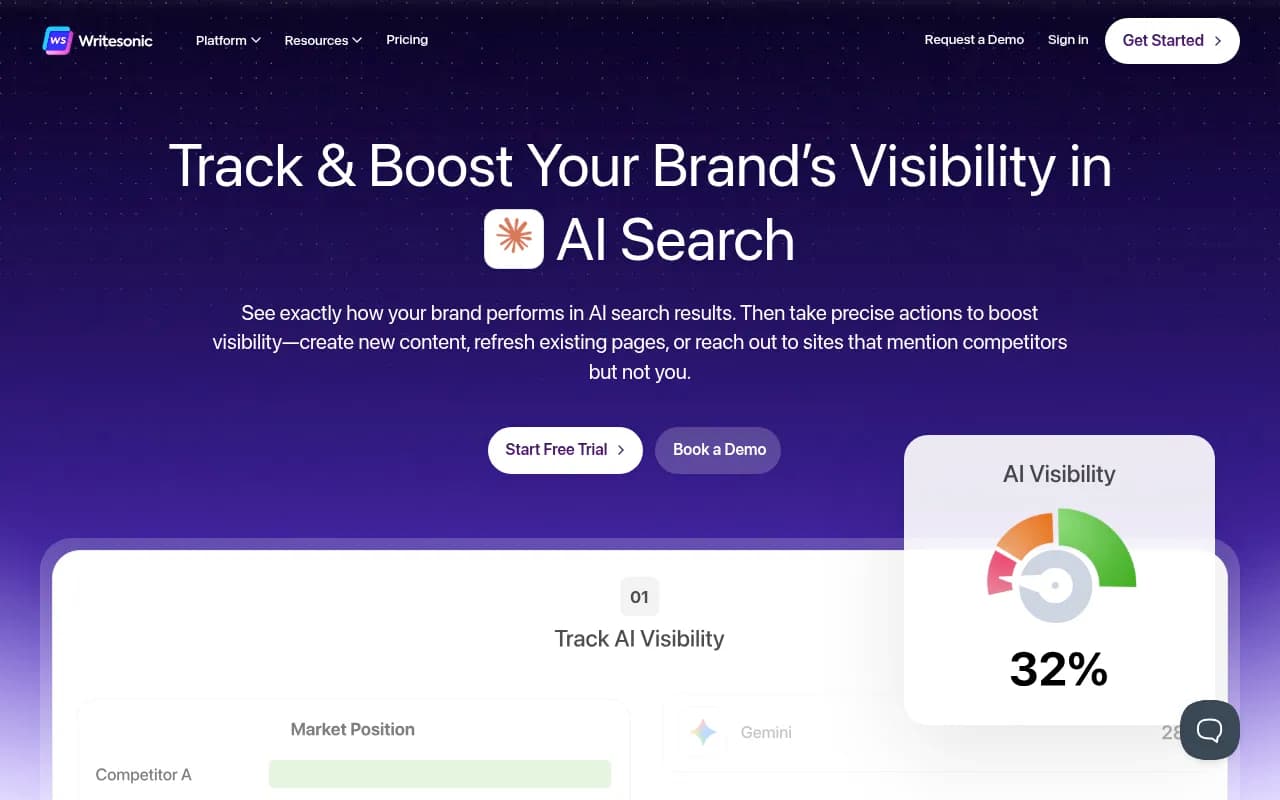
The API access is reasonable, and Writesonic connects to Zapier, which means you can build workflows that pull visibility data into other tools. It's not a native MCP server, but it's more automation-friendly than most GEO platforms.
The limitation: Writesonic's GEO tracking is less deep than dedicated platforms. If you need crawler logs, page-level citation tracking, or prompt volume data, you'll hit its ceiling.
Otterly.AI — affordable monitoring, no path to MCP
Otterly.AI is a solid entry-level option for brand monitoring across AI platforms. It's affordable, easy to set up, and covers the basics.
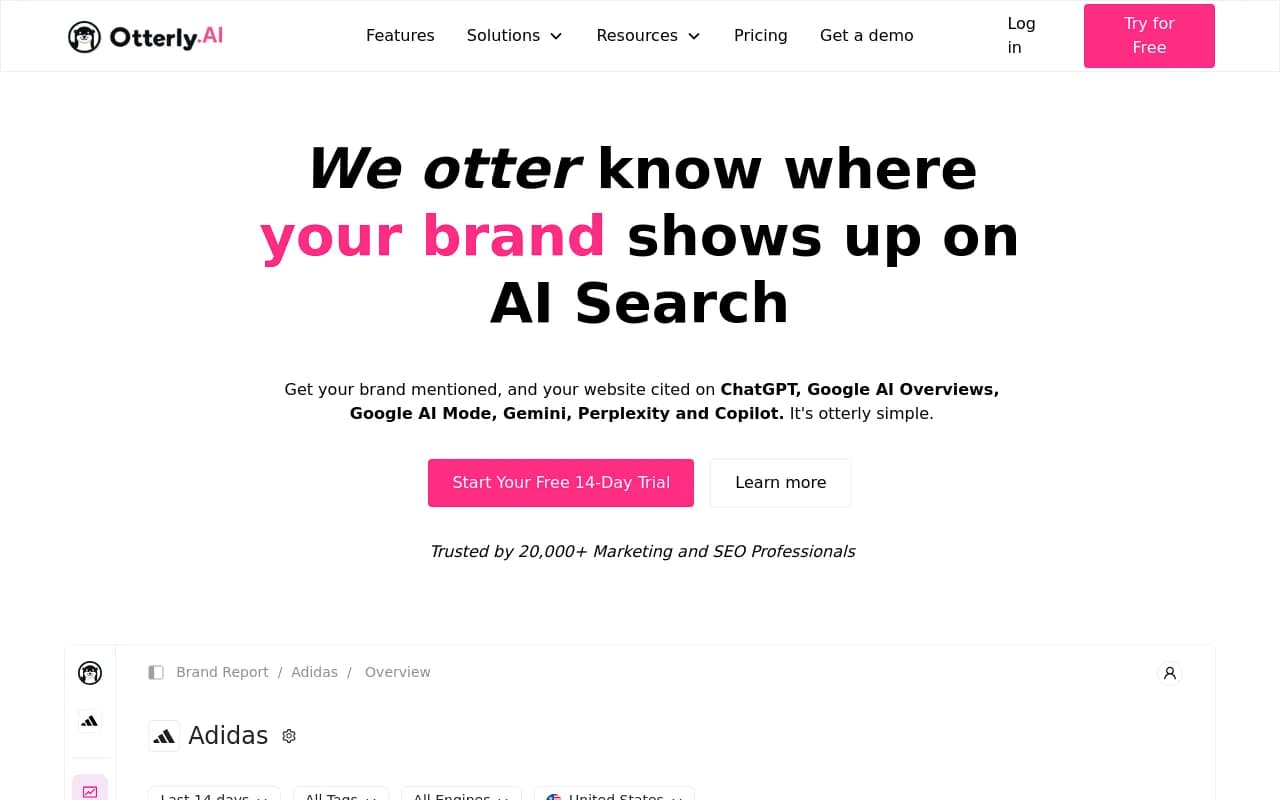
But it's monitoring-only. No content generation, no gap analysis, no API worth speaking of, and no MCP support. If your goal is to pull AI visibility data into Claude or ChatGPT, Otterly isn't the tool for that job.
Peec AI — prompt-level analytics for marketing teams
Peec AI focuses on prompt-level analytics — showing you which specific prompts are driving AI visibility and where your brand appears in the source citations.
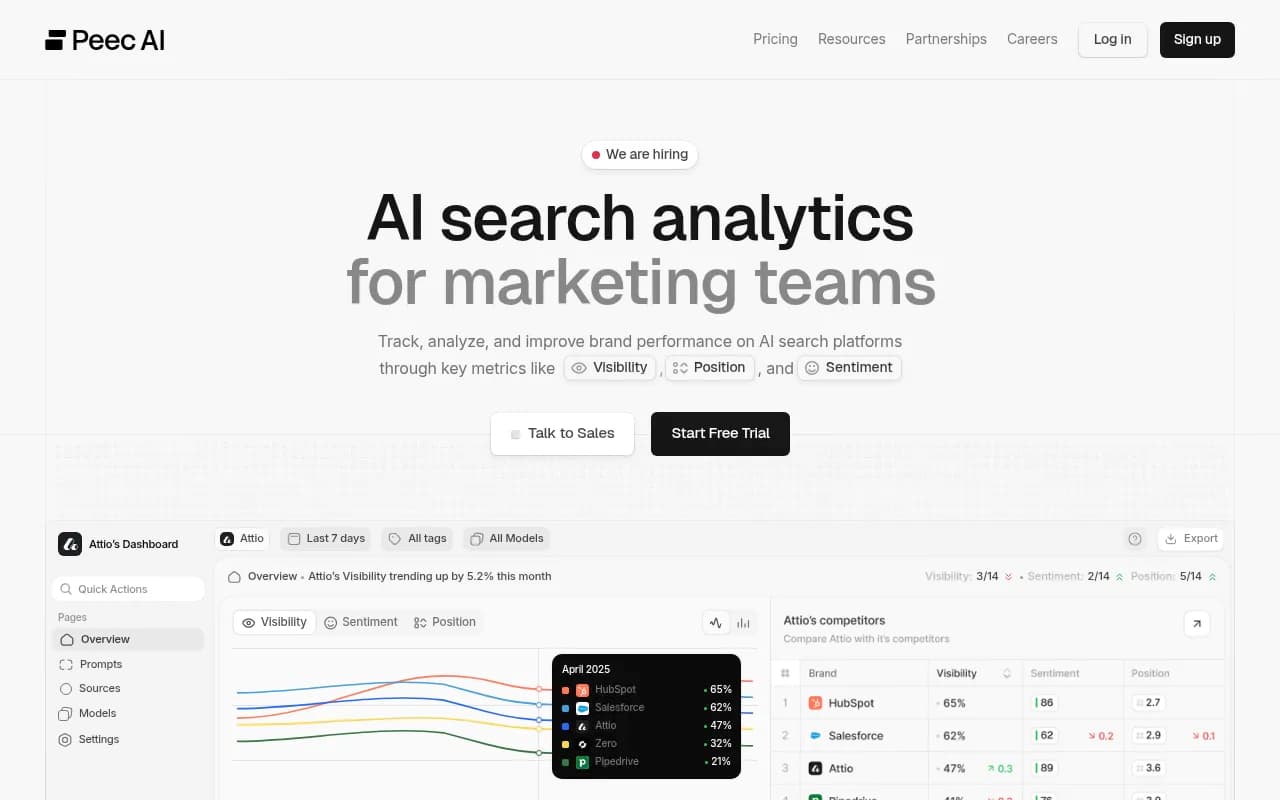
It's a useful tool for marketing teams that want granular prompt data. The API access is limited, which constrains MCP options. Like Otterly, it's primarily a monitoring tool without the optimization layer.
AthenaHQ — enterprise GEO with better automation options
AthenaHQ positions itself as a full GEO platform for enterprise teams, with AI visibility tracking, some automation, and revenue attribution.
It has a public API and connects to enterprise data stacks more readily than most GEO tools. For teams with developer resources who want to build a custom MCP integration, AthenaHQ is more viable than the monitoring-only options. The content generation capabilities are limited compared to Promptwatch, but the enterprise integrations are stronger.
Scrunch AI — monitoring with decent coverage
Scrunch AI covers a solid range of AI models and gives you brand monitoring with sentiment tracking. It's a reasonable Profound alternative on price and coverage.
No MCP support, limited API. Good for monitoring; not built for optimization or workflow integration.
How to actually get GEO data into Claude or ChatGPT today
Since native MCP servers are rare in this category, here's the practical playbook for teams that want to work with AI visibility data inside Claude or ChatGPT right now.
Option 1: Use a platform with a public API and build a custom MCP wrapper
If you have a developer on your team, this is the cleanest path. Platforms like Promptwatch and AthenaHQ expose APIs that return structured visibility data. You can wrap that API in a simple MCP server (Anthropic has published documentation on the protocol) and connect it to Claude Desktop or a ChatGPT plugin.
The result: you can ask Claude "which prompts are my competitors winning this week?" and get an answer grounded in real data from your GEO platform.
Option 2: Use Zapier or n8n to pipe data into your AI workflows
Both Zapier and n8n can connect to GEO platform APIs and route data into Claude or ChatGPT via their respective integrations. This is less elegant than a native MCP server but works for most use cases. You can set up a workflow that pulls weekly visibility data and feeds it into a Claude prompt for analysis and recommendations.
Option 3: Use SE Ranking's MCP server for the SEO/AI Overviews layer
If Google AI Overviews is your primary concern, SE Ranking's MCP support gives you a direct connection to that data inside Claude. It won't cover ChatGPT or Perplexity visibility, but for Google-first teams it's the most turnkey option available right now.
Option 4: Export and use structured data prompts
The lowest-tech option: export your visibility data as CSV or JSON, upload it to Claude or ChatGPT, and ask questions against it. Not elegant, but surprisingly effective for ad-hoc analysis. Most GEO platforms support CSV export.
What to actually look for when evaluating these tools
MCP support is a useful filter, but it's not the only one that matters. Here's what I'd actually evaluate:
Data quality: Are the prompts tracked based on real user behavior or synthetic queries? Ahrefs Brand Radar's approach (real search data) is meaningfully different from platforms that construct their own prompts.
Model coverage: Profound's Starter plan only covers ChatGPT. If you need Perplexity, Google AI Overviews, Claude, and Gemini in one place, check coverage carefully before committing.
Content generation: Monitoring tells you where you're invisible. Content generation helps you fix it. Platforms like Promptwatch and Writesonic close that loop; most others don't.
Crawler logs: Knowing that ChatGPT crawled your site is useful. Knowing which pages it read, which errors it hit, and when a crawl turned into a citation is much more useful. Very few platforms offer this.
API and automation friendliness: If MCP matters to you, you need a platform with a real API. Check documentation before assuming.
The bottom line
The honest answer to "which Profound alternatives have MCP support in 2026" is: not many, and none of them have it in the polished, plug-and-play way that GA4 or DataForSEO do for traditional SEO.
But the more useful question is which platforms give you the data quality, API access, and optimization capabilities to build the workflow you actually need. On that measure, Promptwatch leads the field — it's the only platform in this space that covers monitoring, content generation, and optimization in one place, with an API that makes custom MCP integration realistic.
SE Ranking is the best option if you specifically want MCP server support today and are primarily focused on Google AI Overviews. Ahrefs Brand Radar wins on data quality if you're an existing Ahrefs user. And if you're willing to use Zapier or n8n as the connective tissue, most of the better GEO platforms become workable in an AI-assisted workflow.
The category is moving fast. Native MCP servers for GEO data will exist by the end of 2026. The platforms most likely to ship them first are the ones already investing in APIs and developer tooling — which is another reason to pick a platform with a real API now rather than one that's dashboard-only.