Key takeaways
- Omnia Retail is a dynamic pricing and competitor price monitoring platform built for retailers and brands managing large product catalogs.
- It earns strong ratings (4.4/5 on G2, 4.6/5 on Capterra) from users who value its Pricing Strategy Tree and automation capabilities.
- Pricing is not publicly listed and requires a demo request, which is a real friction point for smaller teams evaluating options.
- The platform is best suited for mid-market to enterprise retailers with complex, multi-channel pricing needs -- not small shops or brands primarily focused on AI search visibility.
- If you're looking for AI search visibility or GEO tools (and searched for "Omnia" in that context), note there's a separate product called Omnia that tracks AI visibility -- this review covers both, with clear distinctions.
There are actually two products called "Omnia" that come up in 2026 searches, and depending on what you're looking for, you might be researching the wrong one. Let's clear that up first, then go deep on each.
The first is Omnia Retail -- a dynamic pricing platform that's been around for over a decade, used by retailers and brands to automate pricing strategies, monitor competitor prices, and manage margins across large product catalogs. This is the one reviewed on G2, Capterra, and Software Advice.
The second is Omnia (useomnia.com) -- a newer AI search visibility and GEO (Generative Engine Optimization) platform that tracks how brands appear in ChatGPT, Perplexity, Claude, and other AI engines. This one competes with tools like Profound, Peec AI, and Promptwatch.
This review covers both, because search results in 2026 blend them together constantly and it's genuinely confusing.
Omnia Retail: the dynamic pricing platform
What it actually does
Omnia Retail positions itself as a "pricing partner for retailers and brands." The core product is dynamic pricing automation -- you set pricing rules and strategies, Omnia pulls in competitor price data from sources like Amazon, eBay, Kaufland, idealo, and Google Shopping, and then automatically adjusts your prices to hit margin and competitiveness targets.
The standout feature is the Pricing Strategy Tree, which lets you build layered pricing logic without needing IT support. You can create rules like "if I'm the cheapest on idealo by more than 5%, raise my price to the next competitor minus €0.01" -- and visualize the entire decision tree in a single view. For pricing teams managing thousands of SKUs, this is genuinely useful. Most alternatives require either a developer or a very rigid rule structure.
Other capabilities include:
- Competitor price monitoring across marketplaces and comparison shopping engines
- Repricing automation with configurable update frequencies
- Market position tracking (where do your prices sit relative to the market?)
- Support for both direct-to-consumer and brand-through-retail scenarios
- Multi-market and multi-currency support
The platform has been around long enough to have real depth here. Users on G2 consistently mention that it saves significant time versus manual price checking and reduces the guesswork in pricing decisions.
Who uses it
Omnia Retail's customer base skews toward mid-market and enterprise retailers -- companies with product catalogs in the thousands or millions of SKUs, operating across multiple markets. It's particularly popular in Europe, with strong support for German, English, and Dutch.
Brands that sell through retail partners (not just direct) also use it to monitor how their products are being priced by resellers, which is a distinct use case that not every pricing tool handles well.
What users say
On G2, Omnia Retail holds a 4.4/5 rating across 100 reviews, with 67% giving it 5 stars and 33% giving it 4 stars. That's an unusually clean distribution -- no 3, 2, or 1-star reviews in the current dataset, which either reflects genuine satisfaction or some selection bias in who's leaving reviews.
On Capterra, the rating is 4.6/5 across 24 reviews, with similar themes: users appreciate the automation, the data quality, and the Pricing Strategy Tree. Common praise includes time savings and the ability to maintain margins while staying competitive.
The recurring criticism is the learning curve. The platform is powerful, but that power comes with complexity. New users often need significant onboarding time before they're getting full value, and the interface isn't immediately intuitive for teams without a pricing background.
Pricing
Here's the frustrating part: Omnia Retail doesn't publish pricing. You need to request a demo to get a quote. Based on the market positioning and the customer profile (mid-market to enterprise), expect this to be a significant investment -- likely in the thousands per month for a full deployment.
This isn't unusual for enterprise pricing software, but it does make evaluation harder. If you're a smaller retailer or just exploring options, the lack of transparent pricing means you might spend time on a demo only to find it's out of budget.
Real limitations
A few things worth knowing before you book that demo:
It's built for pricing, not marketing. If you want to understand why customers are choosing competitors, or what's driving traffic, Omnia Retail won't help. It's a pricing tool, full stop.
Setup complexity is real. Multiple reviewers mention that getting the Pricing Strategy Tree configured correctly takes time and often requires help from Omnia's team. For fast-moving teams, this can be a bottleneck.
No AI search visibility features. If you're a brand that also wants to track how you appear in ChatGPT or Google AI Overviews, Omnia Retail has nothing for you there. That's a different product category entirely.
Pricing opacity. The lack of published pricing makes budgeting difficult. You're committing time to a sales process before knowing if it fits your budget.
Omnia (useomnia.com): the AI visibility platform
This is the newer, separate product that tracks brand visibility across AI search engines. It's a GEO (Generative Engine Optimization) platform, not a retail pricing tool.
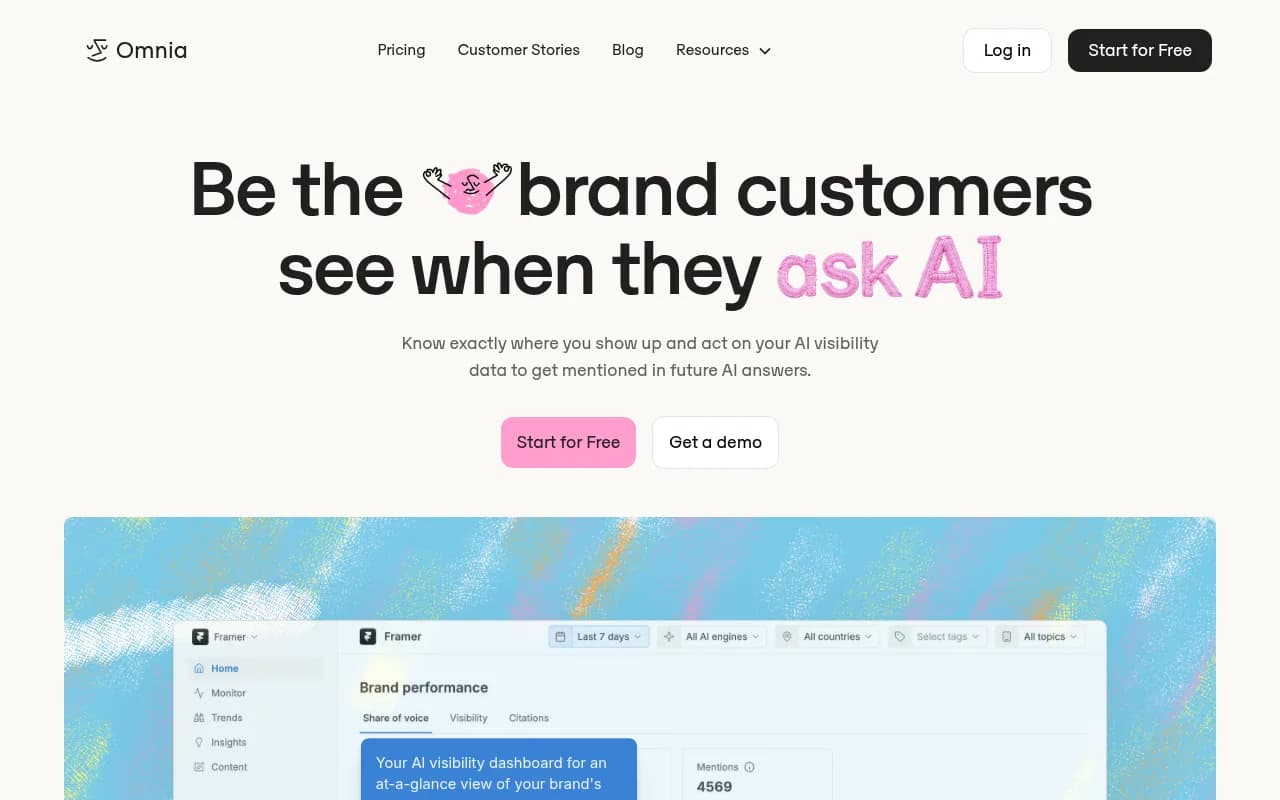
According to their own comparison content, Omnia (the GEO tool) starts at $79/month, which includes 25 prompts across 4 AI engines and unlimited countries. That's a meaningful price point for smaller teams, and the transparent pricing is a genuine advantage over some competitors.
The platform competes directly with tools like Peec AI, Profound, and others in the AI visibility monitoring space.
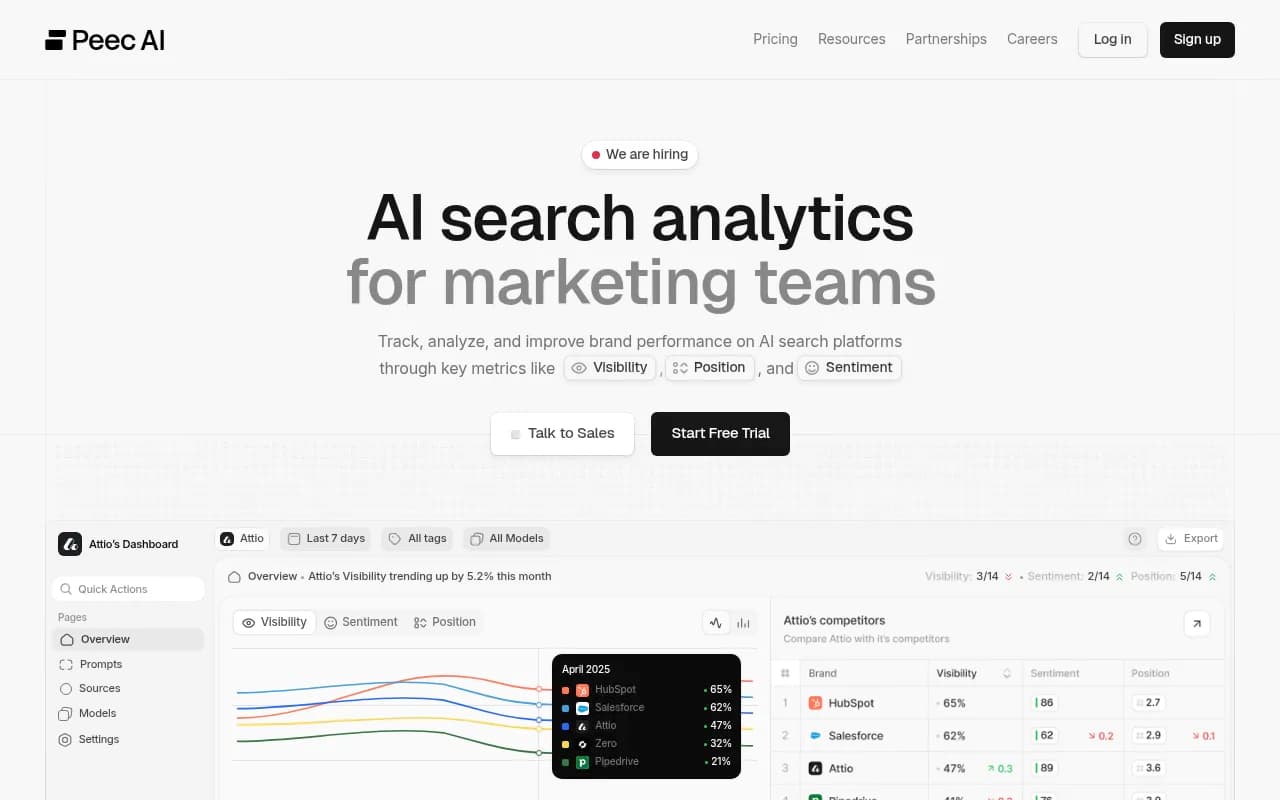
However, based on available information, Omnia (useomnia.com) sits in the monitoring-oriented tier of the GEO market. It tracks where your brand appears in AI responses, but the depth of optimization features -- content gap analysis, AI content generation, crawler logs -- appears limited compared to more comprehensive platforms.
How Omnia (GEO) compares to alternatives
The GEO tool market in 2026 has a clear split: platforms that show you data, and platforms that help you act on it. Monitoring is table stakes now. The real question is what happens after you see that a competitor is getting cited and you're not.
| Feature | Omnia (GEO) | Peec AI | Profound | Promptwatch |
|---|---|---|---|---|
| AI engine monitoring | 4 engines | Limited | Multiple | 10+ engines |
| Prompt tracking | 25 (base plan) | Basic | Yes | 50-350+ |
| Content gap analysis | Unknown | No | Limited | Yes |
| AI content generation | Unknown | No | No | Yes |
| Crawler logs | Unknown | No | No | Yes |
| Reddit/YouTube tracking | Unknown | No | No | Yes |
| ChatGPT Shopping tracking | Unknown | No | No | Yes |
| Transparent pricing | Yes ($79/mo) | Yes | No | Yes ($99/mo) |
For teams that want to go beyond monitoring and actually fix their AI visibility gaps, Promptwatch is worth a close look. It covers the full loop: find which prompts you're missing, generate content to fill those gaps, and track whether AI engines start citing you after you publish.

Other solid options in the monitoring space include Otterly.AI for budget-conscious teams, and Scrunch AI for those who want a more enterprise-oriented monitoring dashboard.

Alternatives to Omnia Retail (dynamic pricing)
If you're specifically evaluating Omnia Retail for dynamic pricing and want to compare options:
Prisync is the most commonly compared alternative. It's more affordable, has transparent pricing, and is better suited for smaller retailers. The trade-off is less sophistication in pricing strategy logic -- if you need the kind of complex rule trees Omnia Retail offers, Prisync may feel limiting.
Wiser (now part of a larger suite) covers pricing intelligence with a stronger focus on brand manufacturers monitoring retail channel pricing.
Competera is another enterprise-grade option with ML-driven pricing recommendations, though it's similarly opaque on pricing.
The honest answer is that Omnia Retail is genuinely good at what it does. If you have a large catalog, operate across multiple markets, and need sophisticated pricing automation, it's a serious contender. The question is whether the investment (in both money and setup time) makes sense for your situation.
Who should use what
Use Omnia Retail if:
- You're a mid-market or enterprise retailer with thousands of SKUs
- You sell across multiple markets and need multi-currency pricing
- You want to automate repricing based on competitor data from Amazon, eBay, idealo, etc.
- You have the budget for an enterprise pricing platform and the team to configure it properly
Use Omnia (GEO tool) if:
- You want basic AI search visibility monitoring at an accessible price point
- You're just getting started with GEO and want to understand where you stand
- You don't yet need deep content optimization or crawler analytics
Use Promptwatch if:
- You want to monitor AND optimize your AI search visibility
- You need content gap analysis to understand exactly what topics to write about
- You want AI-generated content briefs grounded in real prompt data
- You need crawler logs to understand how AI engines are actually reading your site
- You're managing multiple brands or sites (agency or enterprise)
Use Peec AI or Otterly.AI if:
- You want lightweight, affordable monitoring without the full optimization stack
- You're a small team just starting to track AI visibility
The bottom line
Omnia Retail is a solid, mature platform for dynamic pricing. The Pricing Strategy Tree is genuinely useful, the competitor data coverage is broad, and the user satisfaction scores reflect real value delivered. The main drawbacks are the lack of pricing transparency and the setup complexity -- both of which are manageable if you're the right customer.
The GEO-focused Omnia (useomnia.com) is a newer entrant in a crowded space. The $79/month starting price is accessible, but the feature depth for optimization (as opposed to monitoring) isn't yet at the level of more established platforms.
If you're evaluating tools for AI search visibility in 2026, the most important question to ask any platform is: "What do I do after I see the data?" Monitoring tells you there's a problem. Optimization tools help you fix it. Make sure you know which one you're buying.