Key takeaways
- Most platforms in this comparison do AI visibility monitoring well enough -- the real differentiator is whether they help you act on what they find.
- Promptwatch is the only tool here that closes the full loop: gap analysis, AI-native content generation, and citation tracking in one platform.
- Profound is the strongest pure enterprise monitoring play, but it's expensive and stops at insights.
- Morningscore and SE Visible are solid traditional SEO tools with AI visibility bolted on -- fine if you already use them, not worth switching to just for AI tracking.
- Rankability is a good fit for agencies that need to manage AI and traditional SEO visibility for multiple clients in one place.
- If you're starting fresh and AI search is your primary concern, Promptwatch or Profound are the two serious options -- and price will likely decide it.
The category of "SEO platform with AI visibility" has gotten crowded fast. Every tool that tracked keyword rankings in 2023 has now added a dashboard for ChatGPT mentions. Some of them are genuinely useful. Others are just a new tab bolted onto an old product.
This comparison focuses on five platforms that sit at an interesting intersection: they're not pure-play AI visibility trackers, and they're not traditional SEO tools either. They're trying to do both. That's a hard thing to pull off well, and the results vary considerably.
The five tools: Profound, Promptwatch, Morningscore, Rankability, and SE Visible.
What "AI visibility" actually means in 2026
Before diving into the tools, it's worth being clear about what we're comparing. When someone asks ChatGPT "what's the best accounting software for freelancers?" or Perplexity "which CRM should I use?", the AI generates an answer. Your brand either appears in that answer or it doesn't. Traditional rank trackers can't see this at all.
AI visibility tools track those answers. They query AI models with prompts your potential customers are likely to use, then record whether your brand was mentioned, cited, or recommended -- and how prominently.
The more interesting question is what happens after you see the data. Knowing you're invisible in ChatGPT is useful. Knowing exactly which content gaps are causing that invisibility, and having tools to fill those gaps, is what actually moves the needle. That distinction separates the platforms in this comparison more than any feature list.
The five platforms at a glance
| Platform | Primary focus | AI models tracked | Content generation | Crawler logs | Starting price |
|---|---|---|---|---|---|
| Promptwatch | GEO + AI visibility + content | 10+ (ChatGPT, Perplexity, Gemini, Claude, Grok, DeepSeek, Copilot, Mistral, Meta AI, Google AI Overviews) | Yes (AI Content Agents) | Yes | $99/mo |
| Profound | Enterprise AI visibility | ChatGPT, Perplexity, Gemini, Claude, Copilot | No | No | ~$500+/mo |
| Morningscore | Traditional SEO + basic AI tracking | Limited | No | No | ~$49/mo |
| Rankability | Agency SEO + AI visibility | ChatGPT, Perplexity, Gemini, Claude | No | No | ~$99/mo |
| SE Visible | AI visibility monitoring | ChatGPT, Perplexity, Gemini, Copilot, Grok | No | No | ~$49/mo |
Profound
Profound is probably the most recognized name in enterprise AI visibility. It was one of the first platforms to take the category seriously, and it shows in the depth of its monitoring features.
What Profound does well: it tracks brand mentions across major AI models with solid data quality, offers share-of-voice comparisons against competitors, and provides prompt-level breakdowns of where you appear and where you don't. For a large brand that needs to report AI visibility metrics to leadership, Profound gives you credible, defensible numbers.
The limitation is that Profound is fundamentally a monitoring tool. It shows you the gap. It doesn't help you close it. There's no content generation, no content brief tooling, no crawler log analysis to understand why AI models aren't citing your pages. You get the diagnosis but not the treatment.
Pricing is also a real barrier. Profound targets enterprise buyers, and the cost reflects that. For a mid-sized brand or agency, the price-to-value ratio gets harder to justify when the output is a dashboard you still have to act on manually.
Compared to Promptwatch, Profound has comparable (and in some areas stronger) monitoring depth, but it stops there. If your team has the resources to turn monitoring data into content strategy independently, Profound works. If you need the platform to help you do that, it doesn't.
Promptwatch
Promptwatch is the platform that most directly addresses the gap between "seeing the problem" and "fixing it." It tracks AI visibility across 10+ models -- ChatGPT, Perplexity, Google AI Overviews, Google AI Mode, Claude, Gemini, Meta/Llama, DeepSeek, Grok, Mistral, and Copilot -- but the monitoring is only the starting point.

The core workflow Promptwatch is built around:
- Answer Gap Analysis identifies which prompts competitors rank for in AI answers that you don't. You see the specific topics and questions AI models want to answer but can't find on your site.
- Content Agents generate articles, listicles, comparisons, and briefs based on that gap data -- grounded in real prompt volumes, citation patterns, competitor analysis, and brand guidance.
- Page-level tracking shows which pages are being cited, by which models, and how often. Agent Analytics connects the timeline from publish to crawl to citation, so you can see whether new content is actually working.
A few things stand out that most competitors don't have. Crawler logs are one: Promptwatch shows you in real time which AI crawlers (ChatGPT, Claude, Perplexity) are hitting your site, which pages they're reading, and what errors they're encountering. This matters because a page can be well-written and still not get cited if there's a crawling issue. Most platforms have no visibility into this at all.
Reddit and YouTube tracking is another. A lot of what AI models cite comes from community discussions and video content, not just brand websites. Promptwatch surfaces those sources so you know where to publish or engage outside your own domain.
ChatGPT Shopping tracking is niche but increasingly important for e-commerce brands -- Promptwatch monitors when your products appear in ChatGPT's shopping recommendations, which most platforms ignore entirely.
Pricing is more accessible than Profound: $99/mo for the Essential plan (1 site, 50 prompts, 5 articles), $249/mo for Professional (2 sites, 150 prompts, 15 articles, crawler logs), and $579/mo for Business (5 sites, 350 prompts, 30 articles). There's a free trial, and annual billing reduces the cost further.
The honest caveat: Promptwatch's strength is the full loop from gap to content to tracking. If you only want monitoring data and you're happy to do the content work yourself, you're paying for features you won't use. But for most marketing teams, the content generation alone justifies the cost difference over a pure monitoring tool.
Morningscore
Morningscore is a traditional SEO platform -- keyword tracking, backlink analysis, site health monitoring -- that has added AI visibility features. It's genuinely good at the SEO fundamentals, particularly for small to mid-sized businesses that want a clean, approachable interface without the complexity of Semrush or Ahrefs.
The AI visibility layer is more limited. Morningscore tracks brand mentions in a handful of AI models, but the depth is shallow compared to dedicated AI visibility platforms. There's no content generation, no crawler log analysis, no prompt volume data, no gap analysis tied to competitor AI performance.
Where Morningscore makes sense: if you're already using it for traditional SEO and you want a basic sense of your AI presence without switching tools or paying for a separate platform. It's not the right choice if AI visibility is your primary concern.
The pricing is competitive (starting around $49/mo), which reflects the scope. You get a solid SEO tool with AI monitoring as a bonus feature, not a serious GEO platform.
Rankability
Rankability is interesting because it's built with agencies explicitly in mind. The platform combines traditional SEO tracking with AI visibility monitoring and content optimization features, all designed for teams managing multiple clients.
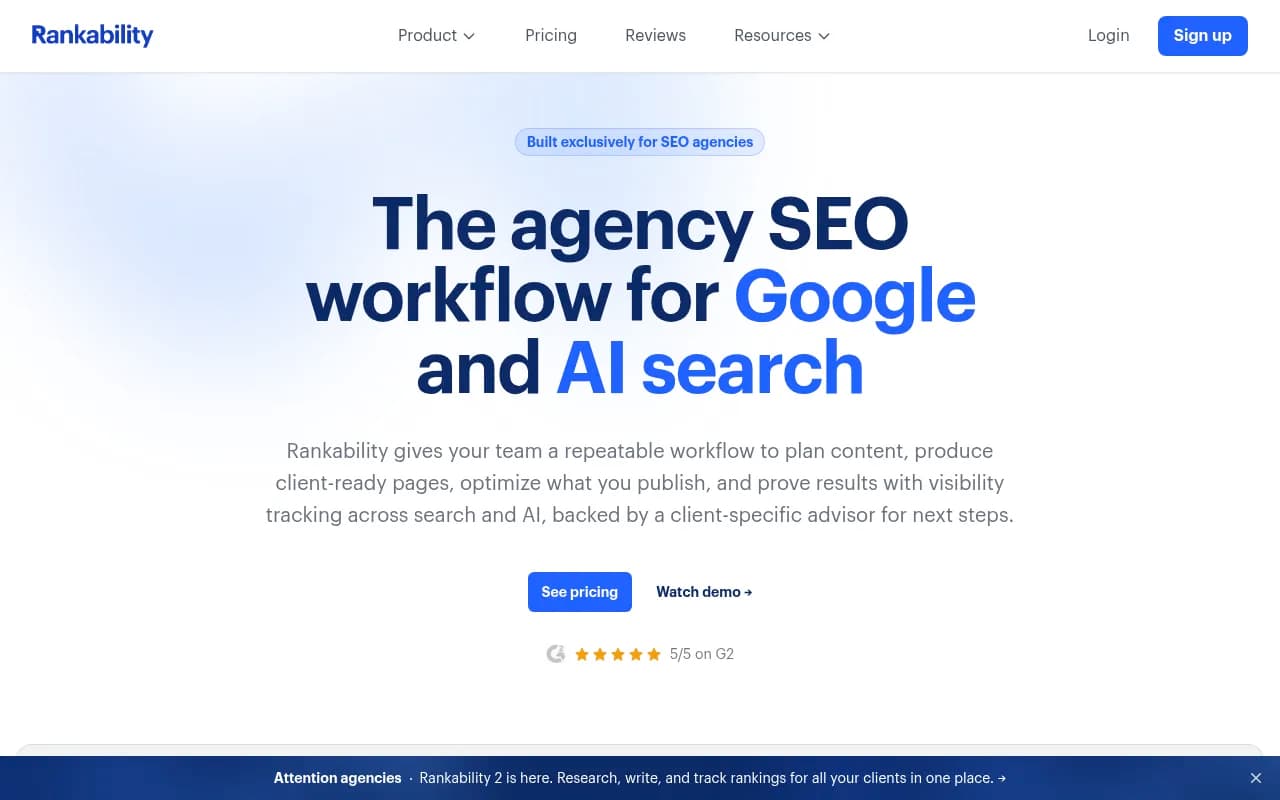
The AI visibility side covers ChatGPT, Perplexity, Gemini, and Claude. Rankability tracks brand mentions, share of voice, and citation sources. The content tools help with brief creation and optimization, though they're more SEO-oriented than AI-native -- the briefs are built around search intent and NLP analysis rather than prompt gap data from AI models.
For an agency that's managing both traditional SEO and AI visibility for clients, Rankability's unified reporting is genuinely useful. You can show clients a single dashboard covering both channels, which simplifies reporting conversations.
The gap compared to Promptwatch is on the action side. Rankability's content tools are solid for traditional SEO content, but there's no equivalent to Promptwatch's Answer Gap Analysis (which identifies specific prompts competitors rank for in AI answers) or the AI Content Agents that generate content specifically engineered to fill those gaps. The crawler log analysis is also absent.
If your agency's primary deliverable is AI visibility optimization -- not just reporting -- Rankability gets you partway there but not all the way.
SE Visible
SE Visible is SE Ranking's dedicated AI visibility product, spun out as a separate tool from the main SE Ranking platform. It tracks brand mentions and sentiment across ChatGPT, Perplexity, Gemini, Copilot, and Grok, with a reasonably clean interface for monitoring share of voice and citation trends.
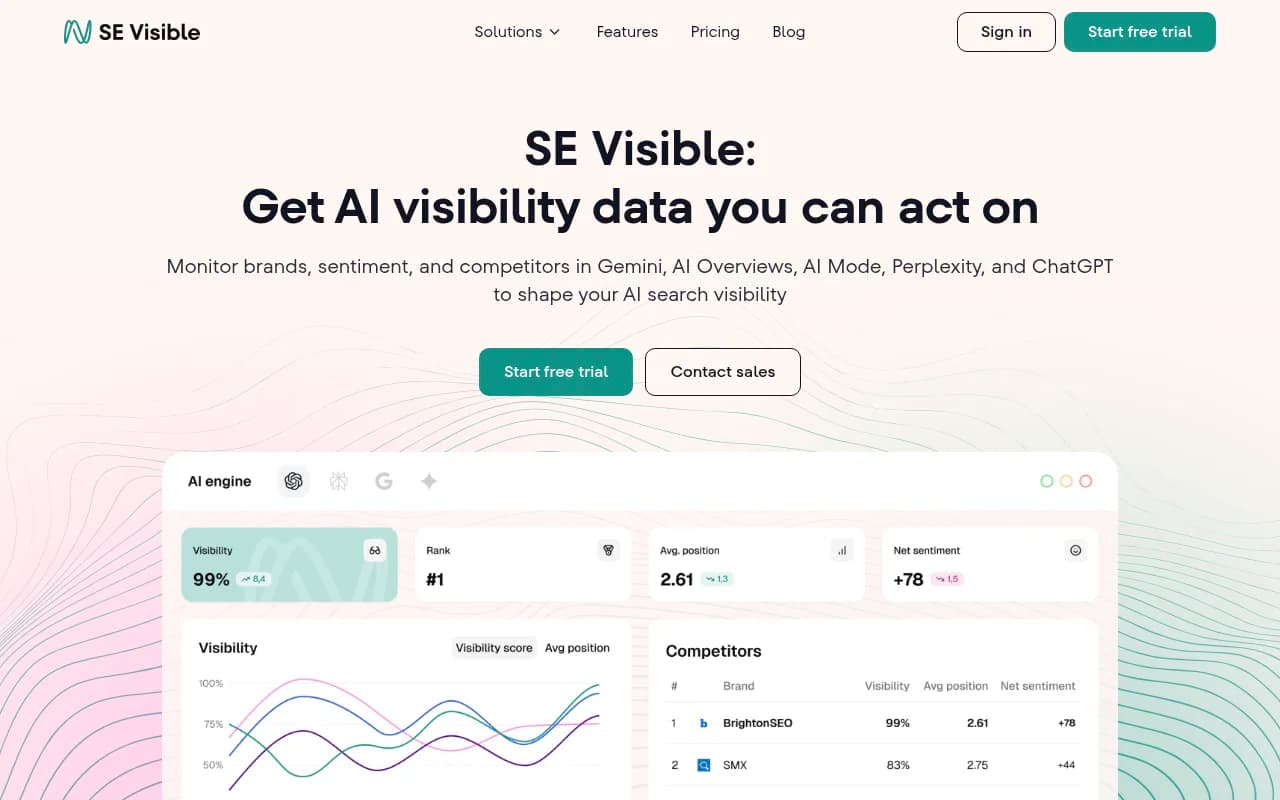
The positioning is as an affordable entry point into AI visibility tracking. Starting around $49/mo, it's accessible for smaller teams or individuals who want to understand their AI presence without a major budget commitment.
The limitations are significant for anyone who wants to do more than monitor. SE Visible is a pure monitoring tool -- no content generation, no gap analysis, no crawler logs, no prompt volume data. It tells you where you stand but offers no path to improving it. The model coverage is narrower than Promptwatch, and there's no Reddit or YouTube tracking, no ChatGPT Shopping monitoring, and no page-level citation attribution.
SE Visible makes sense as a starting point or for teams that genuinely only need monitoring data and have a separate content workflow. For anyone who wants to actually improve their AI visibility, it's a data source, not a solution.
Head-to-head: what each platform does (and doesn't do)
| Feature | Promptwatch | Profound | Morningscore | Rankability | SE Visible |
|---|---|---|---|---|---|
| AI model coverage | 10+ | 5 | Limited | 4 | 5 |
| Answer gap analysis | Yes | Partial | No | No | No |
| AI content generation | Yes | No | No | No | No |
| Crawler / agent logs | Yes | No | No | No | No |
| Prompt volume data | Yes | No | No | No | No |
| Reddit & YouTube tracking | Yes | No | No | No | No |
| ChatGPT Shopping tracking | Yes | No | No | No | No |
| Page-level citation tracking | Yes | Yes | No | Partial | No |
| Traditional SEO tools | No | No | Yes | Yes | Partial |
| Agency multi-site support | Yes | Yes | No | Yes | No |
| Starting price | $99/mo | ~$500+/mo | ~$49/mo | ~$99/mo | ~$49/mo |
Which platform should you choose?
The answer depends on what you actually need.
If AI visibility is your primary concern and you want to do something about it -- not just report on it -- Promptwatch is the clearest choice. The gap analysis and content generation tools are what separate it from every other platform here. It's also the only one with crawler logs, which matter more than most people realize when you're trying to understand why AI models aren't citing your content.
If you're an enterprise brand with a large internal team that can turn monitoring data into content strategy, Profound's depth of monitoring data is worth considering. Just go in knowing you'll need to build the content workflow yourself.
If you're an agency managing both traditional SEO and AI visibility for clients, Rankability's unified reporting is genuinely useful, especially if you're not yet ready to go deep on AI-native content optimization.
If you're already using Morningscore for traditional SEO and want a basic AI visibility signal without adding another tool, the built-in monitoring is a reasonable starting point. Don't expect it to compete with dedicated platforms.
If you need the cheapest possible entry into AI visibility monitoring and have no immediate need for optimization, SE Visible gets you basic data at a low cost.
The monitoring-only trap
One pattern worth naming directly: most of the tools in this comparison are monitoring dashboards. They show you data. They tell you your brand appeared in 12% of relevant AI responses last month, and your top competitor appeared in 34%. That's useful to know.
But knowing the gap and closing the gap are different problems. The platforms that only monitor leave you with a dashboard and a to-do list. You still have to figure out which content to create, brief it, write it, publish it, and then check back in a month to see if it moved the needle.
Promptwatch's design philosophy is different. The Answer Gap Analysis connects directly to content generation, and the content generation connects directly to citation tracking. The loop is closed inside the platform. That's not a feature -- it's a fundamentally different approach to the problem.
Whether that matters to you depends on your team's capacity. A large content team with strong editorial processes might prefer to own that workflow themselves and just use a monitoring tool for data. A leaner team, or one that's new to GEO, will find the integrated approach much faster to act on.
A note on traditional SEO vs AI visibility
Morningscore and Rankability both straddle traditional SEO and AI visibility. That's worth thinking about carefully before you choose.
Traditional SEO (keyword rankings, backlinks, site health) and AI visibility (brand mentions in LLM responses) are related but not the same. Content that ranks well in Google doesn't automatically get cited by ChatGPT. The factors that drive AI citations -- structured answers, authoritative sourcing, topical completeness -- overlap with SEO best practices but aren't identical.
A platform that does both isn't necessarily better than two specialized tools. It depends on whether the AI visibility features are genuinely deep or just a checkbox. In Morningscore's case, the AI features are thin. In Rankability's case, they're more developed but still secondary to the traditional SEO core.
If AI visibility is where you're investing in 2026, a dedicated platform will almost always outperform a hybrid tool on the features that matter most.
Bottom line
The five platforms here represent a spectrum from "traditional SEO tool with AI monitoring added" to "AI visibility platform with content optimization built in." Where you land on that spectrum should match where your team's priorities are.
For most marketing teams in 2026 -- where AI search is already driving meaningful traffic and the question is how to capture more of it -- the platforms that stop at monitoring are becoming harder to justify. The data is only useful if you can act on it, and acting on it requires either a very capable internal team or a platform that helps you do it.
That's the gap Promptwatch is built to fill, and it's why it sits at one end of this comparison while SE Visible sits at the other.