Key takeaways
- Omnia monitors four AI platforms (ChatGPT, Perplexity, Google AI Overviews, Google AI Mode) -- useful for getting started, but limited for enterprise-scale needs
- Most alternatives fall into two camps: monitoring-only dashboards vs. full-stack platforms that also help you fix visibility gaps
- Promptwatch is the only platform in this comparison rated as a "Leader" across all evaluation categories, covering 10+ AI models with built-in content generation and crawler log analysis
- Evertune and Profound are strong enterprise options but lean heavily toward analytics without closing the content loop
- Relixir is worth considering if you want an all-in-one GEO platform with content generation baked in from the start
If you've been using Omnia and started wondering whether it's the right fit for a larger team, you're not alone. Omnia does what it says: it tracks your brand's presence across ChatGPT, Perplexity, Google AI Overviews, and Google AI Mode. For small teams getting their first look at AI search visibility, that's genuinely useful.
But enterprise teams tend to hit the same wall. Four platforms isn't enough when your customers are using Claude, Gemini, Grok, DeepSeek, and Copilot. There's no crawler log analysis to understand how AI agents are actually reading your site. And when you find a gap, Omnia doesn't help you close it -- you're on your own for content strategy and execution.
This guide compares the strongest alternatives across the criteria that matter most for enterprise use: AI model coverage, content generation, prompt intelligence, crawler analytics, and whether the platform actually helps you act on what it finds.
What enterprise teams actually need from a GEO platform
Before getting into the tools, it's worth being clear about what separates a monitoring dashboard from a platform that moves the needle.
Enterprise teams generally need:
- Coverage across at least 6-8 AI models, not just the obvious four
- Prompt-level data: which queries is your brand winning, which are you losing, and to whom
- Content gap analysis that connects visibility gaps to specific missing pages or topics
- Crawler logs that show how AI agents interact with your site (and where they hit errors)
- Multi-region and multi-language support for global brands
- Traffic attribution that connects AI citations to actual revenue
- Agency or multi-seat access for larger teams
Omnia covers some of this. Most monitoring-only tools cover a fraction of it. The platforms below cover most or all of it -- with meaningful differences in how they approach the "fix it" side of the equation.
The tools compared
Promptwatch
Promptwatch is the most complete platform in this comparison. It monitors 10+ AI models (ChatGPT, Perplexity, Claude, Gemini, Grok, DeepSeek, Copilot, Mistral, Meta AI, Google AI Overviews, and Google AI Mode), which already puts it ahead of Omnia's four-platform scope.
What separates Promptwatch from most competitors isn't the monitoring -- it's what happens after you find a gap. The Answer Gap Analysis shows you exactly which prompts competitors are visible for but you aren't. Content Agents then generate articles, listicles, and comparisons grounded in that prompt data, so you're not producing generic filler but content engineered to answer the specific questions AI models are already exposing.
The crawler log feature is something most platforms don't offer at all. You can see which AI agents (ChatGPT, Claude, Perplexity) are hitting your site, which pages they're reading, what errors they encounter, and when a page moves from crawled to cited. That's genuinely useful for diagnosing why content you've published isn't getting picked up.
Other notable capabilities: Reddit and YouTube citation tracking (which surfaces discussions that directly influence AI recommendations), ChatGPT Shopping tracking, multi-language and multi-region monitoring, and traffic attribution that connects AI visibility to revenue.
Pricing starts at $99/month for the Essential plan (1 site, 50 prompts, 5 articles), $249/month for Professional (2 sites, 150 prompts, 15 articles, crawler logs), and $579/month for Business (5 sites, 350 prompts, 30 articles). Agency and enterprise pricing is available on request.

Evertune
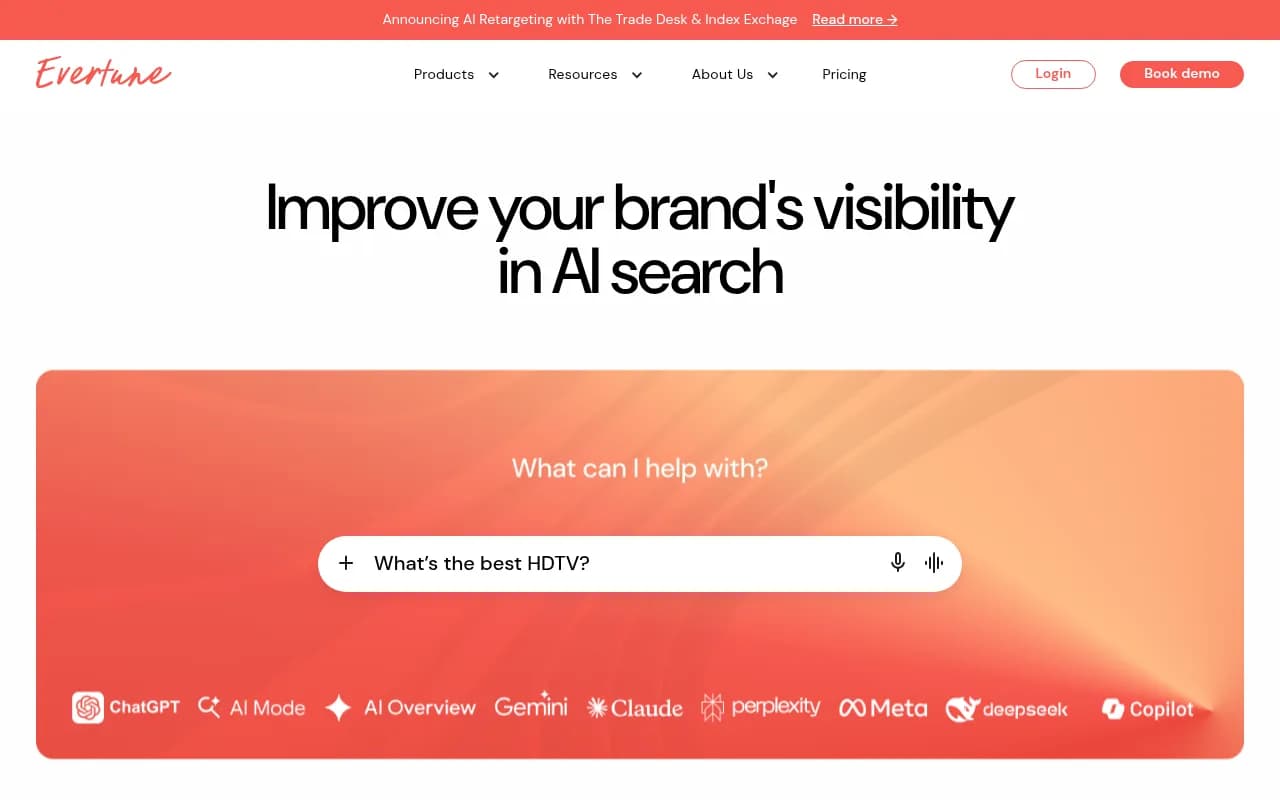
Evertune positions itself as an enterprise GEO platform trusted by Fortune 500 brands. Its strength is analytics depth -- it provides detailed breakdowns of how your brand appears across AI models, with competitive benchmarking and sentiment analysis built in.
The platform covers more AI models than Omnia and has solid multi-region support. Where it falls short for some enterprise teams is the content side: Evertune is primarily an analytics and monitoring tool. It tells you where you're losing visibility, but the path from insight to published content requires you to take that data somewhere else.
For teams that have a separate content operation and just need strong visibility intelligence, Evertune is a serious option. For teams that want the full loop in one platform, it's a partial solution.
Profound
Profound is one of the more established names in enterprise AI visibility. It has strong analytics, compliance-oriented reporting features (useful for regulated industries), and real-time monitoring across multiple AI platforms.
The honest critique: Profound costs significantly more than most alternatives -- one analysis put it at 48% above market rate -- and several key features are locked behind enterprise pricing tiers. More importantly, like Evertune, it's a monitoring platform. It shows you the gaps but doesn't help you fill them.
If your team has budget flexibility and needs enterprise-grade analytics with compliance reporting, Profound is worth evaluating. If you need content generation alongside visibility tracking, you'll need to pair it with something else.
Relixir
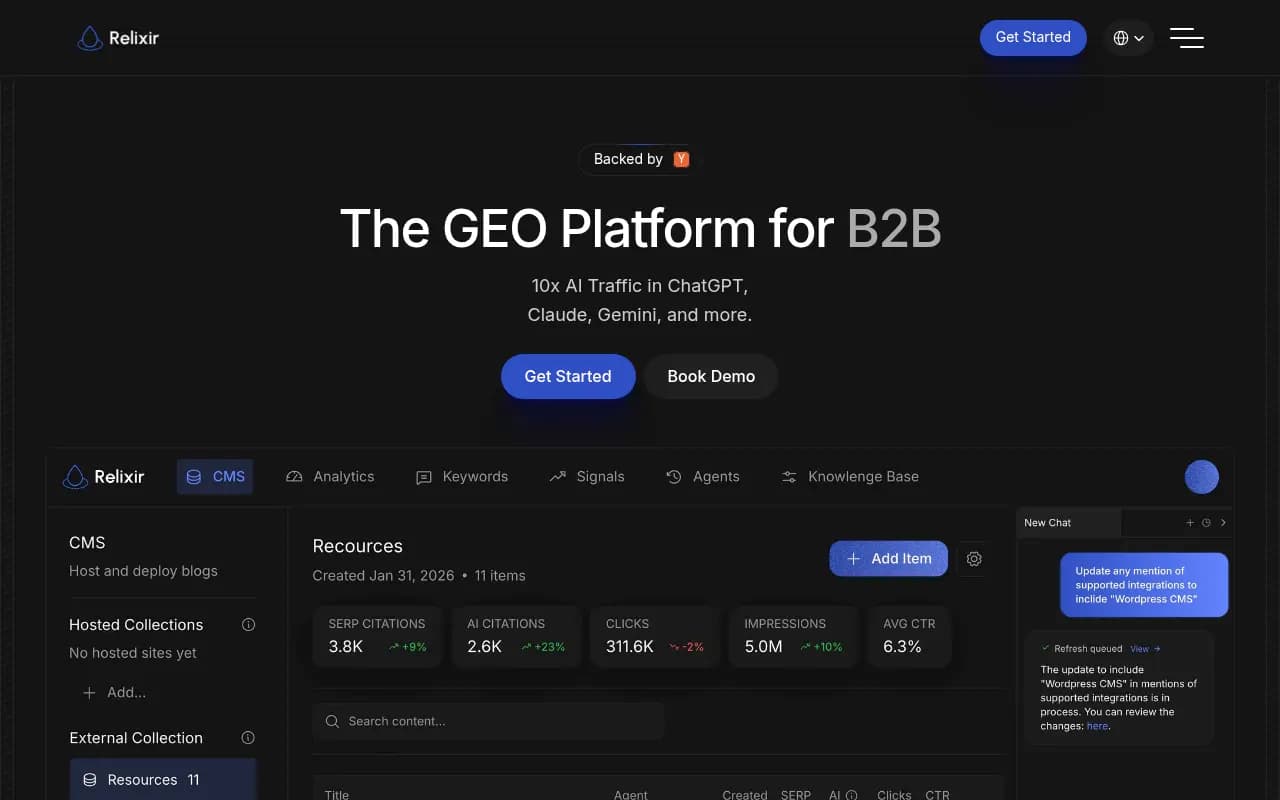
Relixir takes a different approach: it's built as an all-in-one GEO platform with content generation integrated from the start. You get visibility tracking, gap analysis, and AI content generation in a single workflow, which reduces the friction of moving between tools.
It's a newer platform compared to Profound or Evertune, so the analytics depth isn't quite at the same level. But for enterprise teams that are just building out their GEO practice and want a platform that handles both the "what's missing" and "here's what to publish" questions, Relixir is worth a serious look.
Scrunch AI
Scrunch AI focuses on enterprise analytics and has a reputation for strong competitive benchmarking. It covers 6+ AI models and provides detailed breakdowns of how brands appear in AI-generated responses.
The platform is analytics-heavy and works well for teams that need to report AI visibility metrics to leadership. Content generation isn't part of the offering, and prompt volume data is less granular than what you'd get from Promptwatch or Profound.
Athena HQ
Athena HQ covers 8+ AI search engines and has a clean interface that makes it accessible for teams that aren't deep in the GEO weeds yet. It's monitoring-focused, with competitive comparison features that help you see where rivals are outperforming you.
The gap is the same as most monitoring tools: it surfaces problems without providing a path to fix them. For enterprise teams that need content optimization and generation alongside tracking, Athena HQ is a starting point rather than a complete solution.

Bluefish AI
Bluefish AI is positioned as an enterprise GEO platform with a focus on large-scale brand monitoring. It handles multi-location and multi-brand tracking well, which makes it relevant for enterprise teams managing complex brand portfolios.
Coverage and content generation capabilities are more limited than Promptwatch, but if your primary need is monitoring at scale across a large brand structure, it's worth evaluating.
Brandlight.ai
Brandlight.ai focuses on brand perception in AI responses -- not just whether you're mentioned, but how you're described. For enterprise teams where brand safety and narrative control matter as much as raw visibility, this is a useful angle.
It's a narrower tool than the others on this list, but it fills a specific gap that pure visibility trackers don't address.
Side-by-side comparison
| Platform | AI models covered | Content generation | Crawler logs | Prompt intelligence | Reddit/YouTube tracking | Starting price |
|---|---|---|---|---|---|---|
| Promptwatch | 10+ | Yes (Content Agents) | Yes | Yes (volume + difficulty) | Yes | $99/mo |
| Omnia | 4 | No | No | Limited | No | Not public |
| Evertune | 6+ | No | No | Partial | No | Enterprise |
| Profound | 5+ | No | No | Yes | No | Enterprise (high) |
| Relixir | 5+ | Yes | Partial | Partial | No | Not public |
| Scrunch AI | 6+ | No | No | Partial | No | Enterprise |
| Athena HQ | 8+ | No | No | Limited | No | Not public |
| Bluefish AI | 5+ | No | No | Limited | No | Enterprise |
| Brandlight.ai | 4+ | No | No | No | No | Not public |
How to choose
The right tool depends on what your team actually needs to do, not just what looks good in a feature matrix.
If you're running a monitoring-only use case -- you have a separate content team and just need reliable data on AI visibility -- Profound or Evertune are defensible choices. They're expensive, but the analytics are solid.
If you need the full loop (find gaps, generate content, track results) in one platform, Promptwatch is the clearest option. The combination of 10+ model coverage, Answer Gap Analysis, Content Agents, and crawler logs isn't matched by any other platform in this comparison. It's also the most accessible price point for the feature set.
If you're a smaller enterprise team or just starting to build a GEO practice, Relixir is worth testing. The integrated content generation makes it easier to get started without needing to connect multiple tools.
If brand perception and narrative control are your primary concern alongside visibility, Brandlight.ai fills a niche that the other platforms don't prioritize.
One thing worth being direct about: Omnia is a reasonable starting point, but it's not built for enterprise scale. Four AI platforms, no content generation, no crawler logs -- it works for early-stage monitoring, but teams that are serious about AI search visibility will outgrow it quickly.
A quick note on what "enterprise-ready" actually means
A lot of platforms use "enterprise" as a marketing label. In practice, enterprise-ready for GEO means a few specific things:
- Multi-seat access with role-based permissions
- API access for custom reporting and data pipelines
- Multi-region and multi-language monitoring
- SSO and security compliance
- Dedicated support or a customer success manager
- SLA guarantees on data freshness
Of the platforms in this comparison, Promptwatch, Profound, Evertune, and Scrunch AI all offer enterprise tiers with most of these features. Relixir and Athena HQ are building toward this but aren't fully there yet.
If any of those requirements are non-negotiable for your procurement process, make sure to verify them directly with each vendor before committing to a trial.
Bottom line
The GEO platform market has matured enough in 2026 that the monitoring-vs-optimization divide is the most important distinction to make. Most tools show you data. Fewer help you act on it.
For enterprise teams replacing or upgrading from Omnia, the evaluation should start with two questions: how many AI models do you need to cover, and do you need content generation built in? If the answer to both is "yes," Promptwatch is the most complete option available. If you only need the analytics side, Profound or Evertune are worth the evaluation time -- just go in knowing you'll need a separate content workflow.