Key takeaways
- Getting cited by AI search engines (ChatGPT, Perplexity, Claude, Google AI Overviews) is now a distinct discipline from traditional SEO -- and most content tools weren't built for it.
- Profound, Surfer SEO, Outranking, and Junia AI each solve one piece of the puzzle: monitoring, on-page optimization, or content generation. None close the full loop from gap to published content to tracked citation.
- Promptwatch is the only platform in this comparison that combines AI visibility monitoring, content gap analysis, AI-powered content generation grounded in real prompt data, and crawler log analytics in one place.
- If your goal is to appear in AI answers -- not just rank on Google -- you need a platform built around that goal from the start, not one that bolted on "AI features" to an SEO tool.
- For teams that only need traditional SEO content optimization, Surfer SEO and Outranking remain solid choices. For AI citation visibility, the gap between those tools and Promptwatch is significant.
The question used to be simple: does this content rank on Google? In 2026, that's no longer enough. AI search engines now handle a meaningful share of product discovery, research, and purchase decisions. Perplexity, ChatGPT, Claude, Google AI Mode, and Gemini all synthesize answers and cite sources -- and the sources they cite get traffic, trust, and conversions that never show up in traditional rank trackers.
So the new question is: does your content actually get cited?
This comparison looks at five platforms -- Profound, Promptwatch, Junia AI, Outranking, and Surfer SEO -- through that specific lens. Not which one writes the prettiest prose or has the most keyword data, but which one gives you the best shot at showing up when an AI engine answers a question your customer just asked.
What "getting cited" actually requires
Before comparing tools, it helps to understand why AI citation is different from traditional ranking.
Google's algorithm rewards pages based on signals like backlinks, authority, and on-page optimization. AI engines work differently. They synthesize information from multiple sources and cite the ones that most directly and clearly answer the question being asked. A few things matter a lot:
- Does your content exist at all for the specific question the AI is processing?
- Is it structured in a way that's easy for the AI to extract and quote?
- Has the AI crawler actually visited your page recently?
- Are you being cited for the right entity (your brand, product, or category)?
Traditional SEO tools were built to optimize for Google's signals. That's useful, but it's not the same as optimizing for AI citation. A page can rank on page one of Google and never appear in a single AI answer -- and vice versa.
The five platforms, honestly assessed
Profound
Profound is the most established pure-play AI visibility monitoring tool in this comparison. It tracks how your brand appears across AI engines, shows you which prompts you're visible for, and gives you competitive benchmarking.
The honest limitation: Profound is a monitoring tool. It shows you where you're invisible, but it doesn't help you fix it. There's no content generation, no content brief creation, no crawler log analysis. You get the data, then you're on your own to act on it.
ContentMonk's analysis found Profound costs 48% more than comparable alternatives, with key features locked behind enterprise pricing. For a tool that only covers one part of the AI visibility loop, that's a hard sell for most marketing teams.
Where Profound genuinely excels is enterprise-grade data quality and the depth of its prompt analytics. If you're a large brand that already has a content team and just needs the monitoring layer, it's a capable tool. But for teams that need to move from insight to published content, it leaves a gap.
Promptwatch

Promptwatch is built around a different premise: monitoring alone doesn't improve your AI visibility. You need to find the gaps, create content that fills them, and track whether that content gets cited. That full loop -- in one platform -- is what separates it from every other tool in this comparison.
The core workflow looks like this: Answer Gap Analysis shows you exactly which prompts your competitors appear for but you don't. Content Agents then generate articles, listicles, and briefs grounded in that real prompt data -- not generic SEO filler. And once content is published, AI Crawler Logs show you when ChatGPT, Claude, or Perplexity actually visits your pages, and page-level tracking shows when those visits turn into citations.
That last piece -- the crawler logs -- is something most competitors don't have at all. Knowing that an AI engine crawled your page on Tuesday and started citing it by Thursday is genuinely useful. It tells you what's working and why.
Promptwatch also tracks Reddit discussions and YouTube content that influence AI recommendations, ChatGPT Shopping appearances, and multi-region/multi-language visibility. The platform monitors 10 AI models: ChatGPT, Perplexity, Claude, Gemini, Google AI Overviews, Google AI Mode, Grok, DeepSeek, Copilot, and Mistral.
Pricing starts at $99/month for the Essential plan (1 site, 50 prompts, 5 articles), with Professional at $249/month and Business at $579/month. A free trial is available.
For teams whose primary goal is AI citation visibility, Promptwatch is the most complete option in this comparison by a meaningful margin.
Surfer SEO
Surfer SEO is a mature, well-regarded content optimization platform. Its core product -- the Content Editor -- analyzes top-ranking pages for a keyword and tells you which terms, headings, and structures to include to compete. It's genuinely useful for traditional SEO content.
The AI angle is where things get complicated. Surfer has added AI writing features, and its optimization data is solid. But it's fundamentally built around Google ranking signals: NLP terms, word counts, heading structures that correlate with page-one rankings.
That's not the same as optimizing for AI citation. Surfer doesn't track whether your content appears in ChatGPT answers. It doesn't show you which prompts your competitors are being cited for. It doesn't have crawler logs for AI engines. It can help you write well-optimized content, but it can't tell you whether that content is actually being cited by AI.
If your content strategy is still primarily Google-focused, Surfer is a solid tool. If AI visibility is the goal, it's a partial solution at best.
Outranking
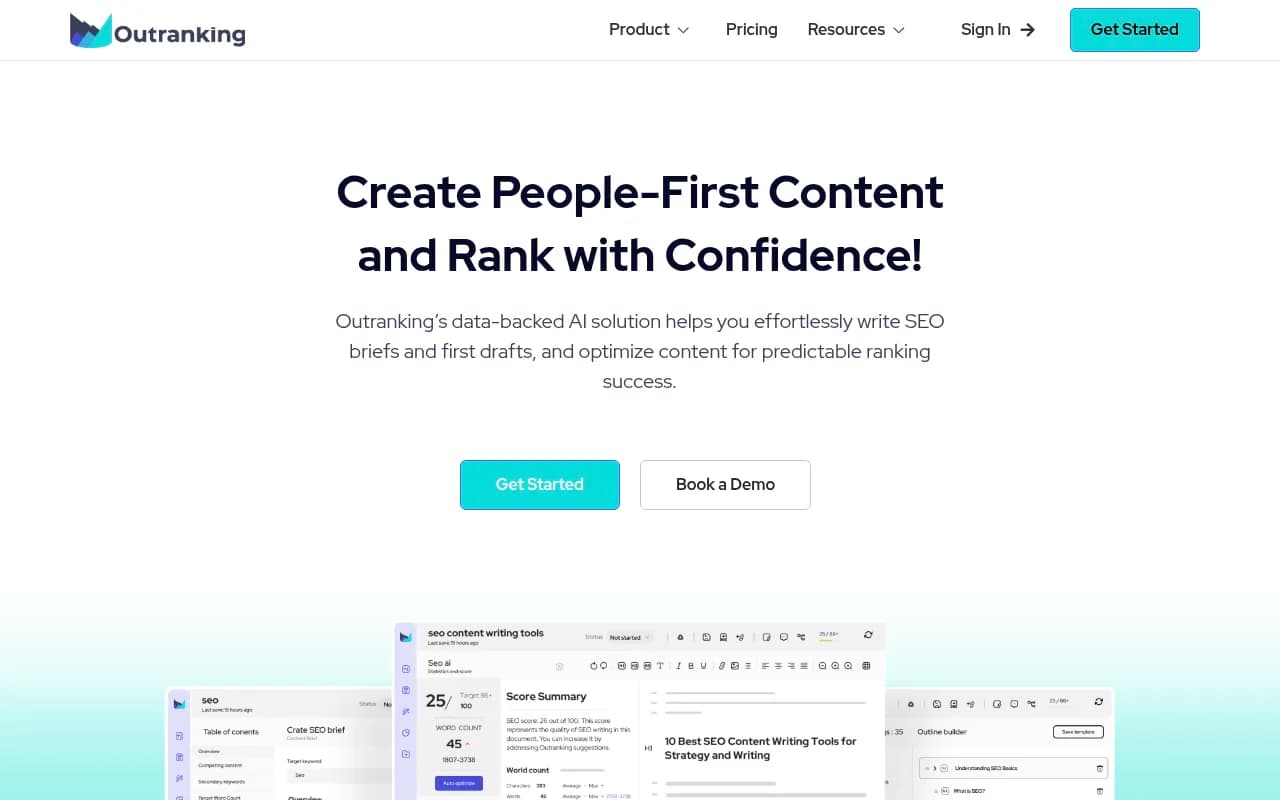
Outranking sits in a similar category to Surfer -- an AI-assisted content creation and optimization platform with a focus on SEO. It has a more automated workflow than Surfer, with features for content planning, brief generation, and drafting.
The platform has added some AI search features, but like Surfer, its core architecture is built around traditional search. It optimizes for Google ranking factors. It doesn't monitor AI engine citations, doesn't track prompt visibility, and doesn't have the infrastructure to show you what AI crawlers are doing on your site.
Outranking is a reasonable choice if you need an automated content production workflow for SEO. For AI citation optimization specifically, it's not designed for that use case.
Junia AI
Junia AI is an AI writing tool with SEO features, positioned as a content generation platform. It can produce long-form articles, optimize for keywords, and integrate with some SEO data sources.
The honest assessment: Junia AI is a writing tool, not an AI visibility platform. It doesn't monitor AI citations, doesn't track prompt visibility, doesn't have crawler logs, and doesn't analyze where competitors are appearing in AI answers. It can help you produce content faster, but it has no mechanism to tell you whether that content is being cited by AI engines or what you should be writing to improve your chances.
For teams that need pure content production volume, it's a functional option. For AI citation optimization, it's the wrong category of tool.
Feature comparison
| Feature | Profound | Promptwatch | Surfer SEO | Outranking | Junia AI |
|---|---|---|---|---|---|
| AI citation monitoring | Yes | Yes | No | No | No |
| Prompt gap analysis | Partial | Yes | No | No | No |
| Content generation | No | Yes | Yes | Yes | Yes |
| Content briefs from AI data | No | Yes | Partial | Partial | No |
| AI crawler logs | No | Yes | No | No | No |
| Page-level citation tracking | No | Yes | No | No | No |
| Reddit/YouTube insights | No | Yes | No | No | No |
| ChatGPT Shopping tracking | No | Yes | No | No | No |
| Multi-model coverage | Yes | Yes (10 models) | No | No | No |
| Traffic attribution from AI | No | Yes | No | No | No |
| Traditional SEO optimization | No | Partial | Yes | Yes | Partial |
| Free trial | Yes | Yes | Yes | Yes | Yes |
| Starting price | ~$99/mo | $99/mo | $89/mo | $79/mo | $69/mo |
The real question: what are you actually trying to do?
This comparison is really about two different goals, and the right tool depends on which one you're chasing.
If your goal is to rank on Google and produce SEO-optimized content efficiently, Surfer SEO and Outranking are well-built tools for that. They have years of data, solid workflows, and large user bases. They're not going away, and traditional Google SEO still matters.
But if your goal is to appear in AI answers -- to be the source ChatGPT cites when someone asks about your category, to show up in Perplexity's recommendations, to be visible in Google AI Overviews -- you need a different kind of tool. One that understands how AI engines discover content, what prompts they're responding to, and whether your pages are actually being crawled and cited.
That's a fundamentally different problem, and it requires a platform built to solve it.

Who should use what
Use Promptwatch if:
- AI citation visibility is your primary goal
- You want to find gaps, create content to fill them, and track whether it works -- all in one platform
- You're monitoring multiple AI engines and need to understand which prompts drive visibility
- You need crawler log data to understand how AI engines are interacting with your site
- You're managing multiple markets, languages, or personas
Use Profound if:
- You're a large enterprise that needs deep monitoring data and already has a separate content team
- You want best-in-class prompt analytics and competitive benchmarking
- Budget isn't a constraint and you're comfortable handling content creation separately
Use Surfer SEO if:
- Traditional Google SEO is your primary channel
- You need a mature content editor with strong NLP-based optimization
- You're not yet focused on AI citation visibility
Use Outranking if:
- You need automated content production workflows for SEO
- You want AI-assisted drafting with SEO optimization baked in
- Traditional search is your main focus
Use Junia AI if:
- You need high-volume content generation
- SEO is secondary to content production speed
- You're not focused on AI citation tracking
The gap that matters most in 2026
The research is consistent across multiple independent analyses: the biggest problem with monitoring-only platforms isn't the data quality -- it's that they stop at the insight. You can see that you're invisible for a set of prompts. You can see that a competitor is being cited and you're not. But the platform doesn't help you do anything about it.
That gap -- between knowing you have a problem and being able to fix it -- is exactly what separates the tools in this comparison. Profound, Surfer, Outranking, and Junia AI each solve one piece. Promptwatch is built to close the loop.
For most marketing and SEO teams in 2026, the question isn't whether to care about AI visibility. It's which tool actually helps you improve it.
A note on content quality vs. citation probability
One thing worth saying directly: AI citation isn't just about having the right keywords or the right structure. AI engines tend to cite content that is specific, well-sourced, and directly answers the question being asked. Generic content -- even well-optimized generic content -- tends to get passed over in favor of pages that give a clear, direct answer.
This is why the content generation approach matters. Tools like Surfer and Outranking optimize for ranking signals. Promptwatch's Content Agents generate content grounded in real prompt data -- the actual questions AI engines are processing -- which means the output is more likely to match what the AI is looking for when it selects sources to cite.
It's a subtle difference but a meaningful one. Writing content that ranks on Google and writing content that gets cited by AI engines are related skills, but they're not identical. The platforms that understand that distinction are the ones worth using in 2026.