Key takeaways
- Yext, Uberall, and SOCi were built for local listings and reputation management — they're adding AI features, but AI search visibility is not their core competency.
- Profound is a strong enterprise monitoring tool, but it stays in the "track and report" lane without helping you create or optimize content.
- Promptwatch is the only platform in this comparison that covers the full loop: find gaps, generate content, track results — plus crawler logs, ChatGPT Shopping, and page-level citation tracking.
- If your primary need is listings management across hundreds of locations, Yext or Uberall still make sense. If AI search visibility is a strategic priority, you need a dedicated GEO platform alongside them.
- Multi-location brands face a specific challenge: AI models often cite a single authoritative source per category, not individual location pages. The brand-level content strategy matters more than most teams realize.
Multi-location enterprise brands have a problem that single-brand companies don't. When someone asks ChatGPT "best hotel near downtown Austin" or Perplexity "which insurance broker should I use in Chicago," the AI doesn't pull up a location page. It synthesizes sources — review sites, editorial content, brand pages, Reddit threads — and produces a recommendation. Your 400 location pages may be completely invisible to that process.
That's the gap this comparison is really about. Not just "which tool tracks AI mentions" but "which platform actually helps a brand with dozens or hundreds of locations build and maintain AI search visibility at scale."
The five platforms in this comparison approach that problem from very different angles.
What each platform was actually built for
Before comparing features, it's worth being honest about origins. These tools come from different worlds.
Yext and Uberall started as local listings management platforms. Their core value is keeping your NAP (name, address, phone) data consistent across Google Business Profile, Apple Maps, Yelp, and hundreds of other directories. SOCi is a localized social media and reputation management platform. All three have added AI-related features in 2025-2026, but AI search visibility is a layer on top of their existing architecture, not the foundation.
Profound is a purpose-built AI visibility platform aimed at enterprise teams. It tracks brand mentions across AI engines, surfaces prompt data, and gives marketing teams a reporting layer for AI search performance.
Promptwatch is also purpose-built for AI visibility, but with a different philosophy. Where Profound focuses on monitoring and reporting, Promptwatch is built around taking action — finding content gaps, generating content to fill them, and tracking whether that content gets cited.
This distinction matters a lot for multi-location brands, because the problem isn't just "are we being mentioned?" It's "why aren't we being mentioned, and what do we do about it?"
Platform-by-platform breakdown
Profound
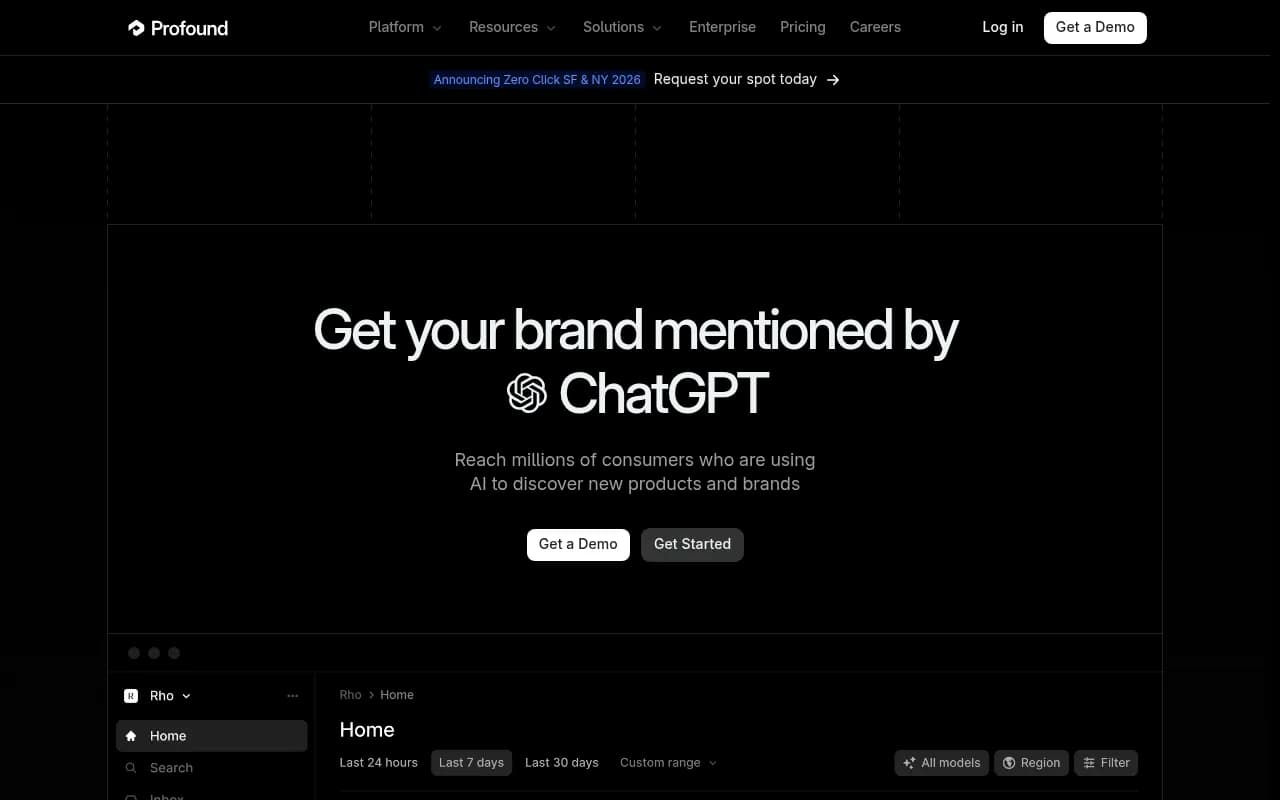
Profound tracks up to 10 AI engines on its Enterprise plan, including ChatGPT, Perplexity, Google AI Overviews, Google AI Mode, Gemini, and Microsoft Copilot. Its prompt research tools are genuinely strong — you can map which prompts competitors appear in, track share of voice over time, and get sentiment breakdowns.
For enterprise brands, Profound's depth of monitoring is a real asset. The reporting is clean, the data is credible, and it integrates into existing marketing workflows reasonably well. It also recently shipped autonomous Agents and MCP integration, which signals ambition beyond pure monitoring.
The limitation is that Profound stops at the insight layer. It tells you where you're invisible. It doesn't help you fix it. There's no content generation, no crawler log analysis, no page-level citation tracking. For a brand that wants to move from "we see the problem" to "we solved it," Profound requires a separate content workflow and a separate set of tools.
Pricing starts at $99/month, with enterprise plans at custom pricing.
Promptwatch

Promptwatch covers 10 AI models — ChatGPT, Perplexity, Google AI Overviews, Google AI Mode, Claude, Gemini, Meta/Llama, DeepSeek, Grok, and Mistral — and tracks real user-facing behavior, not just API outputs. That distinction matters because what users actually see in ChatGPT's interface can differ from what the API returns.
What separates Promptwatch from every other tool in this comparison is the action loop. Answer Gap Analysis shows exactly which prompts competitors rank for that you don't. Content Agents then generate articles, listicles, and comparison pages grounded in that prompt data — not generic SEO content, but material engineered to answer the specific questions AI models are already surfacing. Then page-level tracking shows which of your pages are being cited, by which models, and how often.
For multi-location brands specifically, Promptwatch's crawler logs are particularly valuable. You can see which AI crawlers (ChatGPT's bot, Perplexity's crawler, Claude's agent) are hitting your site, which pages they're reading, and whether those pages are actually making it into citations. Most multi-location brands discover their location pages are being crawled but not cited — and the logs show exactly why.
Other features that matter for enterprise brands: offsite citation analysis (which Reddit threads, YouTube videos, and third-party pages are driving AI visibility), ChatGPT Shopping tracking, competitor heatmaps, multi-language and multi-region monitoring, and a Looker Studio integration for custom reporting.
Pricing: Essential $99/mo (1 site, 50 prompts), Professional $249/mo (2 sites, 150 prompts, crawler logs), Business $579/mo (5 sites, 350 prompts). Agency and enterprise pricing available.
Yext
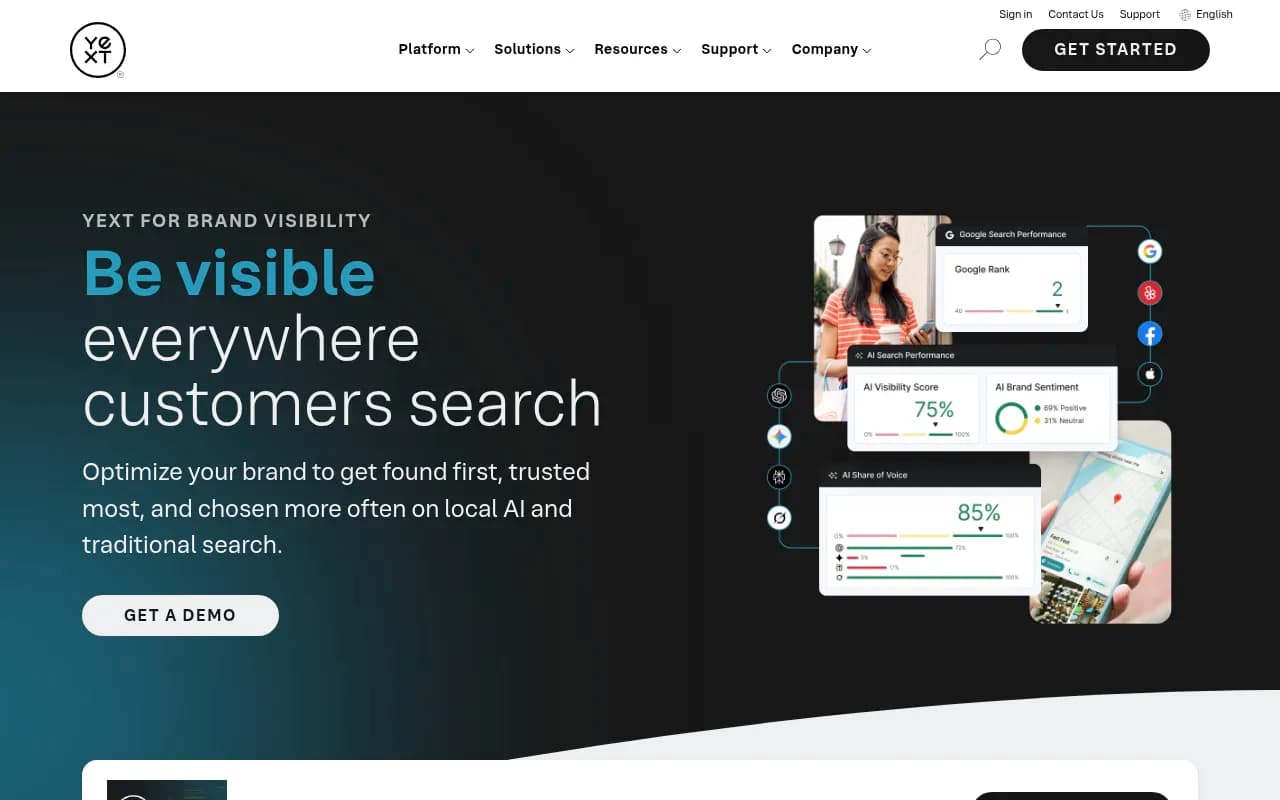
Yext's core product is listings management at scale. For a brand with 500 locations, Yext is genuinely excellent at keeping business data accurate across 200+ publishers, managing reviews, and syncing structured data. Its Knowledge Graph architecture means changes propagate quickly and consistently.
In 2025-2026, Yext has leaned into "AI-ready" positioning, arguing that accurate structured data is the foundation for AI visibility. That's not wrong — AI models do pull from structured sources, and clean NAP data helps. Yext also has features for managing your brand's presence in AI-generated answers, though these are more about data accuracy than active optimization.
What Yext doesn't do: it doesn't track your brand's actual visibility in AI-generated responses, it doesn't identify content gaps, and it doesn't generate content. It's infrastructure, not intelligence. For multi-location brands, Yext is often a necessary foundation, but it's not sufficient for AI search visibility on its own.
Uberall
Uberall sits in a similar category to Yext — listings management, review management, and local presence optimization. Its "Near Me" brand experience platform is well-regarded for helping multi-location brands maintain consistency across locations.
Uberall has added AI-related features, including tools for monitoring how locations appear in AI-generated local search results. But like Yext, its AI visibility capabilities are extensions of a listings-management core, not a purpose-built GEO platform. The monitoring depth is limited compared to Profound or Promptwatch, and there's no content optimization layer.
For brands already using Uberall for listings, it's worth exploring these features. For brands choosing a primary AI visibility platform, Uberall isn't the right starting point.
SOCi
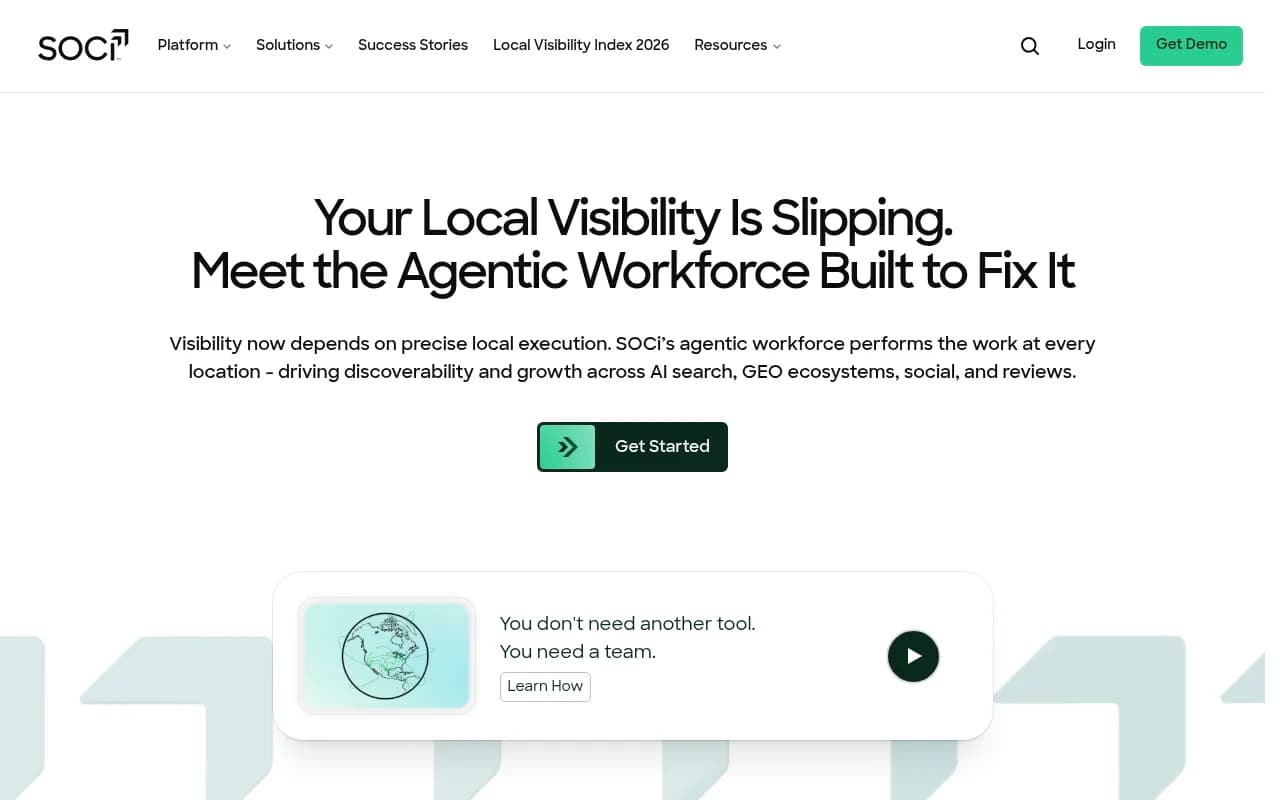
SOCi is a localized marketing platform built for multi-location brands. Its strengths are in social media management, local advertising, and reputation management across locations. The platform is genuinely good at helping franchise brands and multi-location retailers maintain brand consistency while allowing local customization.
SOCi has positioned itself around "CoMarketing" — the idea that national brand strategy and local execution need to work together. In the AI search context, SOCi has started surfacing AI-related insights, but the platform's DNA is social and reputation, not AI search visibility.
For a brand that needs to manage social content and reviews across 300 locations, SOCi is a strong choice. For a brand trying to understand and improve how it appears in ChatGPT or Perplexity, SOCi isn't the right tool.
Feature comparison
| Feature | Promptwatch | Profound | Yext | Uberall | SOCi |
|---|---|---|---|---|---|
| AI models tracked | 10 | Up to 10 (Enterprise) | Limited | Limited | Limited |
| Prompt tracking & volume data | Yes | Yes | No | No | No |
| Citation analytics | Yes | Yes | No | No | No |
| AI crawler logs | Yes | No | No | No | No |
| Content gap analysis | Yes | No | No | No | No |
| AI content generation | Yes | No | No | No | No |
| Page-level citation tracking | Yes | No | No | No | No |
| ChatGPT Shopping tracking | Yes | No | No | No | No |
| Reddit & YouTube insights | Yes | No | No | No | No |
| Offsite citation analysis | Yes | Partial | No | No | No |
| Competitor heatmaps | Yes | Yes | No | No | No |
| Listings management | No | No | Yes | Yes | Partial |
| Review management | No | No | Yes | Yes | Yes |
| Local social media mgmt | No | No | Partial | Partial | Yes |
| Multi-location support | Yes | Yes | Yes | Yes | Yes |
| Multi-language/region | Yes | Yes | Yes | Yes | Yes |
| Traffic attribution | Yes | No | No | No | No |
| Starting price | $99/mo | $99/mo | Custom | Custom | Custom |
The multi-location AI visibility problem, specifically
Here's what makes this comparison genuinely complicated for enterprise brands: you probably need more than one of these tools.
Yext or Uberall handles the infrastructure layer — keeping your location data accurate and consistent across directories. That's table stakes for AI visibility because AI models do pull from structured data sources, and inconsistent NAP data creates confusion.
But structured data alone doesn't get you cited in AI responses. When someone asks Perplexity "best property management company in Denver," the AI is synthesizing editorial content, review aggregators, Reddit discussions, and authoritative brand pages. Your Google Business Profile accuracy matters, but it's not what drives that citation.
That's where a dedicated GEO platform becomes necessary. Profound gives you the monitoring layer. Promptwatch gives you monitoring plus the ability to act on what you find.
For most enterprise marketing teams, the practical stack looks like:
- Yext or Uberall for listings and reputation infrastructure
- Promptwatch or Profound for AI search visibility monitoring and optimization
- SOCi if localized social is a major channel
The question is whether you want a monitoring-only GEO tool or one that helps you close the gap.
Which platform for which use case
If you need to manage listings and reviews at scale
Yext is the market leader here. Uberall is a strong alternative, particularly in Europe. Neither is a GEO platform, but both are solid infrastructure choices.
If you need enterprise AI visibility monitoring with deep reporting
Profound is worth evaluating. Its prompt research and share-of-voice tracking are strong, and the recent Agents and MCP additions show the platform is evolving. The gap is on the action side — you'll need separate tools for content creation and optimization.
If you need to monitor AND improve AI search visibility
Promptwatch is the only platform in this comparison that covers the full loop. The combination of Answer Gap Analysis, Content Agents, and crawler logs means you can identify why you're invisible, create content to fix it, and verify that the fix worked. For enterprise brands that are serious about AI search as a channel, that end-to-end capability matters.
If localized social and reputation management is the priority
SOCi is built for exactly that. It's not an AI visibility platform in the GEO sense, but for franchise brands managing social content across hundreds of locations, it's a strong choice.
What enterprise brands often get wrong about AI visibility
A few patterns come up repeatedly when multi-location brands start thinking about AI search.
The first is treating AI visibility as a listings problem. It's not. Clean structured data helps, but AI models are primarily synthesizing editorial and conversational content. A brand with perfect Yext data and no authoritative content will still be invisible in AI responses.
The second is assuming that existing SEO content is enough. AI models don't just index pages — they synthesize answers. Content that ranks well on Google may not be the content that gets cited in AI responses. The prompts people use in AI search are different from the keywords they type into Google, and the content that answers those prompts needs to be structured differently.
The third is ignoring offsite signals. AI models cite Reddit, YouTube, review aggregators, and third-party editorial content heavily. A brand's owned content is only part of the picture. Platforms like Promptwatch that track offsite citations give you visibility into this layer — and it often explains why competitors are getting cited when you're not.
Bottom line
For a multi-location enterprise brand in 2026, the honest answer is that no single platform does everything. Yext or Uberall handles the listings layer. A dedicated GEO platform handles AI search visibility.
Between Profound and Promptwatch, the choice comes down to whether you want to monitor or act. Profound gives you excellent data. Promptwatch gives you that data plus the tools to do something with it — content gap analysis, AI content generation, crawler logs, and page-level tracking that connects visibility to revenue.
SOCi is a different category entirely: strong for localized social and reputation, not a GEO platform.
If AI search visibility is a strategic priority for your brand in 2026 — and given that AI-referred traffic converts at 3-9x the rate of traditional organic, it should be — the monitoring-only approach will leave you watching competitors gain ground without a clear path to catch up.
Promptwatch is the only platform here that closes that loop.