Key takeaways
- Traditional SEO platforms (Semrush, Ahrefs, SE Ranking) have added AI visibility features, but they remain fundamentally monitoring tools -- they show you data without helping you act on it.
- Dedicated GEO platforms like Profound and Promptwatch were built specifically for AI search, with deeper prompt tracking, citation analysis, and content optimization workflows.
- The "which tool wins" question is often the wrong one. For most teams, the real question is whether you need a monitoring dashboard or a full optimization loop.
- If your primary goal is traditional SEO with some AI visibility data bolted on, Semrush or SE Ranking may be enough. If AI search visibility is a core business priority, a dedicated GEO platform will outperform them significantly.
- Promptwatch is the only platform in this comparison rated as a "Leader" across all GEO categories -- and it's the only one that closes the loop from gap identification to content creation to result tracking.
The search landscape shifted faster than most SEO teams expected. In 2024, AI Overviews started appearing in Google results. By mid-2025, ChatGPT Search had tens of millions of daily users. By 2026, brands are losing meaningful traffic to AI-generated answers they don't even know exist.
So now everyone is scrambling to answer the same question: which tool do I use to track and improve my AI search visibility?
The problem is that the category has fractured. You've got traditional SEO giants (Semrush, Ahrefs, SE Ranking) that have bolted AI visibility features onto existing platforms. You've got dedicated GEO tools (Profound, Promptwatch) built from the ground up for this new reality. And you've got a lot of marketing copy that makes it hard to tell the difference.
This guide cuts through that. We'll look at what each platform actually does, where each one genuinely wins, and when it makes sense to use a traditional SEO tool versus a dedicated GEO platform.
What we're actually comparing
Before diving in, it's worth being clear about what "AI visibility" means in this context, because the tools in this comparison measure it differently.
Traditional SEO tools track keyword rankings in Google's organic results. Their AI visibility features typically track whether your brand appears in AI-generated answers -- usually by running a fixed set of prompts through AI models and checking for mentions.
Dedicated GEO platforms go further. They track prompt volumes, citation sources, competitor visibility, content gaps, and in some cases generate content designed to close those gaps. They're built around the idea that AI search optimization is a distinct discipline, not just an extension of keyword tracking.
That distinction matters a lot when you're choosing a tool.
The five platforms at a glance
| Platform | Primary focus | AI models tracked | Content optimization | Prompt volume data | Starting price |
|---|---|---|---|---|---|
| Semrush | Traditional SEO + AI add-on | ChatGPT, Google AIO, Perplexity, Gemini, AI Mode | No | No | $140/mo |
| Ahrefs Brand Radar | Traditional SEO + AI monitoring | ChatGPT, Perplexity, Gemini, Copilot | No | No | $129/mo |
| SE Ranking / SE Visible | Traditional SEO + AI tracking | Multiple LLMs | No | Limited | $129/mo |
| Profound | Dedicated enterprise GEO | Multiple LLMs | Limited | Yes | Custom/high |
| Promptwatch | Dedicated GEO + optimization | 10+ AI models | Yes (Content Agents) | Yes | $99/mo |
Semrush: the all-in-one that added AI visibility
Semrush is the dominant all-in-one SEO platform for a reason. Its keyword database is enormous, its site audit tools are mature, and it covers everything from backlinks to content optimization to competitive research. For teams that live inside Semrush already, the AI visibility toolkit is a natural extension.
What Semrush's AI toolkit actually does: it runs a set of prompts through AI models and shows you whether your brand appears in the responses. You can track visibility across ChatGPT, Google AI Overviews, Perplexity, Gemini, and AI Mode. The reporting is clean and integrates with the rest of the Semrush dashboard.
Where it falls short: the prompts are largely fixed. You can't easily build out a custom prompt universe based on your actual customer queries. There's no content gap analysis that tells you what topics you're missing. There's no content generation to help you close those gaps. And there's no crawler log data showing you how AI models are actually interacting with your site.
In short: Semrush shows you a score. It doesn't tell you how to improve it.
That's fine if AI visibility is a secondary concern -- something you want to monitor alongside your traditional SEO metrics. It's not fine if you're trying to actively grow your presence in AI-generated answers.
When Semrush wins
- Your team is already deep in the Semrush ecosystem and switching costs are high
- You need traditional SEO capabilities (keyword research, backlinks, site audit) as your primary workflow
- AI visibility is a "nice to have" metric rather than a strategic priority
- You want a single platform bill rather than multiple tool subscriptions
Ahrefs Brand Radar: the backlink king's AI play
Ahrefs built its reputation on the largest backlink index in the industry. Brand Radar is its answer to the AI visibility question, and it's genuinely useful for understanding which prompts your brand appears in across major AI models.
The prompt database is one of Ahrefs' real advantages here -- it's large, and the data quality reflects years of investment in web crawling infrastructure. If you want to understand the broad landscape of prompts where your brand could theoretically appear, Ahrefs gives you a solid starting point.
But Brand Radar has a significant limitation: the prompts are fixed. You can't customize them to match your specific market, your competitors' positioning, or the actual queries your customers are typing into ChatGPT. There's also no AI traffic attribution -- you can see that you appear in AI answers, but you can't connect that to actual website visits or revenue.
The other gap: no content optimization. Ahrefs will tell you where you're invisible. It won't help you become visible.
When Ahrefs wins
- Backlink analysis is your primary use case and Brand Radar is a bonus
- You want a large, established prompt database without building your own
- You're an Ahrefs power user and the switching cost to a dedicated GEO tool is prohibitive
SE Ranking and SE Visible: the value-oriented option
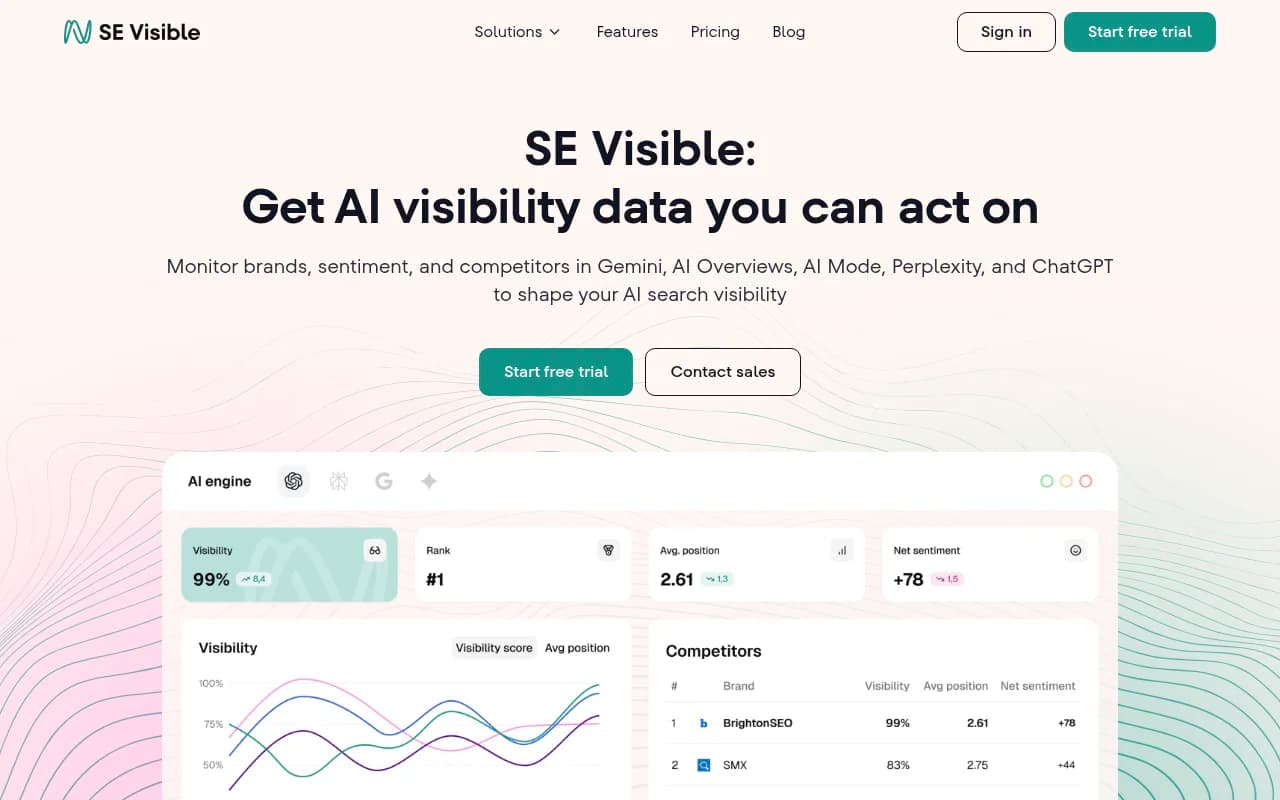
SE Ranking has carved out a solid position as the cost-effective alternative to Semrush and Ahrefs. SE Visible, its dedicated AI visibility product, tracks brand mentions across multiple LLMs and provides sentiment analysis alongside visibility data.
According to a comparison by Predicta Digital, SE Ranking wins on three of four evaluation criteria when compared to Semrush and Ahrefs for AI visibility -- primarily because it offers more flexibility at a lower price point. Semrush wins on AI visibility depth specifically, but SE Ranking's overall value proposition is stronger for agencies managing multiple clients.
The honest assessment: SE Visible is a monitoring tool. It tracks what's happening but doesn't generate content briefs, doesn't show prompt difficulty scores, and doesn't have crawler log data. For teams that need basic AI visibility reporting alongside traditional SEO, it's a reasonable choice. For teams that need to actually move the needle on AI citations, it's a starting point, not a destination.
When SE Ranking wins
- You're an agency managing multiple client sites and need cost-effective reporting
- You want traditional SEO plus basic AI monitoring without enterprise pricing
- Local and regional tracking matters (SE Ranking has strong local SEO features)
Profound: the enterprise GEO specialist
Profound is a dedicated AI visibility platform aimed squarely at enterprise brands. It tracks how companies appear across AI models, provides competitive benchmarking, and offers deeper prompt analytics than traditional SEO tools.
The platform's strength is in enterprise-grade data and reporting. Large brands with complex competitive landscapes get genuine value from Profound's ability to track visibility across many prompts and many competitors simultaneously. The data quality is solid.
The limitations are real, though. Profound's pricing is on the higher end -- it's positioned for enterprise budgets, which puts it out of reach for most mid-market teams. And while it provides strong monitoring and analysis, its content optimization capabilities are limited compared to what a full GEO platform offers. You'll still need to figure out how to act on the data yourself.
It's also worth noting: Profound doesn't have crawler log data, Reddit and YouTube tracking, or ChatGPT Shopping monitoring -- features that matter if you want a complete picture of how AI models discover and cite your content.
When Profound wins
- You're an enterprise brand with a large budget and complex competitive tracking needs
- You need sophisticated reporting for executive stakeholders
- Your primary need is benchmarking visibility against a large set of competitors
Promptwatch: the optimization platform
Promptwatch takes a different approach from every other tool in this comparison. Where Semrush, Ahrefs, SE Ranking, and Profound are fundamentally monitoring platforms, Promptwatch is built around an action loop: find the gaps, create content to fill them, track the results.

The core difference shows up in a few specific features:
Answer Gap Analysis identifies exactly which prompts your competitors appear for that you don't. You see the specific questions AI models are answering where your brand is absent -- not just a visibility score, but the actual content gaps you need to fill.
Content Agents then generate articles, listicles, comparisons, and briefs grounded in real prompt data. This isn't generic AI writing -- it's content engineered around the specific gaps the platform identified, with brand guidance, competitor context, and citation data built in.
AI Crawler Logs show you which pages AI crawlers are actually visiting, how often, and what errors they're encountering. Most competitors don't have this at all. It's the difference between knowing you're not being cited and knowing why.
Promptwatch also tracks 10 AI models (ChatGPT, Perplexity, Google AI Overviews, Google AI Mode, Claude, Gemini, Meta/Llama, DeepSeek, Grok, Mistral, Copilot), includes Reddit and YouTube tracking, monitors ChatGPT Shopping recommendations, and provides prompt volume and difficulty scoring so you can prioritize high-value, winnable opportunities.
The pricing is also more accessible than Profound: plans start at $99/month for the Essential tier, with Professional at $249/month and Business at $579/month.
In a 2026 comparison of 12 GEO platforms, Promptwatch was the only platform rated as a "Leader" across all categories. The reason is straightforward: most tools stop at monitoring. Promptwatch closes the loop.
When Promptwatch wins
- AI search visibility is a strategic priority, not just a monitoring metric
- You need to not just track gaps but actually close them with content
- You want crawler log data to understand how AI models interact with your site
- You're tracking ChatGPT Shopping, Reddit influence, or YouTube citations
- You need prompt volume data to prioritize where to focus
The real question: monitoring vs. optimization
Here's the honest framing for this decision.
Traditional SEO platforms (Semrush, Ahrefs, SE Ranking) added AI visibility features because their customers asked for them. These features are genuinely useful for teams that want a unified dashboard and don't need deep GEO capabilities. They show you what's happening. They don't help you change it.
Dedicated GEO platforms split into two camps. Profound is a sophisticated monitoring and benchmarking tool for enterprises that can afford it. Promptwatch is an optimization platform that moves from data to action -- and it's the only one in this comparison that does.
If you're asking "where do I appear in AI answers?", any of these tools will give you an answer.
If you're asking "how do I appear more often in AI answers?", only Promptwatch gives you the full workflow to get there.
Head-to-head feature comparison
| Feature | Semrush | Ahrefs Brand Radar | SE Ranking | Profound | Promptwatch |
|---|---|---|---|---|---|
| AI model coverage | 5 | 4 | Multiple | Multiple | 10+ |
| Custom prompt tracking | Limited | No (fixed) | Limited | Yes | Yes |
| Prompt volume/difficulty | No | No | No | Yes | Yes |
| Content gap analysis | No | No | No | Limited | Yes |
| Content generation | No | No | No | No | Yes (Content Agents) |
| AI crawler logs | No | No | No | No | Yes |
| Reddit/YouTube tracking | No | No | No | No | Yes |
| ChatGPT Shopping tracking | No | No | No | No | Yes |
| Traffic attribution | No | No | Limited | No | Yes |
| Competitor heatmaps | Limited | Limited | Limited | Yes | Yes |
| Multi-language/region | Yes | Yes | Yes | Yes | Yes |
| Starting price | $140/mo | $129/mo | $129/mo | Custom | $99/mo |
Which tool for which team?
The answer depends less on which platform is "best" and more on what your team actually needs to do.
If you're an SEO team that needs traditional keyword research, backlinks, and site audits as your core workflow, with AI visibility as a reporting add-on, Semrush or Ahrefs makes sense. You're already paying for the platform; the AI features are a bonus.
If you're an agency managing multiple clients on a budget and need basic AI monitoring alongside traditional SEO, SE Ranking is worth a look. It's the most cost-effective option in this group.
If you're an enterprise brand with a large budget and need sophisticated competitive benchmarking across many prompts and competitors, Profound is a legitimate option -- though you'll still need separate tools to act on what you learn.
If AI search visibility is a genuine business priority and you need to move from "we're invisible in AI answers" to "we're being cited regularly," Promptwatch is the only platform in this comparison that gives you the complete workflow. The gap analysis tells you what's missing. The Content Agents help you create it. The crawler logs tell you whether AI models are finding it. And the tracking shows you when it starts working.
That's not a monitoring dashboard. That's an optimization system.
A note on the "just use what you have" trap
One pattern worth flagging: teams often default to using the AI visibility features in whatever SEO tool they already subscribe to, reasoning that it's "good enough" and avoids adding another tool to the stack.
This makes sense as a starting point. But it can become a trap if AI search visibility is actually important to your business. Knowing that your visibility score is 23% and your competitor's is 41% is useful information. Knowing what content to create to close that gap, having a system to create it, and being able to track when AI crawlers find it and start citing it -- that's a different category of capability entirely.
The tools that show you the problem and the tools that help you solve it are not the same tools. In 2026, that distinction is starting to matter a lot.
Bottom line
Traditional SEO platforms are not going away, and their AI visibility features are improving. For teams where AI search is a secondary concern, Semrush or Ahrefs will cover the basics without adding complexity or cost.
But the gap between "monitoring AI visibility" and "optimizing for AI visibility" is wide, and it's not closing. Profound is a strong enterprise monitoring tool. Promptwatch is the platform that actually helps you do something about what you find.
If you're serious about AI search in 2026, the question isn't whether to track it. It's whether you want a dashboard or a system.