Key takeaways
- Product pages earned 22.4% of ChatGPT citations from Sep 28 to Oct 4, 2026, the most of any content type. Landing pages added 16.8%, so pages that describe what you sell take about 39% of all citations (Promptwatch Data).
- On commercial prompts like "best CRM for small businesses", product pages hit 26.0% and landing pages 20.6%.
- ChatGPT quotes product pages directly, so complete, factual specs, prices and positioning matter more than clever copy.
- Product pages decay. In Promptwatch's half-life study, 55% were still cited after 60 days and half were gone by day 74 to 77. Stale specs and prices cost you citations.
- Write for extraction: answer first, one idea per block, concrete nouns, no hedging and no sales fluff.
Why product pages matter more than you think
Most GEO advice sends you off to write listicles, earn Reddit threads, and chase editorial mentions. Fair enough, but the numbers say something less glamorous. In Promptwatch Data's content type report, covering Sep 28 to Oct 4, 2026, product pages are the single biggest slice of ChatGPT citations at 22.4%. Landing pages are second at 16.8%. Listicles, the format everyone obsesses over, sit at 13.6%.
Here is the full picture of what ChatGPT cited in that week:
| Content type | Share of ChatGPT citations |
|---|---|
| Product pages | 22.4% |
| Landing pages | 16.8% |
| Listicles | 13.6% |
| How-to guides | 8.7% |
| Documentation | 7.5% |
| General articles | 6.1% |
| Comparisons | 5.9% |
| News | 5.7% |
| FAQ pages | 3.3% |
| Reviews | 1.7% |
Editorial formats combined (articles, listicles, how-tos, comparisons and so on) come to about 43%. Pages that describe what a company sells come to about 39%. So a store or SaaS site that treats its product pages as a conversion-only asset, written for humans who already decided to buy, is ignoring close to a quarter of the citation pie.
I find this a little humbling. A lot of us have spent two years telling clients to publish more blog content for AI search. The product page, the thing the business already owns and controls, is doing more citation work than most of that blog.
What the prompt type tells you
The share changes with what the user is asking. Same report, same week:
| Prompt type | Product pages | Landing pages | Other notable types |
|---|---|---|---|
| Commercial | 26.0% | 20.6% | Listicles 15.0%, comparisons 7.9% |
| Informational | 19.1% | 13.9% | Listicles 13.6%, how-tos 10.7%, docs 8.5% |
| Branded | 23.3% | 22.8% | Reviews 5.6%, FAQ pages 4.8%, social 3.0% |
Three things stand out.
First, on commercial prompts, those four types (product pages, landing pages, listicles, comparisons) make up almost 70% of citations. Someone asking for the best tool in a category is mostly being answered from pages that describe or compare products.
Second, on branded prompts, your own pages take nearly half the citations (23.3% plus 22.8%). When someone asks ChatGPT about you by name, your product and landing pages are the primary source. If they are vague, thin, or out of date, ChatGPT either quotes something wrong or reaches for a third party to fill the gap.
Third, reviews are small overall (1.7%) but jump to 5.6% on branded prompts, more than triple their overall share. Reviews on trusted sites in your category matter specifically when buyers check you out by name.
How ChatGPT actually uses a product page
ChatGPT does not read a product page the way a shopper does. It retrieves pages through search, pulls out passages, and builds an answer from the pieces that are clean enough to lift. One secondary synthesis from KIME, which I have not verified against the original studies, claims ChatGPT cites only about 15% of the pages it retrieves, and that 44.2% of citations come from the first 30% of a page. Treat those as directional rather than gospel. They do match what practitioners keep reporting: the top of the page does most of the work.
Winston Digital Marketing's playbook makes a similar point about writing style. The passages that get quoted put the answer in the first sentence, keep one idea per section, use concrete nouns, and skip hedging and sales language. If a paragraph only makes sense after reading the one before it, ChatGPT cannot lift it, so it lifts someone else's.
That is the whole brief for product page copy. Make every block liftable.
The anatomy of a citable product page
Open with a plain definition
The first sentence under your H1 should say what the product is, who it is for, and the core outcome. No tagline.
Weak: "Reimagine the way your team works with Flowdesk."
Stronger: "Flowdesk is a help desk for small support teams of 2 to 20 agents. It combines shared inboxes, a knowledge base, and ticket automation, starting at $29 per agent per month."
The second version can be quoted word for word in an answer to "best help desk for small teams." The first cannot be quoted at all.
Put specs and prices in plain text
Promptwatch's own recommendation from the report is to keep specs, prices and positioning complete and factual, because ChatGPT quotes product pages directly. Practical rules:
- Put pricing in HTML text, not inside an image, a PDF, or a script-rendered widget the crawler may never execute.
- State plan names, price, billing period and currency every time.
- List specs in a table or a clean list with units ("battery life: 14 hours", not "all-day battery").
- Say what is included and what is not. Honest limits make a passage more citable, because they read as fact rather than pitch.
Say who it is for, and who it is not for
Commercial prompts are almost always scoped: for small businesses, for agencies, for developers, under $100. If your page never says who the product suits, ChatGPT has nothing to match the scope against. Add a short "Best for" block. Add a "Not ideal for" line too. It feels risky and it is exactly what makes a page trustworthy to a model assembling a recommendation.
Make comparison easy
Buyers ask ChatGPT to compare. Give it comparison-ready material on your own page: a plan table, a feature matrix, a short "how this differs from X" section written in neutral language. Comparison pages are only 5.9% of citations overall, but on commercial prompts they reach 7.9%, and a product page that already contains the comparison facts competes for both.
Add an FAQ block that sounds like real questions
FAQ pages are 3.3% of citations overall and 4.8% on branded prompts. That is not huge, but it is cheap to earn. Write questions the way a buyer would type them into ChatGPT ("Does Flowdesk integrate with Shopify?", "Is there a free trial?") and answer in the first sentence. Mark them up with FAQ schema if your CMS supports it.
Cut the filler
Words like "seamless", "robust" and "best-in-class" give a model nothing to quote. Replace each with a number, a named integration, a measured result, or delete it. Here is a quick before and after:
Before: A powerful, seamless solution that supercharges your workflow.
After:  Syncs two-way with Shopify, HubSpot and Slack. Setup takes about 15 minutes.
Keeping it fresh: the half-life problem
This is the part most teams miss. Promptwatch's content half-life study took every page ChatGPT cited on July 6, 2026 and tracked it for 90 days. Product pages do not hold on by themselves:
| Content type | Still cited after 60 days |
|---|---|
| Landing pages | 69% |
| Docs | 67% |
| Comparisons | 63% |
| Listicles | 60% |
| Product pages | 55% |
| Reviews and how-tos | about 55% |
| News | 41% |
Product pages, reviews and how-tos all reach their half-life at 74 to 77 days. News is much worse, losing half its pages in 36 days. Pricing pages are classified as landing or product pages in this data, which is why the freshness of your pricing and availability matters.
The takeaway from Promptwatch's recommendation is blunt: product pages do not stay cited on their own, so keep specs, availability and prices current. In practice:
- Put a visible "last updated" date near the specs.
- Review top product pages monthly for price, stock and feature changes.
- When you ship a feature, update the product page the same day, not the changelog only.
- Remove or redirect discontinued products rather than leaving thin ghosts.
Do not forget the rest of the stack
Product page copy is the highest-leverage place to start, but it is not the whole job.
- Landing pages are your second biggest citation source at 16.8%. Treat campaign and category landing pages with the same factual discipline.
- Documentation is 7.5% overall and 8.5% on informational prompts, and it stays cited longer than most formats (67% after 60 days). Keep docs public and crawlable.
- Reviews matter most on branded prompts. Collect them on trusted sites in your category rather than only on your own domain.
- Retrieval comes first. If AI crawlers get blocked or served errors, nothing above matters. Check your robots rules and server responses for the bots you want.
Winston Digital also notes that ChatGPT and Google results overlap by roughly 33%, so ranking in Google is useful but not sufficient. Pages that ChatGPT cites do not always rank on page one, which is good news for smaller brands with a well-written product page.
A repeatable workflow
- Pick your 10 to 20 highest-value product and landing pages.
- List the commercial prompts a buyer would ask ("best X for Y", "X vs Z", "is X worth it") and the branded ones ("what does X cost", "is X good for Y").
- Check which of your pages ChatGPT currently cites for each prompt, and which competitor pages it cites instead.
- Rewrite the opening, specs, audience and FAQ blocks of the pages that lose, using the anatomy above.
- Re-check after a few weeks. Compare citations, not just mentions.
- Set a monthly freshness review for pricing and specs.
Step 3 and step 5 are where tooling earns its keep. Checking by hand in the ChatGPT interface does not scale, and answers vary run to run.
Tools that help
You need two kinds of tools: ones that show what is cited, and ones that help you write and maintain the copy.
Tracking which pages get cited
Promptwatch tracks citations in ChatGPT's real interface, shows which of your pages are cited and where, and has page-level tracking so you can see the prompts that cite a given product page. Its Content Agent and Action Board then turn gaps into briefs and updates, and its AI crawler logs show whether ChatGPT's bots can actually read your pages.

If you want to compare options, the directory at bestgeosoftware.com lists a wide set of GEO tools. A few from our catalog worth a look at different budgets:



Writing and editing the copy
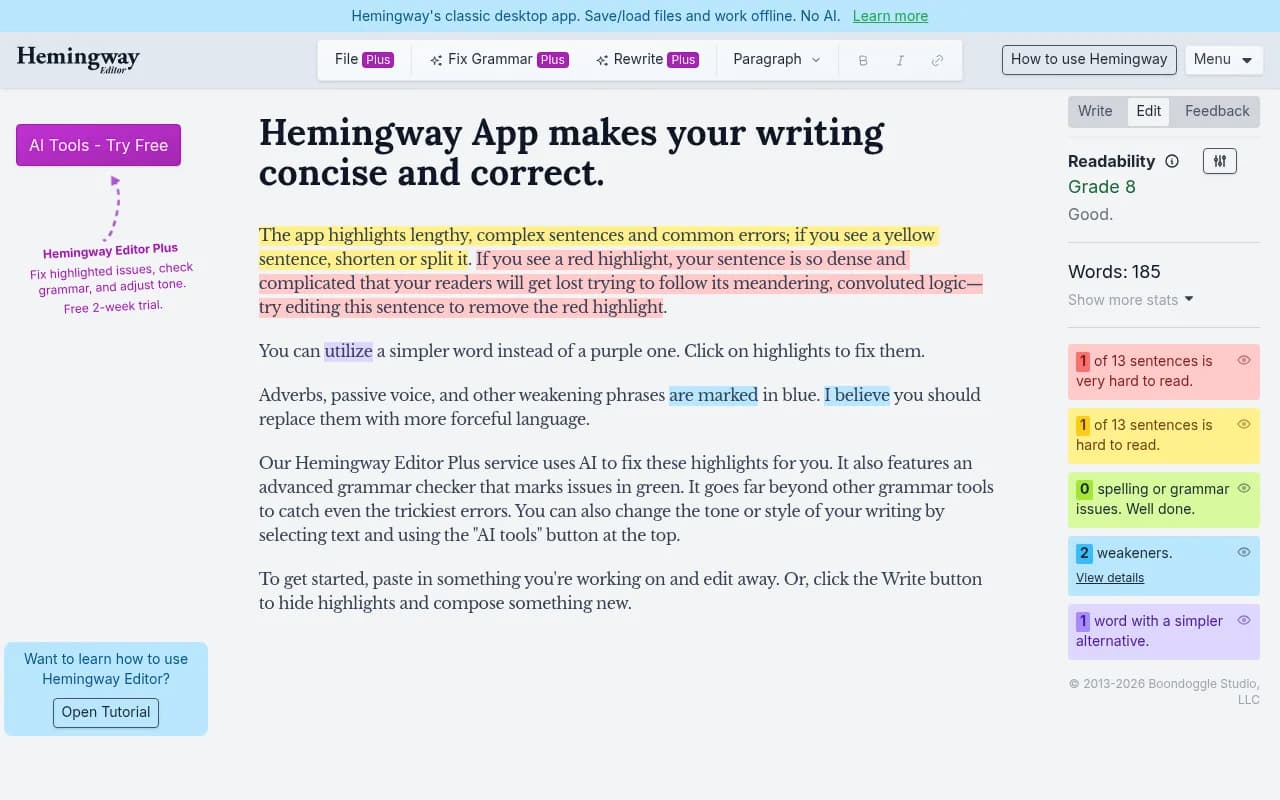
None of these will make your copy citable on its own, but they help with the extraction-friendly style described above.
For structured data on product and FAQ pages, a platform like Schema App can handle markup at scale:
And Google Search Console remains the quickest way to check that the page is indexed and performing in traditional search, since pages that show up in ChatGPT often already perform in organic search:
| Job | Tool type | Examples |
|---|---|---|
| See which pages ChatGPT cites | AI visibility tracking | Promptwatch, Otterly.AI, Peec AI, Profound |
| Check AI crawler access | Crawler logs, site audits | Promptwatch, Screaming Frog |
| Edit for clarity | Writing editors | Hemingway App, Grammarly |
| Add structured data | Schema tools | Schema App, Yoast SEO |
| Confirm indexing | Search data | Google Search Console |
Common mistakes
- Hiding prices behind "contact us" while expecting to be cited for commercial prompts about cost.
- Writing product pages entirely in marketing slogans.
- Relying on images or tabs for specs the crawler may not read.
- Letting old plan names and prices sit on the page for months.
- Publishing a listicle about your category and neglecting the product page it should link to.
- Treating one ChatGPT answer as proof. Answers vary, so look at citation patterns across many prompts and weeks.
What to do this week
Pick your top five product pages. Rewrite the first sentence of each as a plain definition with the audience and price. Move specs into text. Add a "Best for" line and five real FAQs. Put an updated date on the page. Then check in two to four weeks whether those pages show up for your commercial and branded prompts. If you want the broader numbers behind this, the Promptwatch Data hub has the citation research this guide draws on.