Key takeaways
- The basics overlap: unique, useful, crawlable pages with clear answers get picked up by both Google AI Overviews and ChatGPT.
- The rules split on format. ChatGPT leans on product pages and landing pages (about 39% of citations). AI Overviews gives much more weight to how-tos, news, and video.
- Social content barely matters in ChatGPT (0.46% of citations) but earns 12.2% of citations in AI Overviews. YouTube is the biggest piece.
- Match content type to prompt intent. Commercial prompts reward product pages and listicles; informational prompts reward how-tos and docs.
- Measure citations per platform separately. A single "AI visibility" number hides the differences.
Why one content strategy isn't enough
It's tempting to treat "AI search" as one thing. Write a clear, well-structured page, add some schema, and hope both Google and ChatGPT pick it up. Sometimes that works. A lot of the time it doesn't, because the two systems favor different kinds of pages.
Google's own guidance for its AI experiences is refreshingly plain: focus on unique, valuable content for people, provide a great page experience, make sure Google can access your content, and manage visibility with preview controls. There's no secret markup. AI Overviews are built on top of the same index and quality systems as regular Search.
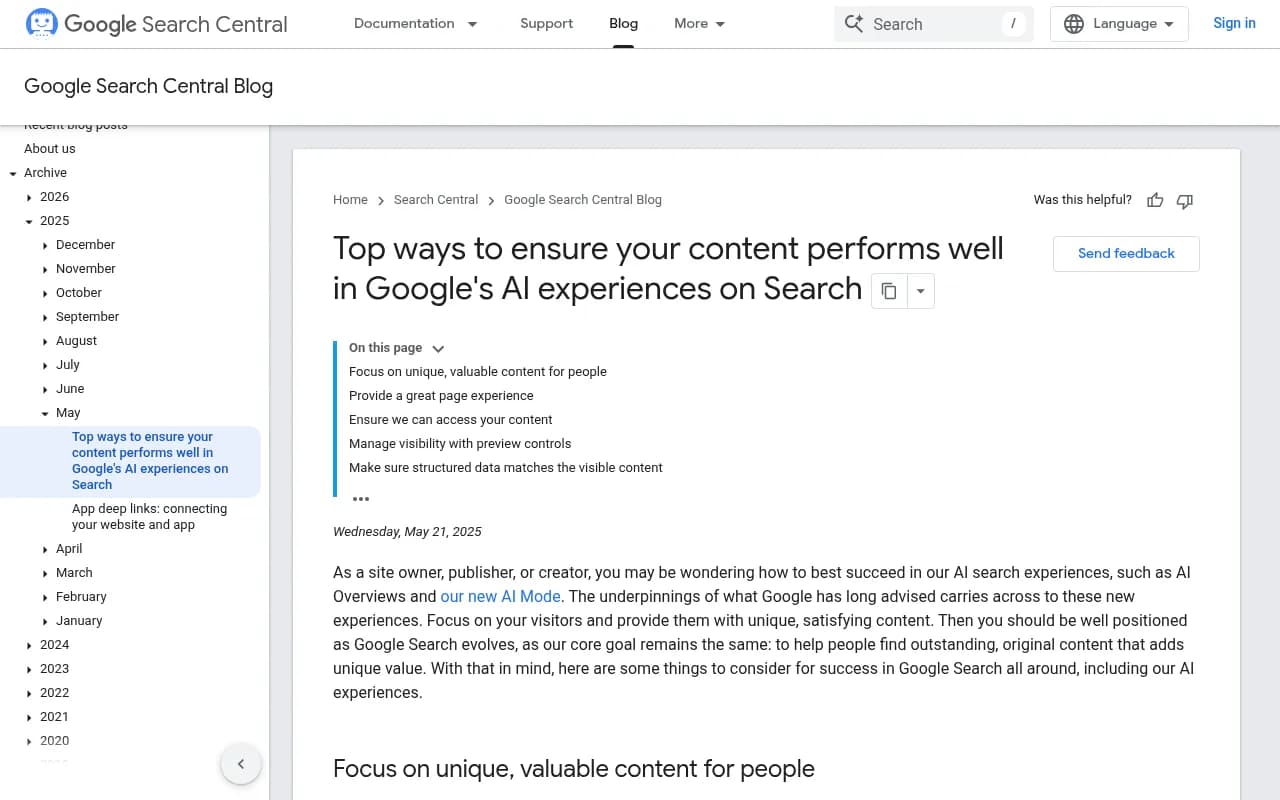
ChatGPT has no equivalent public rulebook. What we have instead is citation data, and it shows real divergence. The numbers below come from Promptwatch Data, which tracks what each platform actually cites. Note that the two reports cover different periods (July 2026 for AI Overviews, Sep 28 to Oct 4, 2026 for ChatGPT), so treat the comparisons as indicative, not exact.

What the two platforms actually cite
ChatGPT: pages that describe what you sell
In Promptwatch's ChatGPT citation share by content type report (Sep 28 to Oct 4, 2026), product pages were the most cited type at 22.4% of classified citations. Landing pages followed at 16.8%. Together, about 39% of ChatGPT citations go to pages describing what a company sells.
Editorial formats add up to roughly 43%: listicles at 13.6%, how-to guides at 8.7%, general articles at 6.1%, comparisons at 5.9%, news at 5.7%, and reviews at 1.7%. Documentation is 7.5% and FAQ pages are 3.3%.
Google AI Overviews: more variety, more freshness
In Promptwatch's AI Overviews citation types report for July 2026, the average mix looked different: listicles around 18.0%, product pages about 16.3%, how-tos 15.1%, news 13.5%, video 5.9%, social posts 5.1%, landing pages 4.7%, and comparisons 3.6%.
Two things stand out. First, product pages took the top spot from listicles on July 28 and ended the month at 17.9% against 16.2% for listicles. Listicles averaged about 26% in Q1, and product pages were around 9% in January, so the mix has moved fast. Second, landing pages are a minor format in AI Overviews (4.7%) but a major one in ChatGPT (16.8%).
Side by side
| Content type | ChatGPT (Sep 28-Oct 4) | AI Overviews (July avg) |
|---|---|---|
| Product pages | 22.4% | ~16.3% |
| Landing pages | 16.8% | 4.7% |
| Listicles | 13.6% | ~18.0% |
| How-tos | 8.7% | 15.1% |
| News | 5.7% | 13.5% |
| Comparisons | 5.9% | 3.6% |
| Video | not broken out | 5.9% |
| Social posts | ~0.5% (all social) | 5.1% |
The short version: ChatGPT cites pages that state facts about offerings. AI Overviews cites a broader mix, with more how-to content, more news, and a real appetite for video and social.
Where the rules are the same
Before getting to the differences, the overlap is worth respecting. Most of your effort should go here.
Answer the question first
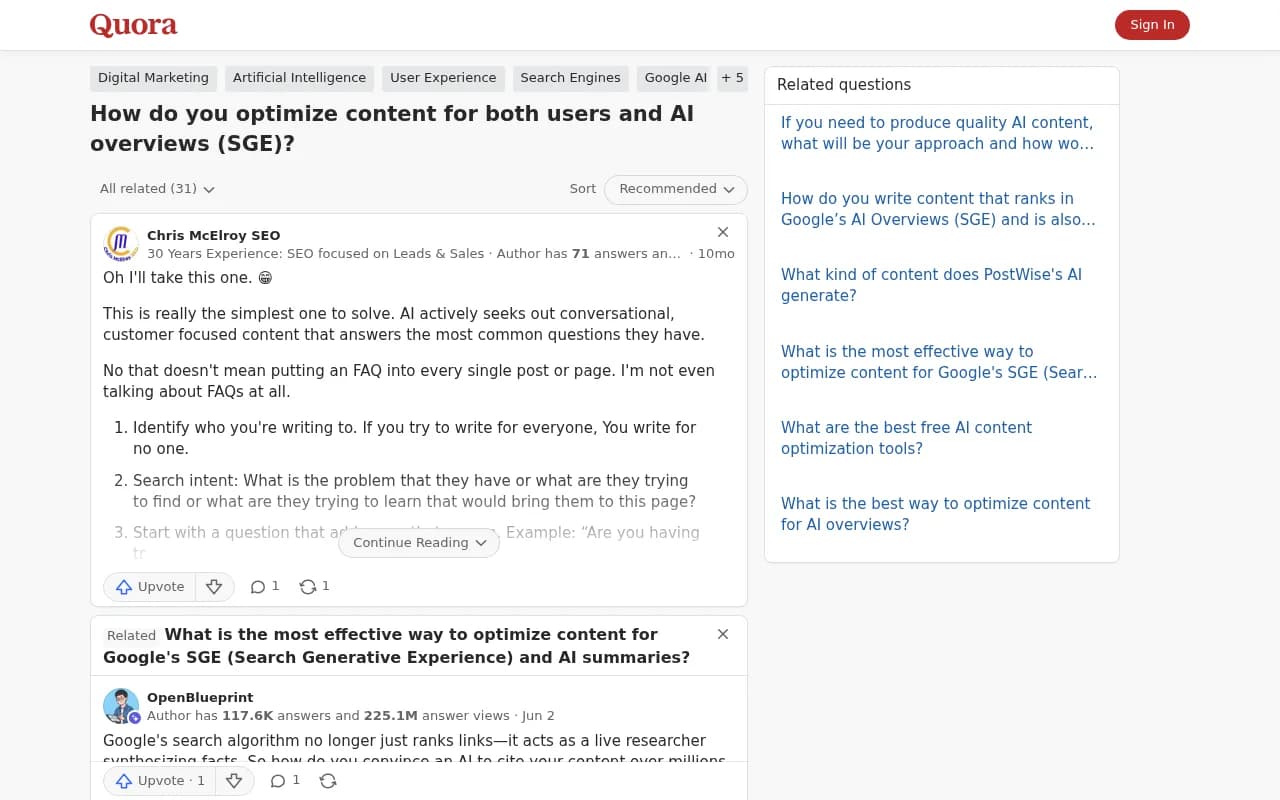
Both systems extract passages. A page that buries the answer under three paragraphs of scene-setting loses to one that states it in the first two sentences. Put the direct answer under the heading, then add nuance. This is the one piece of advice repeated in nearly every guide on the topic, including the practitioner answers on Quora, and it holds up.
Be crawlable
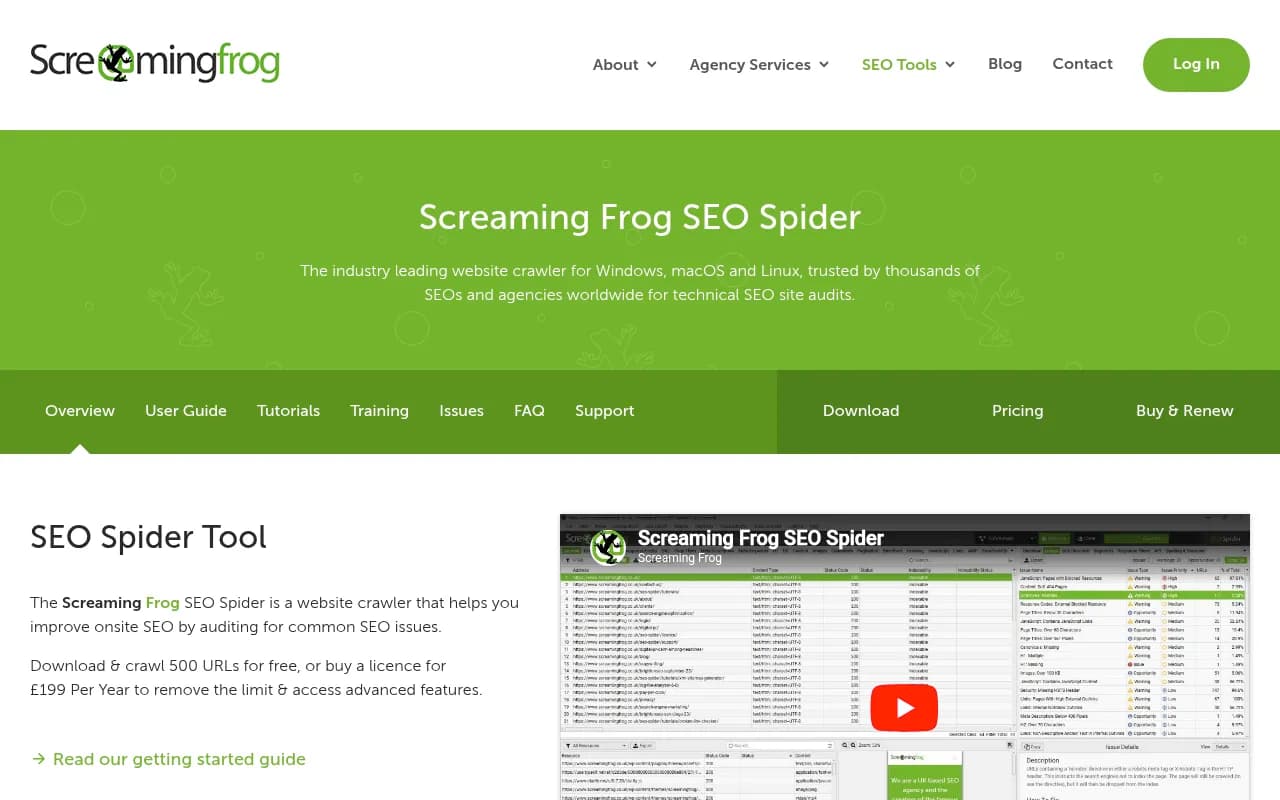
Google's guidance says to make sure it can access your content. The same applies to ChatGPT's crawlers. Check robots.txt, don't hide key content behind scripts that bots don't execute, and keep documentation public. If an AI crawler hits a 403 on your pricing page, no amount of good writing fixes it. A crawler like Screaming Frog SEO Spider helps you find blocked or orphaned pages, and your server logs show which AI bots actually show up.
Write something nobody else has
Google's "unique, valuable content" line isn't decoration. Proprietary data, first-hand testing, original screenshots and specific numbers give a model something to quote. Generic summaries of other summaries don't. This also matters for ChatGPT, where almost half of responses cite 10 or more unique domains (Promptwatch's unique domains per response data). There are many slots, but they go to pages with something distinct to say.
Keep facts consistent
Prices, specs, names and dates should match across your site and the third-party pages that mention you. Contradictions make you a risky thing to cite.
Where the rules differ
Rule 1: Product and landing pages matter far more in ChatGPT
If you only publish blog posts, you're ignoring the single biggest slice of ChatGPT citations. Promptwatch's report recommends keeping specs, prices and positioning on product pages complete and factual, because ChatGPT quotes them directly. Branded prompts show it clearly: product pages are 23.3% and landing pages 22.8% of citations, and reviews jump to 5.6%, more than 3x their share across all prompts.
In practice, this means:
- Put real specs, pricing ranges, integrations and limits on product pages in plain HTML.
- Add a short "who this is for" and "who it isn't for" block. Models love a clean positioning statement.
- Don't make landing pages all slogans. Slogans can't be cited.
Rule 2: How-tos, news and video carry more weight in AI Overviews
AI Overviews cites how-tos at 15.1% against 8.7% in ChatGPT, and news at 13.5% against 5.7%. If your category has a lot of procedural or timely queries, Google is where that content pays off.
For how-tos, use numbered steps, name each step with a verb, and keep the page focused on one task. For news and timely content, publish fast and update. Be aware that freshness cuts both ways. According to Promptwatch's content half-life report, news loses half of its cited pages in ChatGPT within about 36 days, while landing pages and docs keep most of their citations for months. A news-style post can be a short-term win but won't be a durable asset.
Rule 3: Social and video presence is a Google play
This is the starkest difference. In Promptwatch's social media citations by AI model report (Sep 28 to Oct 4, 2026), all seven major social platforms combined made up just 0.46% of ChatGPT's citations. Reddit fell from 5.19% to 0.09%, following the August collapse in Reddit citations. LinkedIn is now ChatGPT's top social source at about 0.3%.
Google AI Overviews is the opposite: 12.2% of its citations come from social platforms, about 26 times ChatGPT's share. YouTube is 4.28%, Facebook 2.38%, Reddit 2.15%, Instagram 1.61% and LinkedIn 1.55%. Perplexity sits in between at 2.7%.
The practical reading: if you have limited time, make a video for Google and put your written effort into your own site for ChatGPT. Don't build a ChatGPT strategy around Reddit threads right now. That bet has already lost most of its value, and the shift happened in a single day.
Rule 4: Listicles and comparisons work, but for different reasons
Listicles are the top or second format on both platforms. In ChatGPT, commercial prompts like "best CRM" send 15.0% of citations to listicles and 7.9% to comparisons. Promptwatch's advice is to get listed in the "best of" roundups ChatGPT cites. That's an off-site job: outreach, review submissions, and being genuinely good enough to include. It isn't something you solve by publishing your own "best of" with yourself at number one, although an honest listicle on your own domain still helps.
Rule 5: Search intent maps to format differently
In ChatGPT, the mix shifts by prompt type:
| Prompt type | Top formats in ChatGPT |
|---|---|
| Commercial ("best CRM") | Product 26.0%, landing 20.6%, listicles 15.0%, comparisons 7.9% |
| Informational ("how does a CRM work") | Product 19.1%, landing 13.9%, listicles 13.6%, how-tos 10.7%, docs 8.5% |
| Branded | Product 23.3%, landing 22.8%, reviews 5.6%, FAQ 4.8%, social 3.0% |
Even informational prompts send a lot of citations to product pages. That surprised me. It means your product page should teach a little, not just sell.
A writing workflow that covers both
Step 1: Map prompts, not just keywords
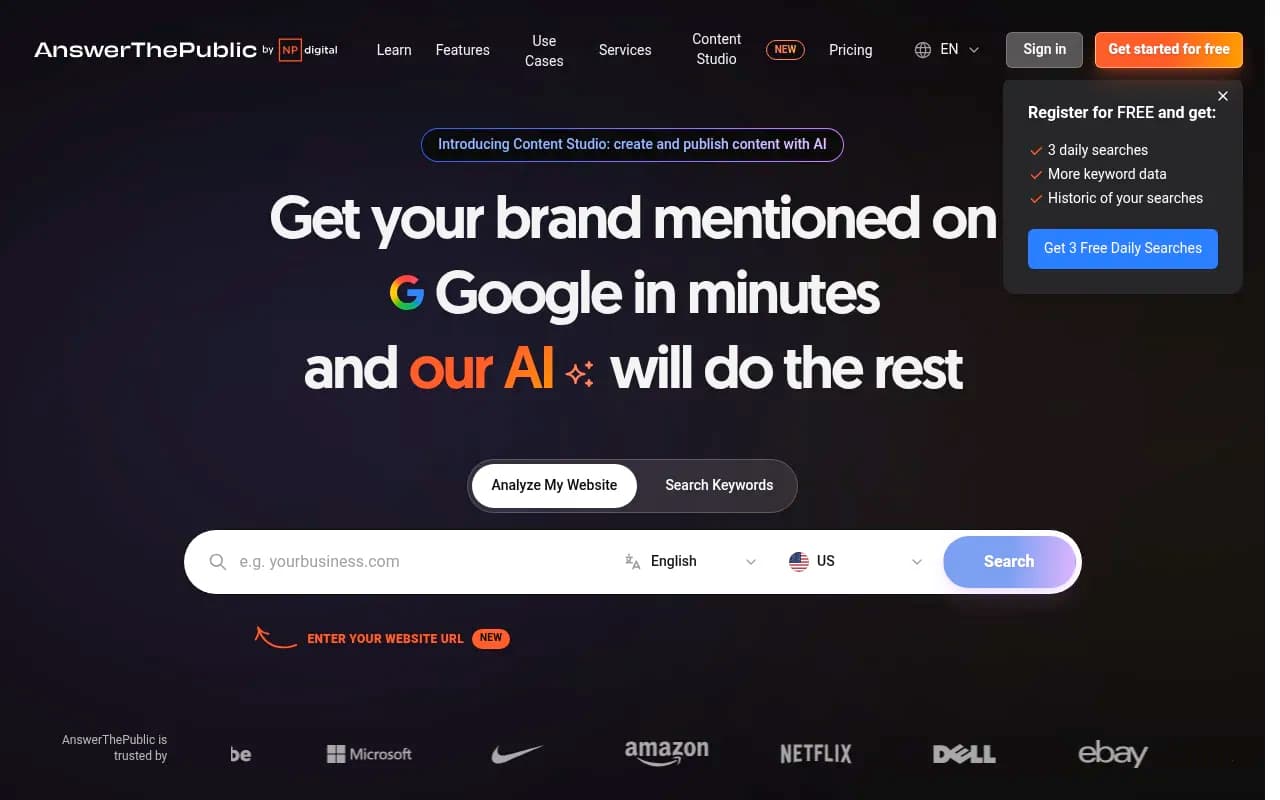
Start with the questions real people ask, grouped by intent: commercial, informational, branded. Tools like AnswerThePublic and AlsoAsked surface question phrasing, and Google Search Console shows which queries you already appear for.
For the AI side, you need to see the prompts and the searches AI runs behind them. Promptwatch shows prompt volumes, difficulty and query fan-outs, which are the exact web searches ChatGPT runs per response. That's useful because a page that matches a fan-out query can earn a citation even if it never ranked for the original prompt.
Step 2: Pick the format by platform goal
- Want ChatGPT citations on commercial prompts? Strengthen product and landing pages, then pursue third-party listicles.
- Want AI Overviews citations on how-to queries? Write task-focused how-tos and add a short video.
- Want both? Build one strong hub page with the direct answer up top, then a how-to, a comparison and a video that link back to it.
Step 3: Write for extraction
A few habits that help on both platforms:
- Lead each section with a one or two sentence answer.
- Use descriptive headings that read like questions or clear statements.
- Put numbers, specs and dates in the text, not in images.
- Use tables for comparisons. They're easy to lift.
- Credit the source of any stat you use, with a date.
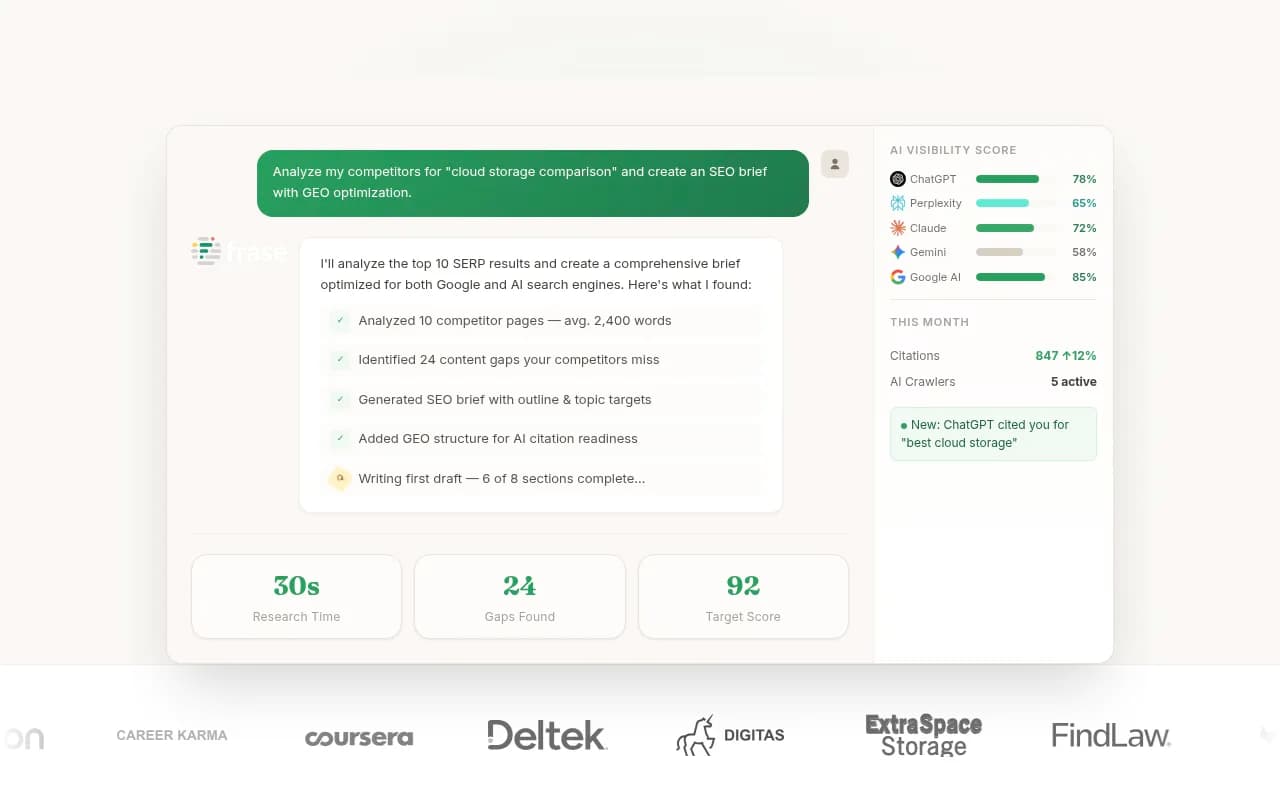
For on-page optimization, content tools such as Clearscope, Surfer SEO and Frase can help check topical coverage. They're built around Google's SERPs, so use them as a coverage check, not a guarantee of AI citations.
Step 4: Add structured data where it helps
Schema won't force a citation, but it removes ambiguity about what a page is. Product, FAQ, HowTo-style content and Organization markup help machines classify pages. Schema App is one option if you manage markup at scale.
Step 5: Refresh on a schedule that fits the format
Given the half-life data, treat news-style content as disposable and update product pages, docs and landing pages when anything changes. A stale price on a product page is worse than no page.
Step 6: Track each platform separately
Measure citations and position by platform, not blended. A page can be a regular in AI Overviews and absent in ChatGPT, and the fix is different in each case.
Tools for tracking and acting on the differences
If you're checking this manually, you'll lose a lot of time. A few categories matter: prompt and citation tracking, crawler visibility, and content production.
| Tool | What it's useful for | Best for |
|---|---|---|
| Promptwatch | Tracks real ChatGPT, AI Overviews and Perplexity answers, citation analytics, AI crawler logs, and content gap analysis with a Content Agent | Teams who want to find gaps and fix them |
| Otterly.AI | Basic prompt tracking | Budget monitoring |
| Peec AI | AI search monitoring | Simple reporting |
| Profound | Enterprise monitoring | Large brands |
| Semrush | Traditional SEO suite with AI tracking added | Teams already inside Semrush |
| Ahrefs Brand Radar | Brand mentions in AI search | Ahrefs users |



The distinction I'd care about is monitoring versus acting. A tracker tells you that you weren't cited. Platforms like Promptwatch go further, with IP-verified AI crawler logs showing whether bots can read your pages, citation analytics showing which of your pages get cited, and content gap and Action Board features that tell you what to write next. Then you check whether the new page got crawled and cited. For a deeper look at the category, the GEO software directory at bestgeosoftware.com lists many more options.
Common mistakes
- Treating Reddit as a ChatGPT channel. The data says it has almost vanished there, though it still shows up in AI Overviews at 2.15%.
- Publishing only blog posts. In ChatGPT, product and landing pages are the biggest share.
- Ignoring video. AI Overviews cites video at about 6%, and YouTube is its largest social source.
- Gating documentation. Docs earn 7.5% of ChatGPT citations and last longer than news.
- Assuming this is permanent. The AI Overviews mix changed a lot between January and July, and ChatGPT shifted overnight in August. Recheck the data every quarter.
A quick checklist
- Confirm AI crawlers and Googlebot can reach your key pages.
- Audit product and landing pages for complete, factual specs and pricing.
- Write direct-answer openings on every how-to and comparison.
- Publish at least one video per priority topic for Google.
- Pursue inclusion in third-party "best of" roundups for ChatGPT.
- Track ChatGPT and AI Overviews separately and refresh by content type.
The core idea is simple. Write the same genuinely useful page for people, then decide which supporting formats each platform rewards. Google gives you more room for how-tos, news and video. ChatGPT mostly wants a clear, factual statement of what you offer, backed up by other sites that say good things about you.
For broader research on how AI engines pick sources, the Promptwatch Data hub is updated regularly, and if you'd like help turning it into a content plan, 1001 SEO Media works on exactly this kind of SEO and GEO strategy.