Key takeaways
- Word count is a weak signal for AI citations. Ahrefs found a correlation of about 0.04 between word count and AI Overview citations across 174,048 pages, which is effectively zero.
- More than half of cited pages (53.4% in the Ahrefs data) are under 1,000 words, but that figure needs a baseline before it means much.
- Structure, extractable passages, query fit and freshness show up in the research far more consistently than length.
- Length still helps indirectly: a deeper page can cover more sub-questions, which gives AI systems more passages to pull from.
- Promptwatch Data has no report on word count, but its content-type data shows short product and landing pages dominating ChatGPT citations.
The short answer
No, a longer page is not more likely to be cited. Yes, a page needs enough depth to answer the question properly. Those two statements sound contradictory, but they are not.
The SEO habit of pushing every article past 2,000 words came from an era when length correlated with links, dwell time and perceived authority. AI systems retrieve passages, not whole pages. A system answering a question looks for the chunk of text that answers it, and whether that chunk sits inside a 600-word page or a 4,000-word guide matters less than whether it is clear, specific and self-contained.
Below is what the studies actually say, where they conflict, and how to turn that into word-count decisions you can defend.
What the 2026 studies found
The Ahrefs numbers everyone is quoting
Most articles on this topic trace back to one Ahrefs study published in December 2025. It looked at 174,048 pages across 560,346 AI Overviews and found a Spearman correlation of 0.04 between word count and citation position. As summarized by Digital Applied, the details are:
- The average length of cited content was 1,282 words.
- 53.4% of cited pages were under 1,000 words (16.6% under 350 words, 36.8% between 350 and 1,000).
- Pages over 2,000 words made up only about 16% of citations.
- Pages in the top citation slot averaged around 1,270 words, while positions four through ten averaged about 1,690, according to PushLeads' write-up of the same study.
The Ahrefs authors' own conclusion is refreshingly plain: write as much as you need to convey the topic to a human audience, concisely.
One caution. "53% of cited pages are under 1,000 words" sounds like a finding about AI preferences, but without knowing what share of all indexed pages are under 1,000 words, it tells you little. If most of the web is short, you would expect most citations to be short too. The correlation figure is the stronger evidence here, not the percentage.
The studies that point the other way
Not everything says length is irrelevant. PushLeads cites an SE Ranking study of 129,000 domains in which pages over 2,900 words earned 59% more ChatGPT citations than pages under 800 words. The same write-up cites a Presence AI figure of citation rates peaking at 3,000 to 4,999 words and dropping after 7,500.
These are not necessarily in conflict with Ahrefs. They measure different things on different platforms. A page with 2,900 words probably covers more subtopics, has more sections and more evidence. Length may be a byproduct of those traits rather than the cause. Screpy makes this point directly: cited pages being longer on average does not show that adding words caused the citation.
Citation likelihood, position and page length are three different measurements
This is the part most summaries skip. Screpy's analysis separates three questions:
- Is a page cited at all (likelihood)?
- Where does its link appear (position)?
- How long are cited pages on average (descriptive length)?
A study can find that cited pages are long on average while also finding that word count does not predict position. Both can be true. When you read a headline claiming "long content wins" or "short content wins," check which of the three was measured.
What Promptwatch Data can and cannot tell you
I looked for first-party data on word count and there is none. Promptwatch Data has no length report, so I will not invent a figure. What it does have is the next-closest thing: which page types ChatGPT cites.
According to Promptwatch's ChatGPT citation share by content type report (Sep 28 to Oct 4, 2026), product pages are the most cited type at 22.4% of citations, followed by landing pages at 16.8% and listicles at 13.6%. How-tos take 8.7%, documentation 7.5%, comparisons 5.9% and news 5.7%.
Product pages and landing pages are frequently short. They still account for roughly 39% of ChatGPT citations combined. That does not prove length is irrelevant, but it fits the picture: page type and what the page is for predict citations better than raw word count.
The content half-life report adds a second angle. Tracking every page ChatGPT cited on July 6, 2026 through Oct 4, ChatGPT still cited 78% of landing pages and 76% of docs after 30 days. News pages lost half their number within 36 days. Format determines how long a citation lasts. Length does not appear in that data at all.
For a wider view of how ChatGPT picks sources, Promptwatch's data on unique domains per response shows that almost half of responses cite 10 or more domains, so a single answer draws on many pages, each contributing a passage rather than a whole article.
Why length is a weak signal: how AI systems read pages
They pick passages, not pages
AI Overviews and similar systems run related searches across subtopics and retrieve supporting passages. Mike King's passage-level ("fraggle") research, quoted by Digital Applied, argues that extraction works at the passage level. A tight 500-word page with one clean answer can beat a 3,000-word guide that buries the same answer in the middle.
There is a related finding on where in a page citations come from. A Wix/Evertune study cited by Digital Applied found 44.2% of LLM citations come from the first 30% of a page, 31.1% from the middle and 24.7% from the final third. Front-load the answer.
Long pages may be mostly unused
PushLeads cites Dan Petrovic's December 2025 grounding research: pages under 1,000 words saw around 61% of their content used, while pages over 3,000 words saw under 15% coverage. Treat that as a single researcher's finding rather than settled fact, but the logic is intuitive. Past a certain point, extra words are not read.
Google says the same thing, in its own way
Google's documentation on AI features and its people-first content guidance contain no word-count benchmark, and Google explicitly advises against writing to a target length. AI features use existing Search systems and have no separate length requirement. That does not mean Google's advice is the whole story, but it does mean no one can show you an official threshold.
Where depth does help
The Ad Firm argues, and I think reasonably, that length plays a supporting role. A longer, well-organized page gives retrieval systems more passage candidates across more query variations. A page that answers the main question plus the five most common follow-ups can be cited for several related queries. Their view is that very short pages (under about 600 words) rarely surface for competitive queries, while a 400-word page can still win a narrow factual one.
That is an agency's observation rather than a controlled study, so weigh it accordingly. But it matches the Screpy point about the overlooked problem: the issue is often not too few words but a page that covers the main subject and misses the narrower follow-up question the AI is trying to answer.
So depth earns its place when it adds:
- Missing examples or definitions
- Evidence and named data points
- Limitations and edge cases
- Decision criteria for comparisons and recommendations
Depth does not mean padding, repeated background or loosely related sections.
Structure and section length: the better lever
If word count is weak, what is stronger? Section-level structure shows up repeatedly.
PushLeads reports an SE Ranking finding that pages with 120 to 180 words between H2 and H3 headings got 70% more ChatGPT citations than pages with sections under 50 words. Very thin sections look like thin content, and very long ones make it harder to isolate a clean answer.
The practical pattern most sources agree on:
- A heading phrased like the question a person would ask.
- A direct answer in the first one or two sentences (roughly 40 to 60 words).
- Supporting detail, evidence or an example after that.
- A stopping point before you start repeating yourself.
Suggested lengths by content type
Treat these as starting points, not measured results. The Am I Cited figures are vendor recommendations, and I could not trace several of its stats (4.2x, 8.7% vs 2.1%, 3x with schema) to a named primary study, so I have left those numbers out. The ranges below combine the vendor guidance with the more cautious positions from PushLeads and The Ad Firm.
| Content type | Typical total length | Passage or section target | Notes |
|---|---|---|---|
| Definition or glossary entry | 300 to 800 words | 20 to 40 word definition, 100 to 150 word expansion | Narrow query, short page can win |
| Service or product page | 500 to 1,000 words | FAQ answers of 120 to 180 words | Page type matters more than length |
| FAQ content | Varies | 120 to 180 words per answer | Vendor guidance |
| Standard blog post | 1,500 to 2,500 words | 120 to 180 words per section | PushLeads recommendation |
| Comparison | 1,200+ words | 200 to 250 words per option | Needs room to be fair to each option |
| Pillar or hub guide | 3,000 to 5,000 words | Many short, self-contained sections | Only when the topic earns it |
| News | Short | 100 to 150 words | Decays fastest, per Promptwatch Data |
Platform differences are weaker than they look
PushLeads lists preferred lengths by platform: about 1,166 words median for Google AI Overviews, 1,200 to 2,000 for Perplexity, 5,000 to 7,500 for ChatGPT and 3,500 to 5,000 for Claude. These numbers are inconsistent even within the same source (its summary text says ChatGPT around 2,500 words, while the table says 5,000 to 7,500). I would not build a publishing plan on them.
What I would take from them is directional: Copilot-style answers lean toward shorter, step-based documents, and Gemini and Claude citations skew toward longer, more factual pages, per Digital Applied's figures of roughly 964 words for Copilot and 1,977 for Gemini. Even so, the same page is going to be read by several systems, so optimizing for one length per platform is impractical.
A practical framework: snacks and hubs
Am I Cited describes a "snack" and "hub" strategy, and it is a useful way to stop arguing about word count.
- Snacks are short, focused pages or sections (roughly 75 to 350 words of answer) for simple factual questions.
- Hubs are long, comprehensive guides for complex or exploratory topics, broken into short self-contained passages.
- The two link to each other, so one site captures direct answers and broader topical coverage.
Query intent picks the format. A definition needs a snack. A diagnosis, comparison or recommendation usually needs a hub because the answer depends on context.
How to decide how long a page should be
- Write down the exact query or queries the page must answer, including the two or three most likely follow-ups.
- Draft the direct answer first, in 40 to 60 words, and put it right under the heading.
- Add only what changes the answer: qualifiers, evidence, examples, limits.
- Check each section on its own. Could it be lifted out and still make sense?
- Stop when the questions are covered. Do not pad toward a number.
- If a page already exists and is not cited, update weak passages before expanding the page.
How to test whether adding content helps
Avoid changing everything at once. Make one meaningful change, wait long enough to collect data, and compare against a similar page you did not change. Short-term movement is not proof. Digital Applied notes that around 70% of pages cited in AI Overviews change citation status within two to three months, so churn will otherwise look like signal.
Freshness is worth tracking alongside any length test. PushLeads reports that frequently updated content earned more citations in its sample, and the Promptwatch half-life data shows news decaying quickly while docs and landing pages persist. A length experiment that ignores freshness and page type will mislead you.
Tools for measuring what works
You need two kinds of tools: ones that tell you whether you are getting cited, and ones that help you structure passages.
For citation tracking, Promptwatch is the one I would point to if you want to go past counting mentions. It shows which of your pages get cited, in which prompts, and lets you compare crawled pages against cited ones, which is the closest you can get to testing a length change on your own site.

Other trackers worth a look include Otterly.AI, which also publishes its own citation research, and Profound for enterprise teams.


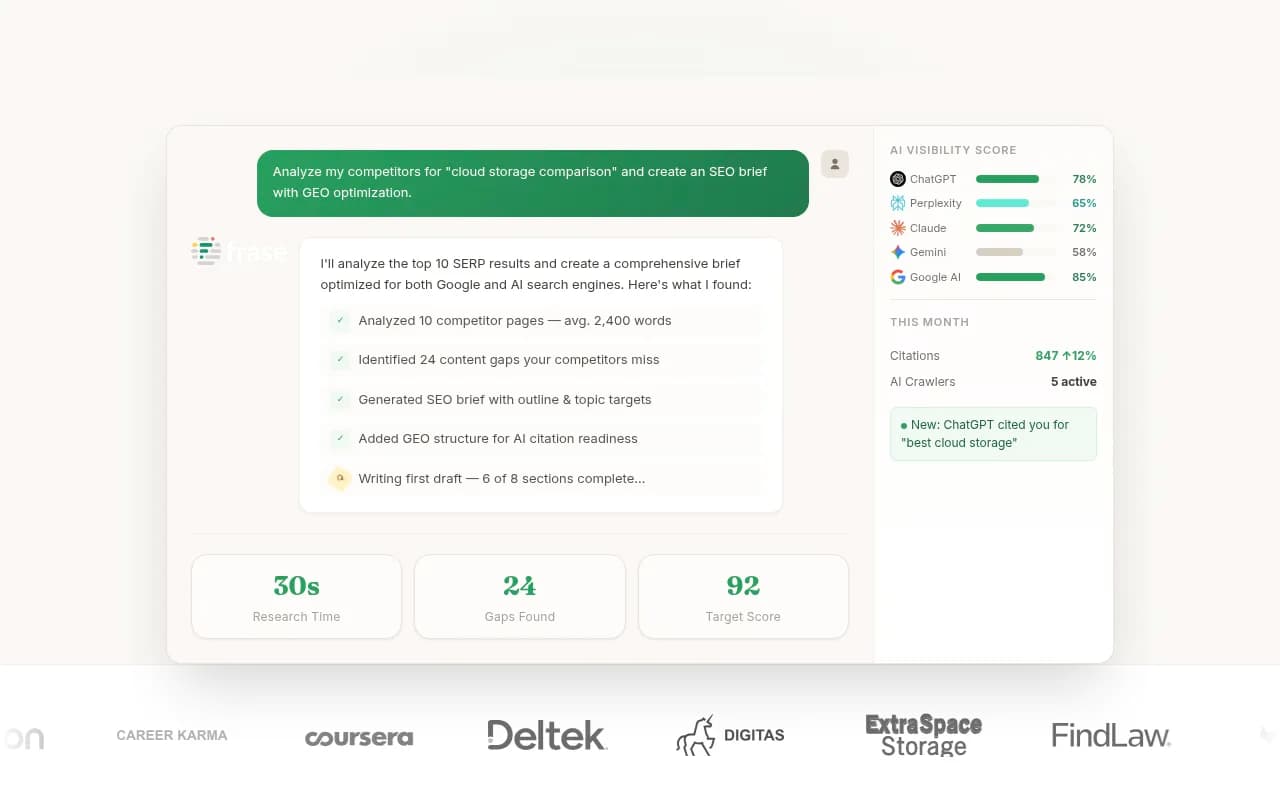
For structuring content, Clearscope and Frase help with coverage of subtopics and follow-up questions, which is where depth really matters.
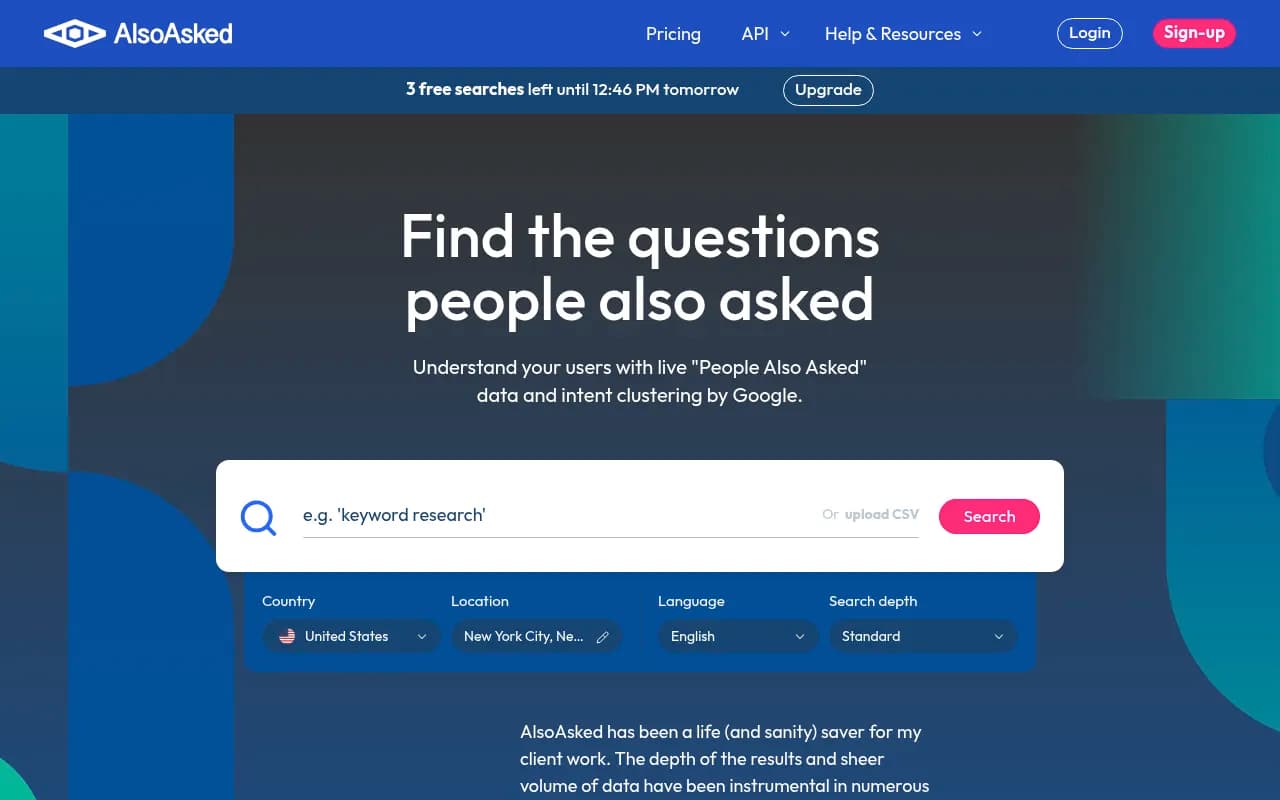
AlsoAsked and AnswerThePublic are useful for finding the follow-up questions a page should answer, and Google Search Console shows which queries your pages already surface for.
| Job | Tools | What it tells you |
|---|---|---|
| Track AI citations by page | Promptwatch, Otterly.AI, Profound | Which pages and passages get cited |
| Find follow-up questions | AlsoAsked, AnswerThePublic | Sub-questions a page must cover |
| Content coverage checks | Clearscope, Frase | Topic gaps against top results |
| Baseline search data | Google Search Console | Queries and pages already earning impressions |
If you want to compare more options, the GEO software directory at bestgeosoftware.com lists the category in more depth.
Common mistakes
- Padding to hit a number. Screpy's warning applies: a 3,000-word guide can be less useful than a 500-word page when the relevant information is diluted by repetition.
- Cutting everything short. Thin pages that answer only one angle get cited for one angle at best.
- Burying the answer. With 44.2% of citations coming from the first 30% of a page, a long preamble costs you.
- Treating vendor ranges as facts. The 120 to 180 word sweet spot is a useful guideline, not a law.
- Ignoring page type. Product and landing pages dominate ChatGPT citations in Promptwatch Data regardless of length.
Bottom line
Word count is a byproduct, not a lever. The evidence is consistent that length alone does not predict citations (Ahrefs's 0.04 correlation is the cleanest number), while depth helps only when it adds answers to real follow-up questions. Start with the query, put the answer first, keep sections self-contained, keep pages fresh, and let the length be whatever the topic needs. Then measure which pages get cited and adjust from your own data rather than anyone's universal rule.