Key takeaways
- No writing tool makes content get cited by itself. Citations depend on what you publish (product pages, landing pages, docs, comparisons), how accurate and current it stays, and whether AI crawlers can reach it.
- Writesonic ranks first for citation-readiness because it is the only one of the five with built-in AI visibility tracking. Jasper is second for brand consistency at scale, Writer third for governed, factual enterprise content.
- Copy.ai and Rytr are short-form and workflow tools. They are useful, but they sit at the bottom for citation-readiness.
- Promptwatch Data shows about 39% of ChatGPT citations go to product and landing pages, so a tool that only spits out blog drafts is aiming at the wrong target.
- Pricing in this space changed a lot. Confirm every number on the vendor's pricing page before buying.
What citation-readiness actually means
I am going to be blunt about this: there is no such thing as a "citation-ready" AI writer in the sense that the software guarantees anything. Nobody has published data showing AI-written content is cited more or less often than human-written content, and I am not going to pretend otherwise. What you can do is judge a tool on whether it helps you produce the kinds of pages AI engines cite, keeps them accurate, and tells you whether the result worked.
So I scored the five tools on four things:
- Page types. Can it produce product pages, landing pages, comparisons, FAQs and docs, not just blog posts?
- Factual grounding. Does it pull live data, enforce terminology or cite sources?
- Freshness. Can you keep specs and prices current at scale?
- Feedback loop. Does it show whether AI engines cite what you publish?
The first one matters more than most people expect. According to Promptwatch Data on ChatGPT citation share by content type (Sep 28 to Oct 4, 2026), product pages are the most cited type at 22.4%, and landing pages follow at 16.8%. Listicles are 13.6%, documentation 7.5%, how-tos 8.7%, comparisons 5.9%. For commercial prompts, product pages, landing pages, listicles and comparisons add up to almost 70% of citations.
That is the opposite of what most AI writing tools are marketed for. They sell blog posts. ChatGPT mostly cites pages that describe what a company sells.
The ranking at a glance
| Rank | Tool | Best for | Citation-readiness strength | Main gap | Starting price (verify) |
|---|---|---|---|---|---|
| 1 | Writesonic | Search and AI visibility workflows | Built-in tracking of ChatGPT, Gemini and AI Overviews, AI articles, site audits | Pricing and tiers conflict across sources; quality ceiling on complex topics | About $79/mo billed annually |
| 2 | Jasper | Brand-consistent marketing content at scale | Brand voice, knowledge assets, GEO agents on Business plan | GEO features need custom-priced plan; non-English quality inconsistent | $69/mo Pro ($59/seat yearly) |
| 3 | Writer | Regulated, fact-sensitive content | Enforced terminology and style, enterprise governance | Not a cheap copywriting tool; no verified citation tracking | $39/user/mo ($29 yearly) |
| 4 | Copy.ai | Sales and go-to-market workflows | Workflow automation | Long-form trails; I did not verify GEO features | $29/mo Chat plan |
| 5 | Rytr | Quick short-form copy | Cheap meta titles, captions, emails | No visibility features, no team seats | $9/mo Unlimited |
1. Writesonic: the only one that closes the loop
Wriesonic has pivoted. The older content-first pricing you will still see in many roundups (Lite at $49, Unlimited at $16 or $39) is outdated. The company now positions itself as an AI search visibility platform, with plans tracking ChatGPT, Gemini and Google AI Overviews alongside AI article generation and site audits.
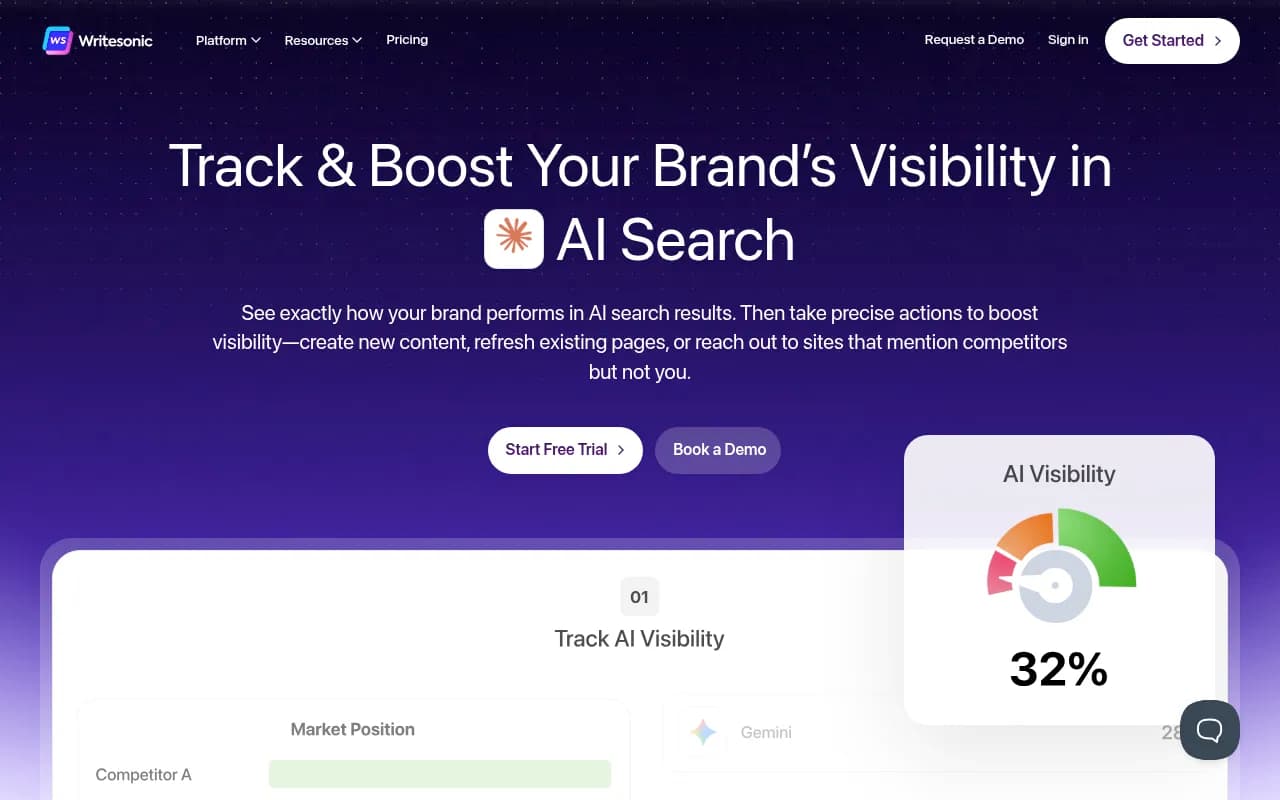
That pivot is why it takes the top spot here. Of the five tools, it is the only one with citation and visibility tracking built in, so you can write, publish and see whether the page shows up in AI answers without leaving the product. Its Article Writer also leans on live search research and reference finding, which helps with factual grounding. Zapier's review notes that Writesonic gives the highest priority to search-optimized content among the apps it tested and mentions the AI platform tracking as worth a look if GEO is on your radar.
Caveats, and there are several:
- Tier names and prices conflict between sources. One review lists a Starter at $99 a month ($79 yearly) tracking 3 platforms with 15 AI articles. The official page lists $79 billed annually, then $399, then a custom enterprise plan. Check writesonic.com/pricing yourself.
- A competitor's review (Profound, so take it with salt) claims Writesonic has no query fan-out support.
- Creaitor notes it hits a quality ceiling on complex topics, and non-English output lags.
Still, if you want one tool that writes and measures, this is the closest of the five.
2. Jasper: best brand control, GEO behind a paywall
Jasper is the enterprise standard for brand voice. It learns your tone from existing content, applies it across outputs, and plugs into Surfer, Google Docs and HubSpot. For a team where ten people and an AI all contribute to the same pages, that consistency matters, because inconsistent product descriptions across a site are exactly the kind of thing that muddies what AI engines say about you.
Pro runs $69 a month, or $59 per seat per month billed yearly, with 1 seat, 2 brand voices, 5 knowledge assets and 3 audiences. The notable part for this guide: GEO agents and the API require the Business plan, which is custom-priced. I could not verify Jasper's current AI-visibility features directly on the vendor site, so treat that as something to ask in a sales call.
Older pricing (Creator at $49) is stale. Non-English quality is also reported as inconsistent, so test before committing if your market is outside the US or UK.
3. Writer: governed facts for regulated teams
Writer is not a cheap copywriting tool. It is an enterprise agentic platform, and that is exactly why it ranks above Copy.ai and Rytr here. Citation-worthy pages are factual pages, and Writer's strength is enforcing terminology and style rules on every output. For finance, healthcare and legal teams, where one wrong claim on a product page is a real problem, that guardrail is worth more than a template library.
Starter is $39 per user per month, or $29 billed annually, with a 14-day trial and no card required, capped at 5 users. Enterprise is custom and adds SOC 2 Type II, HIPAA BAA, SAML SSO and domain-specific Palmyra models. Writer's claim that its newest agent release is 52% cheaper and 48% faster is a vendor claim, not an independent benchmark.
What Writer does not give you is a way to see whether AI engines cite the output. You will need something else for that.
4. Copy.ai: strong on workflow, thin on citation pages
Copy.ai has leaned toward sales and GTM automation: copy that connects to CRM records and workflows. Reviewers consistently say long-form quality trails Jasper or Claude, and that the higher tier is built for revenue teams rather than solo writers.
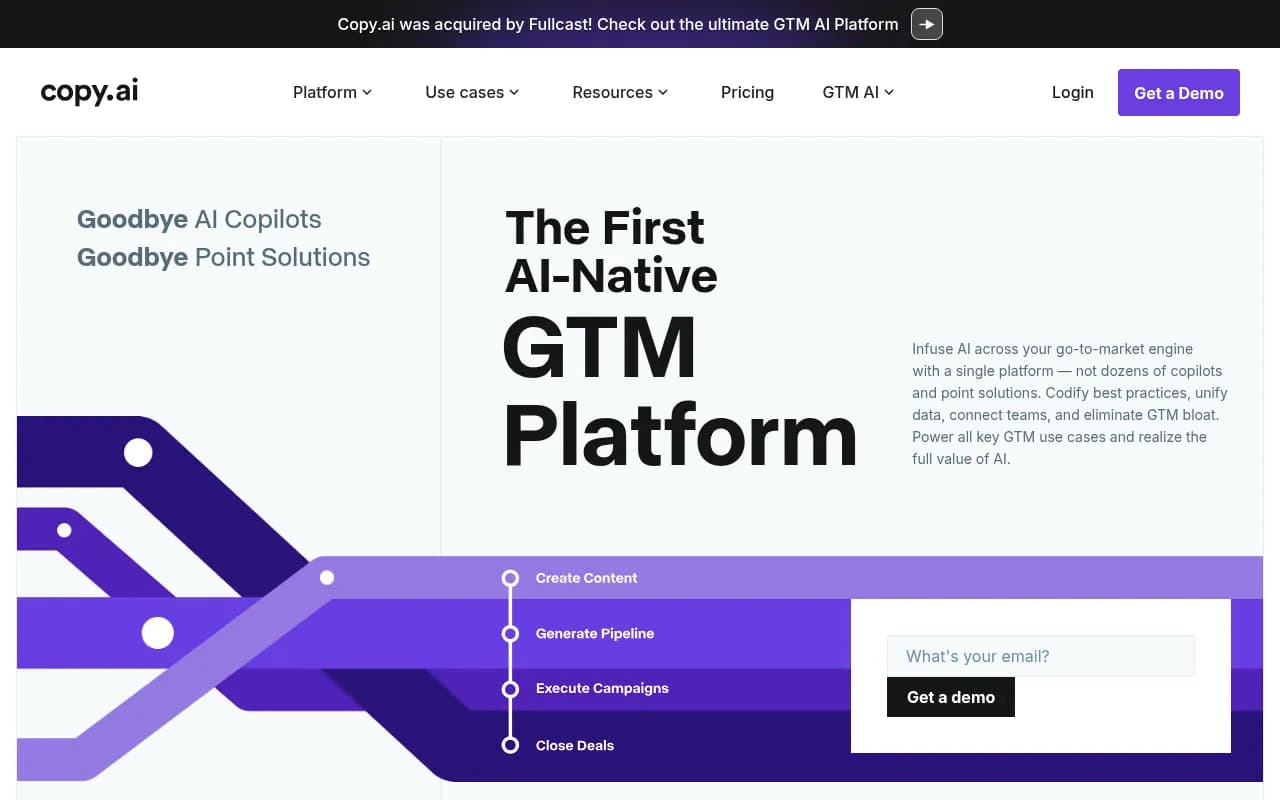
The current pricing I found: a Chat plan at $29 monthly or $24 yearly, then a Growth tier at $1,000 a month billed yearly. The $49 starting price in older roundups is stale. I did not verify Copy.ai's current product direction or any GEO features, so I will not claim any.
Where it can help: outreach, short-form assets and repeatable workflows. Where it will not: owning your comparison pages and docs.
5. Rytr: cheap and fast, but nowhere near the citation surface
Rytr is the budget option. The free plan gives 10,000 characters a month (about 1,700 words). Unlimited is $9 a month ($7.50 yearly), and Premium is $29 ($24.16 yearly). Prices have not moved since at least September 2024. It covers 40+ use cases and 20+ tones, focused on short copy: emails, meta titles, captions, review replies.
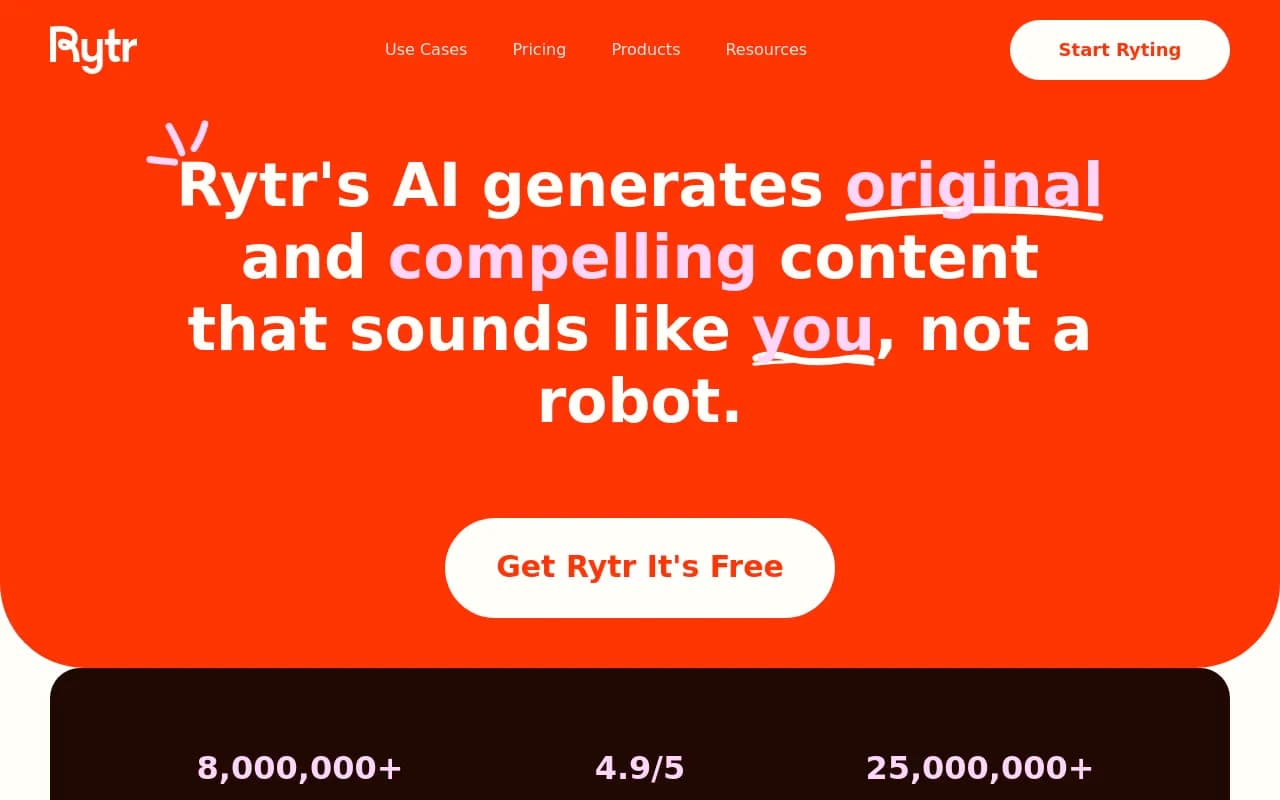
It has no team seats, no SEO or GEO features, and no way to ground output in live data. That makes it weakest for citation-ready long-form pages. It is fine for a freelancer drafting snippets, and I do not want to be unfair to it, because it never pretended to be more.
Why freshness matters more than the first draft
AI-generated pages are easy to produce in bulk and easy to forget. That is a problem, because Promptwatch's content half-life data tracked every page ChatGPT cited on July 6, 2026 through Oct 4, 2026:
| Content type | Still cited after 60 days | Notes |
|---|---|---|
| Landing pages | 69% | 78% after 30 days |
| Docs | 67% | 76% after 30 days |
| Comparisons | 63% | 72% after 30 days |
| Listicles | 60% | Half-life likely near or beyond 90 days |
| Product pages, reviews, how-tos | about 55% | Half-life of 74 to 77 days |
| News | 41% | Half the pages gone after 36 days |
Two lessons. First, the durable types are landing pages, docs and comparisons, so point your writing tool at those, not at news-style posts. Second, pricing pages are classified as landing or product pages, so a stale price or spec on a bulk-generated page is a real citation risk. Whichever tool you pick, build a refresh schedule.
Don't forget the crawler layer
A beautifully written page does nothing if AI crawlers cannot read it. Promptwatch's AI crawler traffic data (June 8 to Sep 6, 2026, IP-verified requests only) shows OpenAI at 79.8% of verified AI crawler requests in the week of Aug 31 to Sep 6, down from 94.8% in early June. Their advice: check robots.txt, CDN and WAF rules for every provider. If a provider looks large in the benchmark but is near zero in your logs, you are probably blocked.
This applies to anything published from these writing tools, because publishing platform settings can quietly block crawlers.
How to pick, by situation
| If you are... | Pick | Pair it with |
|---|---|---|
| A marketing team that wants writing and AI tracking in one product | Writesonic | A second opinion on tracking data |
| A multi-writer brand team needing consistent voice | Jasper | An AI visibility tracker |
| In finance, healthcare or legal | Writer | An AI visibility tracker |
| A sales team building outreach workflows | Copy.ai | A long-form writing tool |
| A freelancer on a tight budget | Rytr | Human editing for anything factual |
The piece none of these five fully covers
Writing is half the job. The other half is knowing which prompts you are missing, which pages AI engines actually cite, whether crawlers can reach you, and what traffic results. Four of these five tools do not tell you any of that, and Writesonic's tracking is only one option in a crowded category.
Tools like Promptwatch sit on the measurement and optimization side: content gap analysis, IP-verified AI crawler logs, citation tracking, and a Content Agent that writes and publishes against the gaps it finds. A reasonable setup is to keep your preferred writer for voice and compliance, and let an AI visibility platform tell you what to write and whether it worked.

If you want to browse more options, the GEO software directory at bestgeosoftware.com lists dozens of trackers and optimizers.
A practical workflow
- Find the prompts where competitors are cited and you are not. Start with commercial prompts, since those lean heavily on product pages, landing pages, listicles and comparisons.
- Draft those page types in your writing tool, using real specs and prices from your own source of truth.
- Add FAQ and documentation sections. Promptwatch's own advice from the content-type report is to keep specs, prices and positioning complete and factual.
- Publish, then confirm AI crawlers can fetch the page.
- Track citations for 30 to 60 days and refresh before the numbers decay.
- Get listed in the roundups ChatGPT cites and collect reviews on trusted sites. Branded prompts cite reviews at 5.6%, more than three times their overall share.
Bottom line
If citation-readiness is your main criterion, Writesonic leads because it measures AI visibility itself, Jasper and Writer are the picks for brand and governance, and Copy.ai and Rytr are tools for other jobs. Prices above come from third-party sources checked in September and October 2026, and several are affiliate-leaning blogs, so confirm everything on the vendor pages first.