Key takeaways
- AI engines lift passages, not pages. Headings, short answer blocks and clean HTML decide whether a passage can be pulled out and quoted.
- Schema is a supporting layer. Third-party studies report big citation lifts for marked-up pages, but those are correlational, and schema added without any content change has minimal impact.
- Page type matters as much as formatting. In Promptwatch Data, product pages and landing pages take about 39% of ChatGPT citations, while FAQ pages take 3.3%.
- Ship plain, server-rendered HTML. Markdown mirrors are 0.05% of AI search citations, and pages a retrieval system can't parse lose citations.
- Structure doesn't keep citations alive. Dates, prices and specs have to stay current.
Why structure matters for AI citations
Traditional SEO rewards crawlability and relevance. AI search rewards extractability: can a system take one section of your page, understand it without the surrounding text, and attribute it to you?
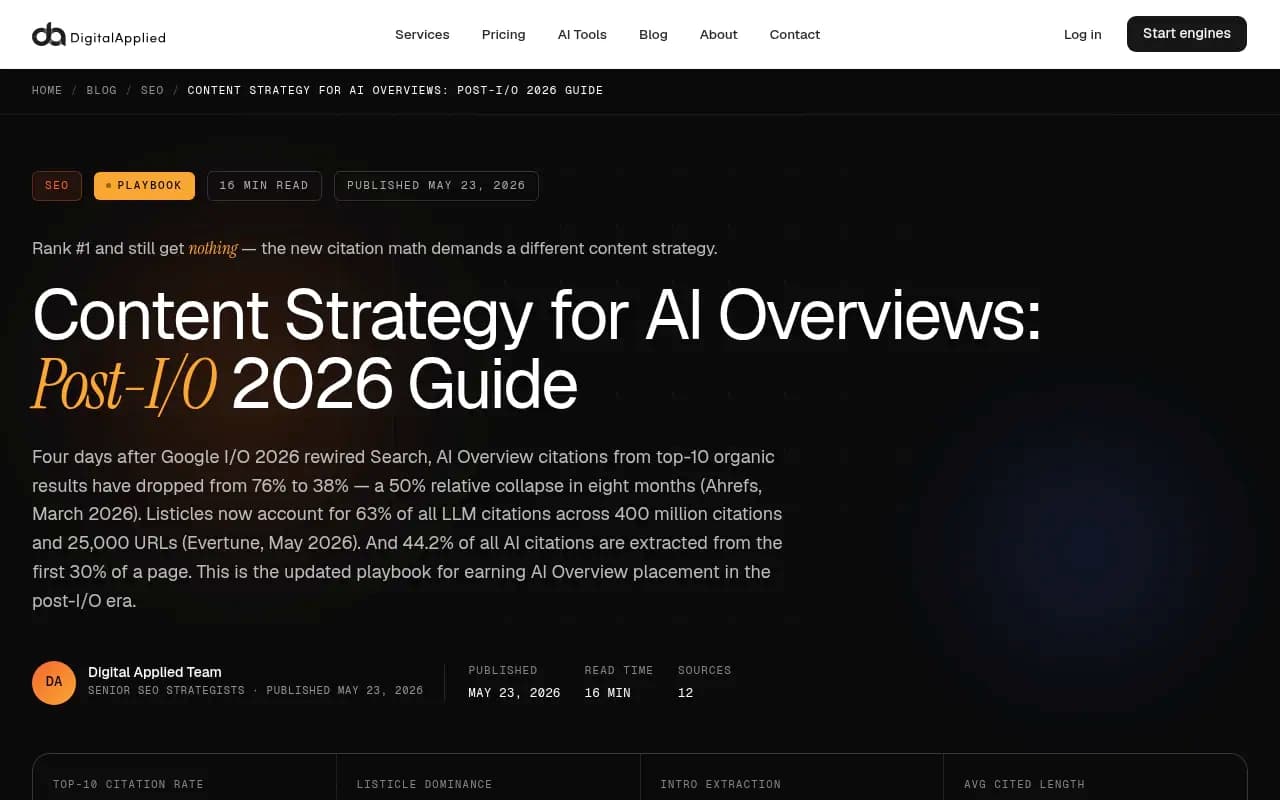
That's a different editorial job. A page can rank well and still not get quoted, because the useful sentence is buried in the fifth paragraph of a rambling section under a heading that says "Our approach." One piece of third-party research from Digital Applied (May 2026), citing Wix and Evertune, claims 44.2% of AI citations come from the first 30% of a page. I haven't verified that number, but it matches what you see in practice: the front of the page and the front of each section do most of the work.
Treat third-party percentages like that one as directional. The first-party data below is more useful for deciding what to build.
Start with what gets cited: page type
Before you touch a heading, check what kind of page you're formatting. Promptwatch Data's report on ChatGPT citation share by content type (Sep 28 to Oct 4, 2026) shows the spread:
| Content type | Share of ChatGPT citations |
|---|---|
| Product pages | 22.4% |
| Landing pages | 16.8% |
| Listicles | 13.6% |
| How-tos | 8.7% |
| Documentation | 7.5% |
| General articles | 6.1% |
| Comparisons | 5.9% |
| News | 5.7% |
| FAQ pages | 3.3% |
| Reviews | 1.7% |
Two things stand out. About 39% of citations go to pages describing what a company sells, so formatting only your blog misses the biggest pool. And FAQ pages are 3.3%, so FAQ schema is not a magic lever.
By prompt type, the picture shifts. Commercial prompts lean on product pages (26.0%), landing pages (20.6%), listicles (15.0%) and comparisons (7.9%). Informational prompts spread out more: how-tos reach 10.7% and docs 8.5%. Branded prompts bring reviews up to 5.6% and FAQ pages to 4.8%.
The practical read: match the structure to the question. Step-by-step guides for informational queries, comparison tables for commercial ones, complete specs and pricing on product pages.
The heading checklist
Headings are how a model decides which passage belongs to which query. A heading like "How to choose a CRM" maps directly to someone asking how to choose a CRM. A heading like "Going further" maps to nothing.
Rules that hold up
- One H1, matching the page's actual topic. Your CMS usually renders it from the title.
- H2s for the main questions the page answers, H3s for sub-points. Never skip levels.
- Write headings the way people phrase queries. Question form works well when it's natural ("How does FAQ schema affect citations?"), and plain topical phrases work when it isn't. Don't force every heading into a question.
- Make each section standalone. If you lifted the H2 and its text out of the page, would it still make sense? Avoid "as mentioned above" and unexplained pronouns at the start of a section.
- Avoid clever headings. Cute beats clear for humans sometimes. For extraction it never does.
Heading mistakes I see most
- Styling text as a heading with bold or large font instead of real heading tags.
- Using H3s as visual decoration under an H1 with no H2s.
- Headings that are only a brand term or a vague noun ("Overview", "Solutions").
- A single giant section with 1,500 words under one heading.
Answer-first blocks
The pattern that shows up in every serious write-up on this: put the direct answer in the first one or two sentences under the heading, then expand.
## How long does ChatGPT keep citing a page?

Landing pages and docs stay cited longest: about 78% and 76% were still cited after 30 days. News drops fastest, with half its pages gone after 36 days. The details follow below.
That opening is quotable on its own. A model can lift it, and a human skimming gets the answer without scrolling. Then you add the nuance, the table, the caveat.
A few habits make these blocks work:
- Lead with the claim, include the number and the subject in the same sentence.
- Name the entity. "Product pages" beats "they". "ChatGPT" beats "the model".
- Keep the lead to roughly two sentences. Long preambles defeat the point.
- Attribute stats to a named source and a period. "Promptwatch Data, Sep 28 to Oct 4, 2026" is stronger than "studies show".
Lists, tables and other extractable formats
Listicles are 13.6% of ChatGPT citations, and comparisons and how-tos add another 14.6% between them. Formats with obvious structure are easy to lift.
Tables
Use real HTML tables for comparisons, specs and pricing. Keep column headers descriptive and put one concept per row. Avoid merged cells and tables built from images.
Numbered steps
Use numbered lists for sequences and bullets for unordered sets. Start each step with a verb. Keep each step self-contained.
Definitions and short blocks
A one-sentence definition under a "What is X" heading is easy for a system to reuse. Follow it with context rather than burying the definition mid-paragraph.
Don't hide content
Tabs, accordions and "read more" toggles are fine if the text is in the HTML on load. If the content only appears after interaction or client-side rendering, a retriever may never see it.
Schema: useful, but not a shortcut
Here's where I'd be careful. Two third-party figures circulate widely: pages with schema cited 2.3x more often (Hashmeta, 100,000 responses) and about 73% higher selection for structured pages in AI Overviews (Leapd). Both are correlational. Pages with schema tend to be better-maintained pages in general. Eastern Standard's breakdown rates schema added without any content change as minimal to none for citation impact.
So treat schema as a layer that confirms what the visible page already says. Don't expect it to rescue thin content.
Which types to use
| Schema type | Use it when | Watch out for |
|---|---|---|
| Article | Any blog post or guide | Keep author, dates and headline accurate |
| FAQPage | The page has a visible Q&A section | Markup must match visible text |
| HowTo | The page has real step-by-step instructions | Don't tag general advice as steps |
| ItemList | Listicles and ranked roundups | List order should match the markup |
| Product / Offer | Product pages | Prices and availability must be current |
| Organization / Person | About pages, author pages | Consistent names across the site |
The rule from the checklists I've read: use FAQPage, HowTo or ItemList only when the visible content supports it. Markup that describes content that isn't on the page is a quality problem, not an optimization.
I didn't check Google's or OpenAI's official structured data documentation for this guide, so confirm current eligibility rules there before shipping anything at scale. Platforms like Schema App exist for managing structured data across big sites, and a plugin like Yoast handles the basics on WordPress.
Technical delivery: HTML first
This part is boring and decides a lot. Promptwatch Data's markdown report (7 days of citations across ChatGPT, Claude, Perplexity and AI Overviews) found HTML is 99.94% of citations, markdown files 0.05% and images 0.015%. That's roughly 2,000 to 1.
What that means for you:
- Skip .md mirrors of your marketing pages for AI search purposes. Put the effort into HTML with a clear heading hierarchy and semantic markup.
- Fix heavy client-side JavaScript rendering first. If a retrieval system can't parse the page, no formatting helps.
- Reserve markdown endpoints for developer docs. Coding agents do fetch /docs/*.md paths, and Promptwatch saw thousands of those requests, but that's agent traffic, not AI search citations.
A crawler like Screaming Frog is handy for checking what the raw HTML contains, and rendering tools such as Prerender.io help if your framework hides content behind JavaScript.
Keep it fresh: structure doesn't sustain citations
A tidy page that goes stale gets dropped. Promptwatch Data's content half-life study tracked every page ChatGPT cited on July 6, 2026 for 90 days:
| Content type | Still cited after 30 days | Still cited after 60 days |
|---|---|---|
| Landing pages | 78% | 69% |
| Docs | 76% | 67% |
| Comparisons | 72% | 63% |
| Listicles | n/a | 60% |
| Product pages, reviews, how-tos | n/a | about 55% |
| News | n/a | 41% |
News loses half its pages within 36 days, and almost a quarter of news pages are never cited again after the first day. Product pages, reviews and how-tos have half-lives of 74 to 77 days.
So put a refresh date on the calendar. Update prices, specs, stats and screenshots, and change the visible "last updated" date only when something real changed.
The 10-point formatting checklist
- Pick the right page type for the query: product, landing, how-to, comparison, docs.
- One descriptive H1. Logical H2 and H3 hierarchy, no skipped levels.
- Headings that read like the queries they answer.
- A one-to-two sentence direct answer under each H2.
- Self-contained sections with named entities instead of vague pronouns.
- Real HTML tables for comparisons, numbered lists for steps.
- Named, dated sources for every statistic.
- Article schema, plus FAQPage, HowTo or ItemList only where the visible content matches.
- Content visible in the rendered HTML without clicks or heavy JavaScript.
- A scheduled refresh for anything with a date, price or spec.
Checking whether it worked
Formatting is a hypothesis until you see what gets cited. You want to know which of your prompts cite you, which pages get crawled by AI bots, and whether updated pages start appearing. Tools like Promptwatch track citations across ChatGPT, AI Overviews and others and show crawler activity per page, which helps connect a formatting change to a result.

Other options in the category include Profound and Peec AI for monitoring, and Google Search Console for your own search-side data. If you want to browse more, the GEO software directory at bestgeosoftware.com lists the field.


What to do this week
Pick your five most important pages. Check each one's rendered HTML, rewrite the headings to match real questions, add an answer-first lead under each, and confirm schema matches visible content. Then re-check citations in a few weeks. If a page type you rely on is rarely cited at all, the fix isn't a prettier heading. It's publishing the page type AI actually cites for that question.