Key takeaways
- In healthcare, ChatGPT leans hard on government and research sources. Promptwatch Data (Sep 9 to Oct 8, 2026) shows NIH at 5.46% of healthcare citations, more than the FDA, NHS, CMS and SAMHSA combined. You usually win by citing those sources well, not by outranking them.
- Compliance and citability are not opposites. Unbranded educational content, clear structure and linked primary sources are easier to approve and easier for AI to lift.
- Format matters as much as expertise. Question-based headings, HTML pages instead of scanned PDFs, and short self-contained answers make legal and financial analysis readable by machines.
- Different engines trust different things. BrightEdge found ChatGPT's top healthcare sources are agencies and hospital systems, while Google AI Overviews put YouTube above every clinical source.
- Measure citations, not just mentions. Being named in an answer and being used as its source are different outcomes with different fixes.
Why regulated content is a different game
Google calls healthcare, finance and legal topics YMYL, short for Your Money or Your Life. These are categories where bad content could plausibly hurt someone's health, finances, safety or wellbeing, and Google's Search Quality Rater Guidelines hold them to a higher standard. AI engines behave similarly. They get cautious, they pull from institutions, and they reward pages that look like they were written by someone accountable.
That creates a bind for marketers. Your compliance team wants fewer claims, more disclaimers and slower approvals. Your AI visibility goals want clear, direct, quotable answers. I think most teams treat these as opposing forces, and that is the first mistake. The content types that clear review fastest (educational, unbranded, well-sourced) are often the same ones AI engines cite.
This guide walks through how to write for that overlap. It covers who AI trusts in each category, how to structure pages, how to build a workflow that survives review, and how to check whether any of it worked.
What AI engines actually cite in YMYL categories
Before writing anything, look at who is already winning. The pattern differs by industry and by engine.
Healthcare: institutions dominate
Promptwatch's healthcare citation report (organic healthcare prompts in ChatGPT, Sep 9 to Oct 8, 2026) gives a clear picture:
- NIH is the top source at 5.46% of all healthcare citations, spread across six nih.gov subdomains. PubMed Central takes 2.38% and PubMed 2.33%.
- The FDA is second at 1.76%, including its drug database. The NHS is third at 1.1%.
- The American Society of Plastic Surgeons is the top non-government site at 0.64%, followed by the American Academy of Dermatology at 0.54%.
- Mayo Clinic (0.49%) and Cleveland Clinic (0.4%) are the only hospitals in the top 20.
- By source type, government and public health sites earn 7.06%, NIH and its databases 5.46%, medical associations 1.39%, hospitals and clinics 0.89%, and reviews and directories 0.46%.
Two details stand out. The top 20 domains together earn only 15.54% of healthcare citations, so the long tail is large. And the AAD and ASPS together (1.18%) beat Mayo Clinic and Cleveland Clinic combined. Specialty associations punch above their weight, which matters if you are a specialty practice or a company working with one.
Healthcare and finance across engines
BrightEdge's weekly analysis, pulled from its AI Hyper Cube, compared cited-domain lists for healthcare and finance in ChatGPT and Google AI Overviews in the same week. Its headline: ChatGPT's five most-cited healthcare sources are government agencies and hospital systems, while Google AI Overviews puts YouTube above every clinical source. Authority, in their words, is not one standard.
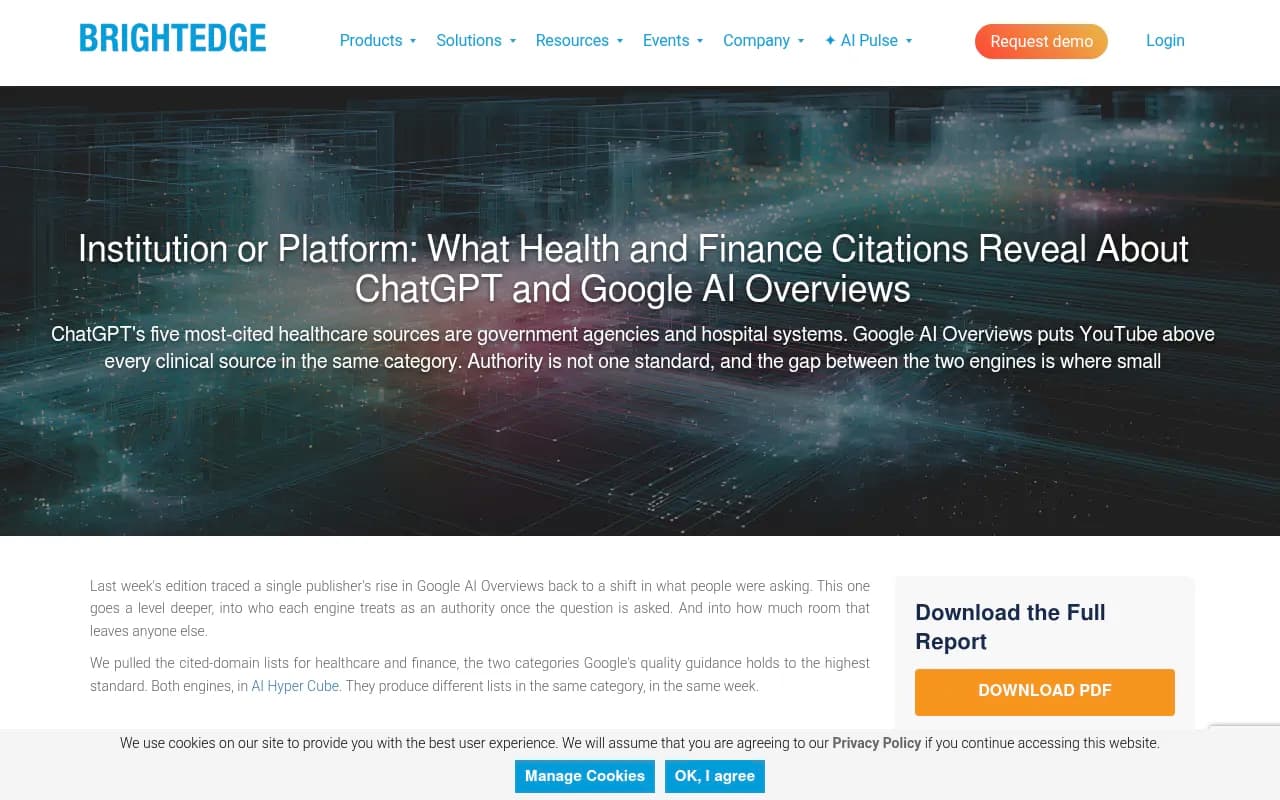
Promptwatch's social citation data points the same way. From Sep 28 to Oct 4, 2026, ChatGPT got 0.46% of its citations from social platforms, while Google AI Overviews got 12.2%. If you work in a sensitive category, a video strategy may matter for Google's surfaces and almost not at all for ChatGPT.
Finance and legal
I did not find a Promptwatch report specific to finance or legal, so treat the following as directional rather than measured. BrightEdge's finance work looked at citation presence by rank position in each engine's top five, and the general pattern holds: established institutions and regulators crowd the top spots. For legal, a 2026 study of 55,393 queries cited by Best Lawyers found that 29.8% of domains cited in Google AI Overviews appeared nowhere on page one of results. Ranking well helps, but it is not the gate it used to be.
Content types that get cited
Compliance aside, the content format has a large effect. Promptwatch's content type report (ChatGPT, Sep 28 to Oct 4, 2026) breaks down all prompts like this:
| Content type | Share of ChatGPT citations |
|---|---|
| Product pages | 22.4% |
| Landing pages | 16.8% |
| Listicles | 13.6% |
| How-tos | 8.7% |
| Documentation | 7.5% |
| General articles | 6.1% |
| Comparisons | 5.9% |
| News | 5.7% |
| FAQ pages | 3.3% |
| Reviews | 1.7% |
For informational prompts, which is where most YMYL questions live, how-tos rise to 10.7% and documentation to 8.5%. Branded prompts shift toward reviews (5.6%), FAQ pages (4.8%) and press releases (2.1%).
What this means in practice: a plain step-by-step guide or a documentation-style explainer is a legitimate citation candidate. You do not need flashy content. And a well-built FAQ page is a cheap way to cover branded questions, which is also where inaccurate claims about you tend to surface.
Shelf life matters too. Promptwatch's content half-life data shows landing pages and docs stay cited longest, while news loses half its cited pages within 36 days. For regulated topics where accuracy beats freshness, evergreen reference pages are a better investment than reactive commentary.
Healthcare and pharma: write around the MLR bottleneck
Pharma is the hardest case. Research on the topic describes a layered compliance stack, with Medical, Legal and Regulatory review commonly averaging 50 to 60 days per piece. Standard GEO needs fast iteration. MLR does not allow it.
The workable answer is to split content into zones by risk.
| Zone | Content | Review burden | AI citability |
|---|---|---|---|
| Disease awareness (unbranded) | Condition explainers, symptom guides, treatment landscape, epidemiology data | Standard medical review, faster than promotional | High |
| Patient-HCP dialogue | "What to ask your doctor about [condition]" resources | Standard medical review | High |
| Company and entity pages | Leadership, research, pipeline overviews | Moderate | Medium |
| Branded product content | Indications, efficacy, safety | Full MLR clearance | Optimize last |
Unbranded disease awareness content is the highest-leverage place to start. It sidesteps promotional requirements and answers the exact questions patients and clinicians ask AI systems before they ever see branded material. Patient preparation guides are especially useful, since AI engines often cite them for questions like "what should I ask my doctor about [condition]", which are high-intent moments.
Practical rules for healthcare writers
- Back up medical claims with peer-reviewed studies and link them on PubMed or PubMed Central. Given NIH's citation share, this is not decoration. You are connecting your page to the sources the engine already trusts.
- Align pages with FDA, CDC, NHS and NICE guidance, and link to it. Say where your content differs and why.
- Work with the medical associations in your specialty. The AAD and ASPS numbers show associations earn real citation share.
- Keep doctor and provider profiles complete. Doctify and WebMD doctor profiles are the only review and directory sites in the top 20, at 0.23% each.
- Name a clinical reviewer with credentials and a review date on every page.
Finance: the quiet compliance mistakes
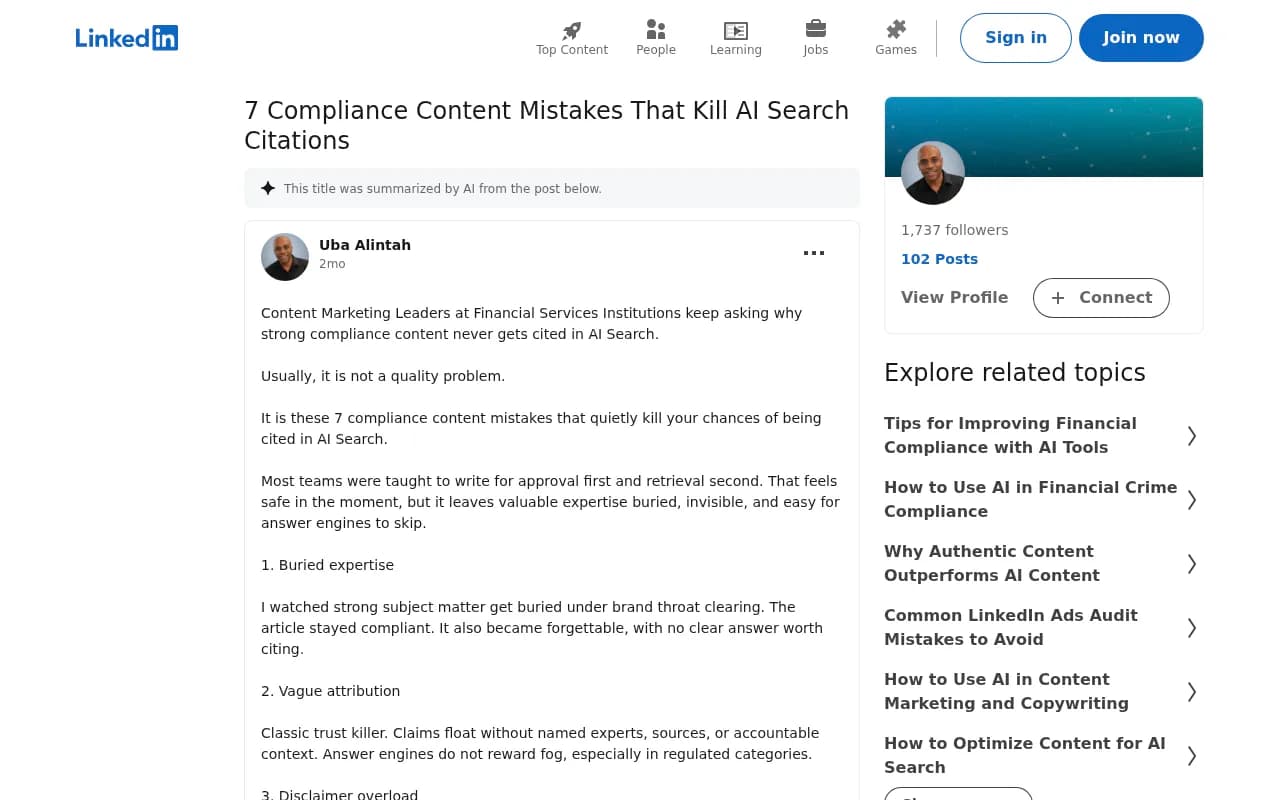
Financial services marketers often ask why strong compliance content never gets cited. A LinkedIn post by Uba Alintah lists seven compliance content mistakes that kill AI citations. The patterns are familiar from audits I have seen: content hidden in gated PDFs, heavy boilerplate that buries the answer, vague headings, and disclaimers that swamp the first screen of text.
A few fixes that rarely cause friction with compliance:
- Put the answer in the first two sentences under each heading, then add the qualifications. Disclaimers belong in a consistent, labeled block, not in the middle of the answer.
- Publish rate, fee and eligibility explainers as HTML pages with dates, not PDFs. State the "last reviewed" date and the reviewer.
- Cite the regulator, statute or filing directly, and link it. Do not paraphrase a rule without saying which rule.
- Say what you know that the category cannot easily aggregate. BrightEdge's advice is to find the thing only you can say: proprietary data, original survey results, your own product mechanics. Generic personal finance advice competes with every institution on earth. Your own loan performance data does not.
That last point is the real strategy. In YMYL categories you will rarely beat government sites at general explainers. You can be the best source for the narrow, specific thing you actually know.
Legal: structure is the whole battle
Best Lawyers' guide to legal content makes a point I agree with: most firms are not short on good material. The analysis exists. It gets posted as a scanned PDF, filed under a heading that says "Overview", or buried under four paragraphs about the firm's founding. Then the software reading the page gives up, just as a client on a phone would.

Concrete changes:
- Convert PDFs and images of text to searchable HTML pages. Offer the PDF as a download in addition, not instead.
- Use question-based headings, such as "Can an employer change my contract without notice?", instead of "Overview".
- Lead each section with a direct answer, then add jurisdiction, exceptions and caveats.
- Link practice pages, articles and attorney bios to each other so the relationship between expertise and author is explicit.
- Mark every article with the author, bar admission, jurisdiction and last reviewed date.
The advertising-rule side (state bar rules, testimonials, "results may vary" language) is jurisdiction specific and outside what I can responsibly summarize here. Get it signed off by your own ethics counsel, and build the approved disclaimer language into your templates so writers do not reinvent it each time.
A workflow that survives compliance review
The cheapest way to avoid headaches is to move compliance earlier, not later.
- Pre-approve a claim library. Compile statements, statistics and phrasing that legal has already cleared, each with its source. Writers pull from it instead of inventing claims.
- Template the disclaimers. One reviewed block per content type, placed consistently, so reviewers stop re-debating it.
- Write the answer, then the caveat. Reviewers see both, and engines can lift the first without the second distorting it.
- Source everything. Every factual claim gets a primary link. Reviewers approve faster when they can click through.
- Date and attribute. Reviewer name, credentials, review date, next review date.
- Keep a Brand Book or knowledge base. Store approved positioning, facts and tone so AI-assisted drafts stay inside the lines.
If you use AI writing tools in this process, treat them as drafting aids only. In regulated categories a human subject expert must verify facts. Tools like Writer, built for governed enterprise workflows, are designed for this kind of control.
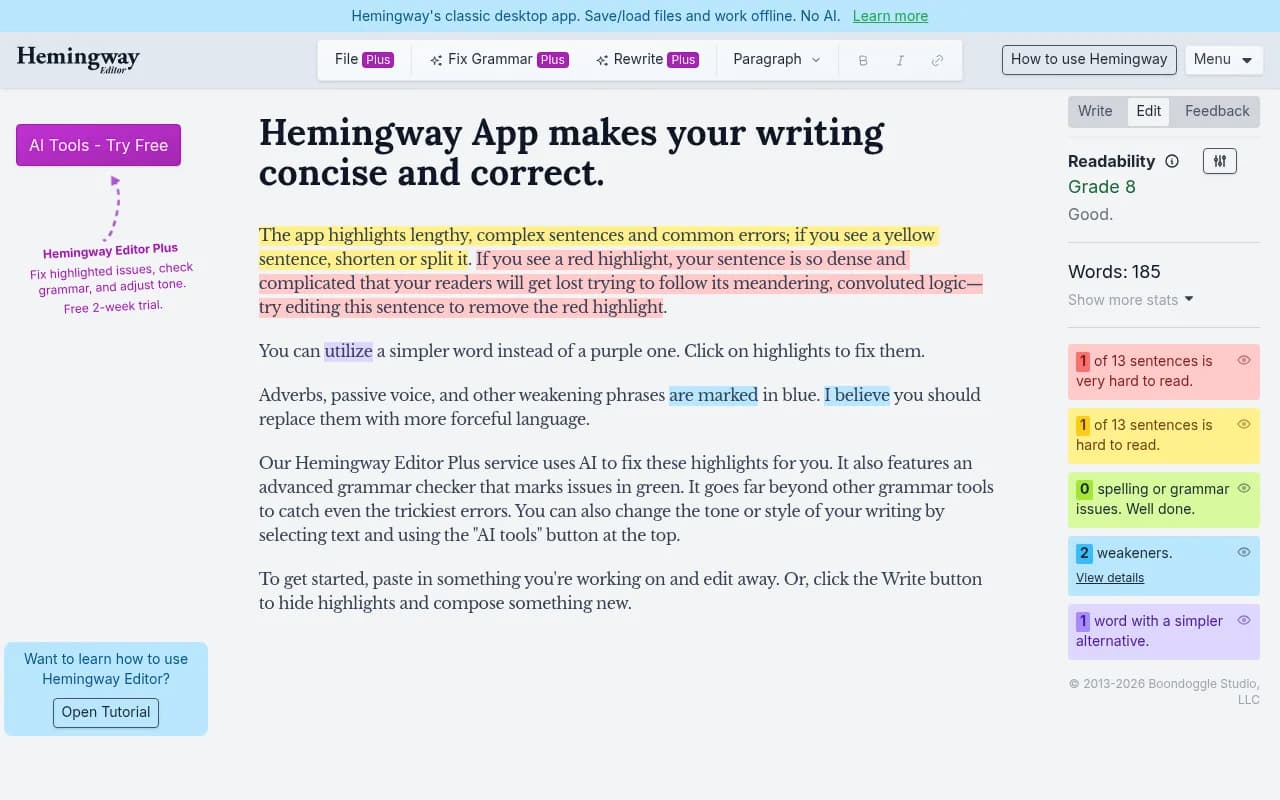
For readability and clarity checks on drafts, Hemingway App is a quick way to catch the sprawling sentences that make answers hard to extract.
Technical foundations that still matter
BrightEdge puts it bluntly: start with Google, and do not read format as a shortcut. Foundational SEO remains the cost of entry to both surfaces. Google also says there is no special optimization needed for its AI features, so the basics apply.
- Make sure AI crawlers can reach your pages. Check robots.txt and your CDN rules, since overzealous bot blocking is a common self-inflicted wound in regulated industries. Promptwatch's AI crawler traffic data covers weekly verified requests from OpenAI, Anthropic, Google, Perplexity and Mistral.
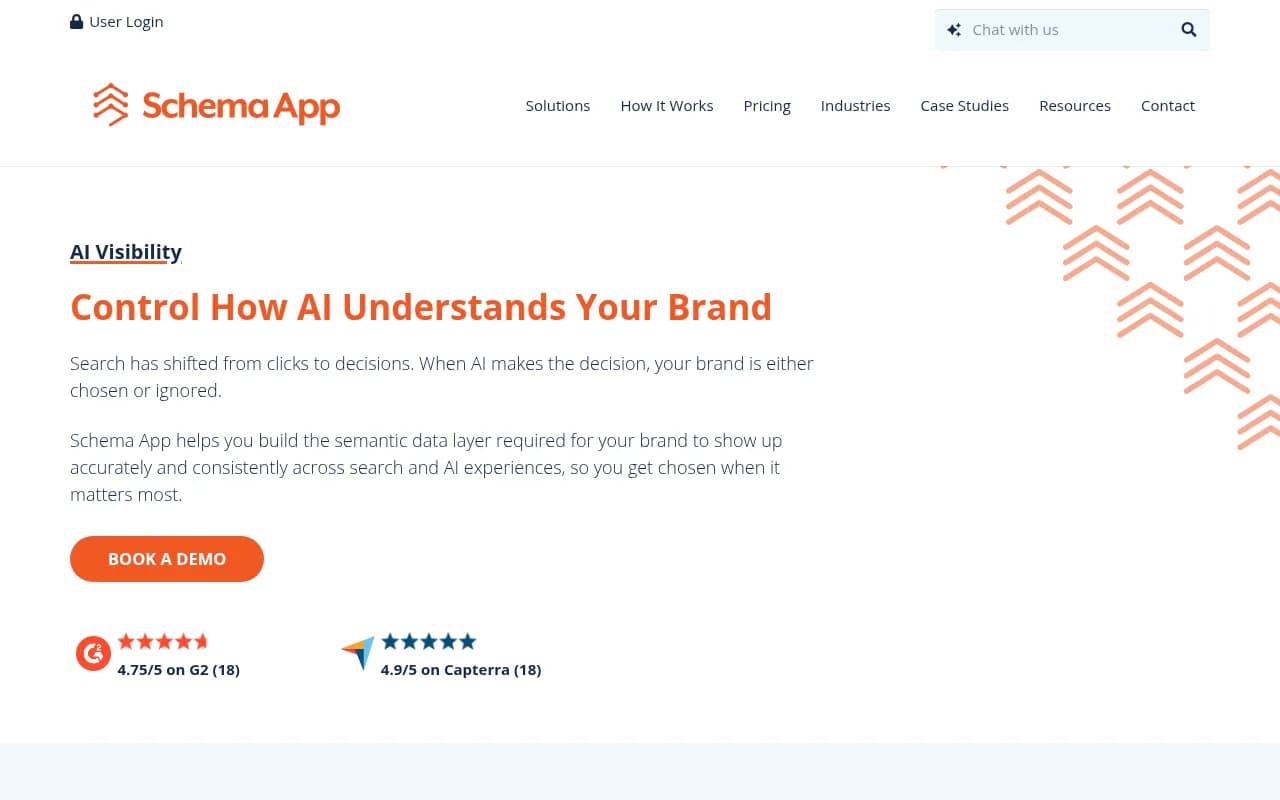
- Add structured data that matches visible content. A platform like Schema App can manage this at scale.
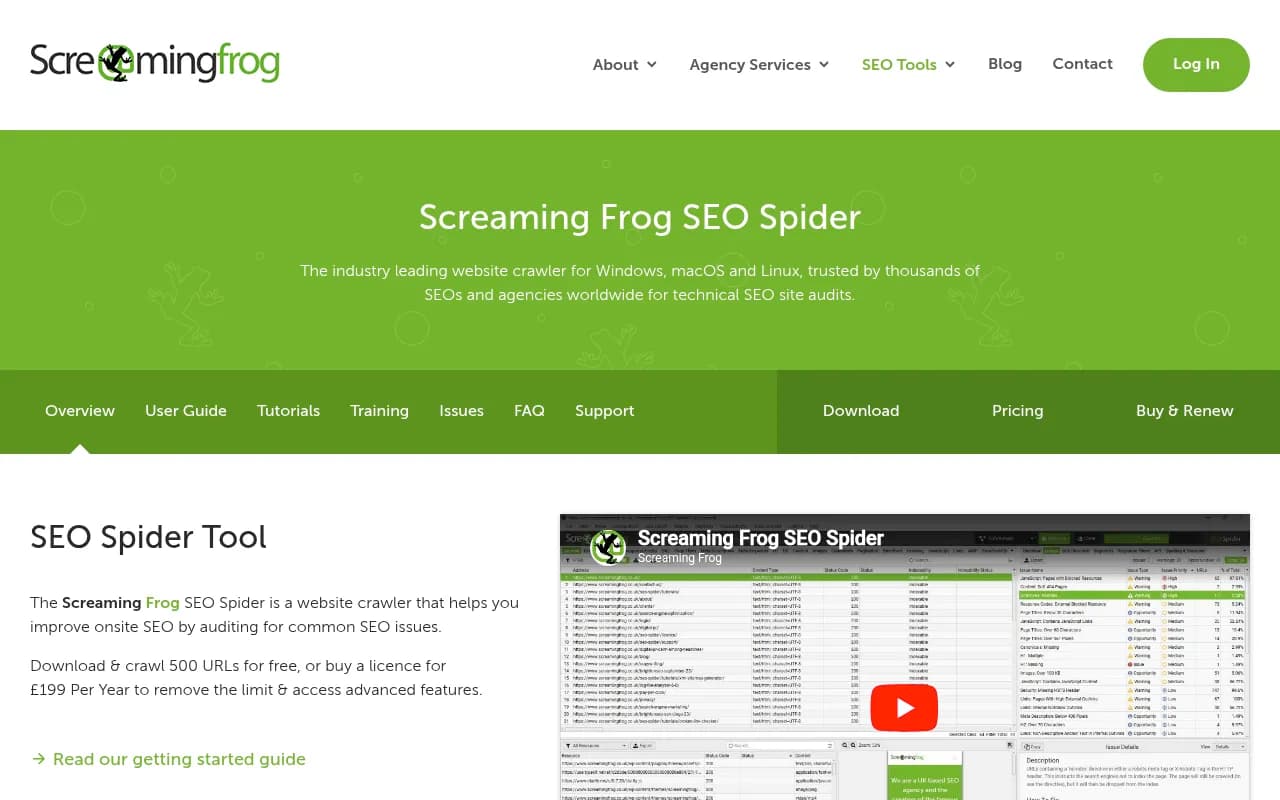
- Crawl your site for broken links, orphaned pages and thin or duplicate content. Screaming Frog SEO Spider does this well.
- Skip gimmicks. Promptwatch's data shows markdown files make up just 0.05% of AI search citations, so do not spend review cycles on formats built for agents rather than search.
- Do not assume domain authority is the gate. In August 2026, sites with domain rank 46 to 75 earned almost half of ChatGPT citations, while DR 91 to 100 fell to about 3%, per Promptwatch's domain rank data. Mid-authority specialists can win.
Also expect to be cited alongside many others. Almost half of ChatGPT responses cite 10 or more unique domains (Sep 28 to Oct 4, 2026), so there is room for more than one winner per answer.
Measuring whether it worked
A useful distinction from the AI visibility writing I have seen: being mentioned in an AI answer and having your page used as its source are different outcomes with different causes. Report them separately. A mention without a citation usually means the engine knows your brand from elsewhere but your page is not the source, which points to a content or crawlability problem.
For regulated content you also want to catch misstatements. If an engine misdescribes your fees, your indications or your jurisdiction, you want to know quickly, because that is a compliance issue and a visibility issue at once.
Promptwatch tracks how brands show up across ChatGPT, Google AI Overviews, Perplexity and other engines, and its crawler logs show whether AI bots can actually read your pages, which is the first thing to rule out when a compliant page is not getting cited.

Other options worth comparing:
| Tool | Useful for | Notes |
|---|---|---|
| Promptwatch | Tracking citations, crawler logs, content gap analysis | Covers many AI engines plus action workflows |
| BrightEdge | Enterprise SEO and AI Hyper Cube cited-domain views | Source of the cross-engine health and finance analysis |
| Profound | Enterprise AI visibility monitoring | Monitoring-focused |
| Otterly.AI | Lightweight prompt tracking | Budget option |
| Google Search Console | Baseline search performance | Free, essential |


For more options, the GEO software directory at bestgeosoftware.com lists many of these side by side.
A starter plan for the first 90 days
- Weeks 1 to 2: Pull the cited-domain list for your category in each engine. Note which institutions dominate and which content types appear.
- Weeks 2 to 4: Audit crawlability, convert PDFs to HTML, and rewrite vague headings as questions.
- Month 2: Build your claim library and disclaimer templates with compliance. Publish five to ten reference pages that lead with the answer and cite primary sources.
- Month 3: Add the content only you can write: proprietary data, original analysis, patient or client preparation guides. Start tracking citations by page and review monthly.
Expect slow movement. Landing pages and docs hold citations for months, which cuts both ways: wins last, but so do gaps.
What to remember
In healthcare, finance and legal, you are not going to out-authority the NIH or the SEC. You can link to them accurately, say something specific that they do not, and publish it in a format a machine can read without guessing. That is also, conveniently, the content a compliance reviewer finds easiest to approve. Start with one reference page per core topic, get it reviewed, and track whether it earns citations before scaling the process.