Key takeaways
- No published benchmark ranks named AI content writers by how often their articles get cited in ChatGPT, Perplexity or AI Overviews. We looked. This guide does not invent one.
- What it gives you instead is a protocol for running the test on your own site with seven common writers, plus the research on what makes a page more likely to be cited.
- A peer-reviewed SIGIR 2026 study of 252,000 trials found topical relevance and list position matter most, price and recency help, and formatting-only edits barely move the needle.
- Promptwatch Data shows product pages, landing pages and listicles earn the most ChatGPT citations, so a blog post from a writer tool is only one of several formats worth testing.
- Measure citations per page, not a vague visibility score. Crawl access, citations and traffic are three separate questions.
Why there is no leaderboard (and why that matters)
The title of this guide started life as a headline promising seven tools, one winner and a table of citation counts. When I went looking for the data, it was not there. The research turned up no report, from Promptwatch or anyone else, that runs named AI writers against the same brief and counts which output gets cited.
So I am not going to hand you made-up numbers. A fake scoreboard would be worse than none, because you would pick a tool on it. What I can do is give you the setup to produce your own results in a few weeks, along with the evidence on what moves citations.
That is arguably more useful anyway. Citation outcomes depend on your domain, your topic, the prompts you target and the day you run the check. Results from someone else's site would transfer poorly.
If you want to see what a skeptic sounds like, this LinkedIn post by SEO consultant Mantas Tamosaitis is a fair summary of the complaint. He says many AI SEO writers cannot identify user intent, avoid answering questions directly, repeat filler openings, and after a few posts start producing duplicate-intent articles that cannibalize each other. He still uses AI writers, but prefers ones where you can customize output with prompts and scraping. Keep those failure modes in mind. They are what the test below is designed to catch.
What a GEO brief is, and why the brief matters more than the tool
A GEO content brief is an SEO brief extended for AI search. According to Contadu's GEO brief guide, it adds five fields on top of the usual keyword, intent and outline: the questions the page must answer, the direct answer for each, the entities to cover, the evidence to include, and which passages you want AI systems to cite. Their point is that you do not need two briefs, just one with those extra fields.
This matters for the test because it removes a variable. If you give seven tools seven different prompts, you are comparing your prompting, not the tools. Use the same brief for all of them.
A separate Demand Genius experiment, which tested four AI setups on real content libraries, reported that a skilled brief plus a content database produced evidence-backed advice 96% of the time. That study is about strategy advice rather than citations, so I would not stretch it. But it points the same direction: input quality drives output quality.
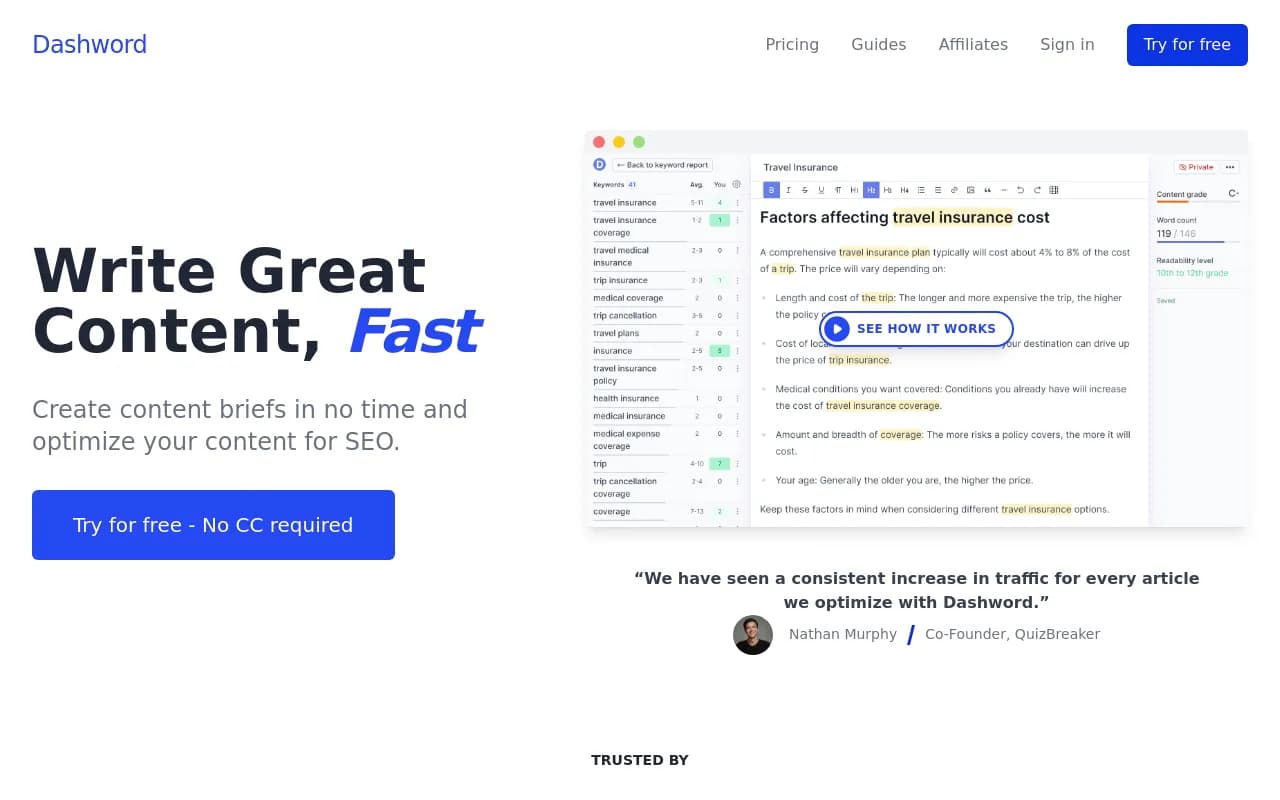
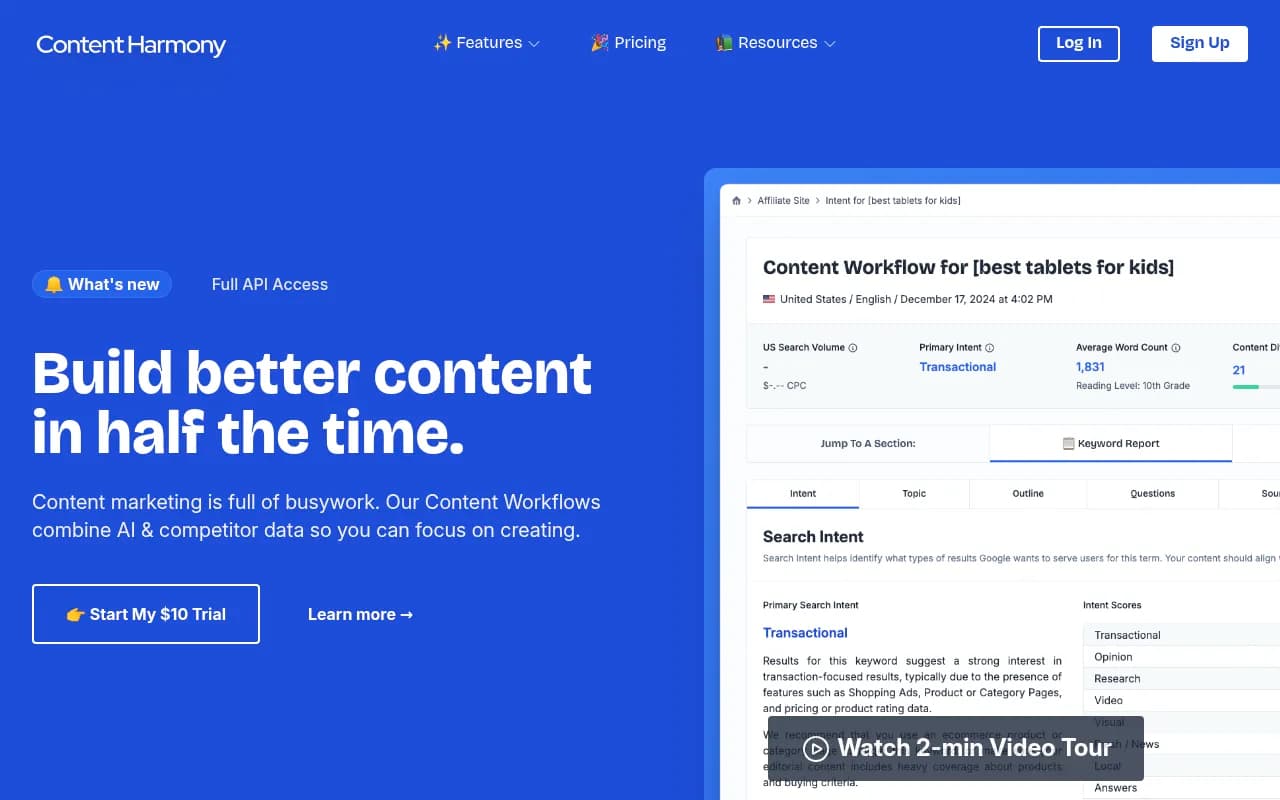
Brief tools can help you build the input. Dashword and Content Harmony both focus on briefs.
What the research says gets a page cited
The most rigorous source I found is the SIGIR 2026 paper What Gets Cited: Competitive GEO in AI Answer Engines, from Sprinklr researchers. They built a controlled setup where exactly two candidate sources are placed in the model's context and measured which one the first citation marker points to. Across six LLMs they ran 252,000 trials covering 18 content factors.
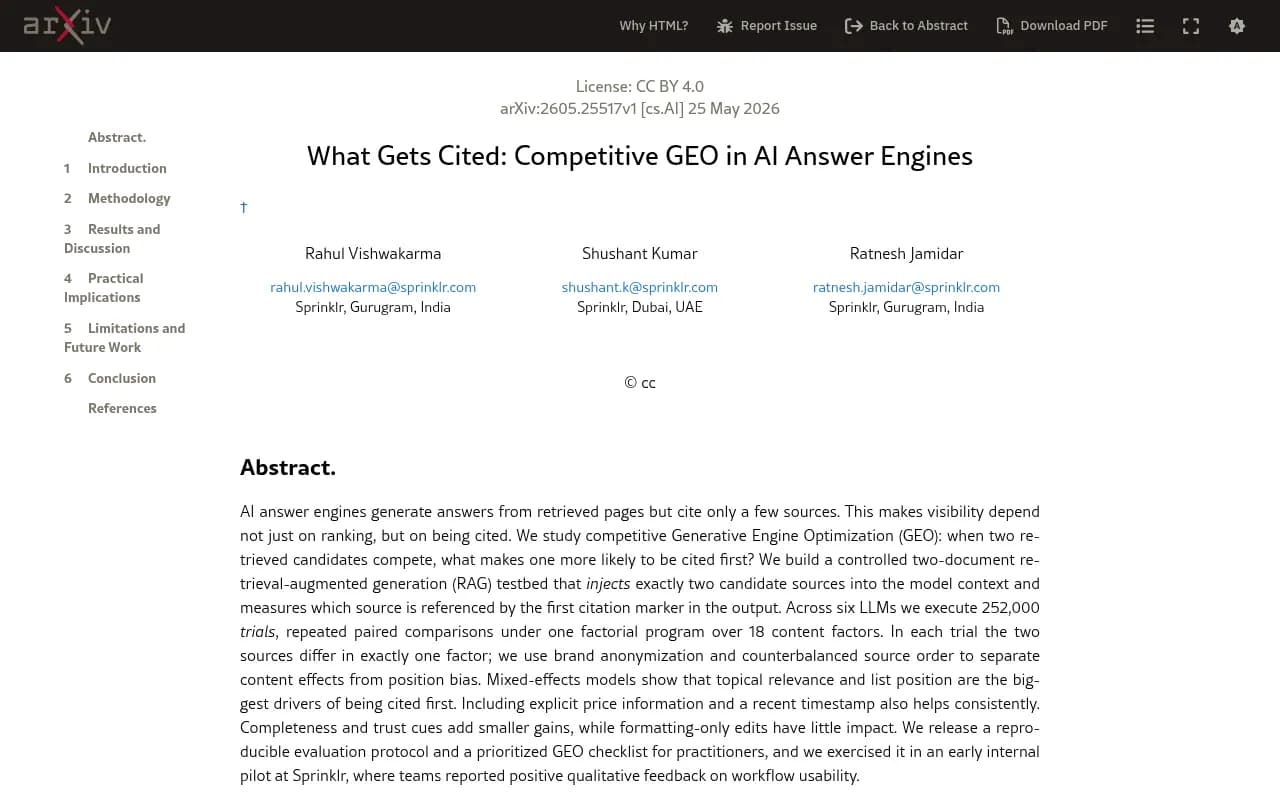
Their findings, in plain terms:
- Topical relevance and list position are the biggest drivers of being cited first.
- Explicit price information and a recent timestamp help consistently.
- Completeness and trust cues add smaller gains.
- Formatting-only edits have little impact.
One caveat. This is a two-document testbed, not live ChatGPT with its web search and dozens of candidate pages. It tells you what tips a close call, not what gets you retrieved in the first place. Still, it is a useful scoring lens for evaluating drafts.
The practical read: a writer tool that produces a pretty, well-formatted article that drifts off the query will lose to a plainer page that answers it directly and includes a price and a date.
Which formats actually get cited
Before picking tools, decide what you are asking them to write. Promptwatch Data's analysis of ChatGPT citations by content type (Sep 28 to Oct 4, 2026) found:
| Content type | Share of ChatGPT citations |
|---|---|
| Product pages | 22.4% |
| Landing pages | 16.8% |
| Listicles | 13.6% |
| How-to guides | 8.7% |
| Documentation | 7.5% |
| General articles | 6.1% |
| Comparisons | 5.9% |
| News | 5.7% |
| FAQ pages | 3.3% |
| Reviews | 1.7% |
For commercial prompts like best CRM for small businesses, product pages, landing pages, listicles and comparisons made up almost 70% of citations. General articles are a small slice. If your test only generates generic blog posts, you are testing the weakest format.
There is also a freshness question. In Promptwatch's content half-life study, which tracked pages ChatGPT cited on July 6, 2026 for 90 days, 78% of landing pages and 76% of docs were still cited after 30 days, while news lost half its pages within 36 days. Product pages, reviews and how-tos reached their half-life after roughly 74 to 77 days. So do not judge a tested article after a week. Check at 2, 6 and 12 weeks.
The seven writers to put through the test
These are the seven I would run, picked because they cover different approaches: general-purpose writers, SEO-optimization-first tools, and bulk generators. The descriptions below come from the tools' own positioning. I am not claiming results for any of them.
Jasper AI
Positioned as an AI writing assistant for long-form SEO content. A good test of a general writer with brand-voice controls.
Copy.ai
An AI copywriting tool for marketing content. Useful as a baseline for landing page and product copy, which are heavily cited formats.
Surfer SEO
A content optimization platform with AI writing. It starts from SERP and term data, so it tests whether classic on-page optimization helps in AI answers.
Frase
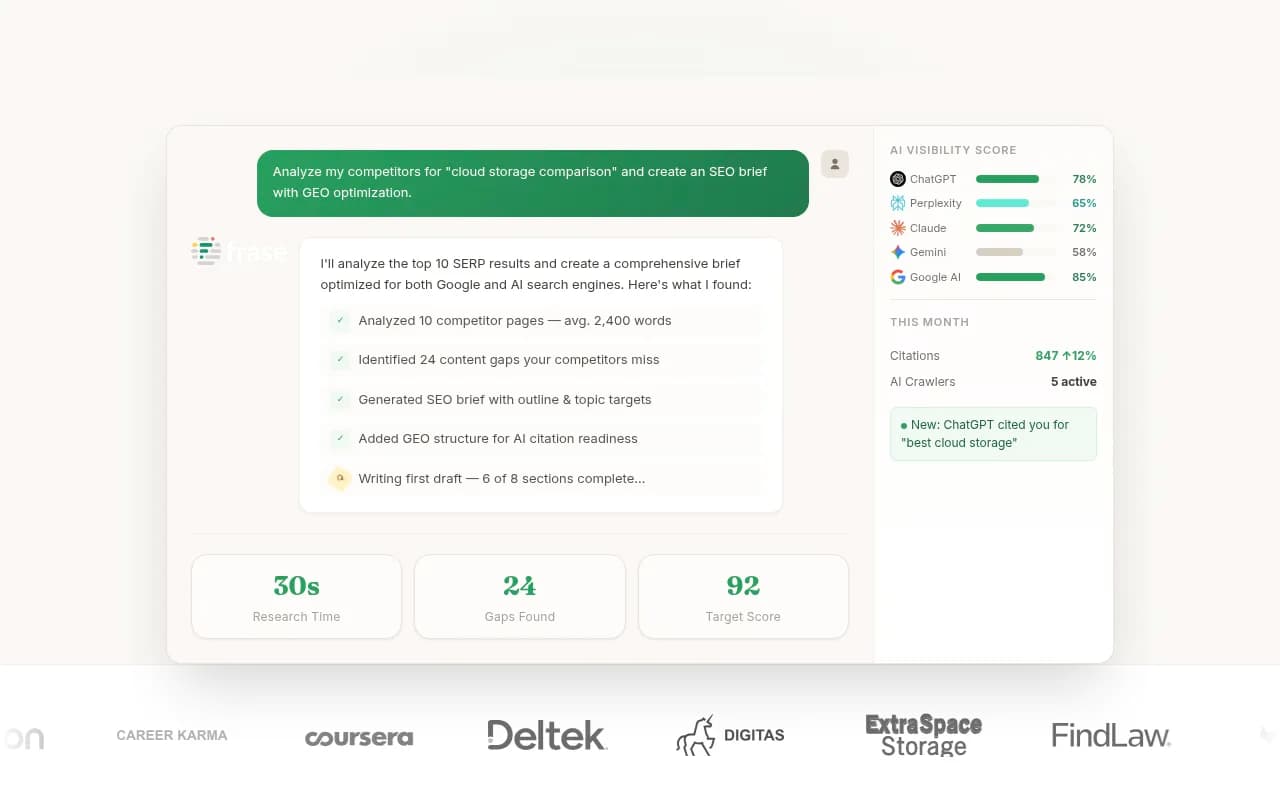
AI content research and SEO optimization. Its research-first workflow is closest to a brief-driven process.
Scalenut
A complete SEO content platform with NLP analysis, covering planning through drafting.

Outranking
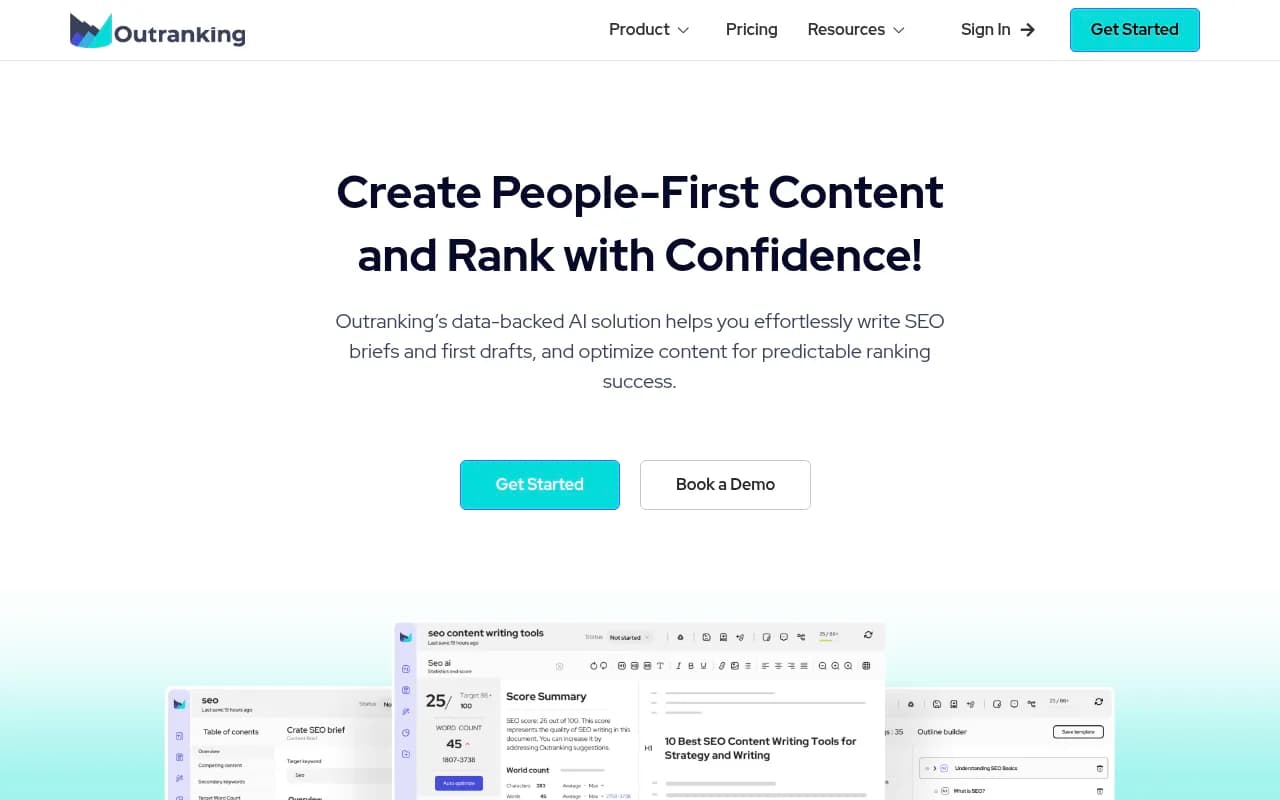
AI-powered SEO content aimed at ranking, with brief and outline steps built into the workflow.
Byword
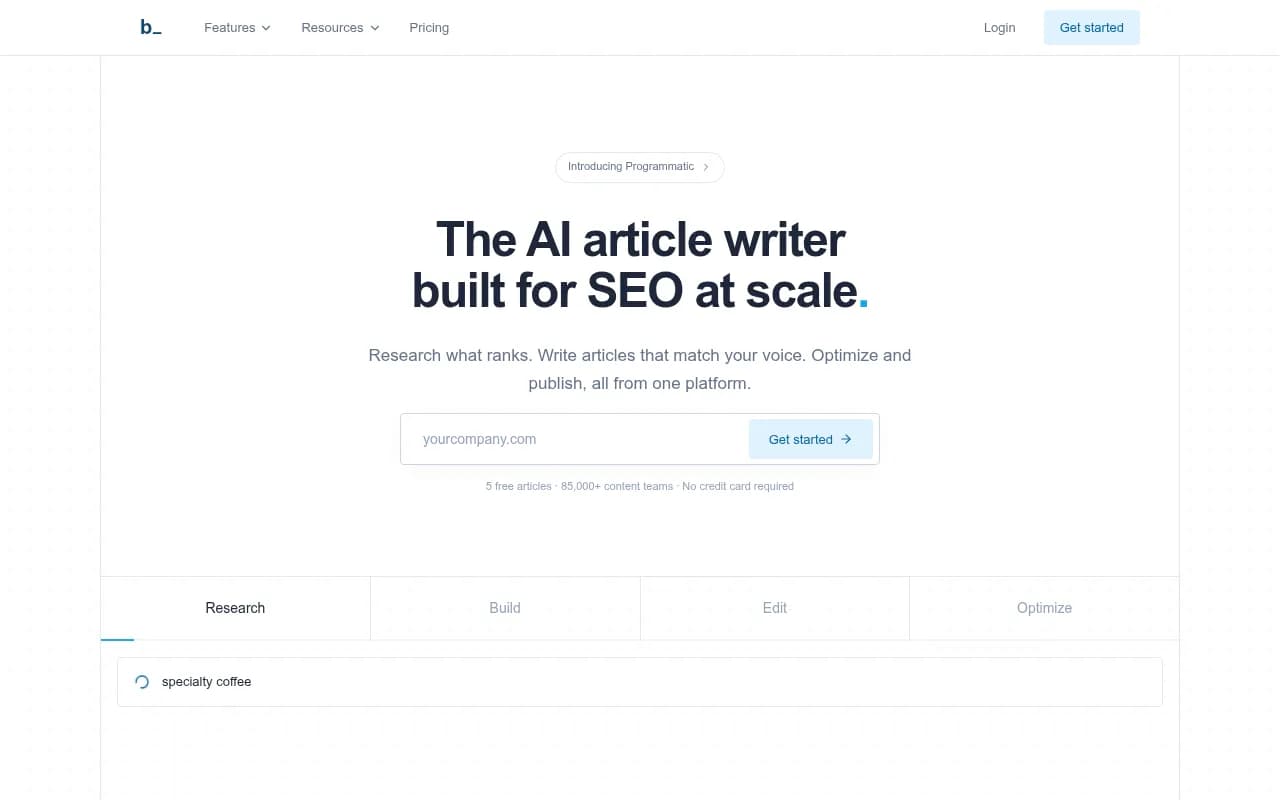
SEO articles at scale, in under two minutes. This is your bulk-generation control. Speed is the pitch, so it shows what you get when you skip human input.
The test protocol
Here is how I would run it so the results mean something.
Step 1: Pick prompts and a topic cluster
Choose 10 to 15 prompts real buyers would type, mixing informational (how to), commercial (best X for Y) and branded. Include at least one query where you have no existing content, so you are not measuring pages that were already cited. Use a query fan-out tool to see what ChatGPT actually searches for; Promptwatch's free query fan-out generator is one option.
Step 2: Write one GEO brief
Use the five-field structure: questions, direct answers, entities, evidence, citable passages. Add price and a visible date where relevant, since the SIGIR paper found both help. Freeze the brief. Every tool gets identical input.
Step 3: Generate, then change nothing but facts
Generate one article per tool per prompt cluster. Allow yourself exactly one pass of human editing: fix factual errors and insert real data. Do not restyle. Otherwise you are measuring your editing.
Log these for every draft:
- Does the first paragraph answer the question directly?
- Does it match the intent of the prompt, or a nearby one?
- Does it overlap with another draft from the same tool (cannibalization)?
- Are there invented facts, stats or quotes?
That last one matters. Journalism research has shown AI search engines are shaky at attribution; the Tow Center's comparison of eight AI search engines found a common tendency to cite the wrong article. An unreliable citation layer is a reason to publish content that is easy to attribute: clear authorship, dates and original data.
Step 4: Publish on equal footing
Put the articles on the same domain, in the same site section, with the same internal linking and schema. Publish within the same week. If one tool's article is buried three clicks deep, you have a bad experiment.
Step 5: Check access before you check citations
A page cannot be cited if AI crawlers never read it. Verify GPTBot, OAI-SearchBot, ClaudeBot and PerplexityBot are not blocked in robots.txt and that pages return clean responses. Promptwatch's Agentic Readiness Check and AI crawler URL inspector cover the basics, and server logs tell you whether bots actually arrived.
Step 6: Measure citations on a schedule
Run your prompt set on day 7, 14, 42 and 84. Record per article: cited yes or no, citation position in the source list, which model, and whether the mention was inside the answer or just a source link. A tracking platform saves hours here. Promptwatch monitors the real interfaces of ChatGPT, Perplexity, Gemini, Google AI Overviews and others, shows which of your pages get cited, and has a Page Tracker for watching individual URLs, which fits this test well.

If you want alternatives, the GEO software directory at bestgeosoftware.com lists a wide range of trackers.
How to score the results
A simple scorecard works better than a single metric.
| Metric | What it tells you | How to collect |
|---|---|---|
| Crawled by AI bots | Access problem or not | Server or crawler logs |
| Cited at day 14 | Fast pickup | Prompt tracking |
| Cited at day 84 | Staying power | Prompt tracking |
| Citation position | Primary source or footnote | Source list order |
| Intent match (manual) | Brief followed or not | Editor review |
| Cannibalization flag | Overlap with sibling posts | Manual or crawl |
| Fact errors per draft | Editing cost | Fact check |
| Edit minutes per draft | Real cost of the tool | Time log |
The last two matter more than people admit. A tool that produces a cited article but needs two hours of fact repair may cost more than one that is cited slightly less often.
Reading the outcomes
Expect small samples. Seven tools with a dozen prompts will give you directional signals, not statistical proof. If one tool's pages are cited and the rest are not, check access and internal linking before crediting the tool. If nothing is cited, that is also a result. It may mean generic articles are the wrong format for your prompts and you should test product pages, comparisons or listicles instead.
Things I would watch for, based on the research above:
- Drafts that bury the answer. The SIGIR findings put relevance first.
- Drafts with no price, date or concrete numbers where they apply.
- Near-duplicate drafts across a cluster, which is the cannibalization problem Mantas describes.
- Polished formatting with thin substance. Formatting-only edits had little effect in the study.
Where AI writers fit and where they do not
My take: these tools are assistants, not strategists. The consensus among the commenters on Mantas's post is similar. The danger is selling them to people who cannot judge the output. The brief, the prompt selection and the fact check are still yours.
A workable division of labor:
- Humans own prompt research, the brief, original data and final review.
- The writer tool drafts structure and prose from the brief.
- A visibility platform tells you whether the result got crawled, cited and clicked, then feeds gaps back into the next brief.
Some platforms try to close that loop. Promptwatch, for example, pairs citation tracking with content gap analysis and a Content Agent that drafts and publishes to WordPress, Webflow or Framer. Its Content Agents page explains the workflow. Whether you use that or a standalone writer, the key is measuring what happens after publishing.
For more options on the writing side, SurferStack has category listings for AI writers and SEO content tools.
A starter checklist
- One frozen GEO brief with questions, direct answers, entities, evidence and citable passages
- Same prompts, same domain, same internal links, same publish week
- Mix of formats: at least one product or landing page, one listicle, one how-to
- Crawler access verified before judging any result
- Checks at 2, 6 and 12 weeks
- Fact errors and edit time logged per tool
- Results shared as your own test with sample size stated
Run it for a quarter and you will have the scoreboard this headline promised, with numbers that apply to your site. If you publish it, say plainly how many prompts and pages you used. For background on the metrics, the Promptwatch Academy on citations vs mentions is a good reference.