Key takeaways
- Agencies have a different problem from in-house teams: many brands, many report cadences, and clients who want their logo on the dashboard, not the vendor's.
- White-label access is often gated behind a specific plan or an add-on. Ask which tier includes it before you promise branded reports.
- Most "best tools for agencies" lists are written by vendors who rank themselves first. Treat them as input, not verdicts.
- Report per engine, not as one blended score. Citation behaviour differs a lot between ChatGPT, Perplexity and Google AI Overviews.
- Run a two-week trial with two real clients before you commit to a stack.
Why agencies need different criteria
A brand team tracks one company. An agency tracks twenty or fifty, each with its own competitors, language, market and reporting rhythm. Tools built for the first case tend to bolt on "team seats" as an afterthought, and that model breaks quickly when you try to run a client book.
So the usual feature checklist (model coverage, prompt counts) matters less than the agency workflow. Here is what I would score on:
- White-label reports: can you export or schedule reports with your branding instead of the vendor's?
- Client portals: can a client log into a branded, read-only view that does not expose your other accounts?
- Multi-brand management: how many brands fit in one account, and how painful is switching?
- Per-client pricing: is adding a client a flat, predictable cost, or an upsell every time?
- Prospecting: can you pull an audit on a prospect before the pitch?
- API and exports: can data flow into your own reporting stack, Looker Studio or an automation?
One more thing before the list. The sources I used for this guide are mostly vendor-authored. RankMonster, Rank Prompt and TrueRanker each rank themselves first in their own roundups, and Rank Prompt's own table marks several competitors as "Verify" or "Partial". I have flagged claims that came from a vendor about itself, and you should confirm every price on the vendor's own pricing page.

Traditional rank tracking vs AI rank tracking
Agencies now report on two surfaces: Google rankings and what AI assistants say about a client. They are measured differently. A Google position is a number. An AI answer is a sampled response that may mention a brand, cite its site, or ignore it entirely.
That difference matters for reporting. Promptwatch Data's average sources per response report shows ChatGPT citing about 5 sources per web-search answer, while Google AI Overviews and Perplexity cite about 10. Copilot swung from under 2 to nearly 17 sources per response within a few weeks before settling. If a client's visibility dips on one engine for a week, it may be retrieval behaviour changing, not your work. Show per-engine results and judge volatile engines on monthly trends.
Prompt sets also need maintenance. Promptwatch's ChatGPT query fanout data shows average fanout dropping from about 2.15 searches per response in early December to 1.84 by early March, and average query length falling from roughly 117 characters to the high 80s. ChatGPT's search behaviour changes in steps, so review tracked prompts on a schedule rather than setting them once at onboarding.
The main options compared
| Tool | Type | White-label | Client portal | Agency fit |
|---|---|---|---|---|
| Promptwatch | AI visibility and GEO platform | Dashboard and reports on Enterprise/Partner; agency plans from $199/mo | Branded read-only access (Enterprise) | Strong for pitching and for fixing, not just tracking |
| Rank Prompt | AI visibility tracker | Agency plan, $149/mo (vendor claim) | Yes (vendor claim) | Cheap per brand |
| TrueRanker | Google ranks plus AI visibility | Included on Pro and Agency (vendor claim) | Live URL reports | Hybrid SEO and AI reporting |
| AgencyAnalytics | All-channel reporting | Included | White-labeled portal | Reporting-first agencies |
| AI Peekaboo | AI answer reports | Self-serve, own domain from $250/mo (vendor claim) | Share links | Agencies selling AI visibility |
| Nightwatch | Rank tracking plus AI | From Professional (vendor claim) | Limited | Rank tracking shops adding AI |
| Peec AI | Prompt tracker | Partial | Limited | Clean daily tracking, unlimited seats |
| Semrush / Ahrefs | SEO suites with AI add-ons | Suite-dependent | Suite-dependent | Existing suite users |
Prices in this table come from vendor pages and roundups. Confirm them before you quote anything to a client.
Tools worth shortlisting
Promptwatch
Promptwatch is the one I would put on the shortlist if you need to do something about visibility, not just report it. It tracks ChatGPT, Gemini, Claude, Perplexity, Google AI Overviews, AI Mode, Copilot and more from the real interfaces, then traces which pages get cited, flags content gaps, and has a Content Agent that writes and publishes pages to WordPress, Webflow or Framer. IP-verified AI crawler logs and visitor analytics let you show a client whether the work produced traffic.
For agencies specifically, the agency plans give unlimited projects, prompts and team seats: Kick-off at $199/mo, Growth at $399/mo and Scale at $799/mo. Pitch projects let you run a prospect audit before a sales call. One caveat worth stating plainly: a white-label dashboard and client portal live on the Enterprise tier, so ask which plan covers branded delivery before you promise it. Agency plans also exclude the Content Agent, so agencies that want content generation inside the tool usually go to Enterprise. See Promptwatch's agency guide and the pricing page for current details. Monks, for example, uses the Answer Gap Report and Visibility Score to build content roadmaps for enterprise clients.

TrueRanker
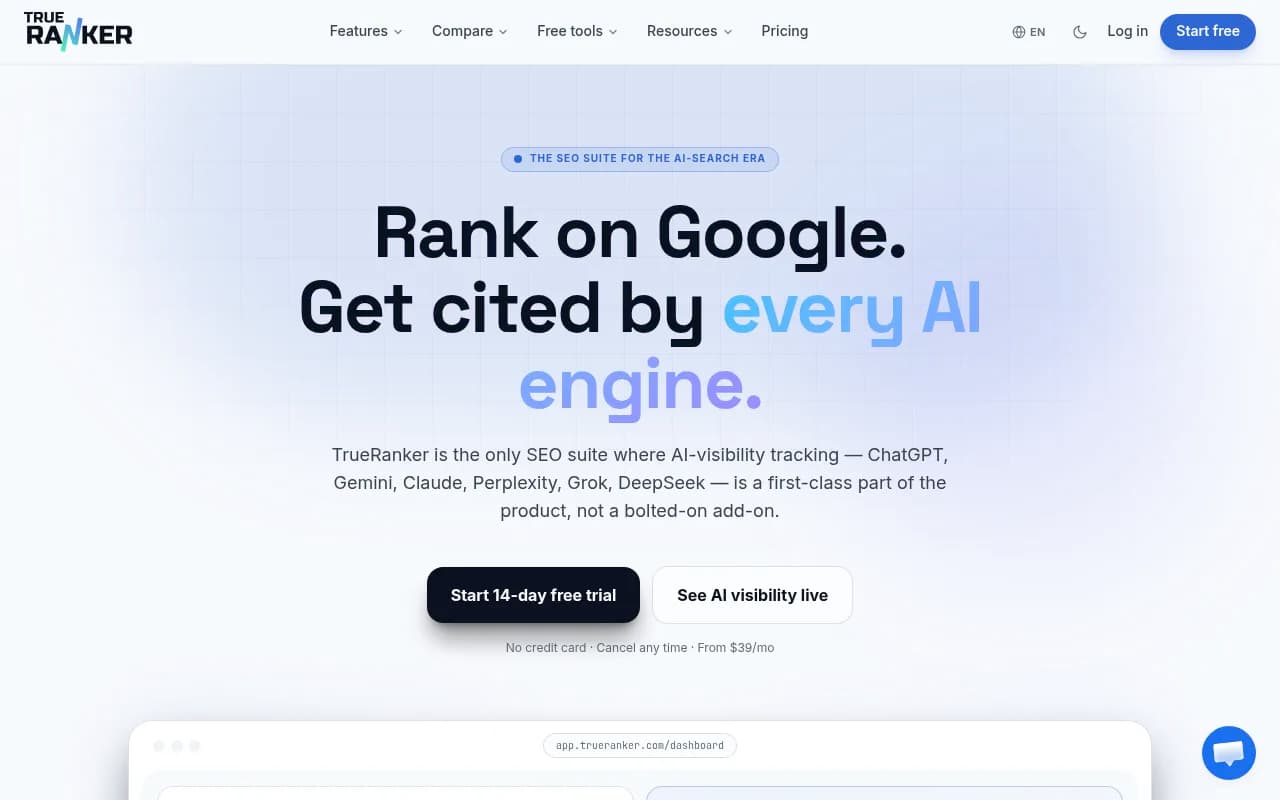
TrueRanker is the most direct answer to "I need Google rankings and AI visibility in one white-label deck." It tracks six AI models (ChatGPT, Claude, Gemini, Perplexity, Grok, DeepSeek) and uses a published 0-100 composite score built from mention rate, citation rate, sentiment, share of voice and model coverage. That formula is nice: no black box. You upload a logo, set a sender address, and the vendor branding disappears from PDFs and emails. Its own claim is that white-label is included from the Pro plan.

Rank Prompt
Rank Prompt's pitch is agency economics: per its own pricing, $149/mo covers 50 brands with white-label reports and a client portal, and a higher tier covers 500 brands with client logins and prospecting. If true, that is hard to beat for a large book of small clients. Because the claim comes from Rank Prompt's own comparison, test the report output yourself.

AgencyAnalytics
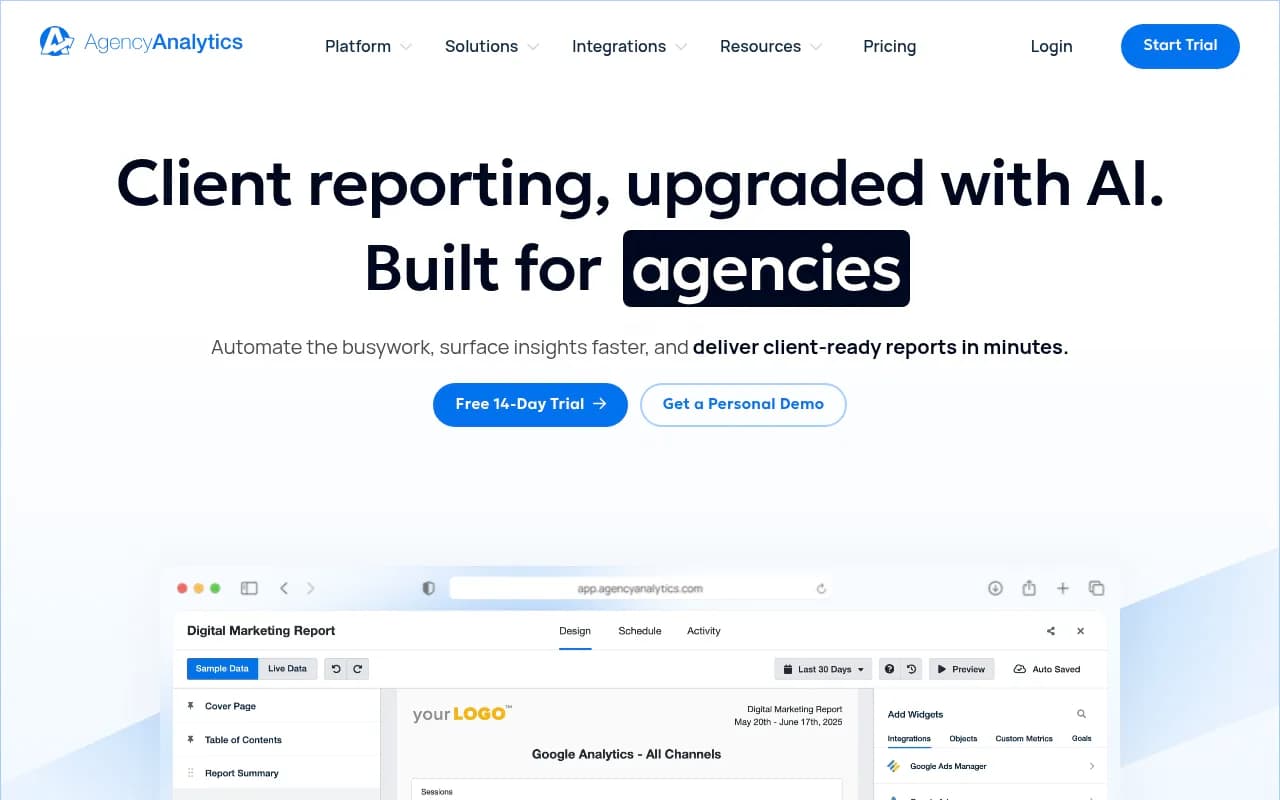
If your clients already get a monthly deck covering SEO, PPC and social, putting AI visibility in the same white-labeled dashboard is a real convenience. You avoid sending a separate report from a separate tool. The AI coverage is lighter than a dedicated tracker, so treat it as the reporting layer and pair it with something deeper.
AI Peekaboo
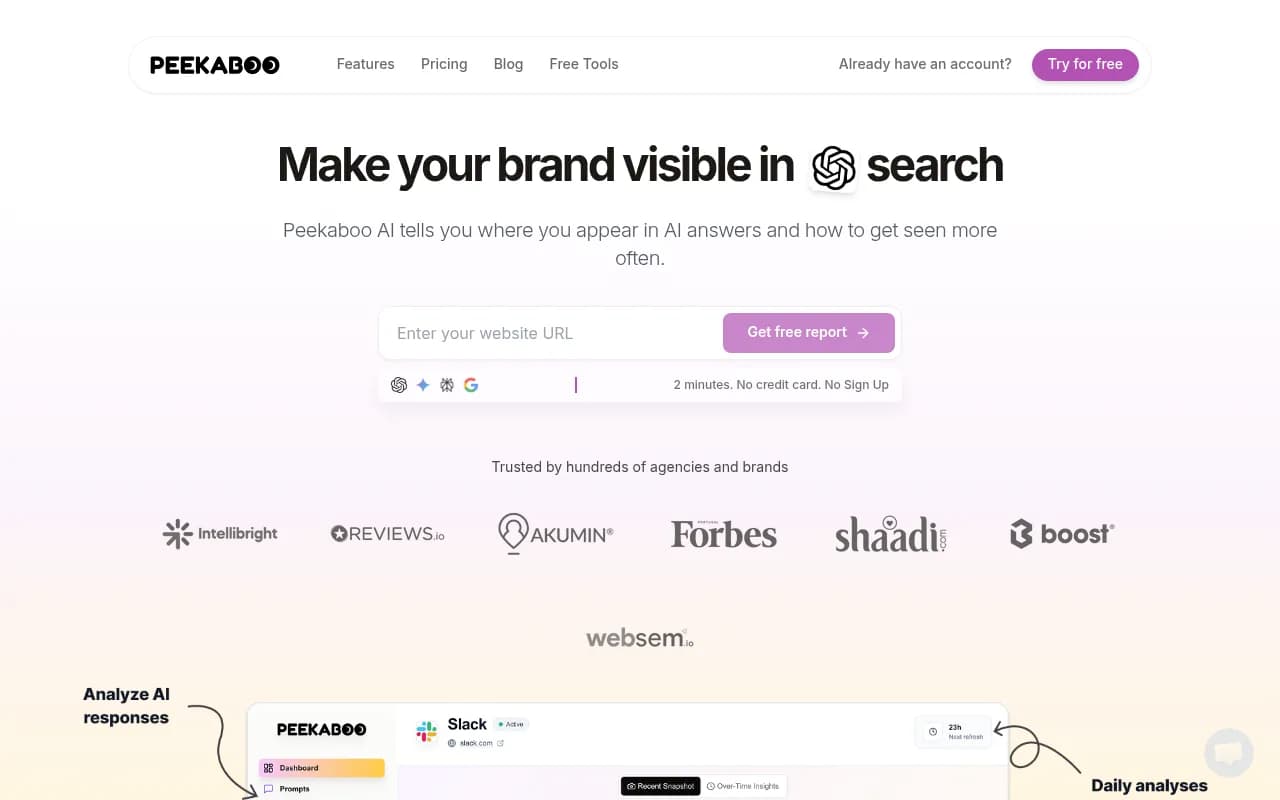
Built around branded reports of AI answers rather than rankings. White-label is reportedly available on self-serve plans with your own domain from about $250 a month, so you do not need an enterprise contract to look fully branded.
Nightwatch
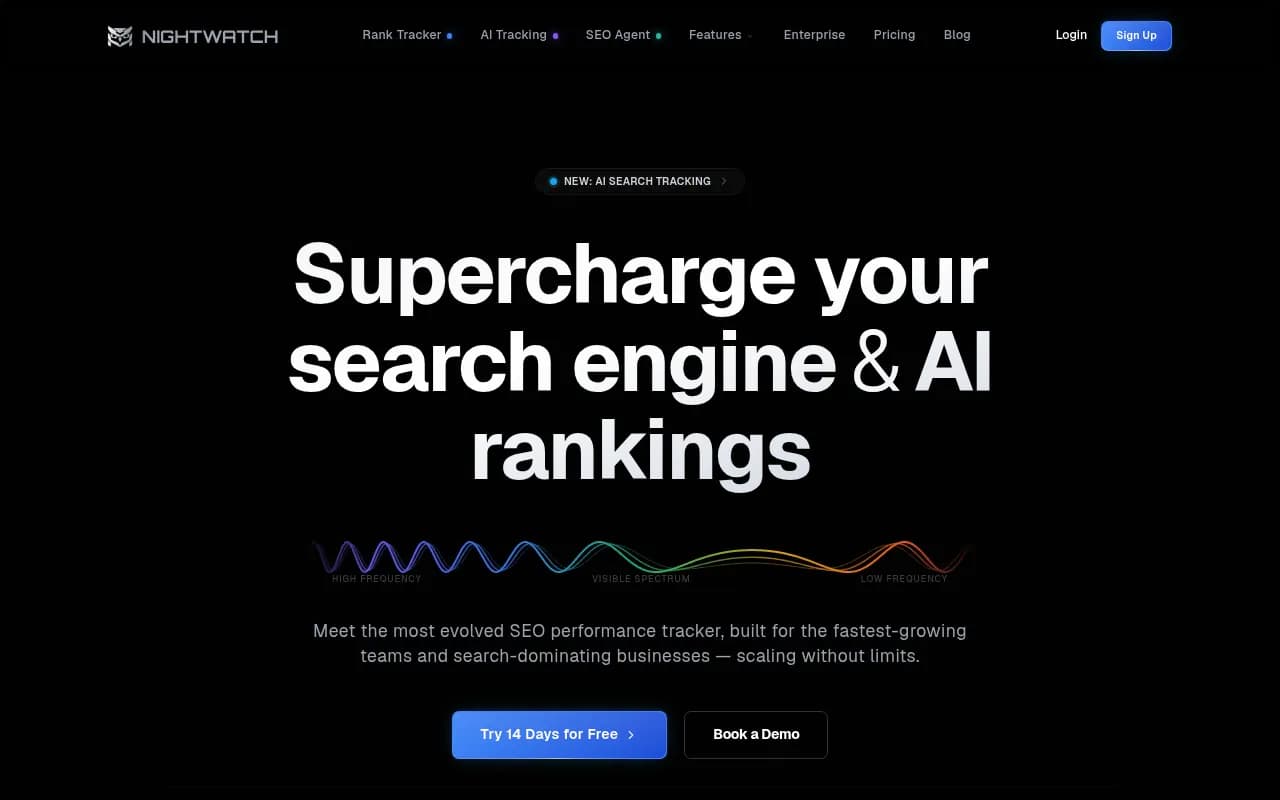
A good fit if rank tracking is your core service and AI answers are the new add-on. White-label reports, Looker Studio and API access are reported from its Professional plan.
Peec AI, Otterly and Scrunch
Peec AI is a clean daily tracker with unlimited seats, a good fit for benchmarking competitors. Its white-label and portal features are thinner than a dedicated agency platform, so expect more manual branding work. Otterly is lightweight monitoring for a small client book. Scrunch leans toward a brand's own team, so check its multi-brand pricing carefully in a trial.


Semrush and Ahrefs
If you already pay for a suite, the AI add-ons are convenient, but fixed prompt sets and per-brand costs add up fast across many clients. Compare the add-on cost per client against a dedicated tool.
The white-label tax
TrueRanker's roundup names something every agency has felt: a vendor advertises an entry plan, then custom branding turns out to be an add-on. One example it cites is SE Ranking's Agency Pack at an extra $59/month billed annually. Whether or not you agree with the framing, the practical lesson is the same. Work out the real monthly cost of the branded version, not the headline price.
Before you sign up, ask each vendor:
- Which plan includes white-label reports, a custom domain and a custom sender email?
- Is the client portal read-only, and does it isolate each client?
- How is a new client priced: flat, per brand, or per prompt?
- Can I schedule reports to a client inbox without logging in?
- Is there a Looker Studio connector or API for my own dashboards?
How to choose by agency type
| Agency profile | Start here |
|---|---|
| Many small clients, tight margins | Rank Prompt or AI Peekaboo, verified in trial |
| Retainers that still need Google rankings in the deck | TrueRanker, Nightwatch or AgencyAnalytics |
| Mid-market and enterprise clients, need to act on gaps | Promptwatch |
| Already deep in Semrush or Ahrefs | Add-ons for a pilot, then compare cost per client |
| Competitor benchmarking on a budget | Peec AI |
If you want a wider catalog, the AI rank tracking directory at ai-rank-tools.com lists many more options.
A simple trial plan
- Pick two real clients, one easy and one with a messy competitive set.
- Build the same 30 to 50 prompts in each tool, split by informational, commercial and branded intent.
- Run for two weeks. Note how many responses each tool collects and whether it uses real interfaces or APIs only.
- Produce one branded report per client and send it to yourself. Check the logo, sender address and domain.
- Ask the awkward question: if visibility is low, what does the tool help me do next?
That last question separates dashboards from platforms. A tracker tells you a client is invisible. A platform shows which pages are missing and helps produce them.
A note on selling AI visibility
If you are adding this as a service line, pricing and positioning matter as much as tooling. Agencies like 1001 SEO Media combine technical SEO, content and generative engine optimization so clients get cited in AI answers as well as ranking in Google. Whatever stack you pick, sell outcomes (citations, AI-referred traffic, conversions) rather than a score.
Frequently asked questions
Do I need a separate AI tracker if I already have a rank tracker?
Usually yes, unless your rank tracker has real AI coverage. Check whether it tracks real interfaces and how many engines it covers, not just whether an "AI" tab exists.
Can I white-label AI visibility reports?
Yes, with several tools. Plan gating is the catch. Confirm which tier includes branding, custom domains and client portals.
How many prompts per client should I track?
Start with 30 to 50 well-chosen prompts per client, review them monthly, and expand once you see which topics matter.
Which tools are verified for the claims above?
Prices and white-label details for most vendors come from their own marketing or roundups. Verify on each pricing page before quoting clients.