Key takeaways
- Most AI visibility tools track brand mentions and category prompts. Very few track individual products inside ChatGPT shopping carousels, so decide early whether you need SKU-level data.
- ChatGPT's product carousel usually shows 8 products, and Peec AI's research found it pulls most of them from Google Shopping via shopping query fan-outs. Your feed quality matters as much as your content.
- Shopping features appear on only a low single-digit percentage of ChatGPT web-search responses, per Promptwatch Data, and the rate changes in steps. One prompt run proves nothing; track across days.
- Promptwatch, Profound, Goodie, Semrush, and Peec AI each cover different parts of the job. The table below shows who does what.
- Ads are now part of the picture: ChatGPT showed ads in 20.1% of web-search responses over a 90-day window.
Why ecommerce needs a different kind of AI rank tracker
A SaaS company asks "does ChatGPT mention us?" A store asks something harder: "which of our 400 products show up, in what slot, at what price, and who gets the click?" A brand-level score cannot answer that.
The demand is real. Adobe reported that 39% of surveyed consumers were already using AI for online shopping. Other vendors cite much bigger conversion gaps for AI-referred shoppers, but treat those numbers as directional; the sources are vendor blogs, not audits.
The practical problem is that shopping answers have two layers. There is the text answer (which brands get recommended in prose), and there is the product carousel (which SKUs appear as cards). Most trackers only see the first layer. If you sell physical products, the second layer is where revenue lives.
How ChatGPT decides what goes in the carousel
Peec AI published a useful breakdown, based on a study that ran on Search Engine Land. When someone asks for something like "fitness trackers with HRV monitoring," ChatGPT splits the prompt into two kinds of queries:
- Search fan-outs, which collect context: what to consider when buying, which brands lead, what the market thinks.
- Shopping fan-outs, which are shorter and more direct, and hit Google Shopping.
The top results from those shopping queries form the candidate pool (Peec describes it as roughly the top 40 organic shopping results). ChatGPT then picks about 8 for the carousel and writes the advice text around them.
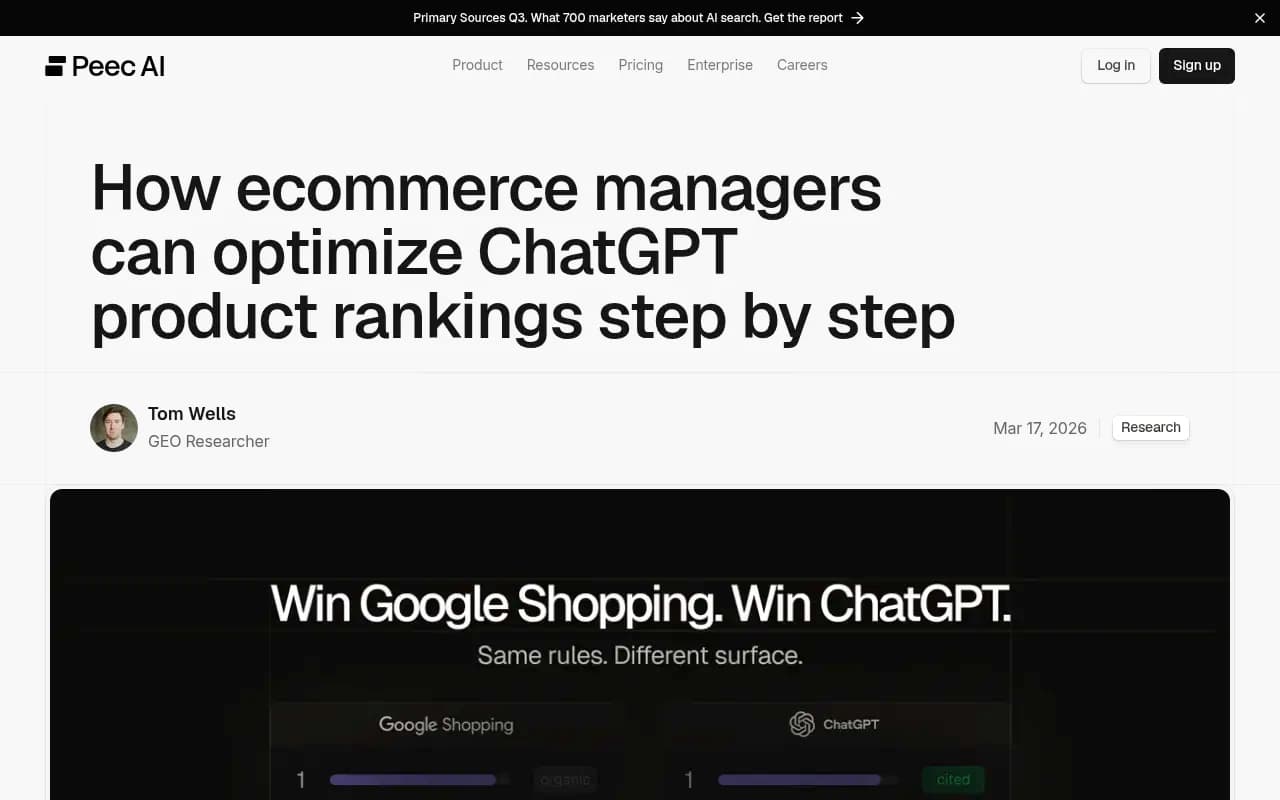
Two things follow from this. First, Google Merchant Center data and feed quality are a ranking input, not an afterthought. Complete descriptions with use cases, features, and differentiators beat thin ones. Second, the text layer still matters, because those context fan-outs shape which products ChatGPT feels comfortable recommending.
Promptwatch's own guide to getting into ChatGPT shopping carousels adds a practical note: short, purchase-ready prompts like "where to buy [product] online" trigger carousels most reliably.
Carousels are unstable, so tracking needs repetition
Promptwatch Data on ChatGPT shopping usage shows that shopping features (product cards, recommendations, price comparisons) attach to a low single-digit percentage of web-search responses overall. They concentrate on commercial and transactional prompts. The rate also moves in steps: it roughly doubled overnight in late May, then fell back weeks later, which looks like OpenAI tuning when cards appear.
The same prompt can show cards on Monday and plain text on Tuesday. Any tool that reports a single snapshot as "your carousel rank" is overselling. Look for tools that run prompts repeatedly and show trends.
Ads are the other half
Per Promptwatch's ChatGPT ads data, ChatGPT served no ads until May 27, 2026. Over the 90 days from May 20 to August 17, ads appeared in an average of 20.1% of web-search responses, peaking at 43.9% on a single day. In the latest 7-day window, 73.3% of ad-bearing responses came from organic prompts, 18% from brand-specific ones, and 8.6% from competitor comparisons. If a competitor is bidding on your product prompts, you want to see that.
What to look for in an ecommerce AI rank tracker
Before comparing tools, run them against this checklist:
- Product-level tracking: does it capture individual product cards, with price, merchant, and position?
- Catalog matching: can it match cards to your SKUs, or does it only know brand names?
- Purchase-intent prompts: can you track "where to buy" and "best price for" style queries, not just informational ones?
- Repeat sampling: how often does it run prompts, and can you see variance across days?
- Real interface data: user-facing answers differ from API outputs, and shopping cards only exist in the real UI.
- Beyond ChatGPT: Amazon's shopping assistant and Google AI Mode matter for many retailers.
- Action layer: does it tell you what to fix, or just give you a chart?
- Traffic attribution: can you connect visibility to visits and orders?
Comparison table
| Tool | Product-card / SKU tracking | Best for | Notable limit |
|---|---|---|---|
| Promptwatch | Yes, ChatGPT Shopping and Amazon Alexa product results, matched to your catalog | Stores that want tracking plus fixes and traffic attribution | Shopping is on Business and Enterprise plans |
| Profound | Yes, SKU-level, per vendor comparisons | Large retailers with enterprise budgets | Enterprise only for SKU tracking, more platform than mid-sized stores need |
| Goodie | Amazon and Alexa-focused | Amazon-first brands and sellers | Narrower beyond marketplace use cases |
| Semrush | AI Shopping reports inside the SEO suite | Teams already living in Semrush | Shallower AI-specific data than dedicated tools |
| Peec AI | Prompt and brand level, strong multi-market | Retail groups across several countries | Monitoring only, no optimization layer |
| Rank Prompt | Category and purchase-intent prompts, no feed ingestion | Budget-conscious category tracking (from $49/mo per vendor) | Cannot tell you where a given SKU sits |
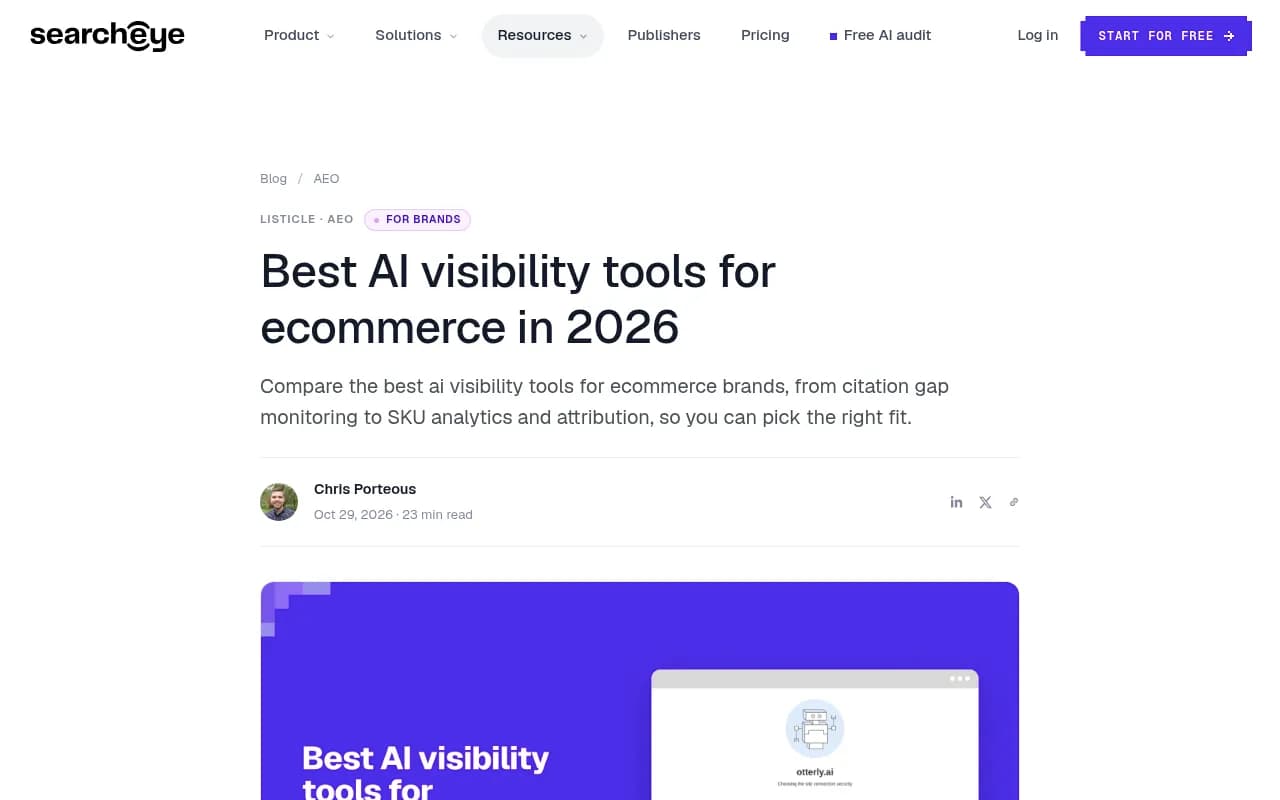
| Otterly.AI | Brand and category prompts only | Cheap daily monitoring | No product-level tracking |
Pricing changes often. Verify on each vendor's site before buying.
The tools, one by one
Promptwatch
Promptwatch is the option I would look at first if you want the whole loop, not just a dashboard. Its ChatGPT Shopping tracking stores every product card from your tracked prompts with price, merchant, and carousel position, and matches cards to your catalog by product ID. So you can see which products win the slot and who captures the click. It also covers Amazon Alexa product results, which matters if shoppers ask Alexa rather than ChatGPT.

Three things make it different for stores. It monitors the real ChatGPT interface, where carousels actually render, rather than API outputs. Ads Radar shows which advertisers bid on your prompts and what their copy claims. And the rest of the platform handles the "now what?" part: the Action Board prioritizes fixes, the Content Agent writes and publishes pages to WordPress, Webflow, or Framer, and visitor analytics plus IP-verified crawler logs show whether AI bots can read your product pages at all.
On pricing, ChatGPT Shopping insights and Ads Radar start on the Business plan at $579/mo (billed monthly; annual billing gives 12 months for the price of 10). Agency plans include Ads Radar but not Shopping. Confirm current numbers at promptwatch.com/pricing. There is a 7-day free trial on monthly billing, and a free AI visibility report if you want a quick read first.
If you are comparing it with Profound directly, see Promptwatch vs Profound.
Profound
Profound is the heavyweight. Vendor comparisons single it out for SKU-level tracking inside ChatGPT Shopping, and its prompt-demand data goes beyond a hand-picked prompt list. The catch, according to those same comparisons, is that SKU-level tracking sits at the Enterprise tier, and it is more platform than many mid-sized stores need. Strong monitoring, though no Reddit tracking or agentic execution in the Promptwatch comparison.

Goodie
Goodie is the pick if your sales run through Amazon. It is described as best for brands and sellers who need to know how Amazon's shopping assistant recommends their listings. If your store is mostly direct-to-consumer, it will feel narrow.
Semrush
Semrush added AI shopping reports to its broader search toolkit. For teams that already pay for Semrush, that means monitoring which products get recommended, which prompts trigger them, and which merchants are surfaced, without a new contract. The tradeoff is that the data is shallower and prompt sets are more fixed than in a dedicated platform.
Peec AI
Peec AI is a clean monitoring tool with good multi-market support, which suits retail groups tracking several countries. Its research on carousel sourcing is genuinely useful, even if you never buy the product. It stops at monitoring, so you will need other tools for the fix.

Otterly.AI and Rank Prompt
Both are cheaper, lighter options. Otterly.AI offers daily tracking and audits but only brand and category prompts. Rank Prompt tracks purchase-intent prompts like "where to buy" across several assistants, but does not ingest product feeds, so it cannot say where a specific SKU sits. Fine for category-level awareness. Not enough if you need to know about a particular product.

Which one should you pick?
- Large catalog, ChatGPT is the priority, and you want fixes plus attribution: Promptwatch.
- Enterprise retailer with a dedicated GEO budget: Profound, or Promptwatch if you want execution included.
- Amazon-first seller: Goodie.
- Already deep in an SEO suite: Semrush, accepting the shallower data.
- Multi-country retail group that mostly needs monitoring: Peec AI.
- Tight budget, category-level questions only: Rank Prompt or Otterly.AI.
A small store with 30 products probably does not need SKU-level tracking yet. Fix the feed first, then pay for tracking once you have something to measure.
What to prep before you start tracking
Tracking a bad feed just gives you a precise picture of a bad result. Do this first:
- Complete Product schema on every product page.
- Accurate price and availability, in the feed and on the page.
- A clean Google Merchant Center feed, since ChatGPT's shopping fan-outs lean on Google Shopping.
- Product descriptions that state use cases, features, and differentiators, not just specs.
- Crawler access: check that AI bots are not blocked in robots.txt. The free Agentic Readiness Check and AI crawler URL inspector are quick ways to verify.
Product pages also matter on the citation side. Promptwatch Data found product pages were the most cited content type in ChatGPT at 22.4% of citations (Sep 28 to Oct 4, 2026).
How to set up your first ecommerce monitor
- Build a prompt list in three buckets: category prompts ("best running shoes for flat feet"), purchase-intent prompts ("where to buy [product] online"), and competitor comparisons.
- Track each prompt daily, not once. Carousel presence is noisy.
- Record who fills the cards, at what price, and in what position.
- Segment by country and, for local retail, by city. Language and location are fixed per monitor in Promptwatch, so create separate ones.
- Review weekly. Flag products that lose a slot, and check whether the cause is feed data, price, or content.
- Tie it to traffic. ChatGPT stopped sending a referrer on October 8, 2026, so tag links with utm_source=chatgpt.com wherever you control them, or your attribution will undercount.
Final thoughts
The tool decision comes down to one question: do you need to know about products, or only brands? If products, shortlist the platforms that match cards to your catalog and sample repeatedly. If brands, almost any tracker in the table works. For more options by category, the GEO software directory at bestgeosoftware.com lists dozens of alternatives, and the first thing I would do with any trial is run your top 20 purchase-intent prompts for a week and see how much the carousel actually changes.