Key takeaways
- Nightwatch includes AI tracking (ChatGPT, Gemini, Perplexity, AI Mode, AI Overviews) on every plan, starting at EUR 79/mo with 500 keywords and 50 AI prompts.
- AccuRanker is the fastest and most accurate pure rank tracker of the three, but AI tracking is a separate product (AccuLLM) with its own pricing.
- Advanced Web Ranking gives you the most keywords per dollar ($139/mo for 7,000 weekly units), with AI visibility tracking included on paid plans, but its keyword count is measured in units, not daily keywords.
- All three are classic rank trackers that added AI prompt tracking. None of them turns citation gaps into published content or measures AI crawler activity on your site.
- Pricing across third-party roundups is inconsistent, so check each vendor's pricing page before you buy.
Why this comparison matters now
Rank trackers were built to answer one question: where does this URL sit for this keyword? That still matters. Google held about 91% of worldwide search referrals in October 2026, according to StatCounter figures quoted by Olostep. But buyers now ask a second question: does an AI engine mention us when someone asks about our category?
All three tools here have an answer to that, but the answers are not equal. One bundles it, one sells it separately, and one folds it into a unit-based pool. This guide goes through each, then compares them side by side.
The short version
| Nightwatch | AccuRanker | Advanced Web Ranking | |
|---|---|---|---|
| Entry plan | Starter, EUR 79/mo | Professional, $269/mo on the live pricing page | Pro, $139/mo |
| Keywords at entry | 500 daily | 2,000 (tiers up to 5,000) | 7,000 weekly units (about 1,000 if checked daily) |
| AI tracking | Included on every plan | Separate AccuLLM product | Included on paid plans |
| Update frequency | Daily plus on-demand | Daily plus on-demand refresh | Daily, weekly, bi-weekly, monthly or on demand |
| Local tracking | ZIP level, 100,000+ locations | Country down to address | Any location, 4,000+ search engines |
| Users | Unlimited | Unlimited | Unlimited |
| Trial | 14 days, no card | 14-day refund policy | 7-day trial, 30-day money-back |
A note on prices. Third-party roundups quote AccuRanker at EUR 224, EUR 229, $224 and $249 for the same plan, and Nightwatch at EUR 79 or $90. The figures above come from the vendors' own pricing pages as of late 2026. Nightwatch was also running a Black Friday 30% banner, and it presents yearly billing as 20% off.
Nightwatch
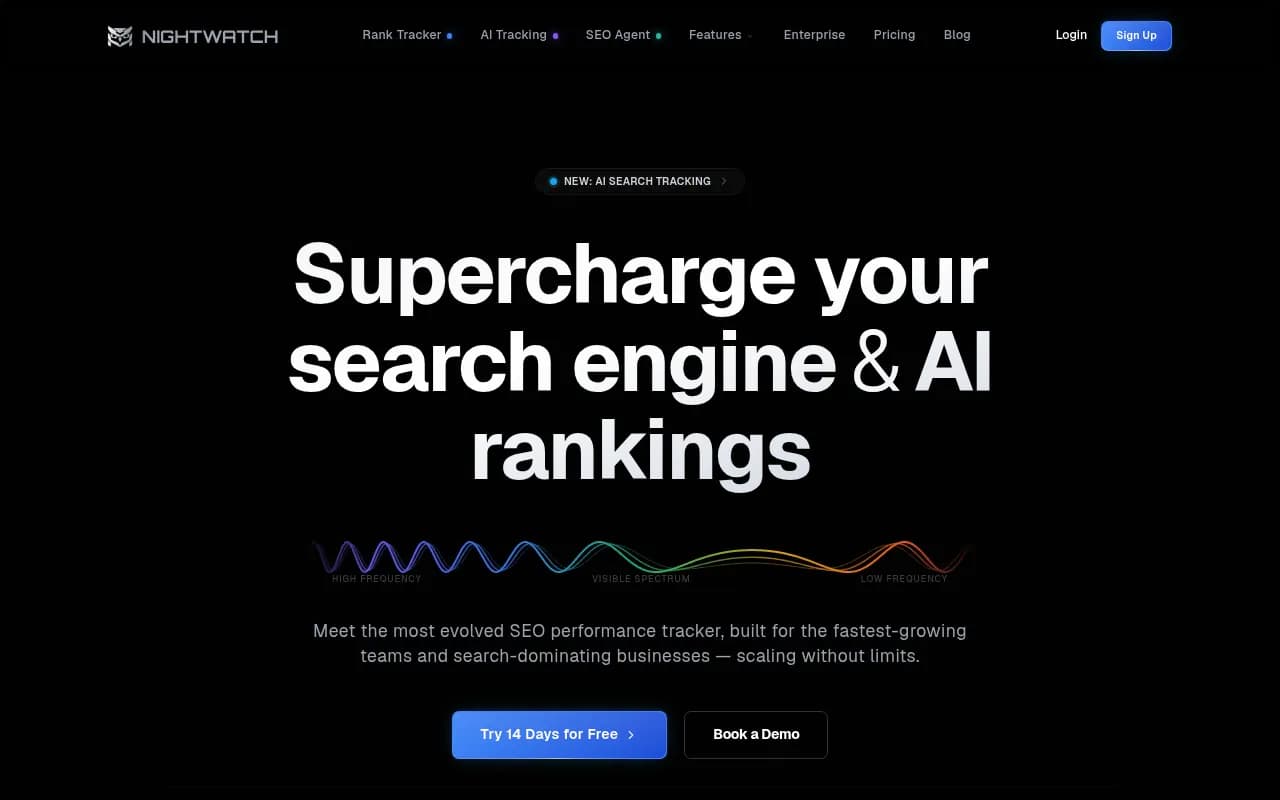
Nightwatch is the only one of the three that treats AI tracking as a default rather than an upsell. Every plan covers ChatGPT, Gemini, Perplexity, Google AI Mode and AI Overviews. Claude is limited to Enterprise. Every plan also includes sentiment analysis, citation analysis, prompt research, an SEO MCP server and a content studio.
Plans and limits
| Plan | Price | Daily keywords | AI prompts | AI answers/mo | Websites |
|---|---|---|---|---|---|
| Starter | EUR 79/mo | 500 | 50 | 1,500 | 5 |
| Professional | EUR 159/mo | 2,500 | 150 | 4,500 | 25 |
| Agency | EUR 399/mo | 7,500 | 500 | 15,000 | 100 |
| Enterprise | Custom | 20,000+ | Custom | Custom | Unlimited |
Looker Studio, white-label reports and API access start at Professional. Starter also limits you to 100 keyword researches a month and 1,000 audited pages.
Where it is strong
Local tracking is the draw. Nightwatch tracks at ZIP-code level across 100,000+ locations, and reviewers cite a 4.9/5 G2 accuracy rating across 43 reviews, which one roundup calls the highest accuracy score in its comparison. Search engines on every plan include Google, Bing, YouTube, Yahoo, DuckDuckGo and Google Maps.
Where it falls short
The keyword counts are modest. At Starter you get 500 daily keywords, which is a quarter of what AccuRanker or SE Ranking give you at their entry plans. The AI side is also prompt-based monitoring: you see whether you are mentioned and cited, but the tool does not write or publish anything to close the gap.
AccuRanker
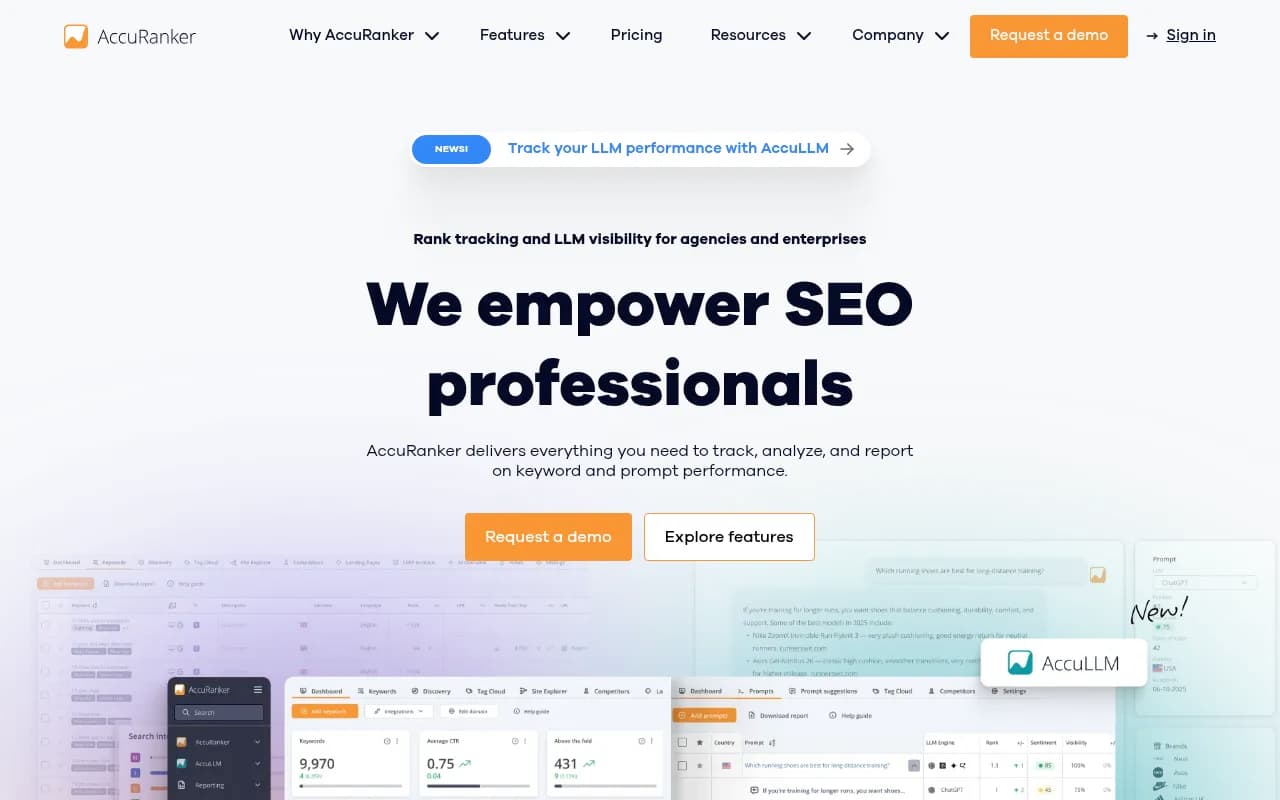
AccuRanker has one job and does it quickly. It refreshes daily, lets you trigger an extra check for any keyword on demand, and claims servers in every supported country and 99.9% accurate data. One roundup describes on-demand refreshes available every two hours.
Plans and limits
The live pricing page showed Professional at $269/mo with 2,000, 3,000 or 5,000 keyword tiers, and Expert at $929/mo with 10,000, 15,000 or 20,000 keywords. Expert adds dynamic tagging, Dynamic CTR, AccuRanker Search Volume, Google Data Studio and an unlimited read API. Enterprise (20K+ keywords) adds BigQuery, a write API, raw SERP HTML and a dedicated CSM. All plans have unlimited users, and annual billing saves up to 15%.
Older articles quote EUR 224 or EUR 229, and one comparison mentions an Expert jump to $764. Treat those as stale or currency-converted figures.
The AI question
AI tracking sits in a separate product, AccuLLM, with its own tab on the pricing page. A third-party roundup says it covers ChatGPT, Perplexity, AI Overviews and AI Mode. I could not verify that on a primary page or find AccuLLM pricing, so confirm both with AccuRanker before budgeting.
Where it is strong
Speed, large keyword sets, and an agency-friendly API. One roundup frames it as the right choice for agencies that need fast, highly accurate daily updates. The catch is cost: at $269/mo it is poor value if you track fewer than about 500 keywords, and AI tracking is extra.
Advanced Web Ranking
AWR has been around for two decades and shows it. It covers 4,000+ search engines, plus YouTube, Amazon, Bing, Naver and Baidu, with desktop, mobile, local and Maps tracking.
Plans and limits
| Plan | Price/mo | Keywords (weekly units) | Notes |
|---|---|---|---|
| Pro | $139 | 7,000 | Unlimited projects and users, AI Visibility tracking, AI Citations and Mentions |
| Agency | $279 | 14,500 | 1-hour on-demand updates, Looker Studio, Developer API |
| Enterprise | $699 | 35,500 | BigQuery connector, automated CSV exports, cross-project reporting |
| Ent Plus 50k | $980 | 50,000 | SSO, custom MSAs and SLAs |
Annual billing saves 10%, and every plan has a 30-day money-back guarantee.
How units work
This is the part people miss. A unit is one keyword checked weekly on one search engine and one device, to a depth of 50 results. The 7,000 headline figure is weekly. AWR's own comparison page translates Pro into 1,000 keywords checked daily. That is still twice what Semrush gives you at the same $139, but it is not 7,000 daily keywords, and you should model your real schedule before comparing it with AccuRanker's 2,000.
AI coverage
AWR's compare page lists AI Overviews, AI Mode, ChatGPT, Perplexity and Gemini on every paid plan, according to one roundup. The pricing page itself does not list the engines, so check the AI visibility tracking page before you commit.
Where it is strong and weak
Strong on volume, flexibility and number of engines. Weaker on polish: one review notes a steeper learning curve than Mangools or Wincher and a less refined interface than Nightwatch or SE Ranking. It rewards setup time.
Head to head: which handles AI search best?
| Question | Best pick |
|---|---|
| AI tracking included without a second product | Nightwatch, AWR |
| Cheapest way to get both rank and AI tracking | Nightwatch Starter (EUR 79/mo) |
| Most keywords for the money | Advanced Web Ranking |
| Fastest on-demand refreshes | AccuRanker |
| Hyper-local ZIP-level tracking | Nightwatch |
| Many engines and markets on mixed schedules | Advanced Web Ranking |
| Engineering-friendly API and BigQuery | AccuRanker (Expert and above), AWR (Agency and above) |
If the question is strictly which one handles AI search best out of the box, Nightwatch has the cleanest answer. AI tracking, citation analysis, sentiment and prompt research are all in the base price. AWR is a close second and wins when keyword volume matters. AccuRanker is the weakest AI story of the three, because you pay for a second product to get it.
What rank trackers can and cannot tell you about AI search
Classic rank tracking and AI prompt tracking are closer than they used to be. Promptwatch's ChatGPT query fanout data shows that the average fanout query length fell from about 117 characters to about 53, so ChatGPT now sends shorter, keyword-like searches (ChatGPT Query Fanouts). That is good news for anyone with a keyword list. Your existing terms are a decent seed for prompts.
But engines still cite very different sources. In Promptwatch's Social Media Citations by AI Model report for Oct 11 to Nov 9, 2026, social platforms earned 13.16% of Google AI Overviews citations, 1.94% of Perplexity's and 0.64% of ChatGPT's. YouTube alone was 6.71% of AI Overviews citations. A tracker that watches one engine, or ignores which sources get cited, gives you a partial picture.
Three gaps are common to all three tools in this guide:
- They report presence, not cause. You may learn that you were not mentioned, but not which pages AI bots fetched, failed to fetch, or ignored.
- They do not close the loop. Nobody here plans, writes and publishes content against your citation gaps.
- They are keyword-first. Prompt volumes, difficulty and persona-based prompting are not their native model.
When a dedicated AI visibility platform makes sense
If AI search is a revenue channel for you rather than a line item on a rank report, a dedicated platform is worth a look next to your rank tracker. Promptwatch tracks the real interfaces of ChatGPT, Google AI Overviews, AI Mode, Gemini, Perplexity, Copilot and others, then goes further with IP-verified AI crawler logs, citation tracking, visitor analytics and a Content Agent that writes and publishes pages to WordPress, Webflow or Framer. Then it checks whether the fix worked.

A common setup is to keep the rank tracker for classic SERP work and add an AI visibility platform for the AI half. You can try the free AI visibility report first, or look at pricing, which starts at $95/mo for Essential. Confirm current prices on the pricing page.
If you want to browse more options, the AI rank tracking tools directory lists dozens of trackers across both categories.
Which one should you pick?
Pick Nightwatch if
You are a small team or local-focused agency who wants rank tracking and AI prompt tracking in one subscription, and 500 to 2,500 keywords is enough. Unlimited seats and a 14-day trial with no card make it easy to test.
Pick AccuRanker if
You track thousands of keywords, need fast on-demand refreshes for client work, and already know you will treat AI tracking as a separate line. Budget for AccuLLM on top and get its pricing in writing.
Pick Advanced Web Ranking if
You run many markets, devices and search engines, or you want the biggest keyword pool at the lowest price. Be ready for a learning curve, and model your daily-versus-weekly mix before you compare unit counts.
Consider something else if
You need to know why AI is or is not citing you, what traffic it sends, or you want content produced to fix the gaps. That is a different job from rank tracking.
Before you buy: a quick checklist
- Count keywords in daily checks, not marketing units.
- Ask each vendor which AI engines are covered on the exact plan you are buying, and whether tracking uses the real user interface or an API.
- Get AccuLLM pricing in writing if you are leaning towards AccuRanker.
- Check currency and billing period. EUR versus USD and monthly versus annual cause most of the price confusion online.
- Run the free trials side by side on the same 50 keywords and 20 prompts for a week.
The trials are cheap and the tools disagree enough that a week of your own data will settle the argument better than any roundup, including this one.